
We’ve made our way down the list of top 7 practice tools every piano student should have and they are ALL awesome practice helpers! From pencils and mini-erasers to timers and metronomes, all of these tools help make practice time more efficient and engaging while keeping students focused on the work at hand.
But none of these tools holds a candle to this bonus entry on our list… Curiosity!
Curiosity is the catalyst that gets students to start learning the piano in the first place and can be exactly what’s needed to keep them going for the long haul!
Why is curiosity so important for practicing?
We all have a natural drive to explore, question, and understand the world around us. Curiosity can transform mundane tasks and routines into explorations. When students invite their innate curiosity into the practice room, they have the potential to infuse every note with a sense of discovery and keep practicing interesting in the long run. Curiosity also helps develop:
1. Intrinsic motivation
Curiosity comes from within and acts as a natural source of motivation. When a student is genuinely curious, they are more likely to practice regularly and enthusiastically. This intrinsic motivation fuels a student’s desire to improve and they will seek out the piano on their own.
2. Exploration and experimentation
Students who are curious are likely to try different techniques and explore different musical genres. They are excited to pull back the curtain on their favorite pieces so they can better understand the theory behind them and recreate the magic. This sense of wonder drives them to practice and helps them push past obstacles and plateaus.
3. Problem-solving skills
Curiosity can drive students to explore solutions for problems they encounter in their music (instead of just waiting for their next lesson). When faced with a difficult passage, curious students are more likely to dig deeper into the problem, analyze it and experiment with different approaches to conquer it.
4. Deep Learning
Curiosity fosters a deeper understanding of music. Curious students are more inclined to study music theory as well as history. The study of music theory helps them understand how their pieces are put together, how the different elements work together, and how to properly shape the notes on the page. Understanding history and music history allows students to understand the cultural context of their pieces which helps inform their playing and interpretation.

5. Growth mindset
Curious students view mistakes as opportunities rather than failures. By embracing the challenge of solving a mistake, the student is developing their critical thinking, problem-solving skills, and resilience, all of which build a student’s confidence. These skills will benefit the student in every aspect of life, not just in music.
6. Enjoyment
Curiosity makes the journey of learning an instrument not only productive but deeply fulfilling and enjoyable.
7. Adaptability
Curious musicians are more adaptable. They are more eager to learn new pieces, adapt to different playing styles, and collaborate effectively with other musicians.
Curiosity and practice feed off each other! Curiosity fuels the desire to practice and practicing satisfies the student’s curiosity by revealing new aspects of music and the instrument itself.
How can we keep curiosity alive?
Learning to play the piano is a life-long pursuit and because of this it can be hard to maintain our curiosity along the way (as is true of any long-term pursuit). But there are several things student’s (and all pianists!) can do to keep the mystery alive and continue to feel sparks in the practice room.
1. Diversify your repertoire
Exploring new musical genres can introduce new challenges to a seasoned player and reignite curiosity. These challenges can take the form of new rhythms, harmony, and/or structure which will force a student to think differently and keep the brain curious and engaged.
2. Improvise
Improvisation can be a fun way to experiment with a new technique, rhythmic motive, chord progression, etc. from a piece a student is working on. Exploring new possibilities with elements from current repertoire can lead to a deeper understanding of the intentions of the composer and can promote new discoveries and inspire creativity.
3. Collaborate
Collaboration usually starts as playing duets with a teacher, parent, sibling, or fellow piano student. These initial steps into collaboration encourages students to listen more carefully and to learn about balancing the sounds of the different players. As a student’s playing skills increase, collaboration with other musicians in a band setting or ensemble can be a way to push a student out of their comfort zone by exposing them to different perspectives, sounds, and music genres. Collaboration also provides students with a sense of community and emotional support.

4. Attend performances
There is nothing quite like live music. Giving students the opportunity to listen to skilled musicians is invaluable. It shows a student what can be achieved if they keep working hard at practicing.

5. Celebrate achievements (no matter how small!)
Music lessons often do not receive the same sort of recognition as sports, dance, and other activities. Piano lessons are more closely related to school than to other extracurricular activities (although most people lump them in with the latter). In the same manner that we celebrate getting a good grade on a test or a great report card, it is SO important to recognize the progress, accomplishments, and milestones in piano practice. Did the student finish a difficult piece that they worked on for weeks? Celebrate. Did the student master a difficult passage? Celebrate. Did the student finish their book? Celebrate. Recognize progress (no matter how small) and celebrate it.
6. Read up on Music
When a student starts a new piece, take some time to explore the composer’s life, read up on the backstory of the piece, and understand the broader cultural context of the piece. It can help to enrich the student’s performance of the piece.

7. Analyze and Deconstruct Music
Dive deep into the music. Analyze the composition and the elements and ideas the composer used to create the piece. This intellectual exploration can lead to new insights and fuel creative exploration.
As a parent, how can I engage my child’s curiosity to help them practice?
Parents have an enormous opportunity to empower their children to become life-long learners who approach the world with enthusiasm and wonder. Even if the parent has never had any musical training, there are still many things they can do to stoke the musical flames and keep their child curious along their journey of learning an instrument!
1. Support their interest in music
Show a genuine interest in your child’s musical pursuits. Music often does not share the hype of sports and other extracurricular activities. Ask questions about their lessons and the pieces they are working on. Ask open-ended questions (instead of yes/no questions). What is the hardest part of your piece? What do you like best about it? How is it different from the piece you were working on last week?
2. Have your child teach you one of their pieces
Children are always eager to share what they know, especially with a parent. It gives them a sense of ownership over their music and pride to be able to teach you, an adult, something that they know that you do not. Sit with your child on the bench and ask them to teach you a part of a piece they just finished. Or, if they are struggling with a passage, ask them to tell or show you what they are finding difficult (oftentimes talking through a problem can help us realize what might be going wrong). Children with parents who take an interest in their day-to-day practice tend to stick with their instruments.
3. Nurture creativity
Make sure they are spending some time at the instrument each day just noodling (it can be as little as 5 minutes). Encourage them to step away from the practice repertoire and experiment with the new concepts they are learning. It won’t sound like much in the beginning but there is a lot going on in their heads… they are making connections between sounds and discovering. It is called “playing the piano” after all and there should always be an element of play and exploration to practice.
4. Listen actively
At least once a week sit in on one of your child’s practice sessions. Do not look at your phone, do not read, just sit and listen as if you were at the concert of your favorite artist (which in fact you are!). It will show them that you are curious about what they are doing and their time at the instrument is valued by you.

5. Attend Live Concerts
Exposing your children to live concerts will spark their curiosity and expand your children’s musical horizons. Seeing skilled musicians perform can be inspiring and can encourage your child to aspire to similar levels of skill and musical excellence.
6. Model curiosity
Demonstrate your own curiosity and love for learning; children often model their behavior after their parents. If the you are not familiar with the artist or the music being performed, take it as an opportunity to model curiosity and learn together with your child. In preparation for a concert, for example, get books from the library about the composer, look up the performer’s bio online, and listen to other pieces by the composer.

7. Create activities around music
Music provides so many opportunities to get creative! Here is a short list of activities you can do with your child and the whole family:
- Dance: Impromptu dance sessions or a planned family dance-a-thon, dancing is instinctive and allows children to physically experience the music.
- Draw while listening to music: Let the music inspire your color and subject choices. Afterwards, talk about how the music inspired the drawings.
- Have a sing-along or a karaoke night: This is a great way to help children naturally learn to recognize pitch variations, the contour of melodies, and expressiveness.
- Musical storytelling: Narrate a story while listening to a piece of music. Ask your child to imagine scenes and characters based on the music.
- Rhythm games: Use tambourines, maracas, drums to play rhythm games. Create rhythmic patterns for other to play back. Try to mimic rhythms from songs you know or even play along with the songs.
- Music and nature: Read about the composer Messiaen and his use of bird songs in his music or listen to pieces inspired by nature (like Beethoven’s Pastoral Symphony). Take a nature walk and encourage your child to identify different sounds: birds singing, leaves rustling, water flowing, the wind blowing. Talk about how those sounds could be recreated on the piano.
- Musical puzzle: Cut up a copy of your child’s current piece and see if they can piece it back together.
- Add lyrics to a piece your child is learning: Work together to come up with words for your child’s current practice piece. You will be surprised at how much this will help your child learn their piece (and you are creating a special memory together!).
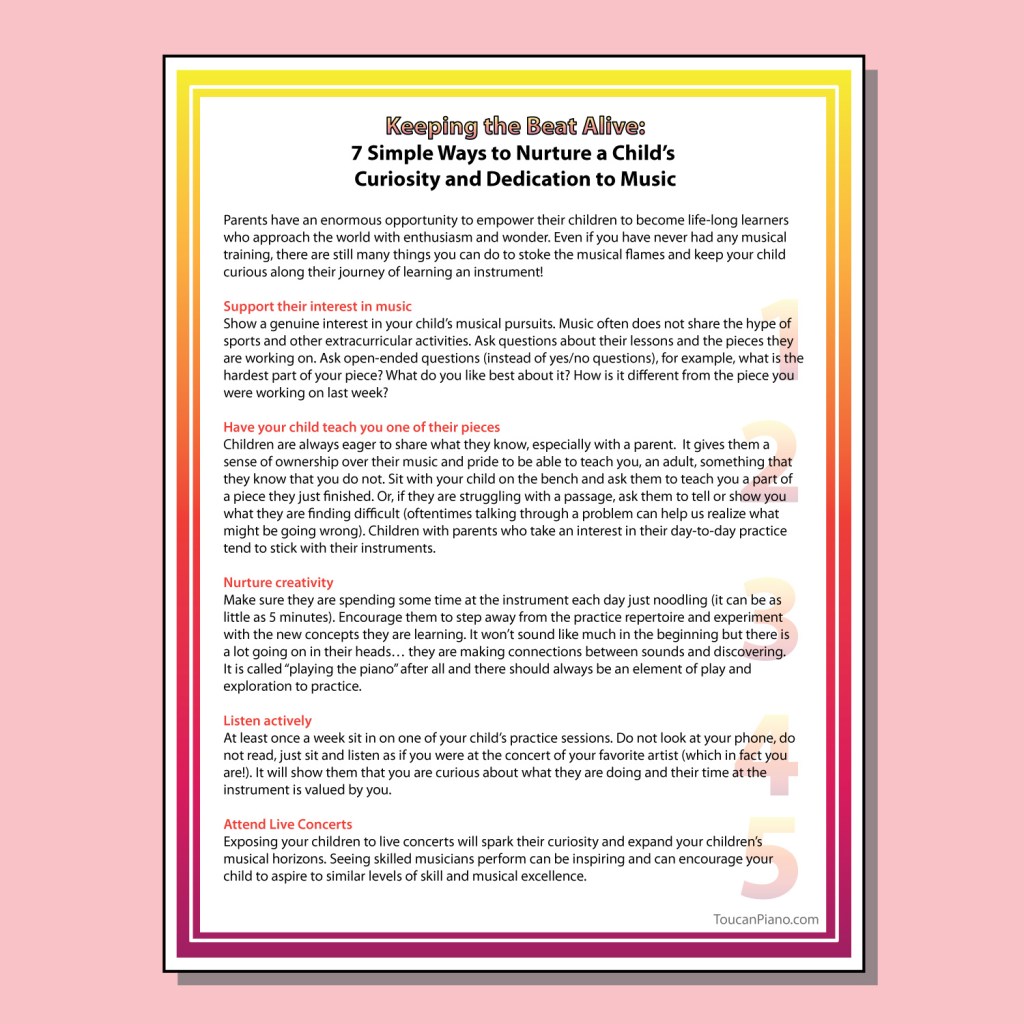
If you would like to receive a printable to share with your piano families on how parents can help their children stay curious in their musical journey, click here!
Check out our top 7 practice tool every piano student should have:
The top 7 practice tools every piano student should have. Be sure to check out the blogposts for the other six practice tools that made my list:
- #7 Mini-erasers
- #6 Music Clips
- #5 Cube Timer
- #4 Recording Device
- #3 Metronome
- #2 Manuscript Notebook
- #1 Pencil

- Rainbow Manuscript Paper
This colorful manuscript paper is available in the Toucan Piano shop as a free printable! They are available in three sizes, so they can be used for a variety of ages and activities, like writing out original compositions, explaining music theory concepts, music dictation, games, and so much more! - Compose a Ringtone
Ringtones are helpful but what if we could make them special too?! This is a fun and quick project that even the most reluctant students can get behind. - Chord Snowblast
Build chords and collect points while trying to avoid the snow blast! Kids will test their knowledge of building chords AND they will actually be hoping to get all the chords with sharps and flats!!

Let’s stay in touch, join the list!
As a “toucan” of our appreciation download a free set of note flashcards (link in our Welcome email)!
We are a participant in the Amazon Services LLC Associates Program, an affiliate advertising program designed to provide a means for sites to earn advertising fees by advertising and linking to Amazon.com. As an Amazon Associate we earn from qualifying purchases.

 Toucan Piano
[…] Top Practice Tools Every Piano Student should Have: CuriosityCuriosity is the catalyst that gets students to start learning the piano in the first place and can be exactly what’s needed to keep them going for the long haul. Why is it so important and how do we keep it going? What if I don’t play an instrument, but want to encourage my child in their practicing? Check out all the answers plus download a free printable for parents! […]
LikeLike
[…] Top Practice Tools Every Piano Student should Have: CuriosityCuriosity is the catalyst that gets students to start learning the piano in the first place and can be exactly what’s needed to keep them going for the long haul. Why is it so important and how do we keep it going? What if I don’t play an instrument, but want to encourage my child in their practicing? Check out all the answers plus download a free printable for parents! […]
LikeLike
[…] Top Practice Tools Every Piano Student should Have: CuriosityCuriosity is the catalyst that gets students to start learning the piano in the first place and can be exactly what’s needed to keep them going for the long haul. Why is it so important and how do we keep it going? What if I don’t play an instrument, but want to encourage my child in their practicing? Check out all the answers plus download a free printable for parents! […]
LikeLike
[…] Top Practice Tools Every Piano Student should Have: CuriosityCuriosity is the catalyst that gets students to start learning the piano in the first place and can be exactly what’s needed to keep them going for the long haul. Why is it so important and how do we keep it going? What if I don’t play an instrument, but want to encourage my child in their practicing? Check out all the answers plus download a free printable for parents! […]
LikeLike
[…] Top Practice Tools Every Piano Student should Have: CuriosityCuriosity is the catalyst that gets students to start learning the piano in the first place and can be exactly what’s needed to keep them going for the long haul. Why is it so important and how do we keep it going? What if I don’t play an instrument, but want to encourage my child in their practicing? Check out all the answers plus download a free printable for parents! […]
LikeLike
[…] Top Practice Tools Every Piano Student should Have: CuriosityCuriosity is the catalyst that gets students to start learning the piano in the first place and can be exactly what’s needed to keep them going for the long haul. Why is it so important and how do we keep it going? What if I don’t play an instrument, but want to encourage my child in their practicing? Check out all the answers plus download a free printable for parents! […]
LikeLike
[…] Top Practice Tools Every Piano Student should Have: CuriosityCuriosity is the catalyst that gets students to start learning the piano in the first place and can be exactly what’s needed to keep them going for the long haul. Why is it so important and how do we keep it going? What if I don’t play an instrument, but want to encourage my child in their practicing? Check out all the answers plus download a free printable for parents! […]
LikeLike