
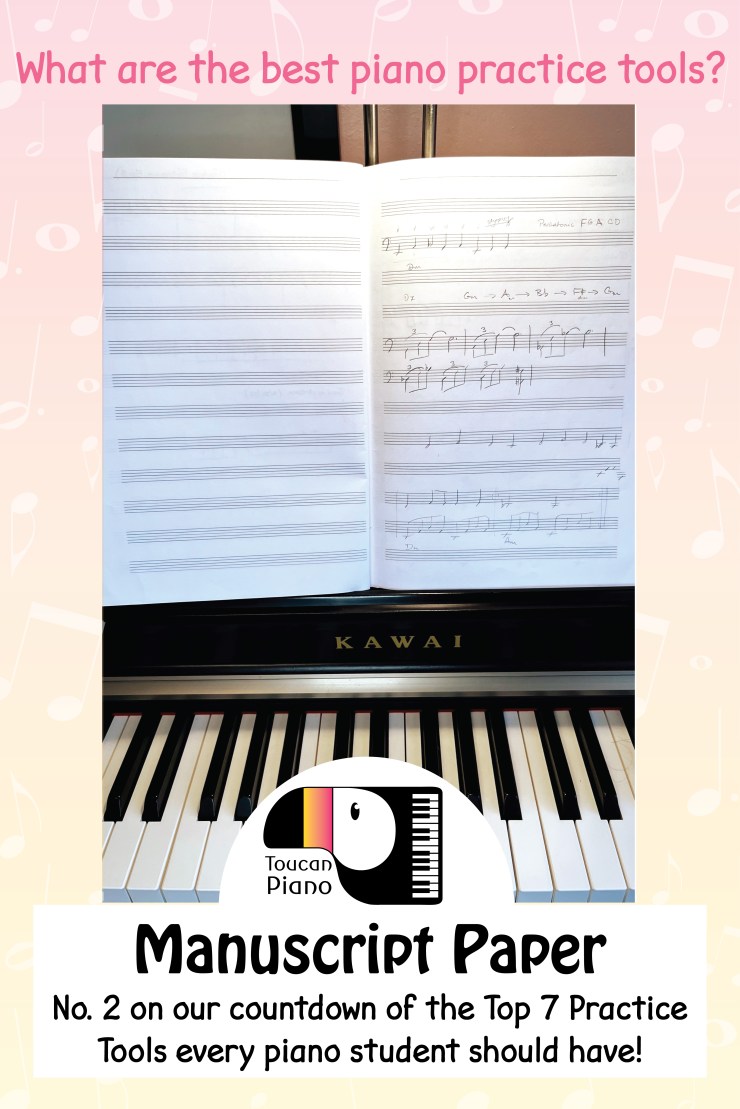
Piano students don’t need a lot of accessories to practice… a quality instrument and sheet music is enough! But there are a few tools that make a practice session easier and more effective.
I’m counting down my Top 7 Piano Practice Tools I think every student should have when they are on the bench (plus a bonus one at the end that you might not expect!).
Coming in at number 2 is:
The Manuscript Notebook
Manuscript notebooks come in all shapes and sizes, with large print staffs or smaller staffs, with plain serious covers or funky color-filled covers. But one thing can be said about all of them: they are essential for effective, goal-oriented practice!

Why not just use a regular notebook?! You most certainly can, but there are many advantages to using staff paper instead of regular lined paper as we will see below.
I do have one instance where I prefer to use regular notebooks and that is with younger beginner students. For them I choose a wide-ruled composition notebook. The reason is that it is just plain easier for them to read! I tend to draw a lot of pictures in the earlier stages of learning the piano to help them remember concepts, the names of rhythm notes and rest, rote pieces, and new notes on the grand staff. It gives us a lot more space for creativity and color which helps young minds learn better.
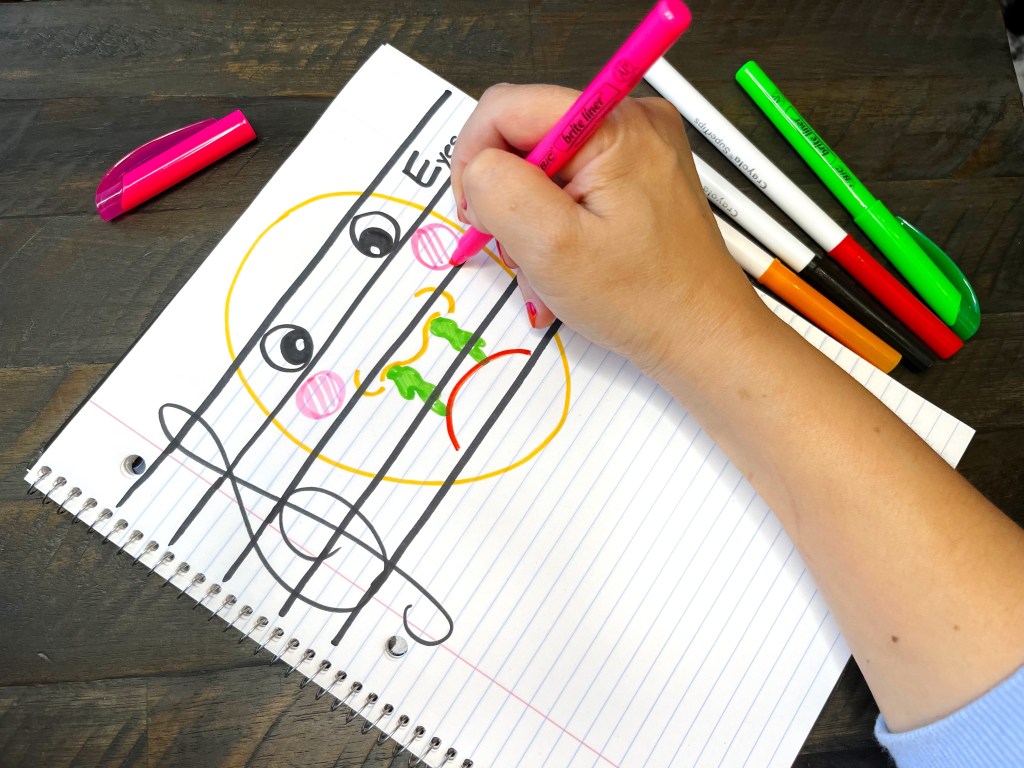
I do have one instance where I prefer to use regular notebooks and that is with younger beginner students. For them I choose a wide-ruled composition notebook. The reason is that it is just plain easier for them to read!
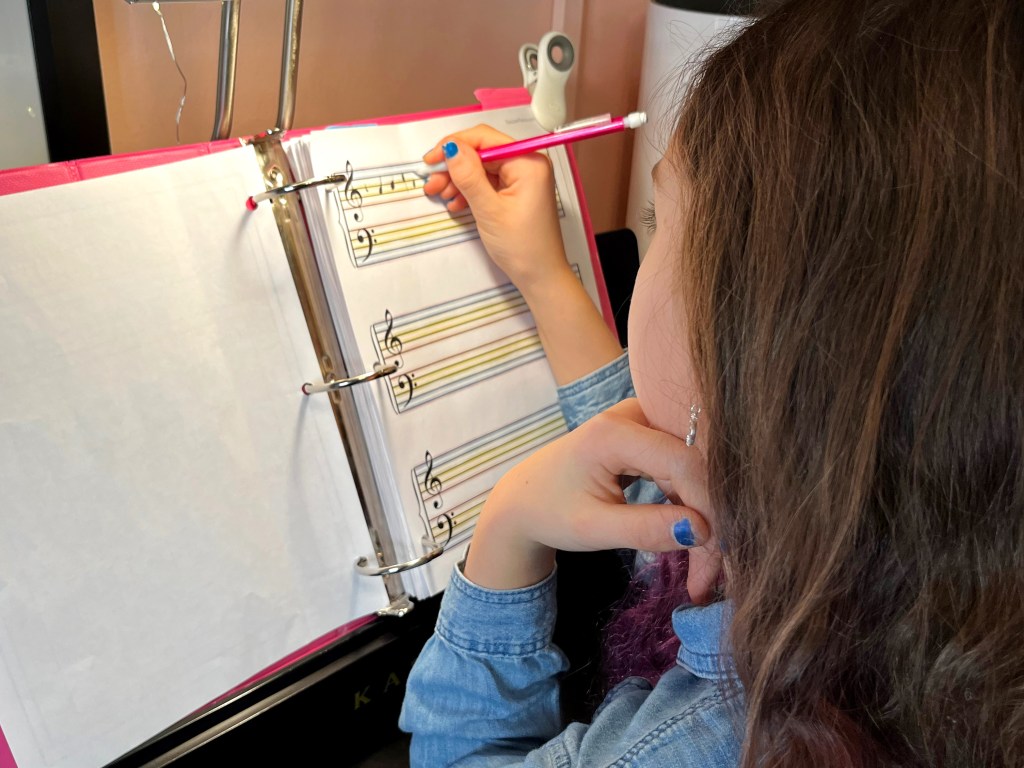
When I need a sheet of manuscript paper for my younger and beginner students I turn to the Toucan Piano Manuscript Paper and Rainbow Manuscript paper. I print out a few sheets for their binders and we are good to go! The manuscript papers are available in the Toucan Piano shop as free printables.
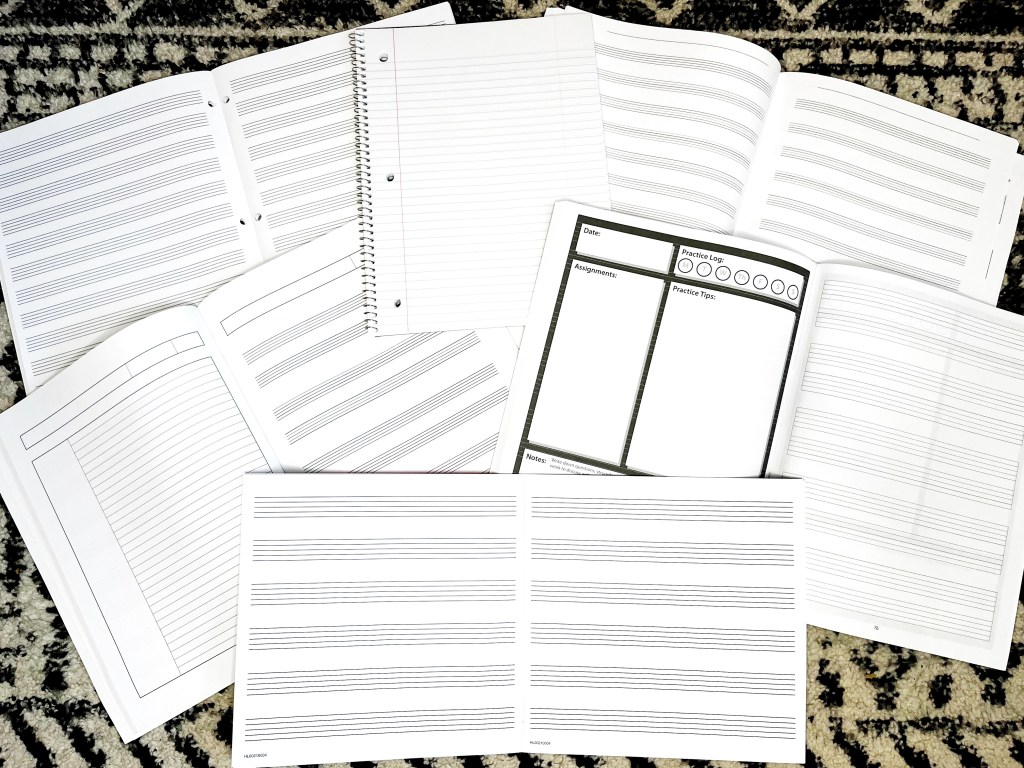
For all other students I prefer to use a manuscript notebook. Here are a few different ones I’ve used in the past with both my students and for my own personal practice:
- Piano Practice Journal – This is the practice journal I use with all of my students. The weekly spread allows me to write out assignments on one side and the manuscript paper on the other side give me plenty of space to write personalized exercises for each student. It has 52 weeks of spreads so it lasts the full year.
- Wide Staff Manuscript Paper – This is the notebook I give every single student I teach when they are ready for a manuscript notebook. It gives us more space to work out composition ideas. 8.5″ x 8.5″, 32 pages, 6 staves per page, the paper quality is excellent, and the staff is nice and wide which makes it easer for small hands to write on. The binding is stitched so it lays flat and can be bent over on itself.
- Blank Sheet Piano Music Notebook for Kids – I’ve had students receive this notebook as a gift and we’ve used it for lessons as well. It is another excellent option for wide staff paper (plus is larger than the previous one I mentioned). 8.5″ x 11″, 100 pages, 6 staves per page (already set up as 3 grand staffs with clefs)
- Standard Manuscript Paper – This notebook is the next step up from the wide staff option (8.5″ x 11″, 64 pages, 12 staves per page). It’s excellent for intermediate and advanced students. It comes punched so that it can fit inside a three-ring binder. The binding is stitched so it lays flat and can be bent over on itself.
- A4 Large Print Music Staff Notebook – This is the one I use for writing out my own ideas for compositions. It is 8.3″ x 11.7″, 110 pages, with 12 staves per page.
- Music Theory Notebook – This is the one I use for my own personal practice. I love how it has one page of regular notebook paper next to a page of music manuscript paper. It gives me an enormous amount of flexibility in working out practice ideas for my music. 8.5″ x 11″, 102 pages. This is a great option for advanced students or pianists working independently.
Although you could choose to use a digital software for music notation and an app for a practice journal, I am a strong believer in putting pencil to paper. I think students think and learn more effectively when writing things out as opposed to typing or clicking the notes on the staff with a mouse. I never recommend digital options for a practice journal until students are playing at an advanced level.
I think students think and learn more effectively when writing things out as opposed to typing or clicking the notes on the staff with a mouse.
Let’s get down to the nitty-gritty of why a manuscript notebook has won my number 2 spot on my list of Top 7 Piano Practice Tools!
Manuscript Notebook as a Communication Tool between Student and Teacher
Creating the habit of using a manuscript notebook or practice journal usually starts as a communication tool between student and teacher. The teacher will use the notebook to write down weekly assignments plus specific instructions for what the student should be practicing each week. This can include warm-ups, technical exercises, and repertoire. The teacher may also add in practice tips and reminders that may have been discussed during the lesson time.

The student should make a habit of going over all the instructions in the notebook each day when they sit down to practice to make sure that they are working on all the specifics outlined by the teacher. The student can also use the notebook to write in comments about things that went well or not so well during their practice time to go over with their teacher during their next lesson. The student can also write down questions that came up during their practice time that they need to ask their teacher.
The student should make a habit of going over all the instructions in the notebook each day when they sit down to practice.
When used this way, the notebook can be an invaluable tool to achieve great results at the piano.
Manuscript Notebook as a Practice Journal
As a student grows in their skills and maturity, the notebook will evolve into a practice journal. Keeping a practice journal can help students stay organized, track their progress, and make the most of practice sessions especially if they are working independently.

At this level a student can choose between a physical notebook and a digital option. It comes down to a matter of personal preference. Whatever the student finds most effective for their own personal style of note-taking and journaling should be used.
How do you set up a practice journal? It’s easier than you’d think and it really comes down to what you are focusing on in your practicing. But here is an outline for setting up your practice journal:
- Choose a journal: Whether it be a manuscript notebook or a digital app, it should be something dedicated to your practicing and easy to take notes (so that you will actually do it!).
- Create sections: There are as many ways to set up a practice journal as there are people on the planet! Ask yourself a few questions before diving in: how do you want to track your goals (daily, weekly, monthly)? How do you want to log in your practice sessions (a chart to color in the days, a page in the journal dedicated to each day)? Do a quick online search for “Bullet Journaling” and you will find a multitude of ideas to make the journal of your dreams. Although I love scrolling through all the beautiful bullet journal spreads, I know that for me, what works best is simplicity. I map out my week, listing what I would like to work on based on the previous week and anything new that popped up.
- Set Goals for your Practicing: Dedicate a spot in your journal to write out your goals. They can be both short-term goals (“I want to work on the first two pages of Beethoven’s first movement of the Tempest sonata this week.”) and long-term goals (“I want to improve my trills.”). Be specific about your goals (“I want the be able to play the first movement at tempo by the end of the month.”) and come up with a plan to achieve them (“I need to learn 3 new measures each day in order to play the whole movement at a comfortable practice tempo by the 15th of the month.”).
- Take Notes during your Practice Sessions: Write down important details from each practice session: the date, the duration, specific pieces and exercises you worked on, problem spots you ran into, questions you need to answer, breakthroughs and challenges you overcame. Your notes will serve as discussion points for your next lesson with your teacher.
- Reflect and Assess: You should dedicate a little time either after every practice session or weekly to assess your progress and how close you are to achieving your goals. You can take this time to adjust your timeline for your goals and write down additional ideas to explore to help achieve your goals.

The practice journal, very much like a personal journal, can be a wonderful tool of self-reflection and personal growth if used faithfully. It is a safe and non-judgmental place for musicians to explore practice ideas and techniques, set goals for themselves, and have a clear view of their progress (or even lack thereof which may indicate a need for a change in approach or direction).
Manuscript Notebook as a Troubleshooting Tool
One thing I strongly encourage students to do when they come across a difficult passage in their music is to copy it in their practice journal or manuscript notebook. As I mentioned above, I believe in the power of putting pencil to paper and it is amazing how much students discover when they take the time to copy out a problem passage. They usually notice details that they hadn’t initially noticed, they realize which notes they are playing incorrectly, and they pay more attention to the rhythms.
It is amazing how much students discover when they take the time to copy out a problem passage.
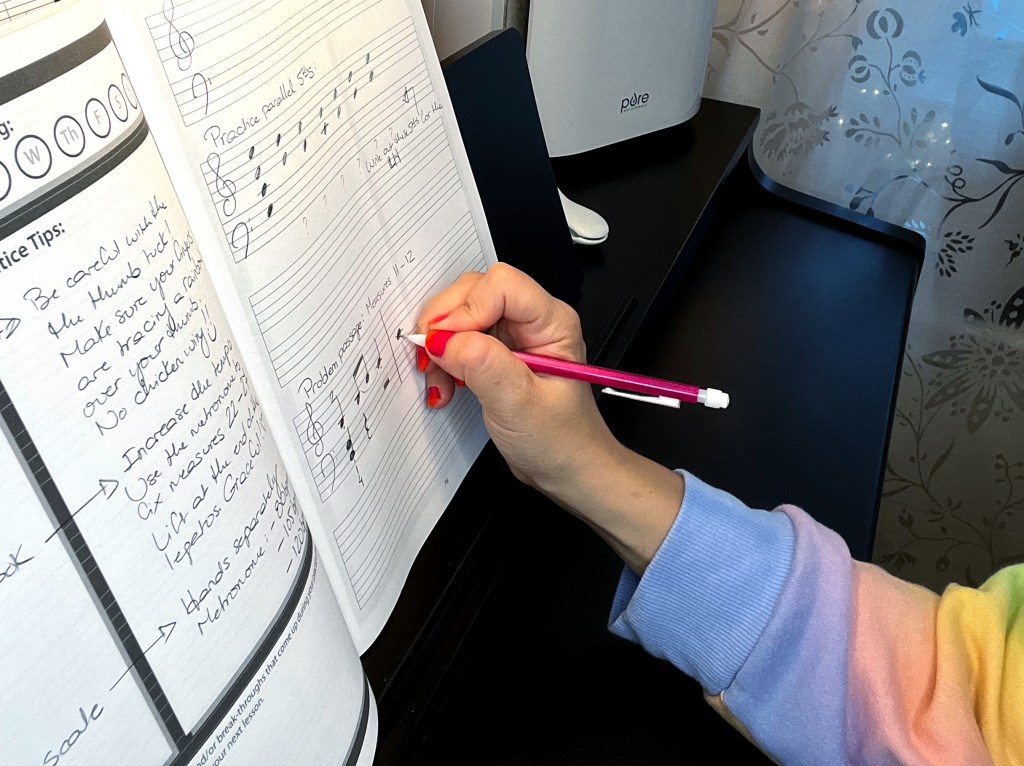
Once a passage is completely understood intellectually, the student can then make a list of different strategies to try out in order to fix the problem. This can be done with the aid of their teacher or by themselves if they encounter the problem between lessons. They can then cross out solutions that didn’t work and comment on ones where they saw improvement in their playing. It’s a great way to foster creativity in their practicing and also become more aware of how different practice ideas play out at the piano.
Manuscript Notebook as a Tool for Analysis and Creativity
I encourage students to copy passages from their music that they really enjoyed (much like writing down quotes you like from books!). Then I ask them to do a little bit of analysis on the passage to see if they can discover what exactly made the music pull at their heartstrings.

The results of their analysis can be a launching board for slew of creative improvisation and composition activities! For example, if they really loved a specific chord progression that the composer used, they can spend some time during the week playing around with the progression and creating melodies on top of it. They can use their notebook to write down anything in particular that they really liked.
And there we have it!
The number 2 practice tool every piano student should have. Be sure to check out the previous blogposts for other practice tools that made my list:
Next up is the Number 1 Practice Tool that is absolutely essential for effective practicing!

- Manuscript Paper
This manuscript paper is available in the Toucan Piano shop as a free printable! They are available in six sizes, so they can be used for a variety of ages and activities, like writing out original compositions, explaining music theory concepts, music dictation, games, and so much more! - Rainbow Manuscript Paper
This colorful manuscript paper is available in the Toucan Piano shop as a free printable! They are available in three sizes. - Compose a Ringtone
Ringtones are helpful but what if we could make them special too?! This is a fun and quick composition project that even the most reluctant students can get behind.

Let’s stay in touch, join the list!
As a “toucan” of our appreciation download a free set of note flashcards (link in our Welcome email)!
We are a participant in the Amazon Services LLC Associates Program, an affiliate advertising program designed to provide a means for sites to earn advertising fees by advertising and linking to Amazon.com. As an Amazon Associate we earn from qualifying purchases.


[…] #2 Manuscript Notebook […]
LikeLike
[…] #2 Manuscript Notebook […]
LikeLike
[…] Manuscript Paper for Younger Kids – A perfect sized notebook for writing down compositions. It has a nice wide staff (easier for kids to write music on), 100 pages, and is 8.5 x 11 inches.Manuscript paper is incredibly versatile and important for any piano student which is why it took the No. 2 spot on my list of Top 7 Practice Tools Every Piano Student Should Have. […]
LikeLike
[…] Manuscript Paper – A perfect sized notebook for writing down compositions. It has a nice wide staff (easier for kids to write music on), 100 pages, and is 8.5 x 11 inches.Manuscript paper is incredibly versatile and important for any piano student which is why it took the No. 2 spot on my list of Top 7 Practice Tools Every Piano Student Should Have. […]
LikeLike
[…] I am a strong believer in putting pencil to paper. I think students focus better and learn more effectively when they are writing things out. I go into detail about why I consider manuscript paper one of the top practice tools a student can have in a this blogpost. […]
LikeLike