
Piano students don’t need a lot of accessories to practice… a quality instrument and sheet music is enough! But there are a few tools that make a practice session easier and more effective.
I’m counting down my Top 7 Piano Practice Tools I think every student should have when they are on the bench (plus a bonus one at the end that you might not expect!).
Coming in at number 3 is:
Metronome
I think everyone saw this practice tool coming from a mile away… ticking, ticking, ticking… growing louder and louder as we worked our way down the list of practice tools! It was inevitable. It’s the tool every piano student loves to hate, but can be SO helpful when used correctly!
Students are often reluctant to use the metronome because of its unrelenting ticking. The metronome waits for no one! It exposes our weaknesses and highlights our mistakes… and who enjoys that?!

If we give the metronome a strategic purpose in our practicing and start to look at it as more of an ally than a bully, we will discover how helpful it’s actually trying to be. So it’s important then to help students become comfortable with the metronome from the very first lessons, that way they will be more confident in using it on their own during their practicing.
I believe metronome practice should be like surgery. You use it to fix the problem and then get out. Don’t allow yourself to linger too long with the metronome. Overuse of the metronome tends to make our music sound mechanical, with no real flow or expression.

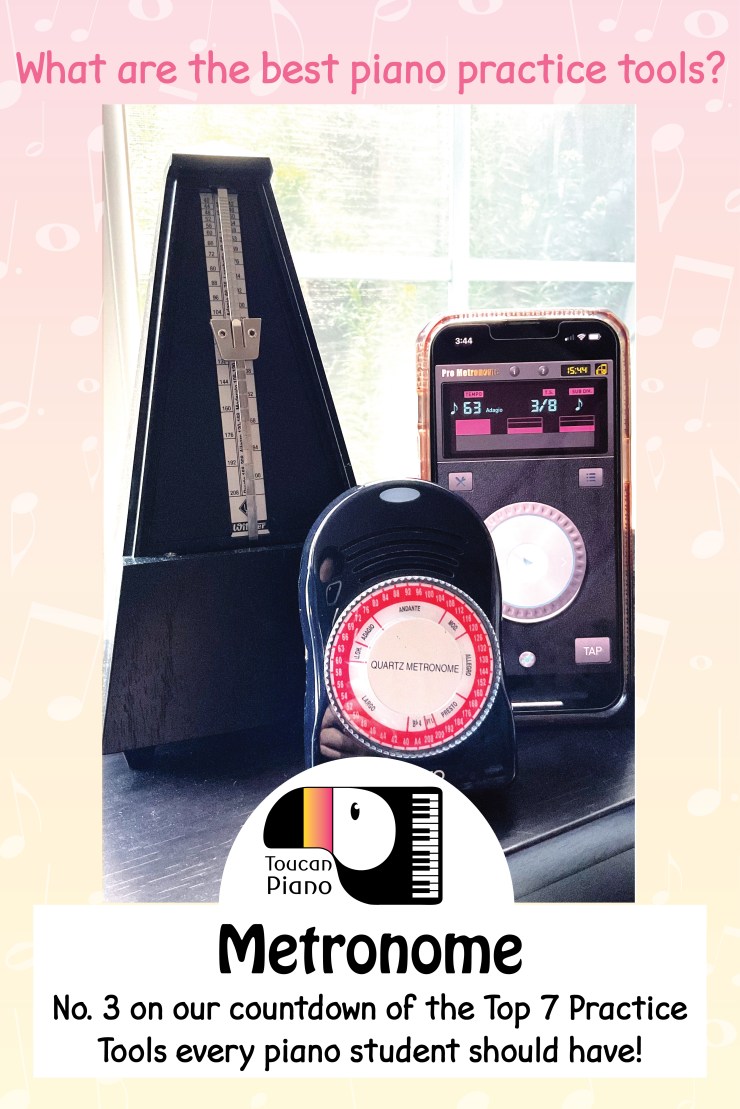
I use metronomes in all forms… analog, digital, app-based! Here are the metronomes I use in my teaching and personal practice:
- Wittner 903304 Metronome: This one works beautifully and looks nice to boot! It’s the most expensive of the metronomes on this list, but not as pricey as a real wood metronome.
- Seiko SQ50-V Metronome: I love this metronome!! It’s the one I usually use during lessons, it’s the one I recommend to parents, and it’s the one that I’ve purchased for a children’s music program I run at my church. It’s keeps great time, it’s reliable, and very easy to use.
- ProMetronome: This is app available for free (in-app purchases) in the Apple Store or Google Play. You can change the sounds of the individual beats and even silence certain beats. You can set the tempo by tapping, turning the dial, or typing in the number you want. You can also change the time signature. The paid version includes beat subdivisions, polyrhythms, rhythm trainer, and more.
Once students are familiar with the metronome and understand how to play along with it, a fun app to try out is SuperMetronome Groovebox Pro (paid app in the Apple Store). This app allows students to create backing tracks to play along with. It can help add a little spice and an element of fun to practicing with the metronome.
So how can we strategically use the metronome in our lessons and practicing? Here are some different ways you can use it to help:
Get Acquainted with the Metronome
I introduce the concept of beat and the metronome usually during my second lesson with a new student. I ask the student to think of things that have a steady pulse or make “tick-tocking” sounds. The student immediately thinks of clocks and will usually say heartbeats, as well. We play around at the piano with the concept of tick-tocking like a clock and oftentimes we’ll do a little improvisation on the black keys.
I then bring out the metronome (usually my analog metronome because it’s more interesting to play around with)! They are usually fascinated by it and I let them move the slider up and down to see how it affects the ticking. We then play a game…
Metronome Madness!
This game is similar to the game Mirror, where players have to copy each other’s movements.
- Teacher and student stand facing each other.
- I recommend having the teacher lead the first round of play, so the student understands how it works.
- The teacher starts the metronome at a comfortable speed.
- The teacher then does a movement (for example, tapping your head) in synch with the ticking of the metronome.
- The student, who is the mirror, has to copy whatever movement the teacher does and stay in time with the metronome.
- After a few repetitions, the teacher changes the movement (for example, hop on one foot) and the student needs to copy it.
- Do several different movements, then swap roles. The student now leads and the teacher has to be the mirror.
- Change up the tempo every now and then! We usually end with a prestissimo which has us both laughing and trying to catch our breath!! Metronome Madness is a workout!
Metronome and Rhythm Practice
This can be incorporated into any rhythm work you use with your students.
- Select a rhythm sequence (it can be a rhythmic motive or passage from a piece your student is working on, a rhythm sequence that you drew on a whiteboard, or something that the student came up with using rhythms that they are working on).
- Go over the rhythmic value of each note and/or rest and the proper counting.
- Practice tapping/clapping the rhythm sequence until the student is comfortable with it.
- Now the game can begin!
- Bring out the metronome and set it to a tempo you know the student will be able to tap the rhythm sequence out with ease (for example, set the metronome to andante).
- Just like a video game has a “big boss”, the metronome is the big boss and must be defeated!
- The student will now try to tap out the rhythm sequence in synch with the metronome.
- The student should be able to pass the first level (remember, start at a speed that you know the student will be successful at).
- The student has now moved onto the next level! The metronome tempo is increased by at least 20 bpm.
- The student will now try to tap out the rhythm sequence in synch with the metronome at the new, faster tempo.
- If the student is successful, the tempo will be increased again. If not, the tempo is decreased by 10 bpm. If the student is successful at that speed, the metronome is set back to the original speed for another try.
- We usually go through 2-3 rounds of increasing the speed before moving onto something else.
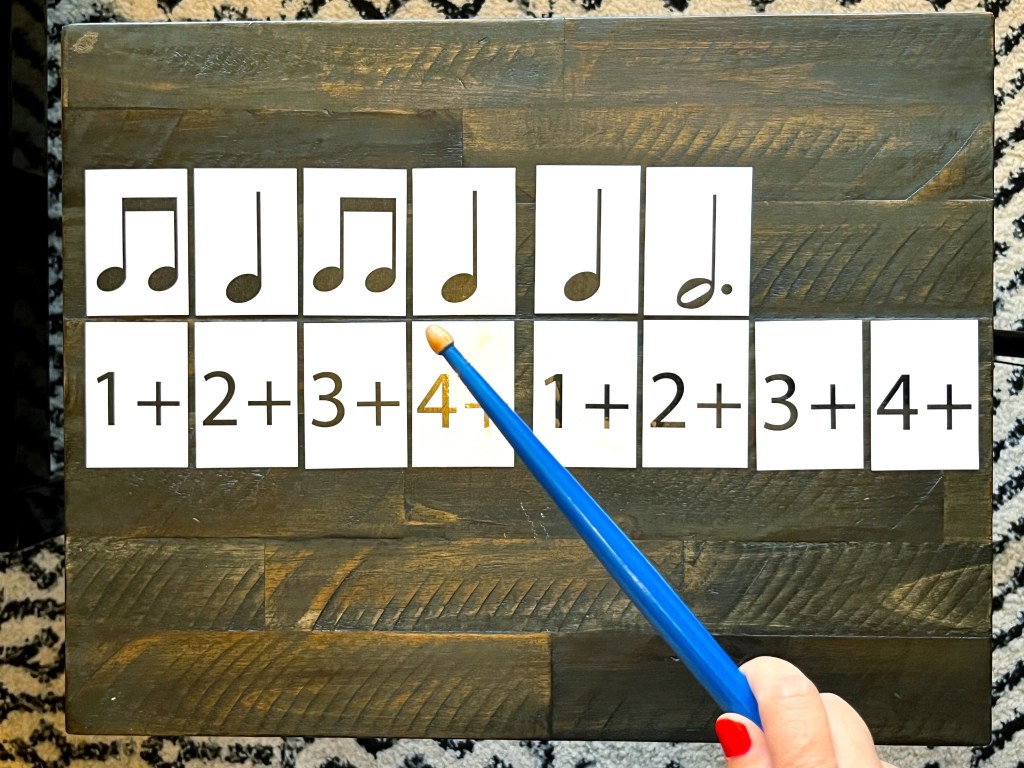
Students really love to try to beat the “big boss” metronome! They can get really determined to nail the faster tempos. Sometimes they will even take the rhythm sequence home to practice during the week to try again at our next lesson!
This game is great for helping student understand how the beats fit in with the different rhythm notes and rests.
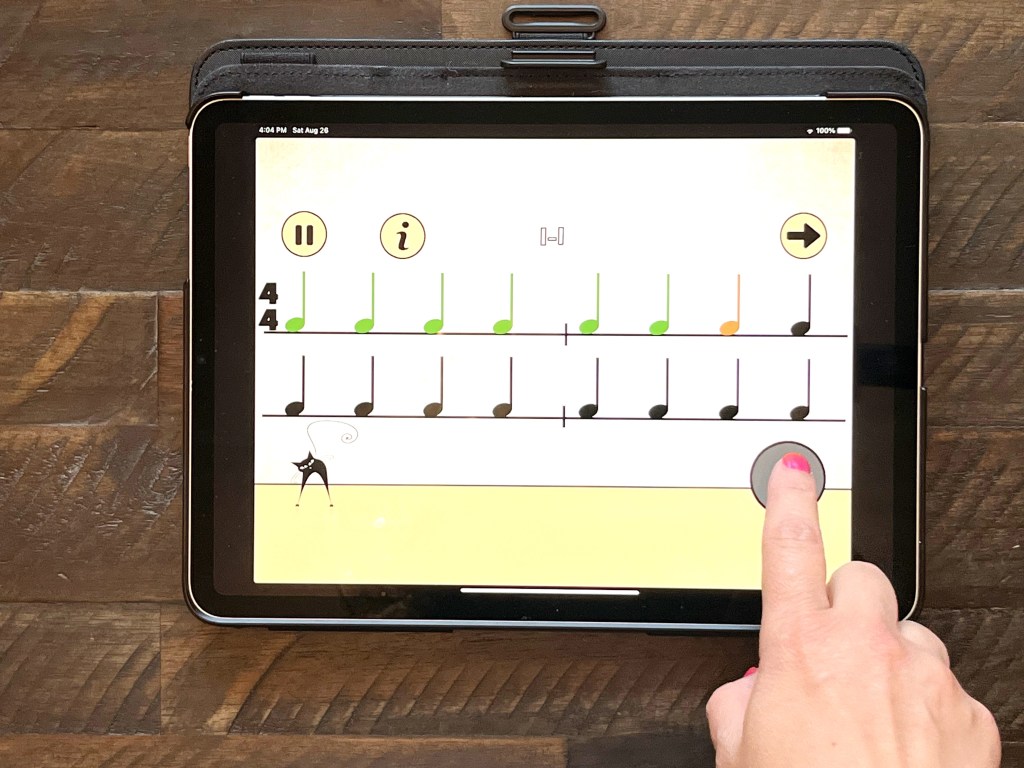
A variation of this game is when I use the app Rhythm Cat (Apple Store link and Google Play link. The Lite version is free if you want to try it out before purchasing). I draw out the rhythm sequence that we will be working on in Rhythm Cat (I need to prep this in advance). The student then works on mastering the rhythm sequence. When they think they are ready, they try it in the app. The app will count the student in and then play an instrumental version of a song (usually traditional songs, like “Twinkle Twinkle”), while the student needs to tap the rhythm sequence correctly on the screen. The cat will judge the student’s performance and award them with either 1, 2 or 3 stars. It’s a fun app that the kids really enjoy!
Metronome Markings in the Score
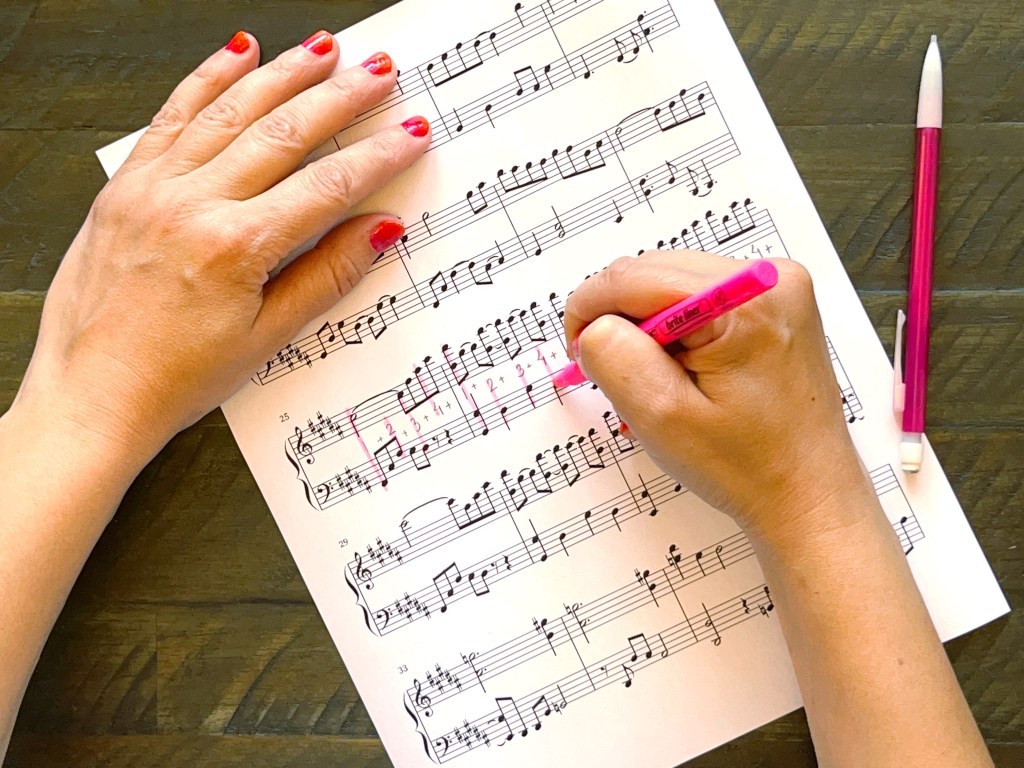
This strategy can be used for fixing passages in the music that are not being played correctly. Work with the student to determine where the beats fall in the passage (it is helpful to also write out the proper counting on the score if it is not already there). Next, mark on the score with a pencil, colored pencil, or marker where the tick of the metronome should be heard. The mark can be as simple as a dot or a vertical dash, but it should stand out enough that the student’s eyes are drawn to it and creates a visual cue to listen for the tick of the metronome. The student would then try to play the passage along with the metronome at a very slow speed.
You can turn this into a game as well:
- The student has 3 “hearts/lives” to make it to the end of the passage.
- For every mismatch between the metronome and the student’s playing, the student loses a heart/life.
- The student must make it to the end of the passage with at least 1 heart/life to spare.
- If the student loses all their hearts/lives, the teacher slows down the metronome.
- If the student has 1 or more hearts/lives at the end of the passage, the teacher increases the tempo by 5-10 bpm.
- Can the student bring the passage up to tempo AND be in synch with the metronome?
Metronome and Counting
I think we can all agree that knowing how to count properly is a basic skill all students need to eventually master. And I think we can also agree that 99.9% of students hate counting, especially if it means counting out loud! Most of the times it stems from just being confused or overwhelmed by the amount of things they need to take care of at the same time (reading the music, playing, counting… it’s a lot!).
That’s what makes rhythm work off the bench so crucial!
But even when they have understood it off the bench, it can still be a struggle to put everything together at the piano. During lessons I will often count out loud for students as they play and then have them try it on their own. A little trick that I have found that works wonders for practice at home is to record either myself (or preferably them) counting along with the metronome on the Voice Memo app of their smartphone. Then, at home, they can play along with the recording to correct their rhythm and eventually count by themselves, without the recording. Check out my video below to see this trick in action:
And there we have it!
The number 3 practice tool every piano student should have. Be sure to check out the previous blogposts for other practice tools that made my list:
Next up is the Number 2 Practice Tool for effective practicing!

- Don’t Miss a Beat!
This fun, multi-level game grows with your students as they learn more and more rhythms. Students will have to use their knowledge of rhythm note and rest values as well as time signatures to fill in the missing rhythms on each card. It can be played in private or group lesson settings! - Snowball Rhythm Game
Who will be able to make the longest rhythm train before the dreaded “Busted!” stick is revealed?! Kids will practice their rhythms while also practicing their aim in this fun toss game. - Sky High Love
The rhythms get longer as the heart towers get higher! Whose tower will remain standing in the end?! This adrenaline-inducing rhythm game is a great way to kick-off a lesson and get the energy up.

Let’s stay in touch, join the list!
As a “toucan” of our appreciation download a free set of note flashcards (link in our Welcome email)!
We are a participant in the Amazon Services LLC Associates Program, an affiliate advertising program designed to provide a means for sites to earn advertising fees by advertising and linking to Amazon.com. As an Amazon Associate we earn from qualifying purchases.

 Toucan Piano
[…] #3 Metronome […]
LikeLike
[…] #3 Metronome […]
LikeLike
[…] Metronome – The friend and nemesis of all musicians! It is always a useful tool to have at the piano. This metronome is a great size and has volume control (my mom for one could not stand the ticking sound of the metronome!). I loved it so much that I bought several to use with the children’s band at my church.Metronomes are essential for practice and came in at no. 3 on my list of the Top 7 Practice Tools Every Piano Student Should Have. […]
LikeLike
[…] Metronome – The friend and nemesis of all musicians! It is always a useful tool to have at the piano. This metronome is a great size and has volume control (my mom for one could not stand the ticking sound of the metronome!). I loved it so much that I bought several to use with the children’s band at my church.Metronomes are essential for practice and came in at no. 3 on my list of the Top 7 Practice Tools Every Piano Student Should Have. […]
LikeLike