Clover Craze: A St. Patrick’s Day Chord Game

You know you have a good game when your piano students end the game by saying, “That was so fun!” A parent even joined in to play during his son’s lesson (all three of us played). He had a blast!

The chord game Clover Craze is displayed on a wood table. A leprechaun-gnome holding a "Happy Be Lucky" signs lays next to the chord gameboards. Clover cards are organized in a clover-shaped bowl.

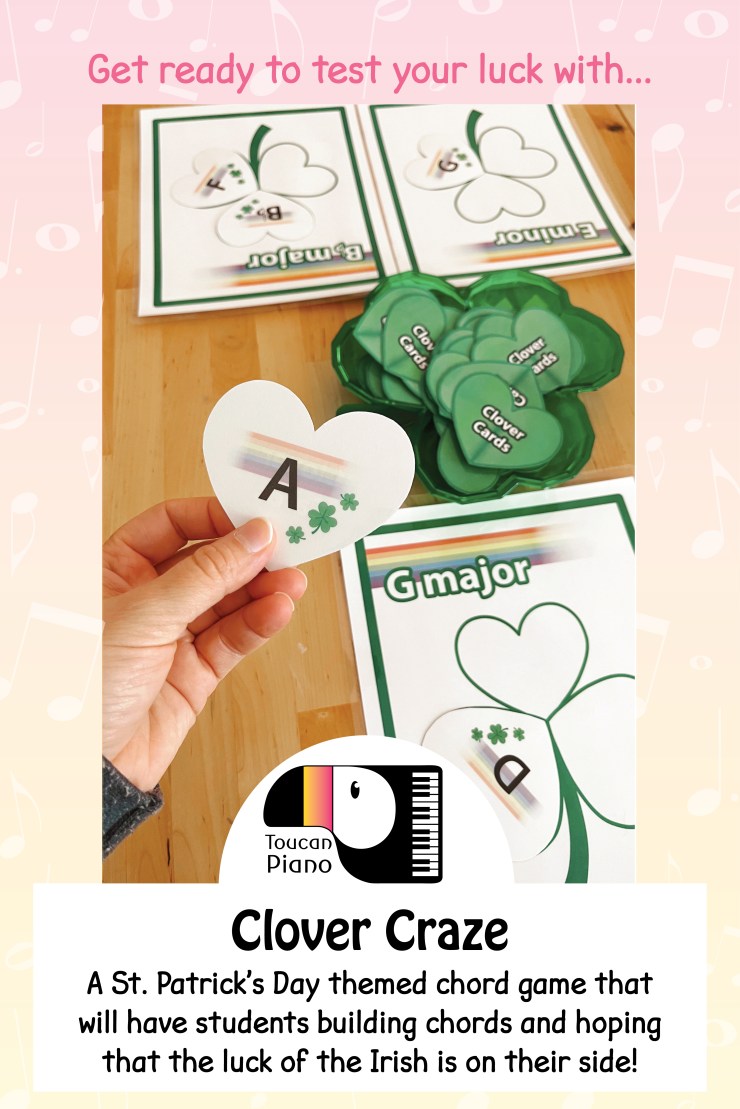
Clover Craze is a chord building game where students test their knowledge of major and minor chords (12 total) while trying to complete their gameboards. But there’s a twist – and players could end up with WAY more clovers than they bargained for! 

Clover Craze is available for purchase in the Toucan Piano Store.

The game starts innocently enough with each player drawing a gameboard. The teacher and student go over the notes that make up each of the chords. Then they take turns drawing Clover Cards to see if they can find the notes they need to complete their chords.

Two players play Clover Craze. A player draws a Clover Card from the clover-shaped bowl.

But there are wildcards mixed in with the notes and they’ve been touched by the mischievous leprechauns! The wildcards are meant to shake things up and bring the craze to Clover Craze.

A player draws another chord gameboard.

What I love about Clover Craze is that it has students working on multiple chords at once (players start with one but that changes quickly thanks to the wildcards!). They have to really think about each note that they draw and check every chord to see if it belongs to one of them. The record so far is a student working simultaneously with 7 chords (that student won the game and got a kick out of managing all their gameboards)!

What I love about Clover Craze is that it has students working on multiple chords at once (players start with one but that changes quickly thanks to the wildcards!).

My students and I played Clover Craze the entire week leading up to St. Patrick’s Day. Several students came back the following week asking to play again (which make me SO happy!).
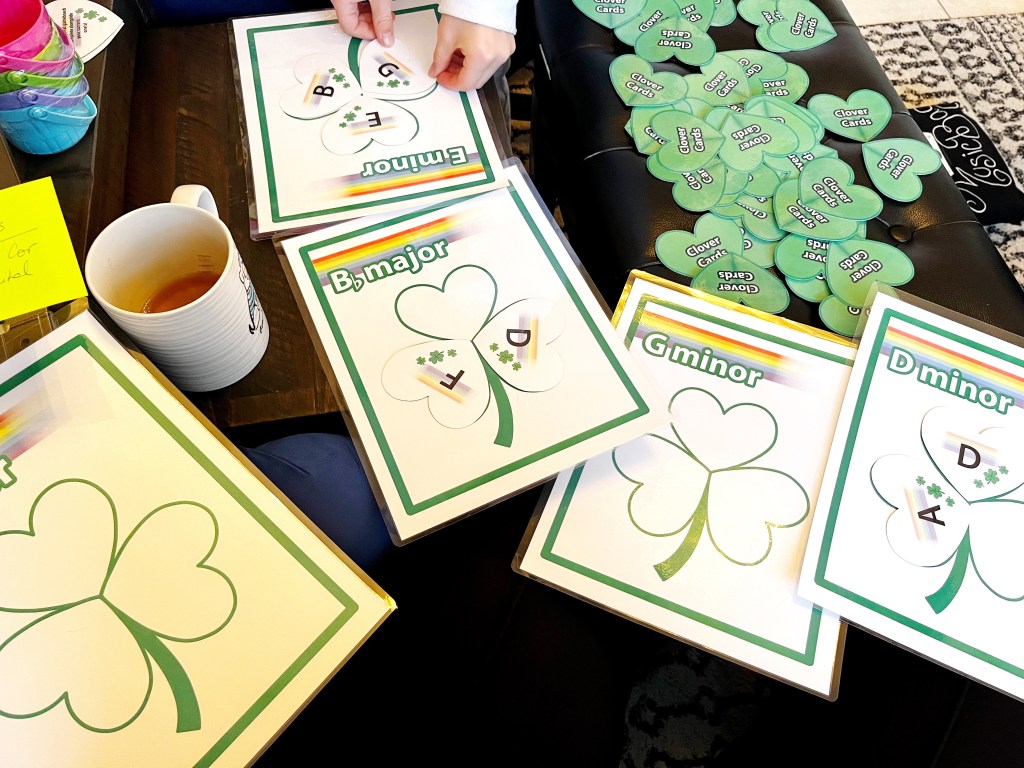
A piano student completes his chord during a piano lesson, thus winning Clover Craze.

Clover Craze is available for purchase in the Toucan Piano Store.

Explore more creative teaching ideas
  • St. Patrick’s Day Piano Games
    Bring the luck of the Irish into your piano lessons this St. Patrick’s Day with fun and engaging music theory games that make learning feel like a celebration!
  • Musical Madness – A Basketball-Inspired Music Appreciation Competition
    Your students will experience the thrill of the competition as composers are pitted against each other in a March Madness-style showdown! This interactive approach not only introduces students to classical music and composer but also fosters critical listening skills and helps develop personal musical preferences.
  • Prac-Tris: A Videogame-Inspired Practice Challenge
    Music teachers often wish their students would to step up their practice game. So why not turn it into an actual game? And not just any game, but a videogame-inspired practice game? Prac-Tris will have your students stacking practice days as they work their way to the top… of the board and their musical mastery!

Let’s stay in touch, join the list!

As a “toucan” of our appreciation download a free set of note flashcards (link in our Welcome email)!

Processing…
Success! You're on the list.

We are a participant in the Amazon Services LLC Associates Program, an affiliate advertising program designed to provide a means for sites to earn advertising fees by advertising and linking to Amazon.com. As an Amazon Associate we earn from qualifying purchases.

St. Patrick’s Day Piano Games

I love bringing some green and rainbows into March – when the weather teases us with hints of spring only to turn around and blast us with more ice and snow! And let’s be honest, kids love St. Patrick’s Day! There’s something about those little mischievous leprechauns and their tricky antics that sparks their imagination and gets their creativity flowing.

Holiday-themed music theory games are such a great way to add some variety to lessons while also reinforcing important concepts. Whether you’re working on rhythm, note reading, composing or more, these fun St. Patrick’s Day activities will have your students feeling lucky as they learn. So grab your shamrocks, turn the keys green, and let’s bring a little Irish charm into the piano studio!

  1. Pot of Gold Rhythm Game
  2. Two Sides of the Same Coin
  3. Mystery Note
  4. Magnetic Note-Naming Game
  5. Clover Craze: Chord Game
  6. Rainbow Manuscript Paper

Pot of Gold Rhythm Game

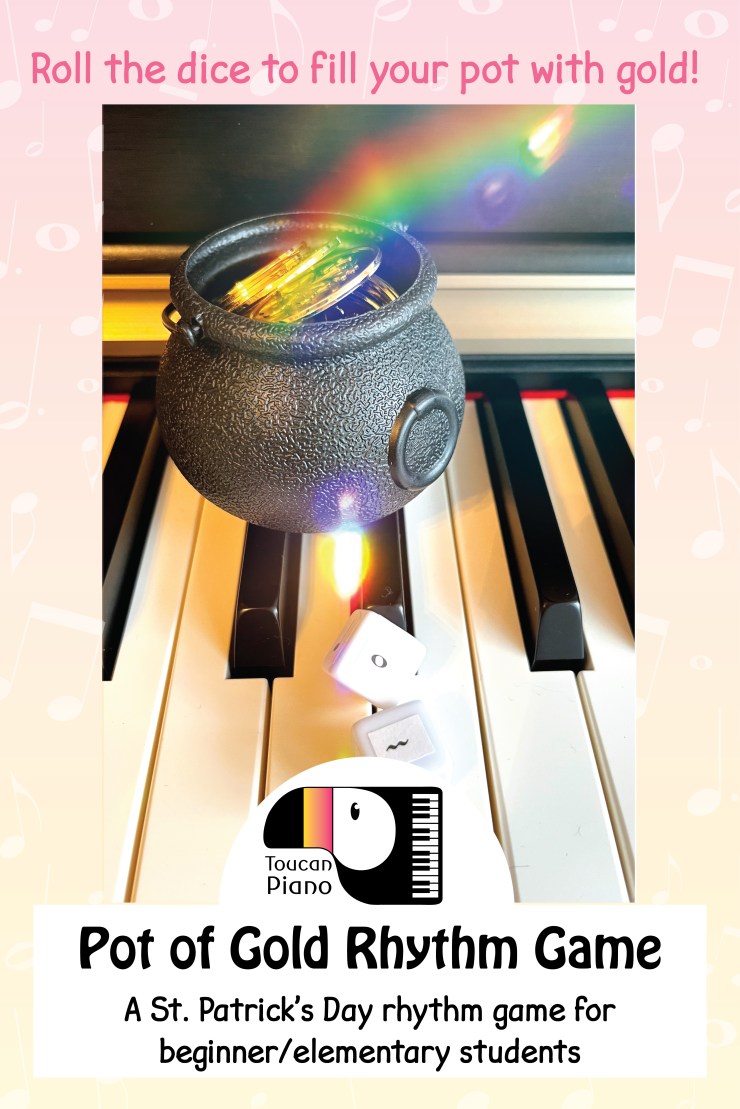
Students love this easy rhythm game for beginner/elementary level students. The value of each rhythm note or rest will determine how many gold coins go into the pot. Who can fill their pot the fastest?! With the mini-cauldrons this game can be played at both St. Patrick’s day or Halloween (just swap out the gold coins for Halloween themed mini-eraser or spiders!).

Check out the blog post on how to play.

Two Sides of the Same Coin

Two Sides of the Same Coin is an extremely versatile game about enharmonics. It can be played at least three different ways with many different combinations of coins to put your students’ knowledge of sharps and flats to the test! Check out the blog post for all the details.

Mystery Note

Mystery Note is another way to use the Two Sides of the Same Coin game pieces.

The teacher chooses a key on the piano but does not tell the student which one it is. The teacher then sets a timer for 1 minute (I love this timer by Teach Timers on YouTube). The student has 1 minute to pull coins out of the Leprechaun’s pot and play the corresponding keys on the piano to try to discover the mystery note. For example, the student pulls out an A-sharp, so the student must play the A-sharp on the piano in order to pull out another coin. If the student finds the mystery key, he/she must then name that key’s enharmonic in order to win! For example, the mystery key was C-sharp. The student pulls a C-sharp coin out of the container and plays the correct key on the piano. The teacher then says, “You’ve found the mystery note, what is the enharmonic of C-sharp?” The student must then say D-flat to win. For this version of Two Sides of the Same Coin, I would suggest using a smaller set of note coins depending on the student’s level and ease in naming notes on the staff.

Magnetic Note-Naming Game

This is by far one of the most popular games at my studio! All you need to play are some magnetic rocks (I have 2 sets) and a grand staff print out (available as a free download in the Toucan Piano Shop).

Players take turns placing rocks on the grand staff and naming the line or space as they go. But here’s the twist—if their rock connects to others, they must pick up the entire group and add it to their pile! Whoever gets rid of all their rocks first wins! It’s a game of strategy, skill, and suspense… it is SO fun!! And there is something so satisfying about fiddling around with those magnetic rocks while you play.

Plus, you can make it a St. Patrick’s Day game (or any other holiday for that matter!) by just adding a couple of stickers!

Clover Craze: Chord Game

Clover Craze is a chord building game where students test their knowledge of major and minor chords (12 total) while trying to complete their gameboards. But there’s a twist – and players could end up with WAY more clovers than they bargained for! Check out the blog post for all the details.

The chord game Clover Craze is displayed on a wood table. A leprechaun-gnome holding a "Happy Be Lucky" signs lays next to the chord gameboards. Clover cards are organized in a clover-shaped bowl.

Rainbow Manuscript Paper

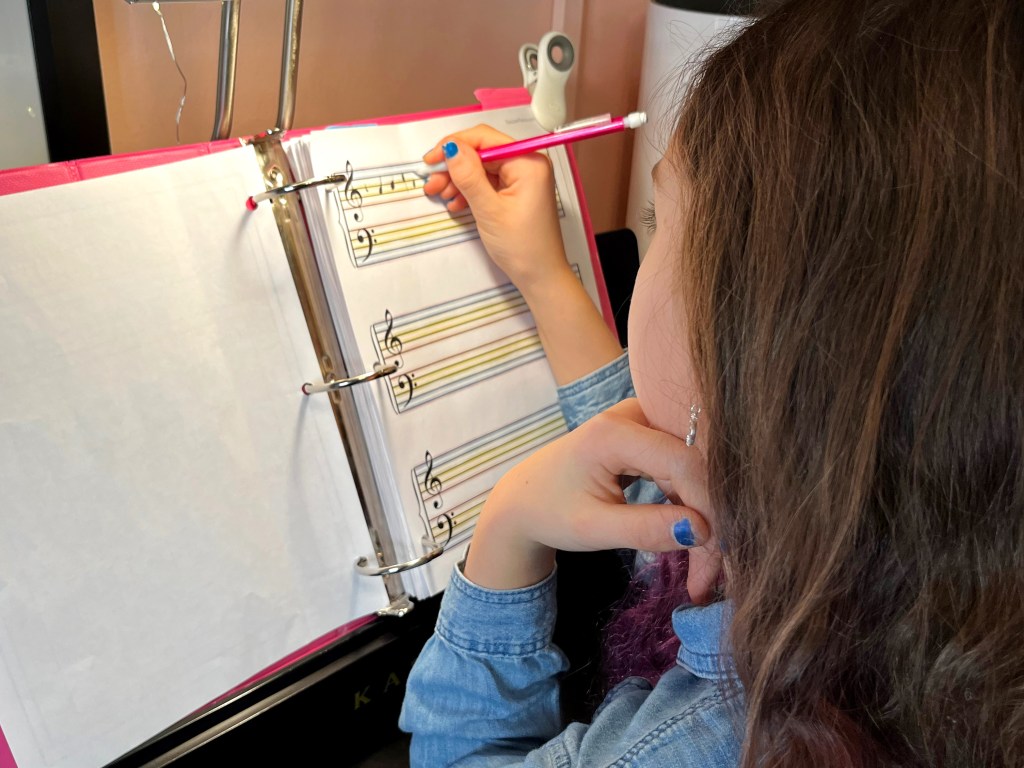
We are in the season of hearts and rainbows – Valentine’s Day and St. Patrick’s Day – and what better way to show your love for someone than with an original piece of music! The rainbow manuscript paper is available in the Toucan Piano shop as a free printable! Print as many as you like for your students. You can read more about how I use the rainbow manuscript paper with my students here.

Piano student composes an original song on a piece of rainbow manuscript paper.

Explore more creative teaching ideas
  • Slurs & Ladders: The Recital Prep Game
    If there is one game my students beg to play year after year (and sometimes when we don’t even have a recital anytime soon!) is this recital prep game. It’s a great de-stressor and it shows students how prepared they are to perform while also injecting some fun and joy back into those recital pieces that may be sounding a little tired.
  • Top Practice Tools Every Piano Student should Have: #2 Manuscript Paper
    No matter what type of manuscript notebook or journal you choose, one thing is always true: a manuscript notebook is an essential tool for effective, goal-oriented practice! It can serve so many purposes… it can be a communication tool for students and teachers, a practice journal, a troubleshooting tool, a place to be creative, and so much more!
  • Music Friendship Bracelets
    Colorful friendship bracelets make great student gifts for your next recital or they could be a craft for your students to make at a group lesson or studio event! They are colorful, easy to make, and show off our piano pride!
  • Three-Chord Dash
    Boost your students’ chord skills with this fun, fast-paced game! In Three Chord Dash, students race to build their chords quickly and accurately. Who will be the fastest?! On your mark, get set, go!

Let’s stay in touch, join the list!

As a “toucan” of our appreciation download a free set of note flashcards (link in our Welcome email)!

Processing…
Success! You're on the list.

We are a participant in the Amazon Services LLC Associates Program, an affiliate advertising program designed to provide a means for sites to earn advertising fees by advertising and linking to Amazon.com. As an Amazon Associate we earn from qualifying purchases.
Pot of Gold: Rhythm Game

Happy St. Patrick’s Day!!! If you are looking for a last minute game to play with your beginner/elementary students with things you probably already have on hand, this simple rhythm game fits the bill! This game is great all year round, all you have to do is change the game markers.

For the St. Patrick’s day version of this game I am using 40 gold coins, mini pots/cauldrons (also great for Halloween games!), and rhythm note/rest dice. I made the dice by gluing note and rest stickers on the sides of a blank die. Check out my blog post on how to make your own music theory dice!

pot of gold coins with rhythm dice

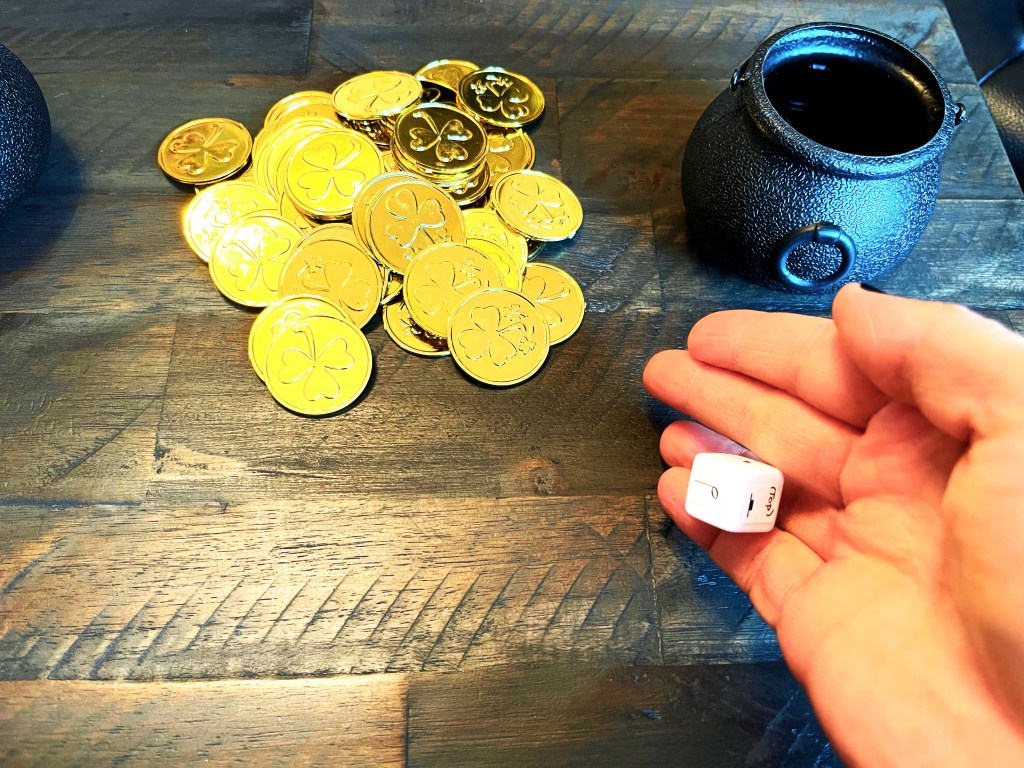
The student rolls his/her rhythm die and names the note or rest it lands on.

pot of gold coins with hand rolling rhythm die dice

The student should then determine the number of beats the note/rest gets and put the corresponding number of gold coins in his/her pot.

Half note rhythm die dice with two gold coins

For example, if the student rolled a half note, he/she should then place 2 gold coins in their pot.

hand placing gold coins in a pot cauldron

It is now the teacher’s turn. The teacher follows the same procedure above.

The first player to collect 20 gold coins in their pot wins!

For students who enjoy some adrenaline and intense competition, instead of taking turns, both players roll and fill their pots at the same time. When played this way, the game is turned into a race to see who will fill their pot first!

This is a fast-paced game which is great to play when you have less than 5 minutes to fill at the end of a lesson. And there is just something so satisfying about dropping the gold coins in the pots!

For more St. Patrick’s Day fun, check out Two Sides of the Same Coin in the Toucan Piano Shop. For three different ways to play it, check out the blog post Two Sides of the Same Coin.

Let’s stay in touch, join the list!

As a “toucan” of our appreciation download a free set of note flashcards (link in our Welcome email)!

Processing…
Success! You're on the list.

We are a participant in the Amazon Services LLC Associates Program, an affiliate advertising program designed to provide a means for sites to earn advertising fees by advertising and linking to Amazon.com. As an Amazon Associate we earn from qualifying purchases.