Rhythm Relay: A Fun Group Rhythm Game

Rhythm is the foundational element of music. Even if a student hits all the right notes, if the rhythm is off, the music will not sound right… That is why I tend to spend a lot of time working on rhythm with my students. I always incorporate one or two rhythm games into our bi-annual group lessons. This year was no different!

Rhythm Relay is a no-prep rhythm game that can be used in group lessons or in a classroom setting. It helps students actively apply their rhythm skills by practicing rhythm notation (both notes and rests), recognizing and internalizing rhythm patterns, hearing rhythm sequences in their minds, and accurately writing them from memory. It’s a well-rounded way to reinforce rhythm fluency in a fun and engaging way!

To play, all you will need

are a dry erase board and a marker for each player. You could also just use sheets of paper or students’ notebooks. For my group lessons I use these dry erase keyboard/staff sheets (they are made from a cardstock-like material and are double-sided: one side is blank and the other has a keyboard and staff). They are so versatile and I use them for a wide variety of tabletop games (because they are flexible I had students place one of their piano book underneath them when writing since we were not at a table).

How to Play

  • Start by giving everyone a dry erase board and marker.
  • Have students spread out around the room.
  • The teacher writes out a rhythm sequence and shows it to Student 1.
  • Student 1 has 10 seconds (or less!) to memorize it. Students should be encouraged to hear the rhythm sequence in their heads (without making any sounds!) and look for patterns.
  • Student 1 then runs over to Student 2 and writes out the rhythm sequence from memory on Student 2’s dry erase board.
  • Student 2 has 10 seconds to memorize it.
  • Then Student 2 goes over to Student 3 and repeats the procedure.
  • Keep going until the last student is reached.
  • The last student should tap out the rhythm sequence. The other students should follow along by reading the rhythm sequences on their dry erase boards.
  • Do they have a match?! Students should try to correct any mistakes on their boards based on what the final student tapped.
  • Compare everyone’s boards to the original board.
  • If they got it correct, the students win the round. If there was a mistake on the dry erase board and the student corrected it upon hearing the rhythm sequence tapped out, it counts as a match.

Make the game more challenging by making the rhythm sequence incrementally longer and more complicated each round. Make sure to rotate the students each round so everyone eventually has a chance to be last and tap out the rhythm sequence.

For General Music Classrooms

If you are playing this game with a large number of students in a classroom setting, you can divide them into teams. Let’s say there are 3 teams. For Round 1, the teacher will create 3 different but evenly-leveled rhythm sequences.
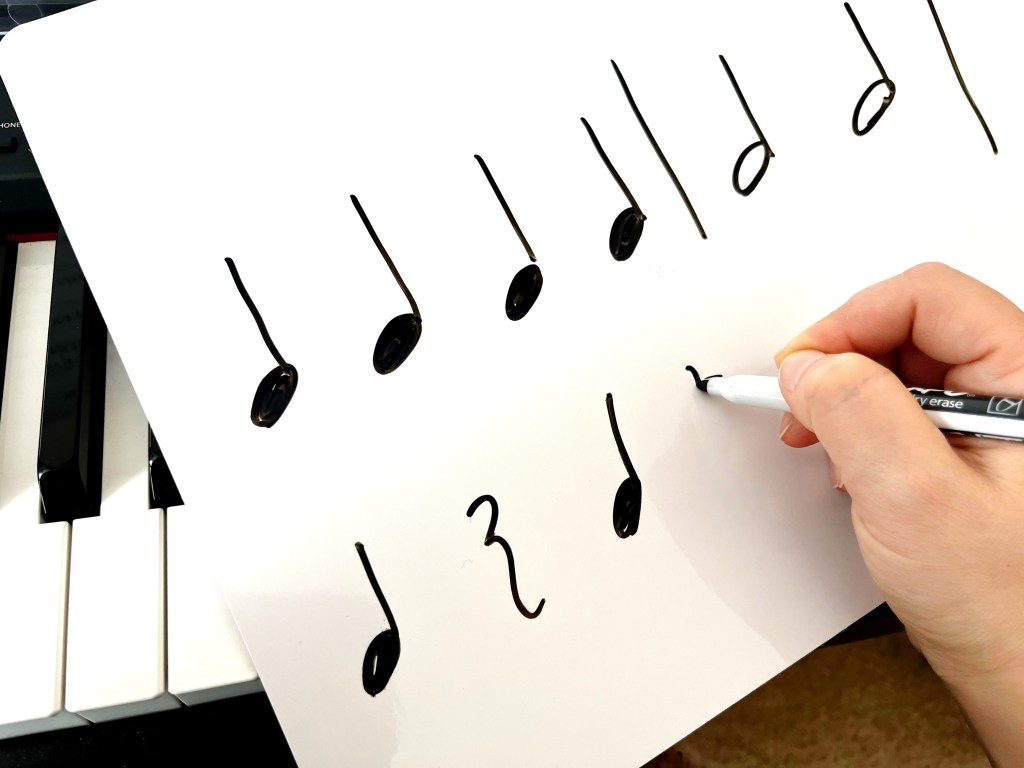
A piano teacher writes out a rhythm sequences of quarter notes, quarter rest, and half notes on a dry erase board.
  • Team 1 is up first. Teams 2 and 3 should receive a dry erase board and a marker each.
  • The teacher shows the rhythm sequence to the first student on Team 1.
  • The game follows the same instructions as above.
  • When it comes time for the last student of Team 1 to tap out the rhythm sequences, Teams 2 and 3 should try to write out what they hear on their dry erase boards.
  • If Team 1 correctly relayed the rhythm sequence to the last student, they win 2 points.
  • BUT if Team 1 got it wrong, Teams 2 and 3 have a chance to steal the points. If they correctly wrote down the rhythm sequence that the last student tapped, each team gets 1 point. If only one team wrote it down correctly, that team gets 2 points.

Please note, in the case of stealing points, the rhythm sequence will be different from what the teacher originally wrote. The dry erase boards of Teams 2 and 3 should be compared the dry erase board the last student was using to tap out the rhythm sequence.

Then it is Team 2’s turn, followed by Team 3. If playing multiple rounds, the teacher can make the rhythm sequences incrementally longer and more complicated!

Explore more creative teaching ideas
  • Rhythm Olympics
    Students will go for gold in the Rhythm Olympics, a multi-level multi-week rhythm game! Students compete in 5 rhythm sporting events in the hopes of collecting all 5 gold medals and being crowned a Rhythm Olympics champion!!!
  • Don’t Miss a Beat!
    This fun, multi-level game grows with your students as they learn more and more rhythms. Students will have to use their knowledge of rhythm note and rest values as well as time signatures to fill in the missing rhythms on each card. It can be played in private or group lesson settings!
  • Snowball Rhythm Game
    Who will be able to make the longest rhythm train before the dreaded “Busted!” stick is revealed?! Kids will practice their rhythms while also practicing their aim in this fun toss game.
  • Sky High Love
    The rhythms get longer as the heart towers get higher! Whose tower will remain standing in the end?! This adrenaline-inducing rhythm game is a great way to kick-off a lesson and get the energy up.

Let’s stay in touch, join the list!

As a “toucan” of our appreciation download a free set of note flashcards (link in our Welcome email)!

Processing…
Success! You're on the list.

We are a participant in the Amazon Services LLC Associates Program, an affiliate advertising program designed to provide a means for sites to earn advertising fees by advertising and linking to Amazon.com. As an Amazon Associate we earn from qualifying purchases.

Rhythm Olympics

I’m so excited for the Paris 2024 Summer Olympic Games! The amazing breadth of sports, the stories of the athletes, the pure perseverance and triumph over adversity… the Olympics are always epic!

My students are going for gold this summer as well as they compete in the Rhythm Olympics!

Rhythm Olympics cover sits on top of a page from the Metric Medley sporting event. Gold medals lay around the rhythm game.

I’m busting out this studio-wide multi-week game that I made for the 2020 Olympic games again this summer. And since it’s multi-level, the students who played it back in 2021 (both virtually and in-person) will be able to do it again (we’ll just level up)!

I love studio-wide activities because it provides a sense of community for the students (lots of the kids know each other and I LOVE it when I hear that they are talking about our piano lessons outside of the studio!). The studio-wide activies can serve to introduce concepts to younger students, solidify concepts more deeply with older students, and serve as a refresher for more experienced students.

And the summer is an excellent time for a themed activity… especially when the Olympic games are happening!

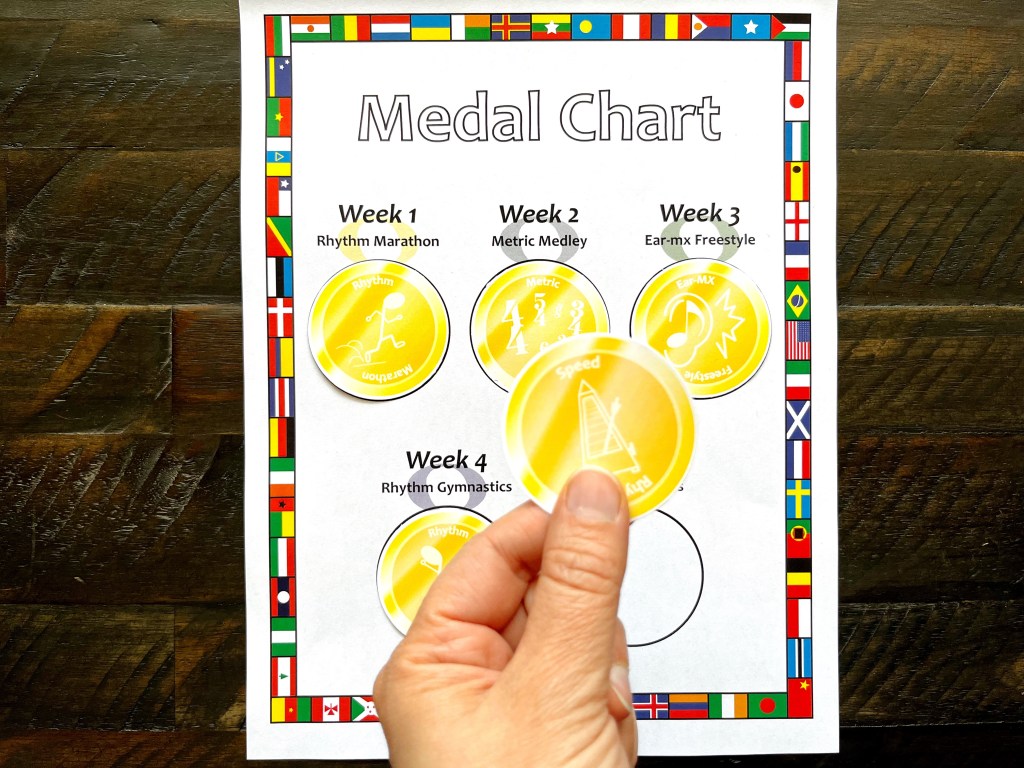
Each student receives their own medal chart. Each week as they try out a new rhythm sport they have a chance to earn a gold medal to add to their chart.

A hand hold a gold medal in the Rhythm Olympics over a medal chart filled with other gold medals.

There are five different rhythm sporting events that students compete in:

  • Rhythm Marathon: Will students be able to make it to the end as more and more rhythms are added on each round?!
  • Metric Medley: Students will put their time signature knowledge to the test!
  • Ear-mx Freestyle: Remind students to clean out their ears because they are going to need them in this x-treme listening challenge!
  • Rhythm Gymnastics: Rhythm and coordination must come together in order to take home the gold!
  • Speed Rhythms: How fast can students play the rhythm sequence?! Will it be enough to earn the gold?

The Rhythm Olympics download also comes with Microsoft PowerPoint versions of all the rhythm sporting events, which is perfect for online/virtual lessons.

A piano student draws a bar line on a rhythm sheet with a black dry erase marker.

Rhythm Olympics also comes with a practice log. In order to qualify for the next Rhythm Olympics sporting event, students have to practice a certain number of days during the week.

Rhythm Olympics can be an individual challenge for each student or you can use the silver and bronze medals that come in the download to turn it into a competition among all your students! Each Rhythm Olympics sporting event comes with suggestions on how to incorporate the silver and bronze medals. Keep track of how many gold, silver and bronze medals each student wins and see who can earn the most gold medals!

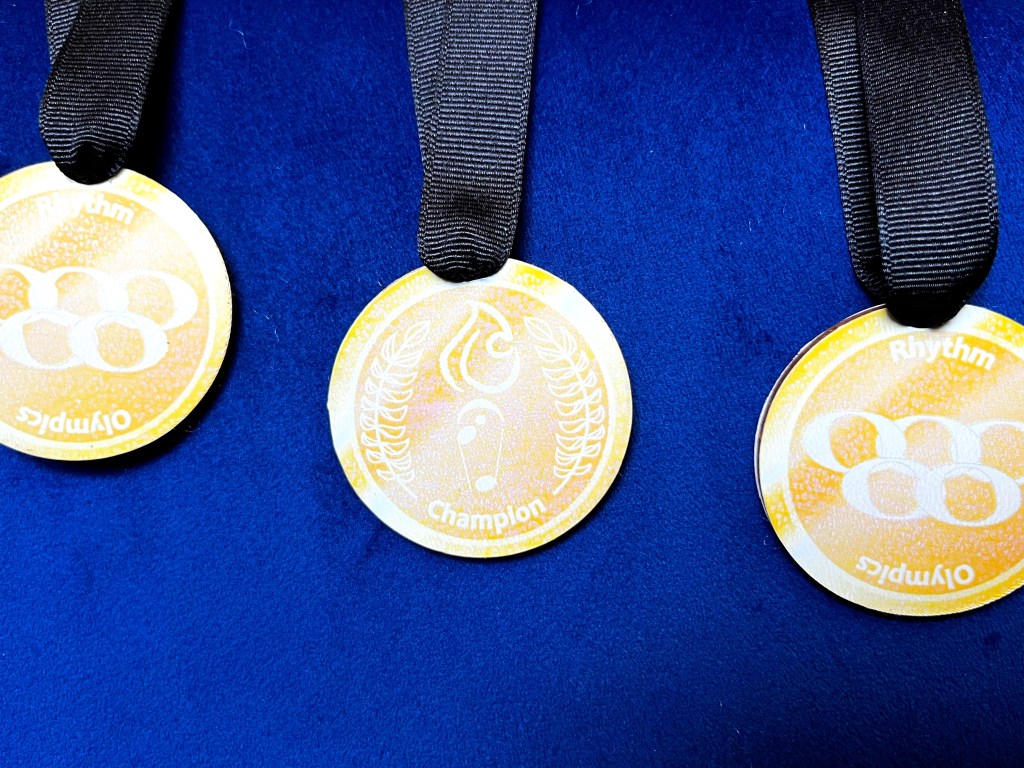
Included in the download is a gold Champion medal printable. At the end of Rhythm Olympics, each student can receive a Champion medal for having completed all of the rhythm sporting events!

The gold champion medal sit on a velvety blue background

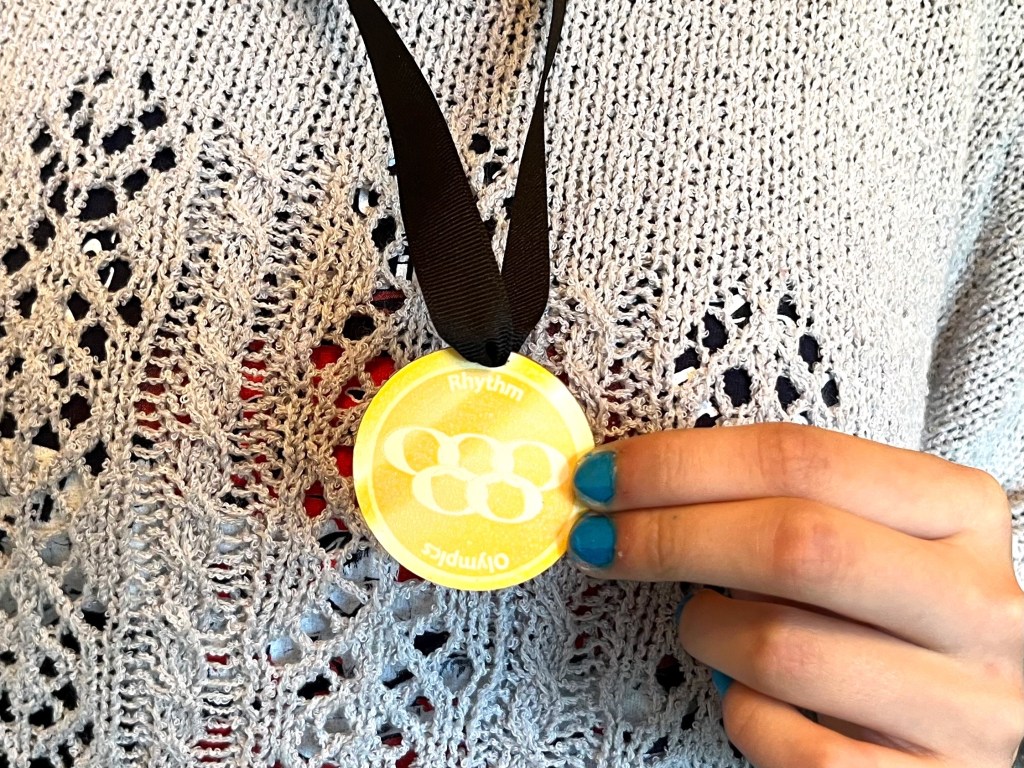
I took the medals a step further and glued them to these wooden circles with holes and ran a strand of ribbon through the holes, turning them into actual medals my students could wear! They loved them!

A piano student holds up a gold Rhythm Olympics medal.

Rhythm Olympics is available for purchase in the Toucan Piano store.

Explore more creative teaching ideas
  • Halloween Note-Reading Challenge
    Every fall, when students return to lessons after summer break, I feel like we spend the first month just reviewing concepts and note-reading. The summer slide is a real thing… This studio-wide Halloween note-reading challenge gets things back on track. Only the best note-readers will survive the Zombie Pian-o-pocalypse!
  • Slurs & Ladders: The Recital Prep Game
    If there is one game my students beg to play year after year (and sometimes when we don’t even have a recital anytime soon!) is this recital prep game. It’s a great de-stressor and it shows students how prepared they are to perform while also injecting some fun and joy back into those recital pieces that may be sounding a little tired.
  • Top Practice Tools Every Piano Student should Have: Curiosity
    Curiosity is the catalyst that gets students to start learning the piano in the first place and can be exactly what’s needed to keep them going for the long haul. Why is it so important and how do we keep it going? What if I don’t play an instrument, but want to encourage my child in their practicing? Check out all the answers plus download a free printable for parents!

Let’s stay in touch, join the list!

As a “toucan” of our appreciation download a free set of note flashcards (link in our Welcome email)!

Processing…
Success! You're on the list.

We are a participant in the Amazon Services LLC Associates Program, an affiliate advertising program designed to provide a means for sites to earn advertising fees by advertising and linking to Amazon.com. As an Amazon Associate we earn from qualifying purchases.
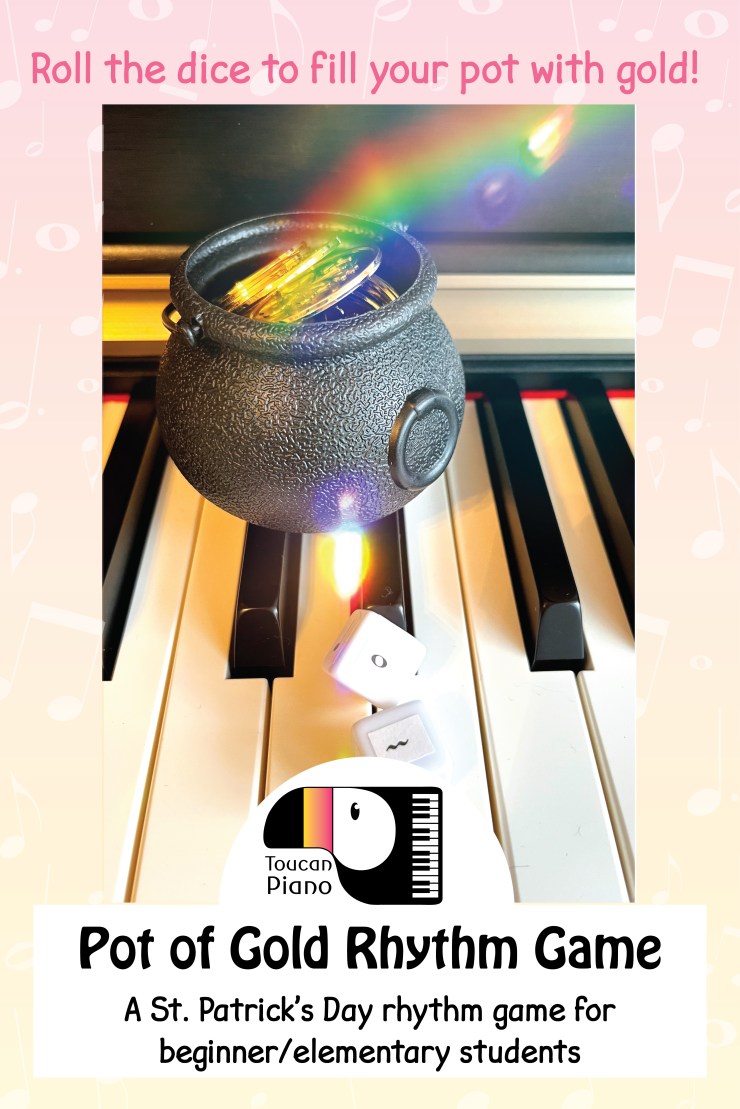
Pot of Gold: Rhythm Game

Happy St. Patrick’s Day!!! If you are looking for a last minute game to play with your beginner/elementary students with things you probably already have on hand, this simple rhythm game fits the bill! This game is great all year round, all you have to do is change the game markers.

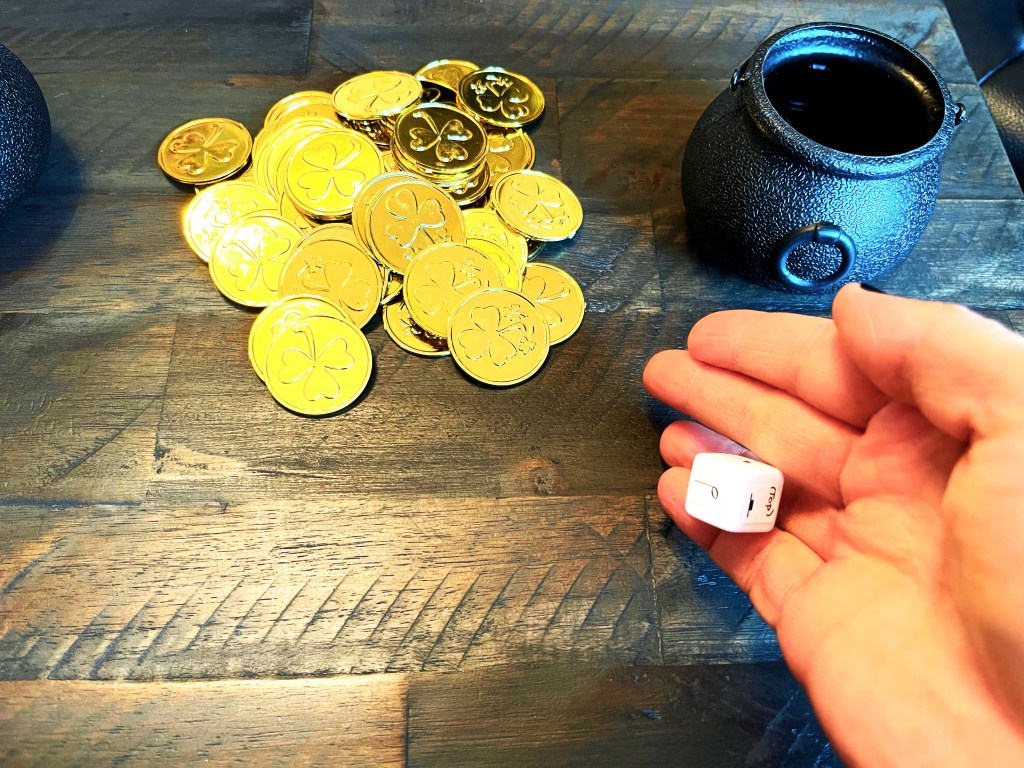
For the St. Patrick’s day version of this game I am using 40 gold coins, mini pots/cauldrons (also great for Halloween games!), and rhythm note/rest dice. I made the dice by gluing note and rest stickers on the sides of a blank die. Check out my blog post on how to make your own music theory dice!

pot of gold coins with rhythm dice

The student rolls his/her rhythm die and names the note or rest it lands on.

pot of gold coins with hand rolling rhythm die dice

The student should then determine the number of beats the note/rest gets and put the corresponding number of gold coins in his/her pot.

Half note rhythm die dice with two gold coins

For example, if the student rolled a half note, he/she should then place 2 gold coins in their pot.

hand placing gold coins in a pot cauldron

It is now the teacher’s turn. The teacher follows the same procedure above.

The first player to collect 20 gold coins in their pot wins!

For students who enjoy some adrenaline and intense competition, instead of taking turns, both players roll and fill their pots at the same time. When played this way, the game is turned into a race to see who will fill their pot first!

This is a fast-paced game which is great to play when you have less than 5 minutes to fill at the end of a lesson. And there is just something so satisfying about dropping the gold coins in the pots!

For more St. Patrick’s Day fun, check out Two Sides of the Same Coin in the Toucan Piano Shop. For three different ways to play it, check out the blog post Two Sides of the Same Coin.

Let’s stay in touch, join the list!

As a “toucan” of our appreciation download a free set of note flashcards (link in our Welcome email)!

Processing…
Success! You're on the list.

We are a participant in the Amazon Services LLC Associates Program, an affiliate advertising program designed to provide a means for sites to earn advertising fees by advertising and linking to Amazon.com. As an Amazon Associate we earn from qualifying purchases.

Snowball Rhythm Game

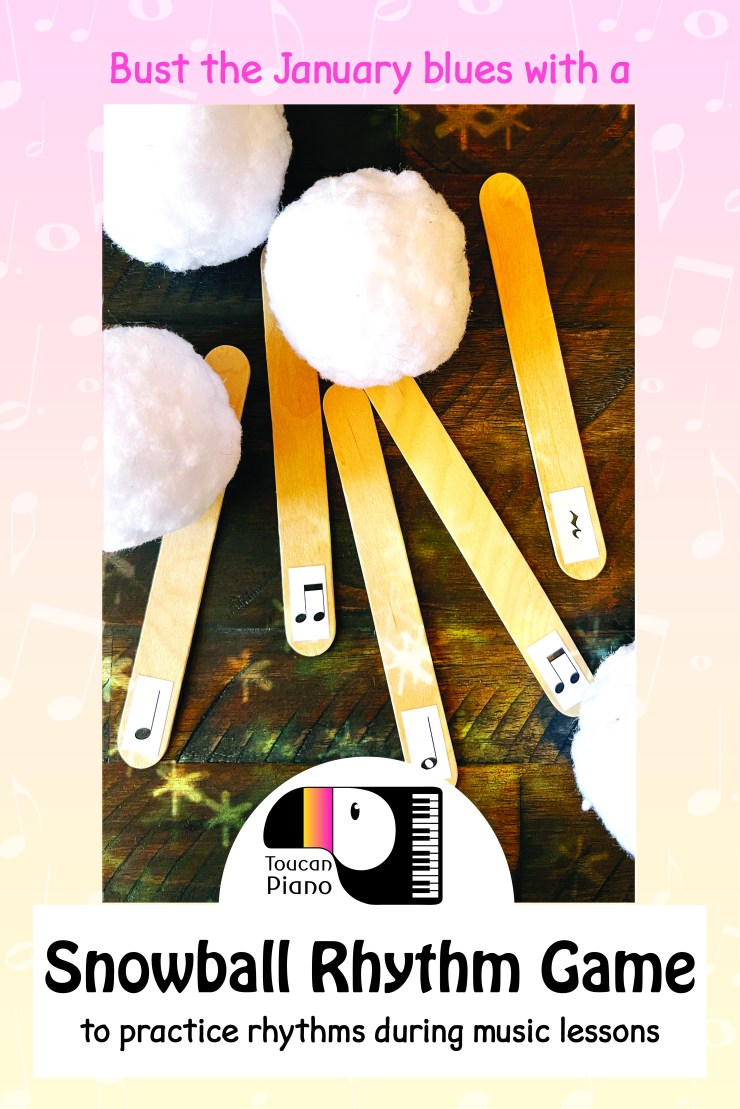
One of my favorite rhythm games to play with my students is Busted! from the Stay Tuned! blog. It’s easy to put together, easy to play, and a lot of fun!

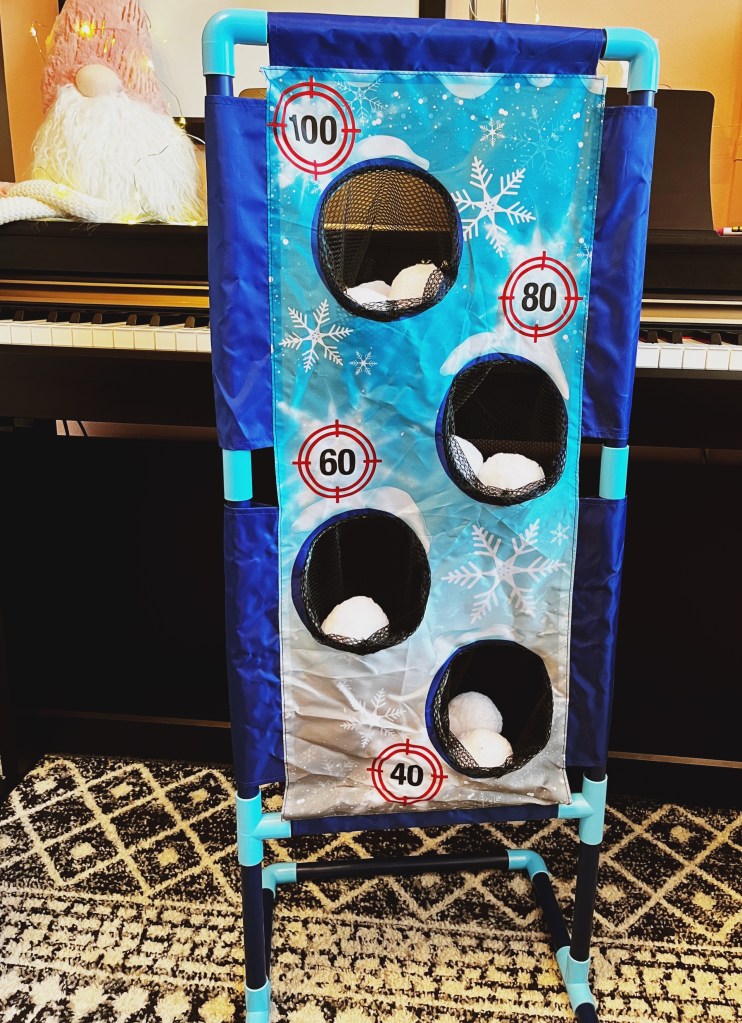
Every now and then I like to change it up a bit to keep it fresh. And that’s where snowballs come into play! I found my snowball toss game at Walmart marked down after the holidays and thought it would be a fun way to kick off my lessons after Winter Break (but any target-type game will work). It was a huge hit!! The kids have been asking to play it for the past couple of weeks and it’s been fun to dust off our rhythm skills after two months of Christmas Carols (we start in November, the day after Halloween!).

Here is a similar game from Amazon that works just as great and can be used for any season of the year!

Here’s how we played it:

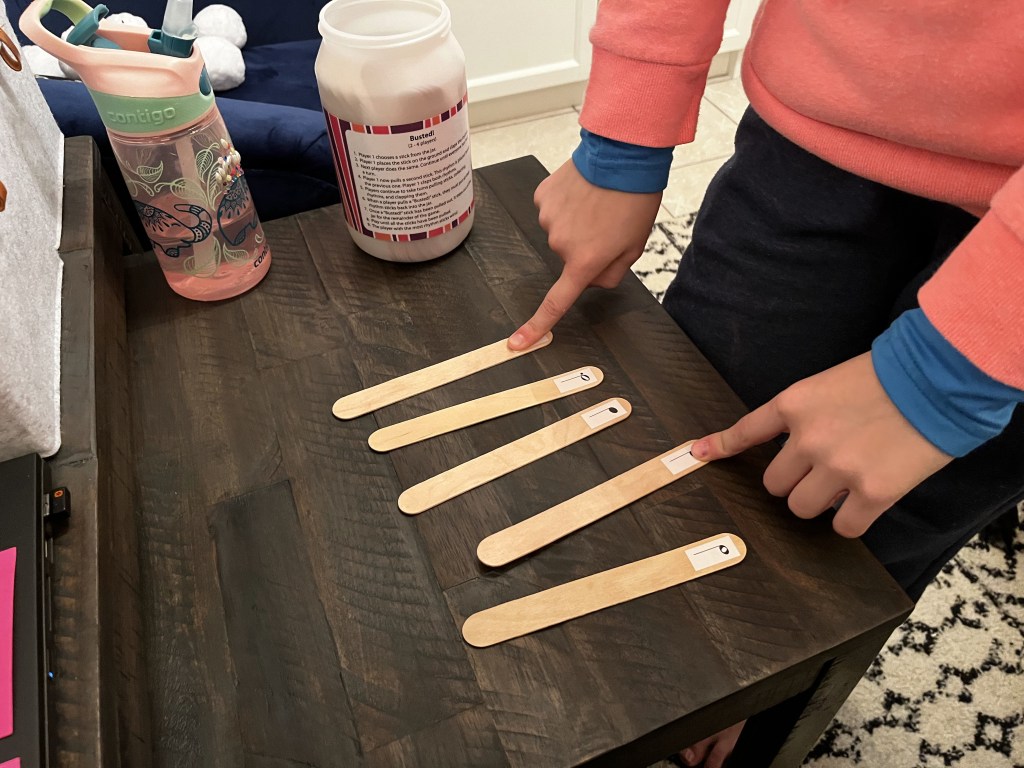
Place all the rhythm sticks inside the container along with only one “Busted!” stick.

Each player gets two chances to land a snowball in a hole before it’s the other person’s turn.

The first player (I always let the student go first), tosses a snowball at the board.

If the snowball lands inside one of the holes, the player removes the number of rhythm sticks corresponding to the hole the snowball landed in (for example, 40 hole = 2 rhythm sticks, 60 hole = 3 rhythm sticks, 80 hole = 4 rhythm sticks, 100 hole = 5 rhythm sticks). The player lays out the sticks to create a rhythm sequence. If the player already has sticks from a previous turn, the new sticks are placed after the last stick of the previous sequence, thus creating a longer rhythm sequence.

In order to earn the points, the player must clap and count the rhythm sequence correctly.

Then it is the next player’s turn. Repeat the same instructions.

Play continues until someone pulls out the “Busted!” stick and the game ends.

The total score of each player is calculated and the player with the highest score wins.

The game is more fast-paced then traditional Busted! (which can take awhile to play depending on how many rhythm sticks you used) and the kids had an absolute blast! It would be a fun game to play at piano party, buddy lesson, or a group lesson.

I plan on using this same game board for other games, I want to get some mileage out of it (and improve my aim!! I learned that my sweet spot is the 80 points hole, but I can’t seem to get the snowballs in any other hole! lol). It will most definitely be back and revamped!

Let’s stay in touch, join the list!

As a “toucan” of our appreciation download a free set of note flashcards (link in our Welcome email)!

Processing…
Success! You're on the list.

We are a participant in the Amazon Services LLC Associates Program, an affiliate advertising program designed to provide a means for sites to earn advertising fees by advertising and linking to Amazon.com. As an Amazon Associate we earn from qualifying purchases.