Thanksgiving Piano Practice Challenge

October, November, and December seem to be three of the four busiest months of the year (along with May here in the States because of all the end-school-year activities). But despite all that, my piano families love our annual Christmas Concert in early December and were unanimous in keeping it when I offered to do a Halloween recital instead (my thoughts were to ease up their December schedules but they shot me down LOL).

This is a small recital where my students perform only one Christmas carol and that carol is a duet or ensemble piece played alongside another student, family member, or friend.. their choice! We’ve had not only piano duets but performances with violins, drums, guitars, flutes, saxophones, and even voice! I love the creative ways my students find to involve their collaborators in sharing music and the holiday spirit with others! It is such a special evening!

We usually start learning the Christmas carol to be performed in September or October (depending on the complexity of the piece). But the weeks leading up to the concert are critical for getting the piece performance ready.

That’s where our annual “Save the Turkeys!” Practice Challenge comes in! My students LOVE this practice challenge (even my teens!) and are always so eager to meet the turkeys. They earn votes for their favorite turkey(s) by practicing, and the turkey with the most votes at the end of the challenge gets symbolically “adopted” by our studio! It’s a fun way to encourage more intentional practice while also supporting a good cause.

Let’s get into the details of the practice challenge:

  1. How to Set up the Practice Challenge
  2. How it Works
  3. My Visit to Farm Sanctuary
  4. Let’s stay in touch, join the list!
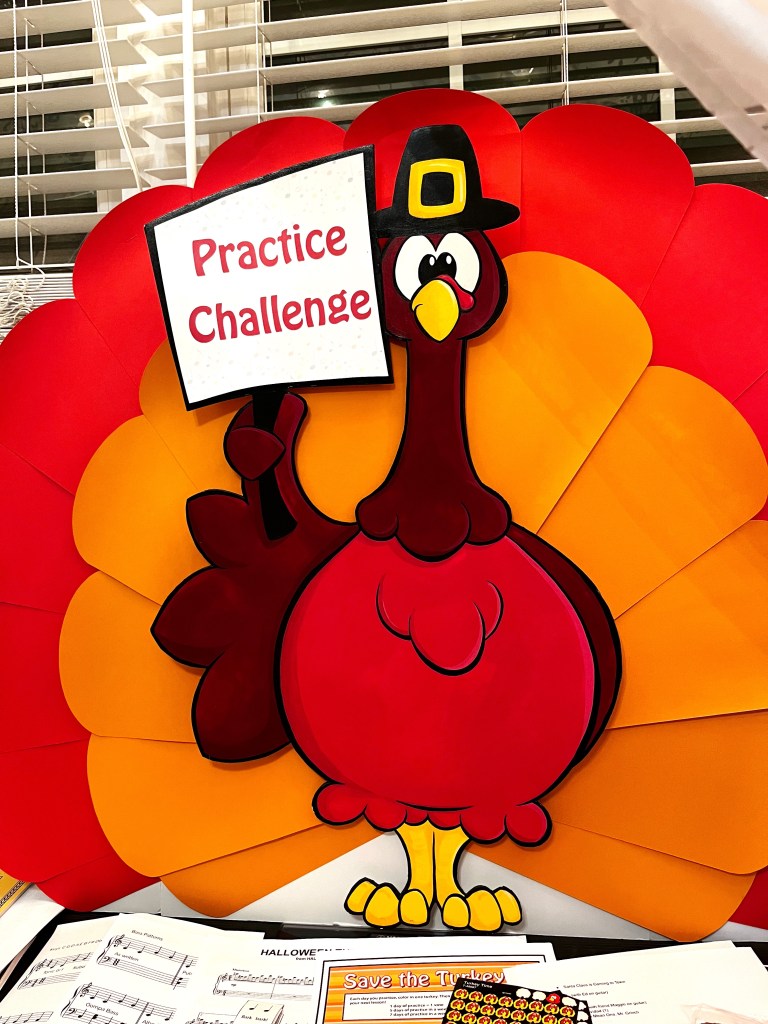
A colorful turkey decoration holding a sign that says 'Practice Challenge', set against a backdrop of layered orange and red feathers.

How to Set up the Practice Challenge

Farm Sanctuary holds an annual Adopt a Turkey Project. It is a fundraiser that helps support their mission of ending farm animal cruelty. The money goes towards supporting the everyday needs of the animals they rescue (including food, bedding, shelter, and veterinary care) as well as their efforts to build public awareness, education projects, advocacy, and the direct rescue of animals suffering abuse.

Each year, five turkeys are selected from their flock to be their ambassador turkeys for the fundraiser. On the Adopt a Turkey Project website they provide each turkey’s backstory along with their personality traits (I never tell the kids their backstories… they are heartbreaking… We only concentrate on their cute personalities!).

I print out a photo of each turkey along with their personality traits and favorite pastimes then cut them out.
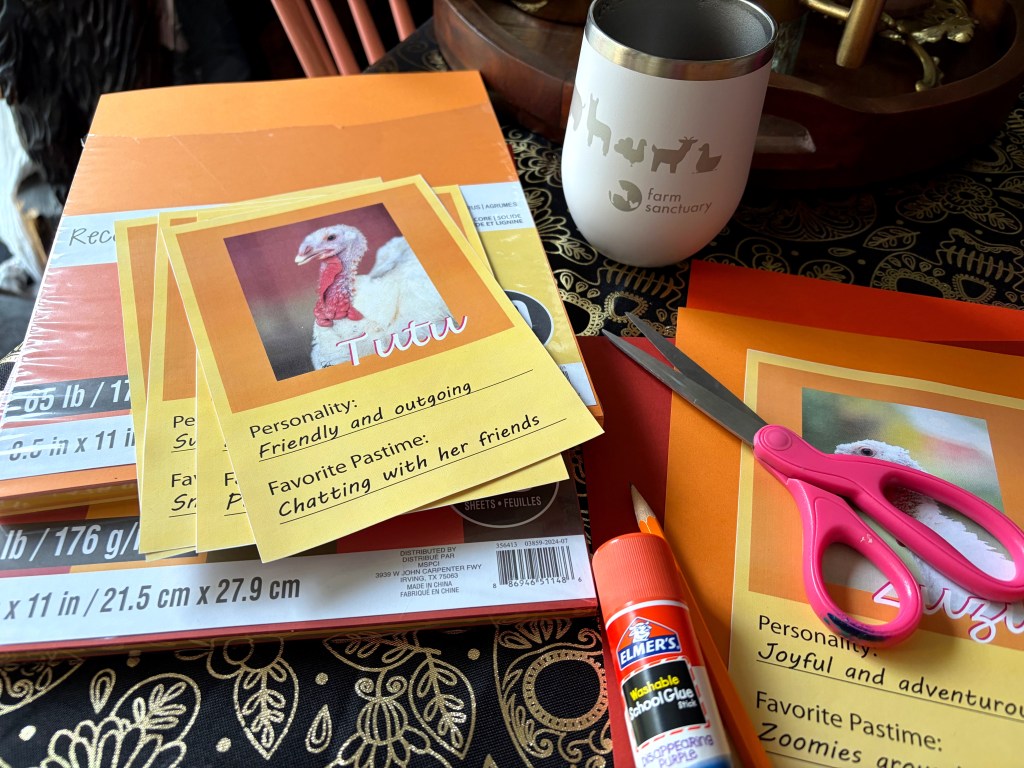
Colorful craft materials including orange cardstock, scissors, and glue, with printed cards featuring a turkey named Tutu showcasing personality traits and pastimes.

Using orange cardstock, I cut out fifteen feather-like shapes (three feathers for each turkey). I glue the turkeys to a feather and then glue two feathers below it. These feathers are where the kids will place their votes.

Then I hang the feathers in my teaching studio.
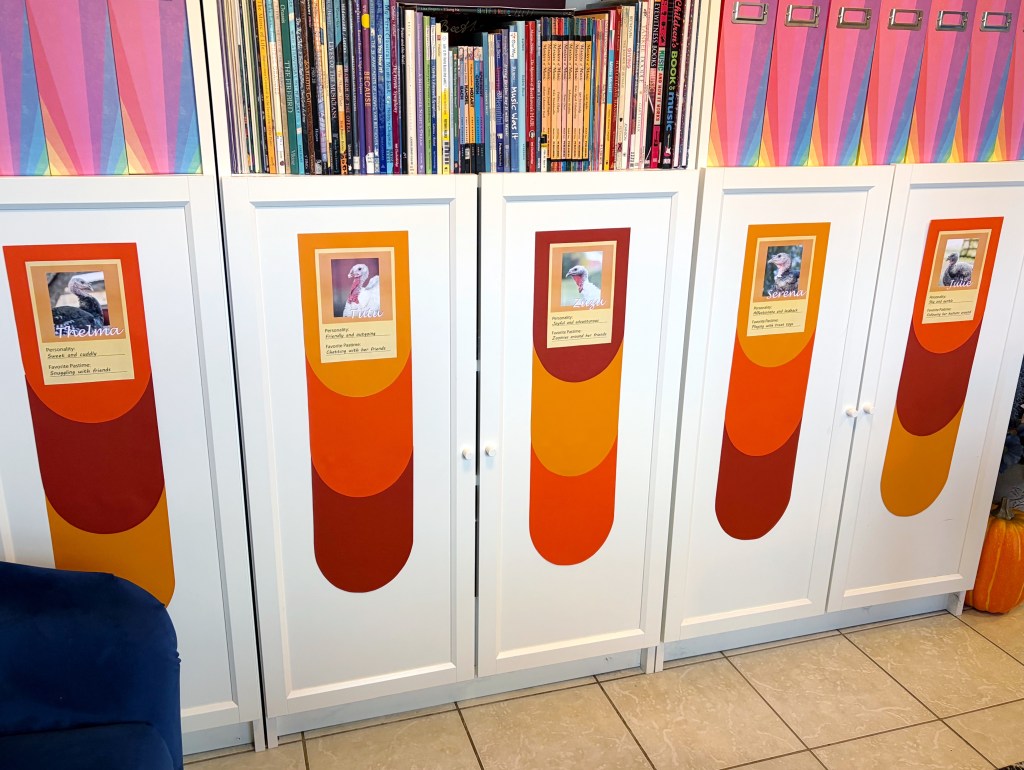
Cabinets decorated with orange and red paper feathers, each featuring a framed photo of a turkey and information about its personality and favorite activities.

Next, I then print out my “Save the Turkeys” practice tracker, one per student. Because I don’t want to overlap Halloween and Thanksgiving too much, the practice challenge runs for just three weeks.

If you would like to do your own “Save the Turkeys” practice challenge, you can download the free practice tracker in the Toucan Piano shop!

Four printed practice tracker sheets with a 'Save the Turkeys!' design, featuring boxes for coloring to track practice days across three weeks.

I always send out an email to my piano families the week the students will be receiving their practice charts. In the email I explain the practice challenge, give them a quick background on Farm Sanctuary’s mission, and a link to an additional fun activity: the Who’s your Turkey Twin? quiz.

Each year Farm Sanctuary provides this short and endearing quiz on their website (this year one of the questions was “What is your dream job?” And one of the possible answers was music teacher!!).

The kids who decide to take the quiz always want to know who my turkey twin is. This year my turkey twin is Serena:

“Like Serena, you are quite affectionate. You have uttered the phrase, “I’m a hugger!” on more than one occasion, and people love you for your warmth! You are known to others as laidback, charming, and fun to be around.” (Source: Farm Sanctuary)

How it Works

At our first lesson of the practice challenge, we meet the turkeys and I explain the challenge to them. I also make a point of saying that all the turkeys are safe and happy no matter which one wins (one year a student thought that the others would be eaten, so I always make sure to add that they are all safe no matter what before any questions pop up!).

Each student then receives a “Save the Turkeys” practice tracker.

For each day they practice, they color or check off a turkey on the practice tracker.

At our next lesson, we tally up the number of days they practiced that week to determine how many votes they will be casting for the turkeys:

  • 1 day of practice = 1 vote
  • 5 days of practice in a week = 5 votes plus 2 bonus votes (7 votes total)
  • 7 days of practice in a week = 7 votes plus 4 bonus votes (11 votes total)

The bonus votes are extra incentive to keep the practicing going!

A young child is placing a sticker on the turkey they chose to vote for. The turkey is a printout on a colorful feather frame, taped to a white cabinet in a music studio.

Once we tally up the votes for the week, the student then receives Turkey Stickers representing their votes (for example, 4 votes equals 4 turkey stickers).

The student can then place the stickers on the feather of their chosen turkey (or turkeys! My students usually have multiple favorites and want to distribute their votes).
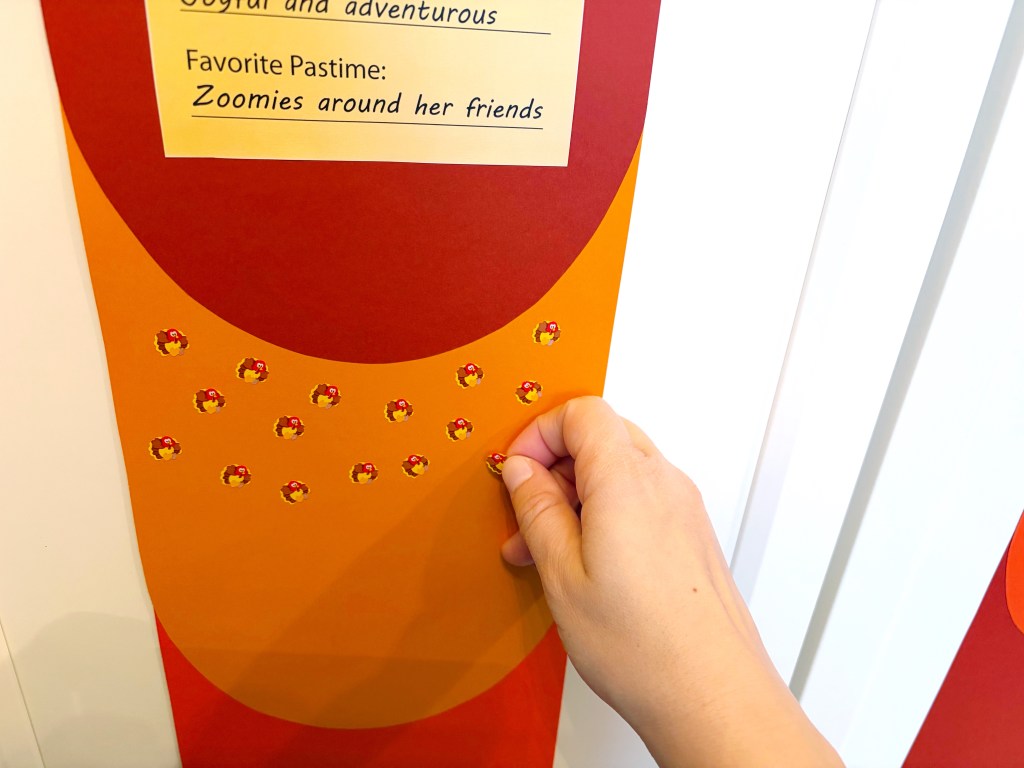
A person placing a sticker on an orange and red display board decorated with turkey illustrations, alongside information about the turkey's personality.

At the end of the three weeks and after all the votes have been cast, I count all the stickers for each turkey. The turkeys with the most stickers/votes is our winner!

(Side note: I usually keep a spreadsheet and write down how many stickers each turkey is getting along the way. It’s SO much easier than counting the stickers at the end.)
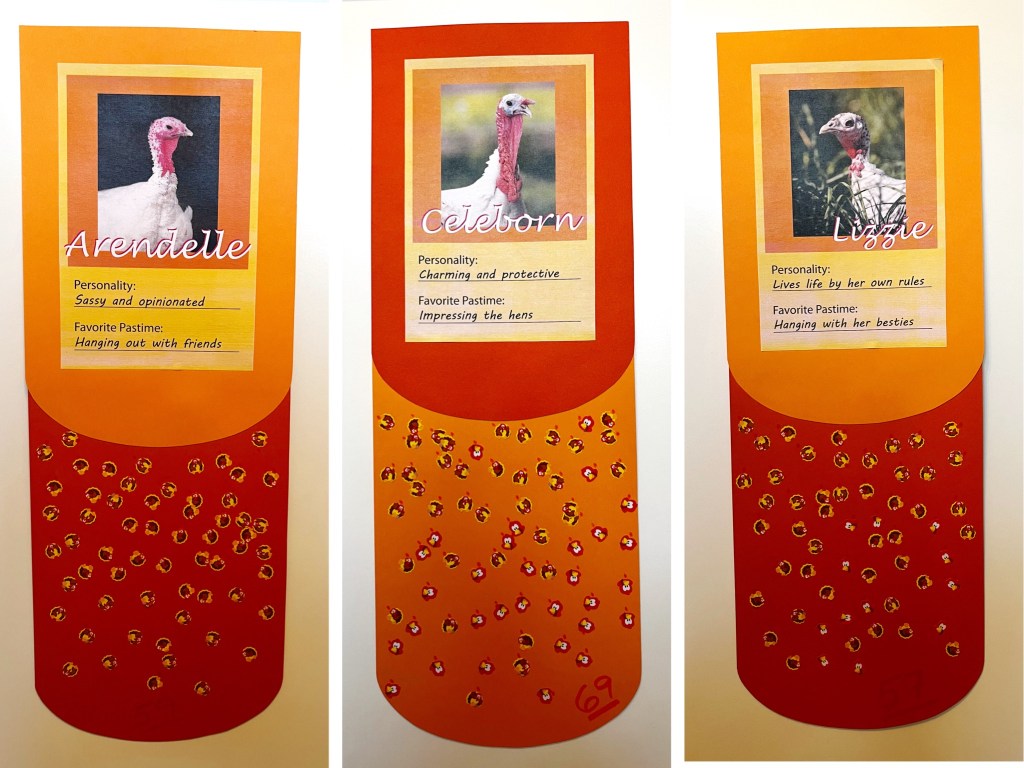
Three decorative cards featuring turkeys named Arendelle, Celeborn, and Lizzie. Each card includes a photo, personality traits, and favorite pastimes, set against a colorful orange and red background. Stickers representing votes are placed below the pictures of the turkeys.

Before Thanksgiving, I visit the Adopt a Turkey project website and symbolically adopt the turkey with the most votes (i.e., make a donation in that turkey’s name).

Farm Sanctuary then sends me a digital adoption certificate, which I print out and place in a gold frame on my book case in my teaching studio. The winning turkey is our studio mascot for the year and watches over us as we learn.
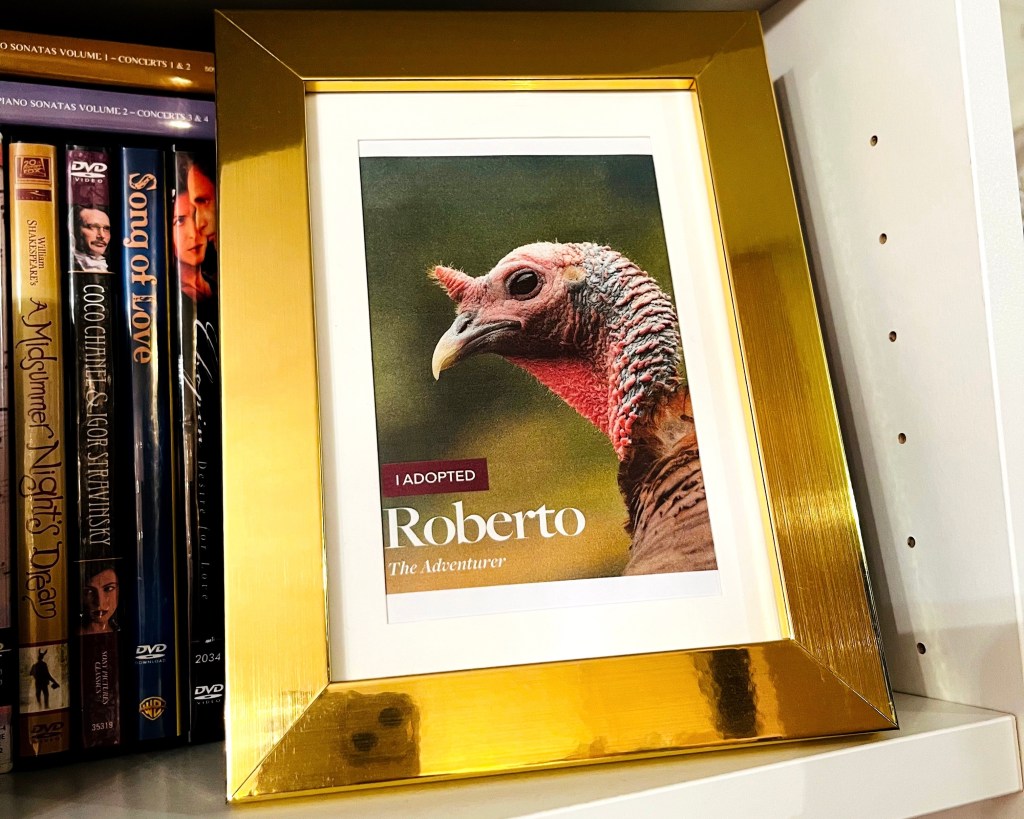
A framed adoption certificate for a turkey named Roberto, displayed on a shelf with DVDs in the background.

The “Save the Turkeys” practice challenge has become a fun, annual tradition at my studio and the kids are always so excited to meet the new turkeys each year.

My Visit to Farm Sanctuary

I started this practice challenge back in 2018 and it is by far my students’ favorite practice challenge. They would often ask me if I had ever met the turkeys…

This past summer I had the enormous pleasure of visiting Farm Sanctuary’s Watkins Glen location in New York State!

Exterior view of the Visitor Barn at Farm Sanctuary in Watkins Glen, featuring a sign indicating guest parking and a large sign with the Farm Sanctuary logo.

Serendipity is such a wonderful thing! We were in Watkins Glen to visit the Watkins Glen State Park and its beautiful waterfalls (it did not disappoint! What a unique and gorgeous place!).

We were looking for more things to do in the area (we already had the Corning Museum of Glass on our list but we still had a morning to fill). I asked ChatGPT for some suggestions of activities in the Watkins Glen area and Farm Sanctuary popped up on the list.
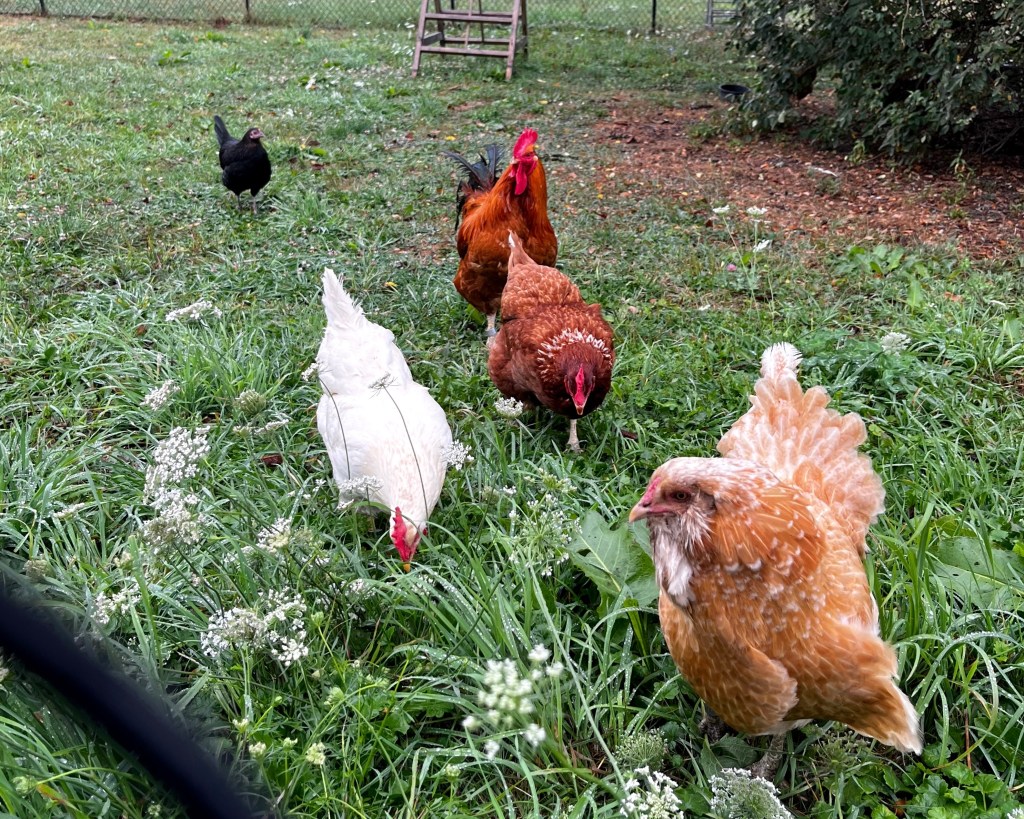
A group of chickens foraging in a grassy area at Farm Sanctuary.

I literally did a facepalm… How did I not put 2 and 2 together?! I immediately reserved a tour and it was the perfect way to finish up our vacation!

Two people in white protective clothing gently pet a large pig lying on straw in a barn.

It was a rainy morning but the rain stopped during our hour-long tour. And we lucked out; we were the only ones in our group tour and we basically got a private tour!

As we walked the grounds, we learned about the history of Farm Sanctuary and visited Hilda the sheep’s grave (Farm Sanctuary’s first rescue).
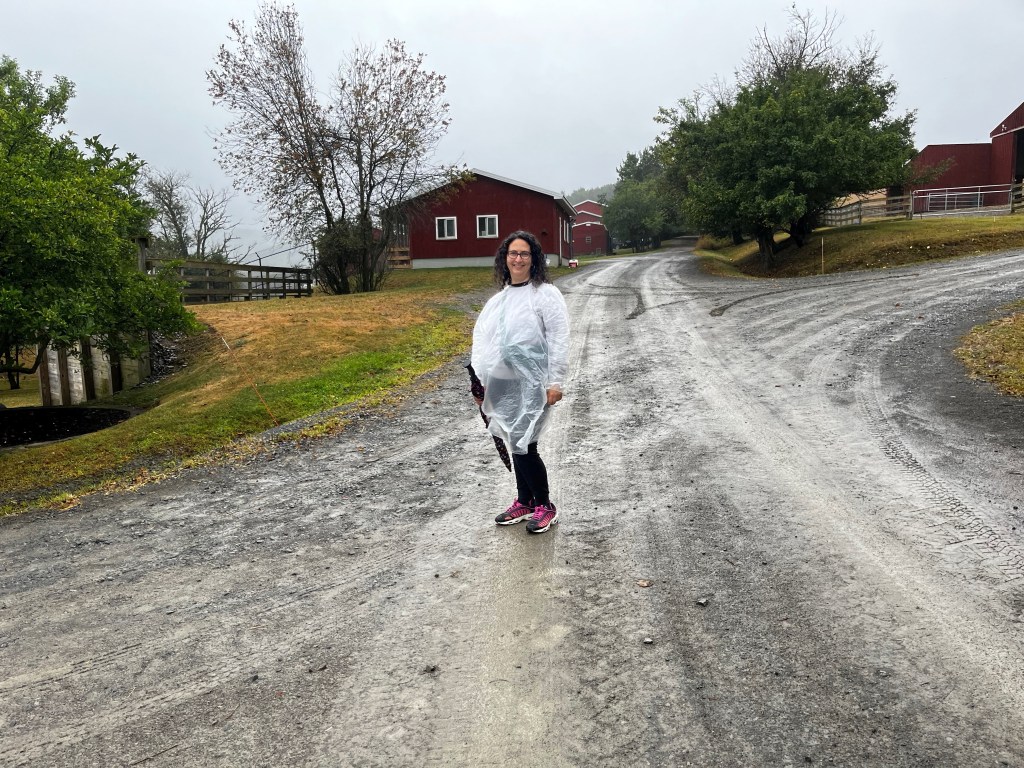
A person wearing a clear rain poncho stands on a gravel road on a rainy day, with red barns and trees in the background at Farm Sanctuary.

We got to meet and pet cows, sheep, goats, and pigs. We saw the turkeys (!!!), chickens, geese, and ducks. We learned about their backstories and how they are thriving and living their best lives on the farm.

I had always wanted to visit the farm and it was such a dream come true! They even had a turkey tote that I snatched up in the gift shop! It had the names of past turkeys from their Adopt a Turkey project, including my all-time favorite turkey, Roberto! (I don’t know, there is just something so endearing and funny about a turkey named Roberto. And his personality was just so cute!).

A person stands outside a red barn, holding a tote bag featuring the turkeys of Farm Sanctuary.

I highly recommend a visit to Farm Sanctuary if you are in the Watkins Glen area or their Southern California location.

We got a little laugh upon leaving the farm when we saw this street sign for “Unexpected Road”. It was a dirt road that was best not to go down because of all the mud from the rain. But it got me thinking about how compassion and acts of kindness (like the founder’s impulse decision to rescue a sheep left for dead) can completely change the course of our lives and lead us to a new purpose.
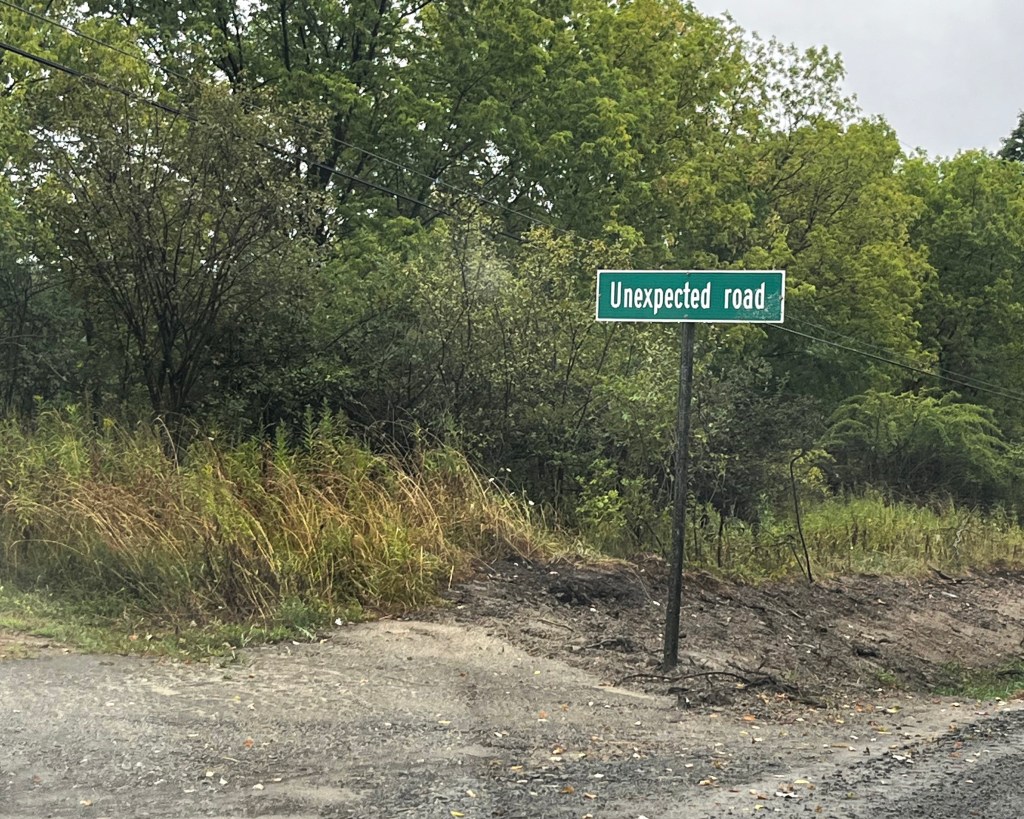
A green sign reads 'Unexpected road' beside an overgrown path surrounded by trees and tall grass.

I am deeply thankful for the unexpected twists that led me to teaching piano. I am enormously grateful for my wonderful students and families and I look forward to keeping our “Save the Turkeys” practice challenge tradition going strong for years to come!

Happy Thanksgiving!!!

Explore more creative teaching ideas
  • 25 Piano Gifts for Young Musicians
    Looking for a gift to inspire your child to pick up their instrument and practice more in the new year? The list is a mixture of useful and fun stuff that kids can use for their practicing or to show off their piano pride!
  • Slurs & Ladders: The Recital Prep Game
    If there is one game my students beg to play year after year (and sometimes when we don’t even have a recital anytime soon!) is this recital prep game. It’s a great de-stressor and it shows students how prepared they are to perform while also injecting some fun and joy back into those recital pieces that may be sounding a little tired.
  • Positive Notes: Recital Encouragement
    Spread some positivity and encouragement to your students this recital season with these adorable Positive Notes! They will help remind them of how hard they work and how much you believe in them.
  • Snowball Rhythm Game
    Who will be able to make the longest rhythm train before the dreaded “Busted!” stick is revealed?! Kids will practice their rhythms while also practicing their aim in this fun toss game.
  • Chord Snowblast
    Build chords and collect points while trying to avoid the snow blast! Kids will test their knowledge of building chords AND they will actually be hoping to get all the chords with sharps and flats!!

Let’s stay in touch, join the list!

As a “toucan” of our appreciation download a free set of note flashcards (link in our Welcome email)!

Processing…
Success! You're on the list.

We are a participant in the Amazon Services LLC Associates Program, an affiliate advertising program designed to provide a means for sites to earn advertising fees by advertising and linking to Amazon.com. As an Amazon Associate we earn from qualifying purchases.

Performance Practice – Part 1: External Distractions

Recital season is upon us and a topic that comes up a lot is performance anxiety. As children get older and become more self-conscious, performance anxiety can start to creep in… It affects everyone (there are countless stories of professional musicians who suffer from performance anxiety) but it doesn’t always affect everyone in the same way or even negatively. It can be harnessed as an agent of good to enhance their performance. 

A student in braids plays the grand piano at a recital.

As pianists we do not always have the luxury of numbers (like other instruments playing in orchestras or bands) and it can feel overwhelming to sit in front of an audience to perform (even if it’s a wonderfully friendly audience made up of family and friends). This is an extremely important topic to work on with students but oftentimes gets overlooked because of the more “pressing” matter of working out the technical difficulties of the performance pieces (and I’ve been guilty of this too!).

In this four part series, I’m going to talk about how students can practice for performance.

But isn’t practicing for a performance just playing the piece from beginning to end like one would on the day of the recital? As we will see, the answer is a resounding no.

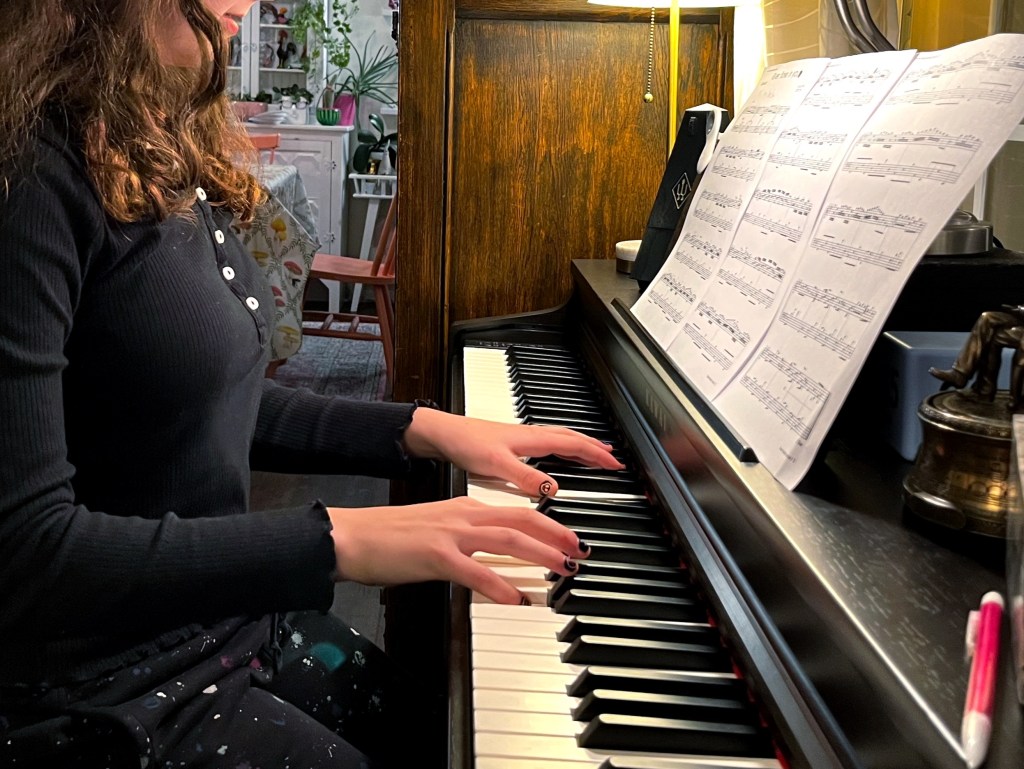
A piano student practices the piano.

The type of practice most students are familiar with is used to learn the piece. Through this type of practice, the student works out the technical difficulties, gains consistency and ease in playing it, increases accuracy and expression. Then when they are “done learning”, they are able play the piece. But this is not enough to perform the piece with confidence in a high-stakes setting like a recital or audition.

Performance practice requires a different set of practice strategies. The suggested strategies in this series are based on research but obviously not everything works for everyone. Students should experiment with all the different strategies to find the best ones that work for them. But, all of these strategies take time and consistent effort to make them useful… They require practice.

As teachers we want our students to approach the piano at the recital feeling confident and ready to share their music with the audience. The performance practice strategies will help prepare students for things that may happen on the day of the recital… intrusive thoughts, performance anxiety, and unexpected and unwelcome distractions. When students have a sense of control over the “unexpected” and are equipped with tools to handle them, they are free to play in the moment with confidence. They have practiced for performance and they know what to do!

  1. References
  2. What are External Distractions?
  3. Types of External Distractions and Management Methods
    1. Distraction no. 1 – Electronics
    2. Distraction no. 2 – People
    3. Distraction no. 3 – Practice Space
    4. Distraction no. 4 – Noise
  4. Spot the Distractions: What’s Stealing your Focus?
  5. Coming up next!
  6. Let’s stay in touch, join the list!

References

I used many sources for my research and I wanted to take a moment to highlight a few that you may find helpful if you want to dive deeper into the subject:

  • The Bulletproof Musician – This website is a treasure trove of information about performance anxiety! Noa Kageyama, a performance psychologist and faculty member of The Julliard School and Cleveland Insitute of Music, offers weekly posts, courses, and a myriad of free resources to help musicians with performance anxiety.
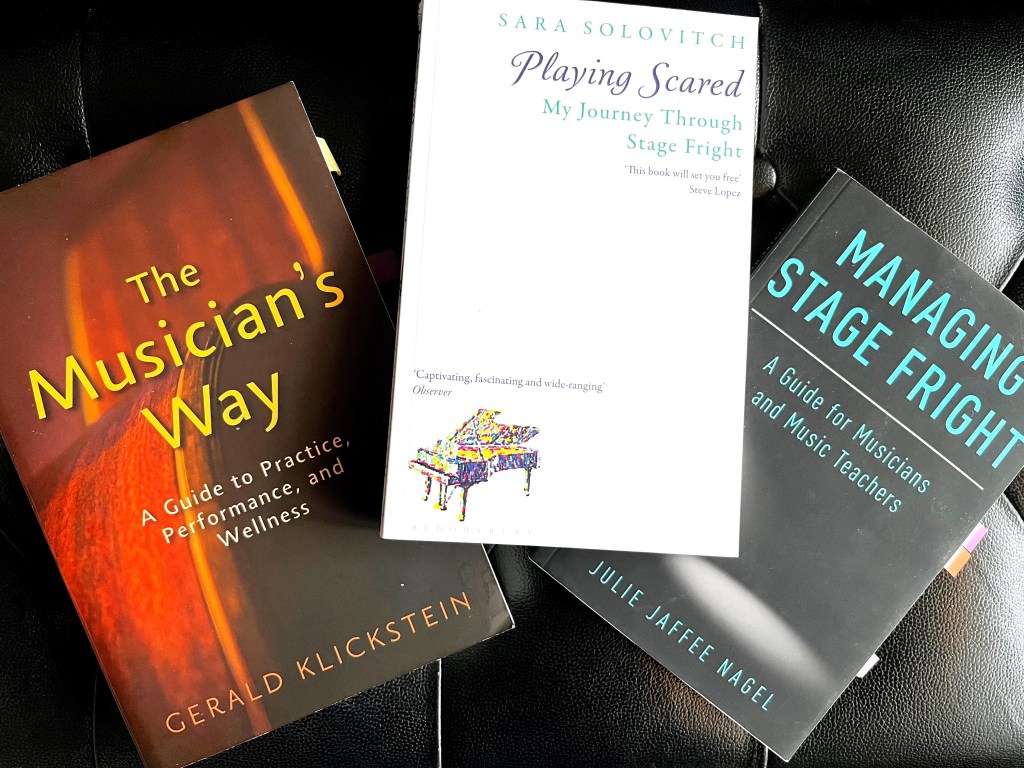
  • Managing Stage Fright – A Guide for Musicians and Music Teachers by Julie Jaffee Nagel: This book is filled with practical strategies for managing performance anxiety. The book is directed at teachers, making it unique in the literature. As teachers, we have to navigate the intense emotions students feel when it comes to performing and the author, a pianist and psychoanalyst, conveys her research and strategies in a wonderfully empathetic manner.
  • Playing Scared – My Journey through Stage Fright by Sara Solovitch: This is the personal account of the author in achieving her goal of giving a formal recital the day before her 60th birthday. She does research along the way and describes the journeys of famous musicians, actors, athletes, and even a reverend in managing their own stage fright.
  • The Musician’s Way – A Guide to Practice, Performance, and Wellness by Gerald Klickstein: This book covers a wide variety of topics. Part II of the book on performance is very informative and provides great practical strategies for musicians to try implementing in their performance practice.
Three books lay on a piano bench: The Musician's Way, Playing Scared, and Managing Stage Fright.

What are External Distractions?

As students prepare for their recital performance, they may be facing lots of external distractions when they sit down to practice (or maybe even ones that prevent them from practicing altogether!).

An external distraction is something that comes from the outside (not from within you) that takes your attention away from what you are doing.

Everyone is surrounded by external distractions… devices, pets, siblings, children, parents, friends and SO much more! It can often feel like the world around us is constantly trying to distract us from what we really need to do. Our students face the same challenges.

Learning a new piece and preparing it for performance takes a lot of focused work. Winning the battle against external distractions may seem challenging but it’s well worth the effort!

It all starts by removing the distractions students can control AND coming up with a plan to handle the distractions they can’t control.

Examples of external distractions include pets, conversations, smartphones, videogames, siblings playing, sirens, and storms.

Although it is important for students to be able to play through the occasional unintended noise during a performance (we’ll talk about that in a later post), for the hard work of learning their recital pieces, students should work in a space where external distractions are minimal.

By learning to protect their focus from everyday distractions, students set themselves up for productive practice sessions while also strengthening their ability to stay focused in any setting.

Types of External Distractions and Management Methods

Let’s talk about four of the most common external distractions that students may run into and different strategies for students to handle them.

Distraction no. 1 – Electronics

I think this is the one most students struggle with… The brain LOVES electronics because they stimulate the brain without the brain having to do any real work. They are instant gratification suppliers and the brain eats it up! Children and teens are particularly susceptible to their siren call. Some of the most common culprits are smartphones, smartwatches, tablets, videogames, computers, and the television.

A piano student plays on her smartphone instead of practicing the piano.

Here are five suggestions to protect practice time from electronics:

  • Put the device in another room.
  • Put the device in Airplane mode.
  • Turn off notifications.
  • Turn off the device.
  • Use these distractions as rewards for practicing.

With electronics, the easiest method is distance. Students may think about their electronics during practice, but if the device is out of reach, they’ll be less tempted to stop.

Distraction no. 2 – People

Our friends and family mean well, but sometimes they can unintentionally distract us from our practicing. Most of the time parents will be so delighted that their child is practicing that they will not interrupt them (unless there is a real reason). The true culprits are usually siblings and friends.

In order to handle these distractions, a student could:

  • Let everyone in the house know that they are practicing and don’t want to be disturbed.
  • Practice when siblings are not home (for example, their sister is at a dance class).
  • Ask siblings to do their activities in a different room of the house (this may require parental intervention).
  • Set aside a specific time to answer texts or FaceTime friends (a student could even go so far as to let friends know that they are practicing and will only be available at after a specified time).

Usually a conversation is enough to get these external distractions under control.

Distraction no. 3 – Practice Space

A student’s practice space should have everything they need for a successful practice session, which could include but is not limited to their instrument, their instrument’s accessories, proper lighting, comfortable ambient temperature, metronome, and a pencil.

A piano and its bench are covered in books, a blanket and stuffed animals.

To set themselves up for success a student could:

  • Make sure their instrument is always ready for practicing (tuned, not convered in clutter, etc.).
  • Keep everything they need at their instrument (sheet music, metronome, pencil, timer, etc.).
  • Make sure their space is well-lit, whether with natural or artificial light.
  • Make sure they are comfortable (wear clothing that is season appropriate so they are not too hot or too cold, ensure that their outfit is not restrictive and allows them to move freely while wearing it, etc.).

If the practice space is ready to go without the need to tidy up or move things around, it’s easier to just slip into practice mode. Taking a few minutes at the end of practice to reset the space makes the next session easier to start.

Distraction no. 4 – Noise

As musicians our sense of hearing is extremely important! Our ears need to focus on the music we are practicing. Students in particular are still developing their listening ear so external noise is even more problematic.

Noise can come from every source imaginable… pets, siblings, background house noise, conversations, neighborhood noise, devices, etc.

A black labrador dog lays its head on a piano student's lap as she tries to practice the piano.

In order to keep focused and not be distracted by external noise sources, students can:

  • Use headphones while practicing (if they are using a digital piano).
  • Put pets in a different room.
  • Ask family members to use their devices in a different room.
  • Turn off machines that generate a lot of noise (dishwashers, fans, robot vacuums, etc.).

Spot the Distractions: What’s Stealing your Focus?

Last year, when my students and I worked through this four part performance practice series, they occasionally had a little extra homework beyond the performance practice strategies. Since external distractions are something students can easily recognize, the following activity empowers them to take control of their practice environment by identifying and addressing the specific distractions that interfere with their focus.

We drew a table and labeled the columns:

  • External distraction – If the student identified an external distraction, they would describe it here.
  • How did you manage the distraction? – The student would then explain what they did to eliminate/minimize the distraction or refocus on practicing (if the external distraction was beyond their control).
  • Did it work? – A simple yes or no answer.
Table of external distractions, a strategy to manage them, and whether or not the strategy worked.

It was very interesting to see the variety of distractions my students were facing (every home is different!) and the creative solutions they came up with to handle them. I was very proud of them!

Coming up next!

In the next post we will be talking about internal distractions – thoughts that pop into our heads – and strategies to calm the inner chatter and refocus our minds.

A piano student thinks about a cheeseburger while practicing the piano.

Explore more creative teaching ideas
  • Slurs & Ladders: The Recital Prep Game
    If there is one game my students beg to play year after year (and sometimes when we don’t even have a recital anytime soon!) is this recital prep game. It’s a great de-stressor and it shows students how prepared they are to perform while also injecting some fun and joy back into those recital pieces that may be sounding a little tired.
  • How to Bow at a Piano Recital
    You’ve just finished playing your piano recital pieces and now the audience is clapping, what do you do now??! It’s time to take a bow and enjoy the adulation for all the hard work you put into learning your pieces. Here’s the step-by-step on nailing the perfect piano recital bow!
  • Positive Notes: Recital Encouragement
    Spread some positivity and encouragement to your students this recital season with these adorable Positive Notes! They will help remind them of how hard they work and how much you believe in them.

Let’s stay in touch, join the list!

As a “toucan” of our appreciation download a free set of note flashcards (link in our Welcome email)!

Processing…
Success! You're on the list.

We are a participant in the Amazon Services LLC Associates Program, an affiliate advertising program designed to provide a means for sites to earn advertising fees by advertising and linking to Amazon.com. As an Amazon Associate we earn from qualifying purchases.
Prac-Tris: The Videogame-Inspired Practice Challenge

As recital season barrels towards us, music teachers everywhere know it’s time for students to step up their practicing game. So why not turn it into an actual game? And not just any game, but a videogame-inspired practice game?

Prac-Tris will have your students stacking practice days as they work their way to the top… of the board and their musical mastery!

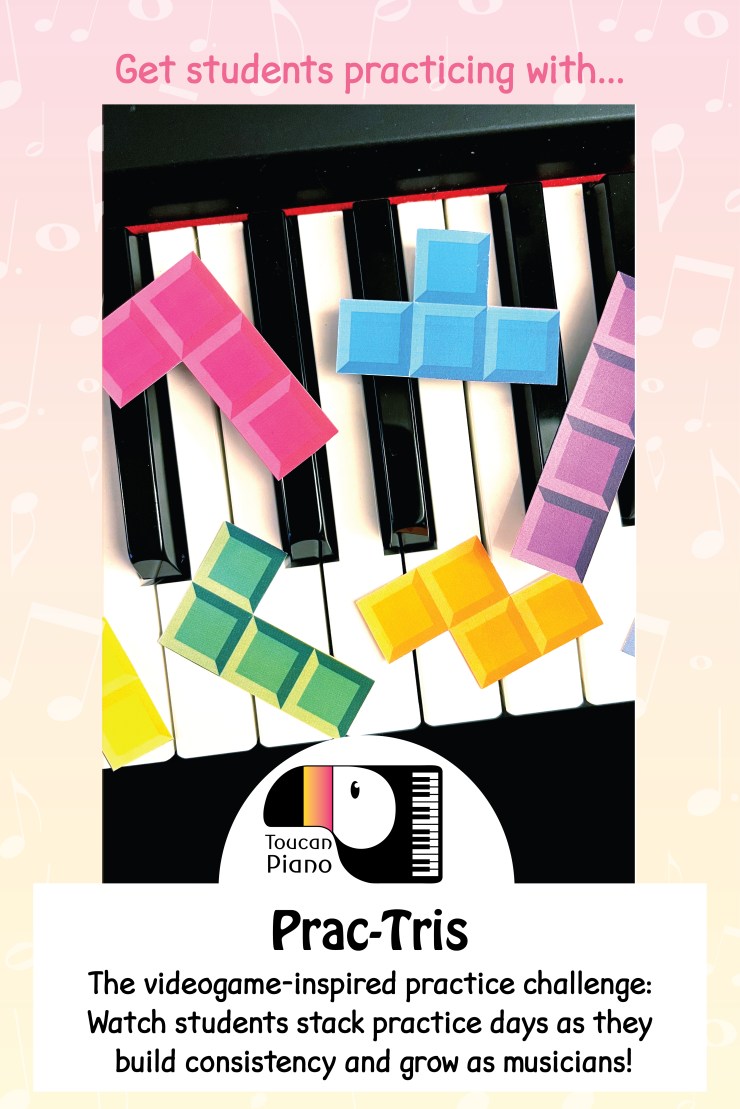
Giant colorful game blocks sit on top of a Prac-Tris poster.

Prac-Tris is available as a free digital download in the Toucan Piano shop.

You can use Prac-Tris as an individual practice challenge with the Prac-Tris printables or as a studio-wide challenge with the Prac-Tris poster and Prac-Tris logs… OR combine them both, like we did, for a true challenge!

Prac-Tris: Individual Practice Challenge

This version of Prac-Tris has students working on completing their own Prac-Tris printable board. For students who enjoy the thrill of a competition, Prac-Tris can be turned into a race to see which student will complete their board first (up to the point where no additional blocks can be placed on the board).

I was surprised to see some students putting in extra practice minutes in order to earn a specific block they needed!

Each student receives a blank Prac-Tris printable board. Each day they practice, they should log the duration of their practice session. When they have finished practicing, they should draw in the block that corresponds to the number of minutes they practiced.

Piano student fills in their Prac-Tris gameboard.

If a student practiced multiple times in a day, they should add up their total practice minutes for the day and draw the corresponding block on their board.

There are two versions of the Prac-Tris printable board in the digital download: the first one has suggested practice minutes and the second one is blank for the teacher to fill in (so the teacher can personalize practice expectations for students of different ages and skill levels).

Prac-Tris: Studio-Wide Challenge

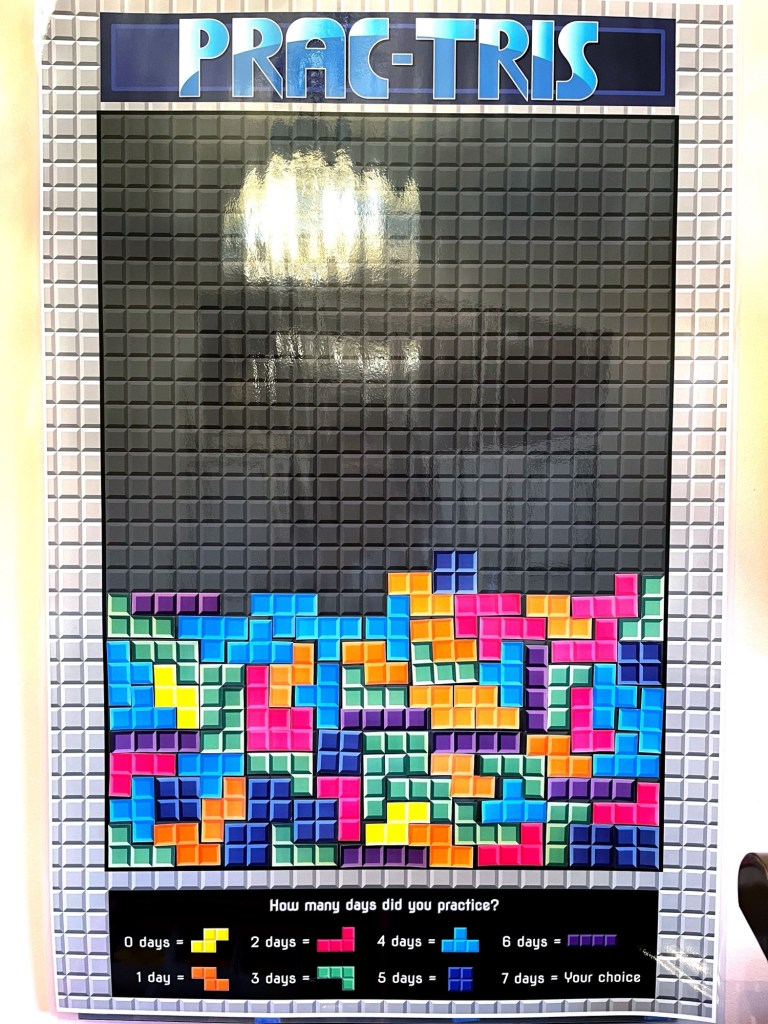
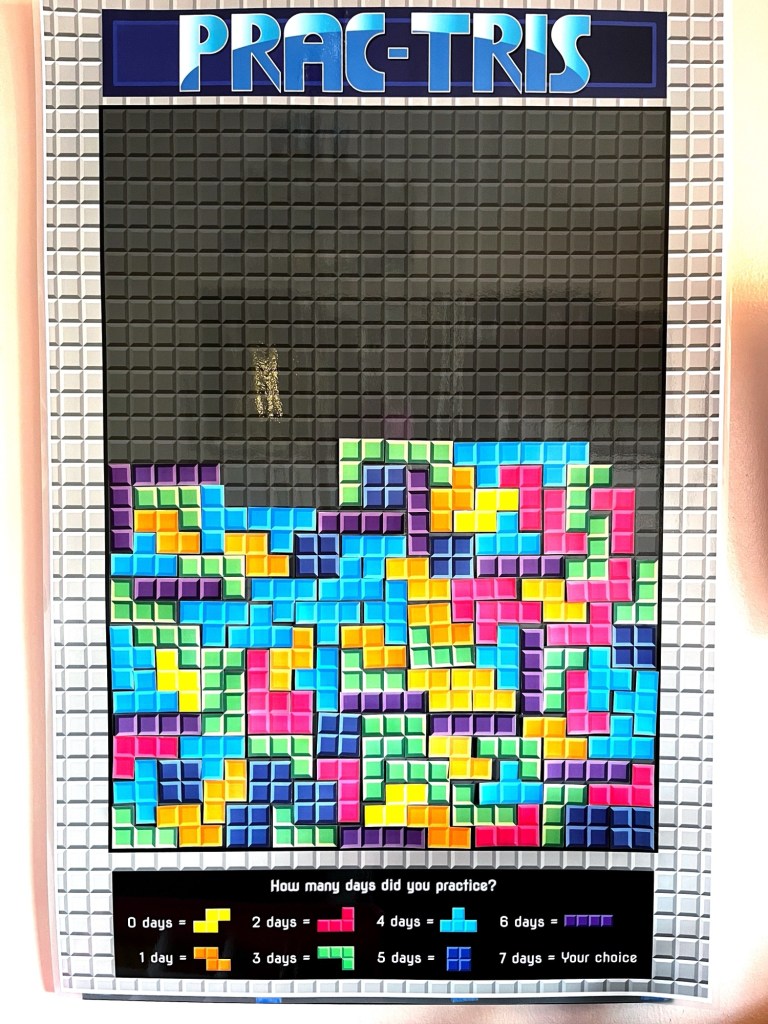
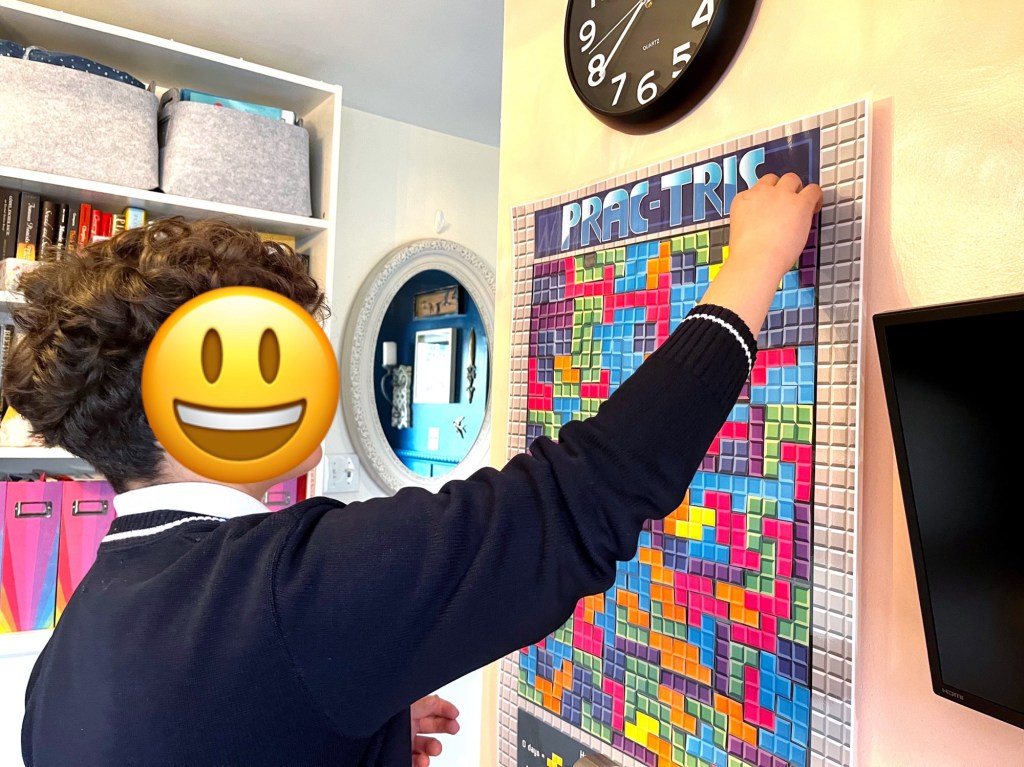
This version of Prac-Tris has students working together to fill the Prac-Tris poster. Each block corresponds to the number of days practiced in a week. Students receive a Prac-Tris log to keep track of their practice days. When they come in for their lesson, they can place their block on the poster. My students were always so excited to see how much the block pile had grown from week to week!

Progress picture 1 of the Prac-Tris poster being filled up by students' practicing.
Progress picture 2 of the Prac-Tris poster being filled up by students' practicing.
Progress picture 3 of the Prac-Tris poster being filled up by students' practicing.
Progress picture 4 of the Prac-Tris poster being filled up by students' practicing.

As an extra incentive, you can reward the students who complete a line on the poster (with, for example, a piece of candy or a favorite activity). This will encourage them to work towards earning a better block or even being able to pick the block they place on the board (instead of leaving it to fate).

I gave any student who practiced 7 days a gold star sticker on their block. Students always wanted to know who had practiced 7 days (and who had practiced zero!).

Piano student places a Prac-Tris game block on the Prac-Tris poster.

If you have a smaller studio, you can block off part of the poster or divide it into milestones. This way students stay engaged for the long haul!

If you have a large studio or a multi-teacher studio, you can divide students into teams and each team can have their own poster. Which team will complete their poster first?!

The digital download includes a 24”x36” printable Prac-Tris poster (I had mine printed and laminated at my local office supply store), printable Prac-Tris logs, and printable blocks. I had my students use a small piece of tape to attach their blocks to the poster.

I had 25 of my students participate in Prac-Tris and it took us about 2 months to complete the poster. And looking back, it was one of my most successful practice challenges to date! My students still talk about it.

Explore more creative teaching ideas
  • Slurs & Ladders: The Recital Prep Game
    If there is one game my students beg to play year after year (and sometimes when we don’t even have a recital anytime soon!) is this recital prep game. It’s a great de-stressor and it shows students how prepared they are to perform while also injecting some fun and joy back into those recital pieces that may be sounding a little tired.
  • Top Practice Tools Every Piano Student should Have: Curiosity
    Curiosity is the catalyst that gets students to start learning the piano in the first place and can be exactly what’s needed to keep them going for the long haul. Why is it so important and how do we keep it going? What if I don’t play an instrument, but want to encourage my child in their practicing? Check out all the answers plus download a free printable for parents!
  • How to Bow at a Piano Recital
    You’ve just finished playing your piano recital pieces and now the audience is clapping, what do you do now??! It’s time to take a bow and enjoy the adulation for all the hard work you put into learning your pieces. Here’s the step-by-step on nailing the perfect piano recital bow!

Let’s stay in touch, join the list!

As a “toucan” of our appreciation download a free set of note flashcards (link in our Welcome email)!

Processing…
Success! You're on the list.

We are a participant in the Amazon Services LLC Associates Program, an affiliate advertising program designed to provide a means for sites to earn advertising fees by advertising and linking to Amazon.com. As an Amazon Associate we earn from qualifying purchases.