Musical Madness

I think as teachers we all wish our students listened to more music, especially piano music. I assign listening homework every now and then and, before Covid, we would do a Composer of the Month (we would spend that month learning about a specific composer’s life, the period he/she lived in, and his/her music). We put “Composer on the Month” on hiatus while we were all virtual because of the logistics of getting the print-outs to everyone (it was a lot of stuff). But since resuming in-person lessons, I’ve found out that the kids really miss it and want to bring it back… and this is where March’s Musical Madness comes in!

I have so many students who love to play basketball so I decided to jump on the March Madness bandwagon and do a little competition of our own. Over the next month and a half we are going to be embarking on weekly showdowns between two great composers of classical music to see who will come out on top and be our first “Composer of the Month” of 2022! We will also have our first piano party since 2019 to celebrate the end of Musical Madness!

I chose to focus on the Romantic composers (because my brain hurt when trying to narrow all of the classical periods down to 8 composers!), more specifically Chopin, Liszt, R. Schumann, Brahms, Felix Mendelssohn, Fanny Mendelssohn Hensel, Dvořák, and Rachmaninoff. Other groups of composers I thought of focusing on were female composers, impressionist composers, and living composers… I feel I will definitely be revisiting these groups in the future for other music appreciation events.

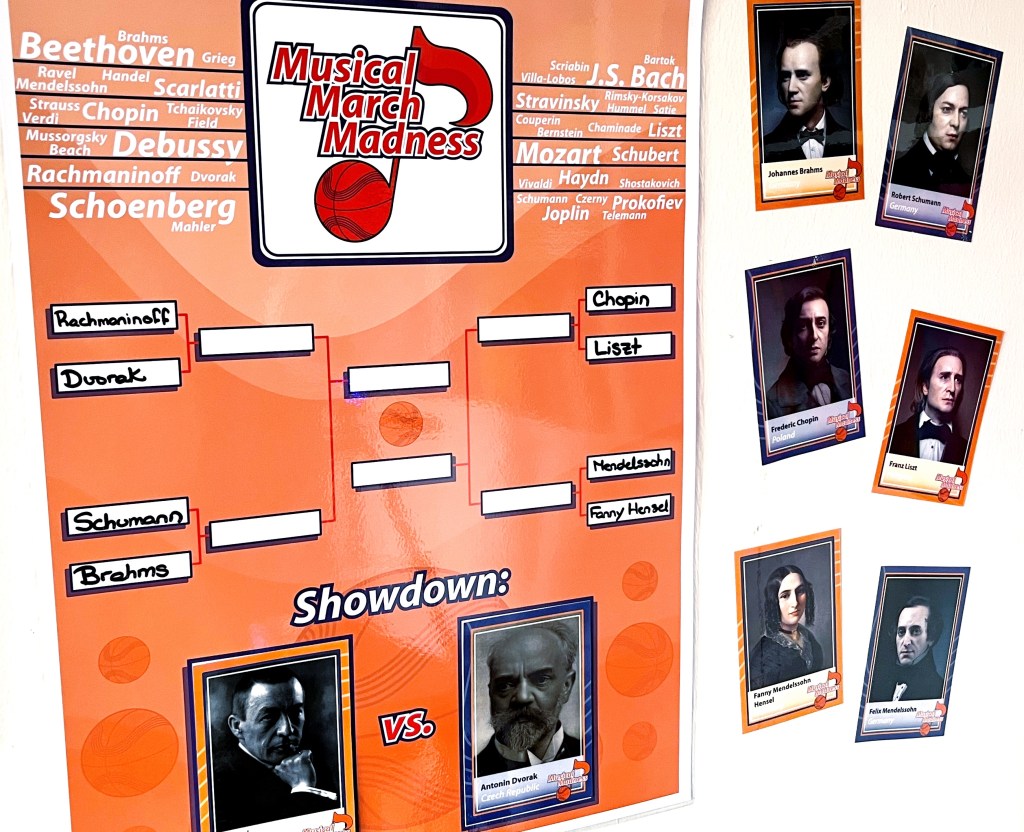
Musical Madness: Romantic Composers. (All composer portraits were found on Google. Some of the portraits are by artist Hadi Karimi. You can check out his amazing series of portraits of classical composers at https://hadikarimi.com/ )

I made a frame for the portraits of the composers I chose so that they would resemble basketball cards (do kids still collect cards??). And then I wrote their names in the brackets of our Musical Madness poster.
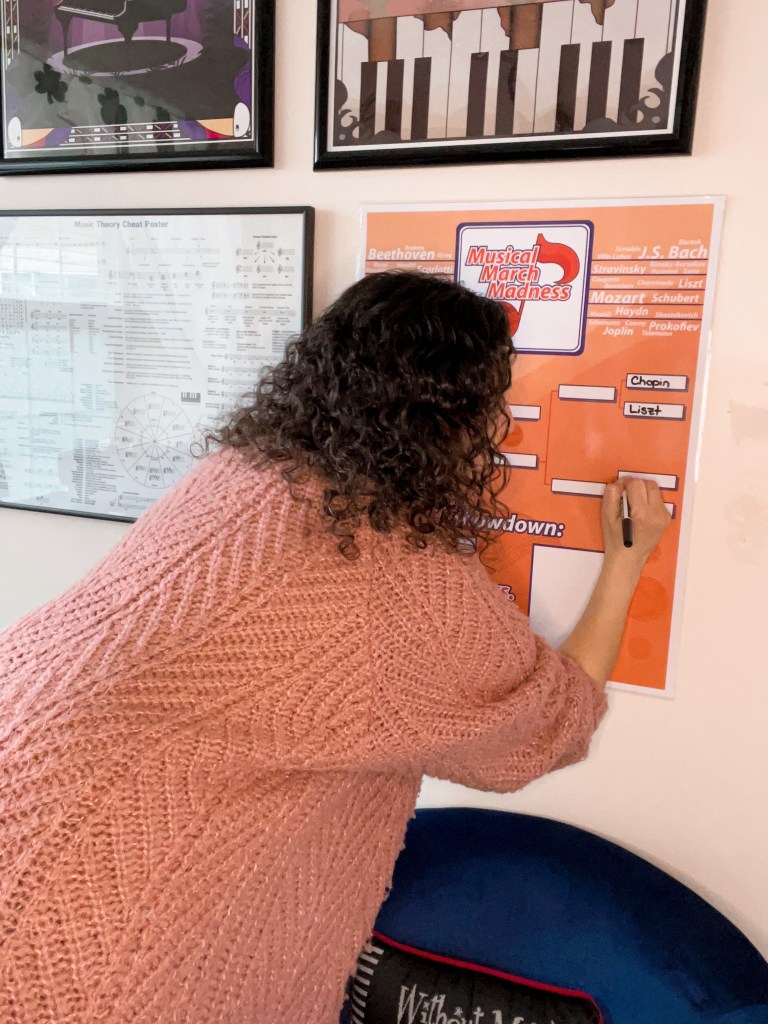
Each week two composers will face off to see who will make it to the next round. At my lessons I will give a quick introduction to that week’s composers to spark my students’ curiosity. Then I will send an email to all my piano families with one piano piece by each of the composers (I try to keep each piece under 5 minutes). My students will listen to the pieces at home and choose their favorite between the two. At their next lesson, they will give their vote to their favorite. The composer with the most votes moves on to the next round and the loser is out. Our first showdown is between Sergei Rachmaninoff and Antonín Dvořák!

I’m just glad I’m not the one voting… this is really hard!

I taped the composer cards to the poster so I can swap them out each week. The composers waiting to jump into the competition are taped to the wall next to the poster. I’m very excited to see which composer will take it all!
If you would like to play your own version on Musical Madness and bring some beautiful music into your students’ homes, the poster and blank composer cards are available in the Toucan Piano Shop. I made three different poster sizes (with cards that fit each size) to best fit your needs: letter size (if you want to print it out for each of your students to have their own copy), 12″ x 18″, and 18″ x 24″. All three sizes come with your purchase. I hope you have as much fun as we are having!

Let’s stay in touch, join the list!

As a “toucan” of our appreciation download a free set of note flashcards (link in our Welcome email)!
Processing…
Success! You're on the list.

I Can Heart-ly Wait for the Punchline!

Valentine’s day is a month-long affair at my studio! As I tell my students, it’s a holiday that celebrates pink, I need to milk it for all it’s worth.

We’ve played a few different note-reading games this month and this one in particular had me giggling long after I had memorized all the punchlines for the jokes. It was so much fun to introduce a lot of my students to music theory jokes. From puns to just plain silly jokes, it was so funny to see the wide range of expressions on their faces when they “got” it (most called them “Dad jokes” but they laughed all the same! Because Dad jokes are hilarious!).

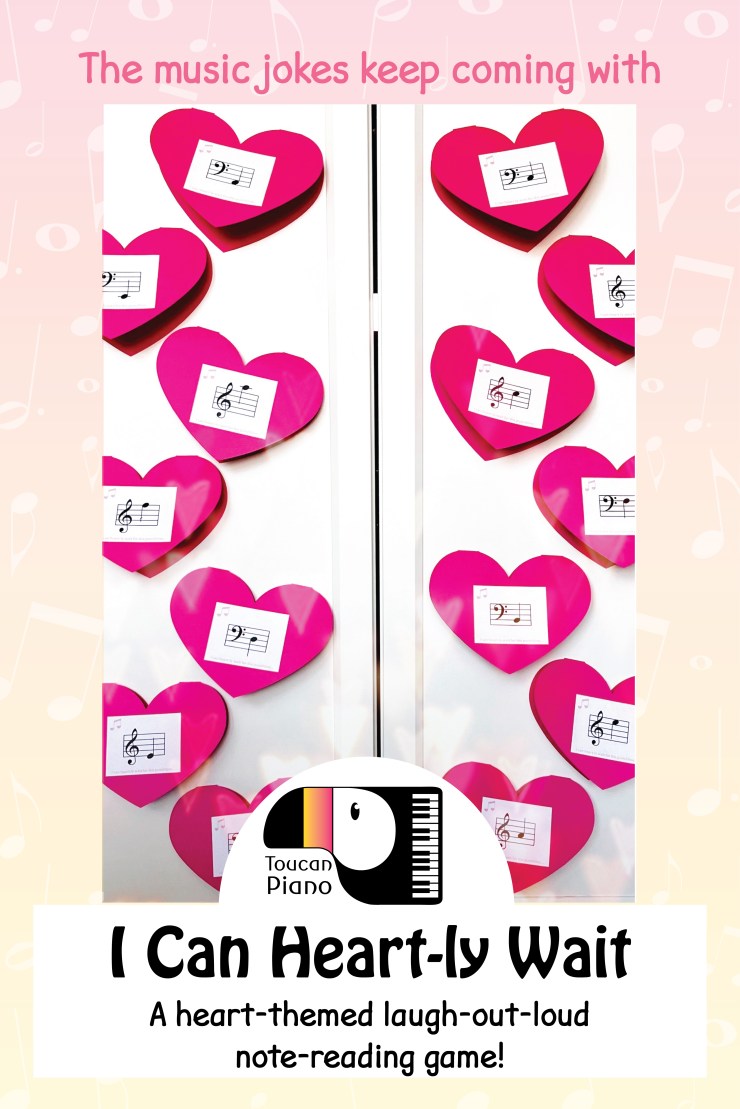
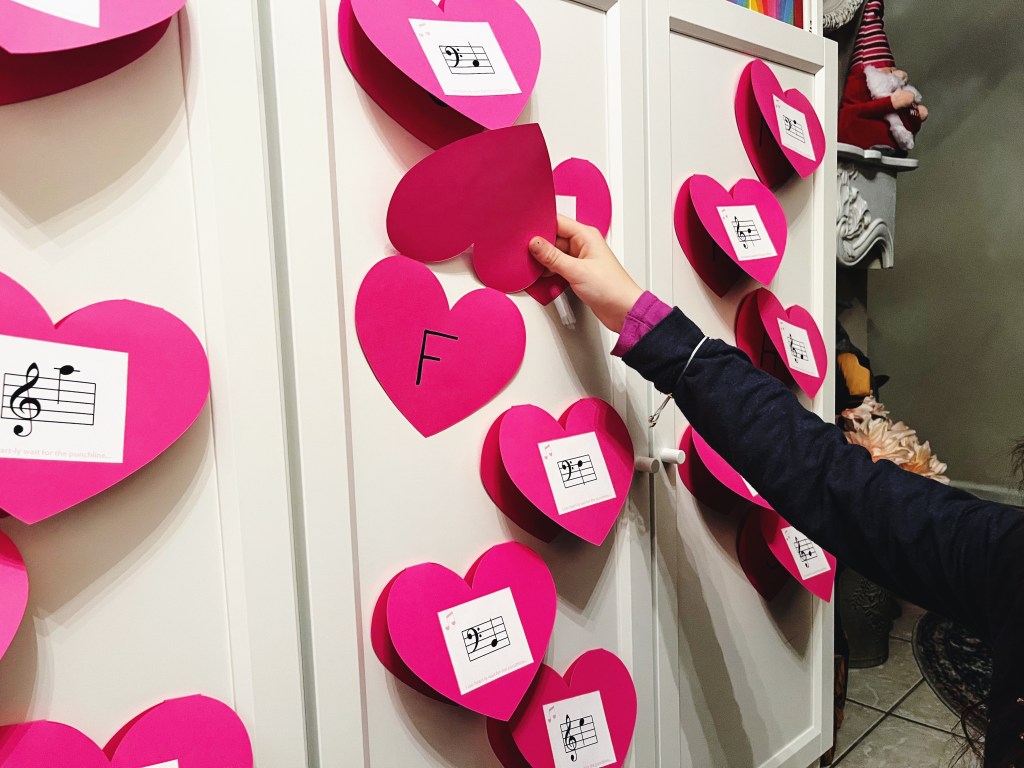
I wanted to go all out with this game so that it would be a decoration for my studio space as well as a game (I’m also sharing an easier way to play it up below). I wanted my student to be curious about it when they walked in. I cut out hearts and folded them in half; on the outside was a note on the staff and on the inside was a letter of the alphabet. Here is a reel I posted of how I made them:

I loved the way it turned out!!

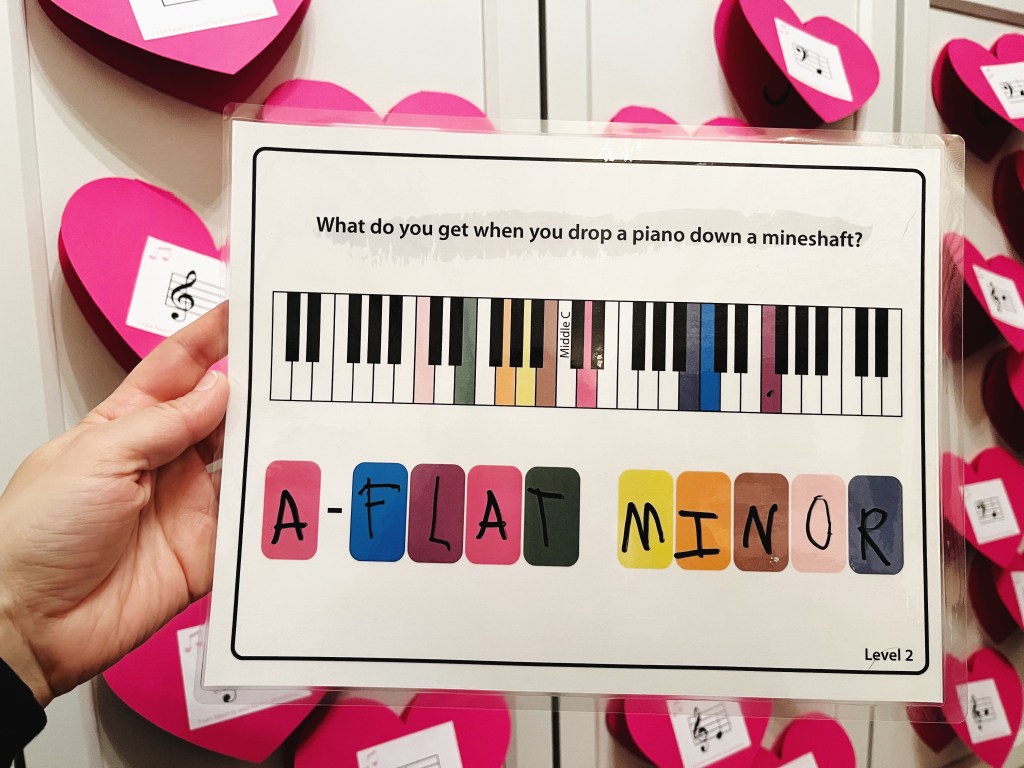
To play, I had my students randomly pick a joke:

I would have them read the setup of the joke and then I’d explain that the punchline is written out as a series of colored rectangles that they have to decode. Each color corresponds to a key on the keyboard picture. We would then pick a color and find the key on the keyboard printout (for example, blue is Middle C). Then they had to find that note on my wall of hearts to reveal the letter that goes in the punchline.

They would then write that letter inside the colored rectangle.

Once all the notes had been found and all the colored rectangles had been filled in, they would tell me their joke!

Here is another reel of me playing this game with a student:

I love this game because not only do students have to think about keyboard geography, they have to be able to associate the notes with their exact location on the piano. A tip I always started with was, “Look at the clef first!” because often they would find the correct line or space but the clef was wrong. They caught on quickly!

I have this game available in my shop: I Can Heart-ly Wait for the Punchline. It comes with 10 jokes for students to decode as well as all the hearts. The hearts are double-sided, one side has the note and the other, the letter of the alphabet, so set-up is much easier. I would love to hear what you think if you decide to play this game with your students! We had a blast!

Let’s stay in touch, join the list!

As a “toucan” of our appreciation download a free set of note flashcards (link in our Welcome email)!

Processing…
Success! You're on the list.

Musical MASH: A Note Reading Game that Predicts the Future

Did you play MASH (Mansion, Apartment, Shack, House) when you were a kid? All it required was a piece of paper and a pencil! My friends and I would spend countless recesses trying to find out if we would marry our crushes, have 20 kids while living in a mansion (we all wanted the mansion, of course) and driving a Ferrari! It was loads of fun and provided a lot of good laughs! If you want to check out the original game, MASH+ has all the details.

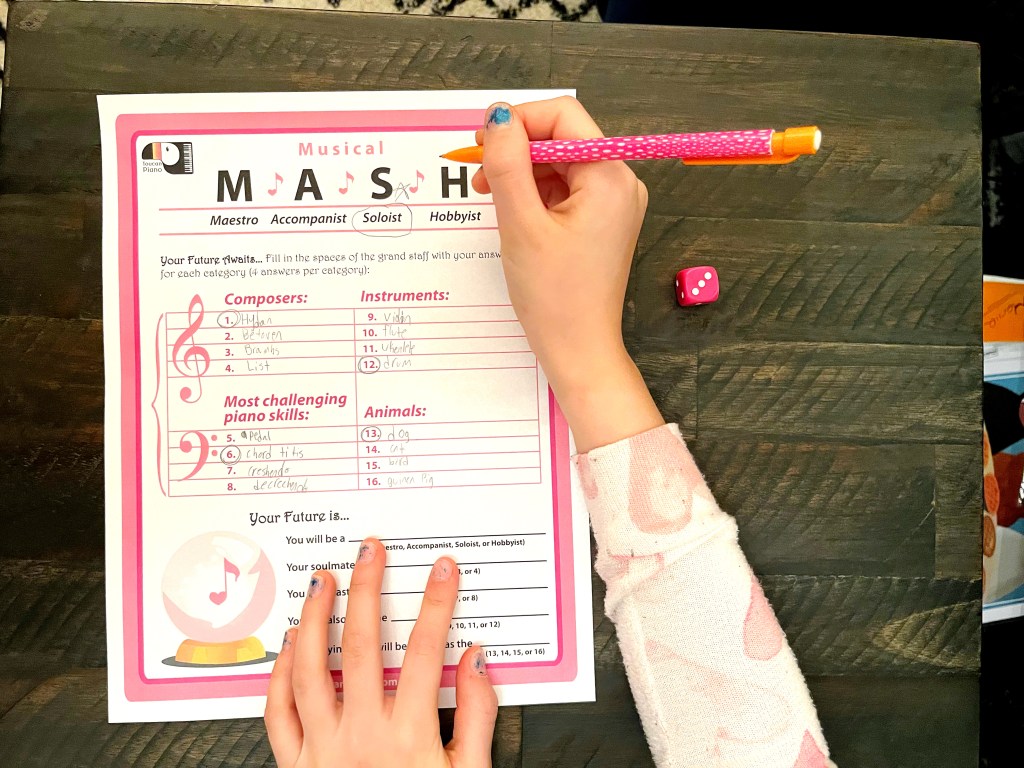
This Valentine’s Day my students and I are playing the musical version of MASH (maestro, accompanist, soloist, hobbyist) that I created! We will be drilling our knowledge of the spaces on the grand staff while figuring out our musical futures!

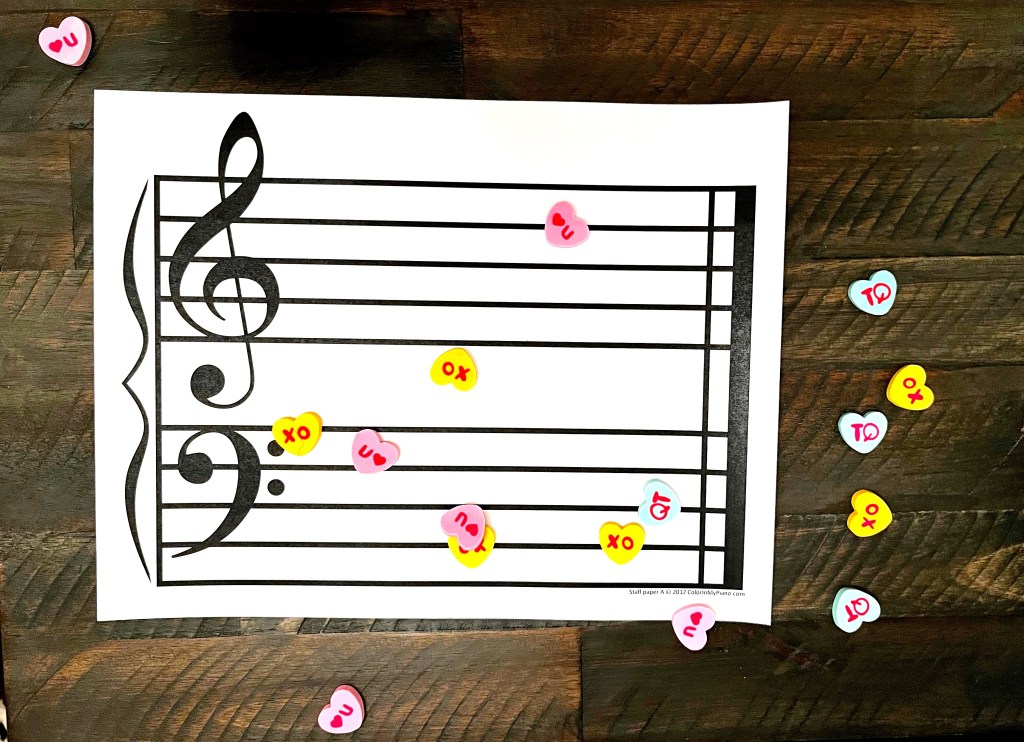
It’s a fast, easy game to play, and has already given us some funny results! I am using a print-out of the grand staff and some mini-erasers in my example here but it could also be played with a floor staff and beanbags or at the piano (see the instructions in the download for details).

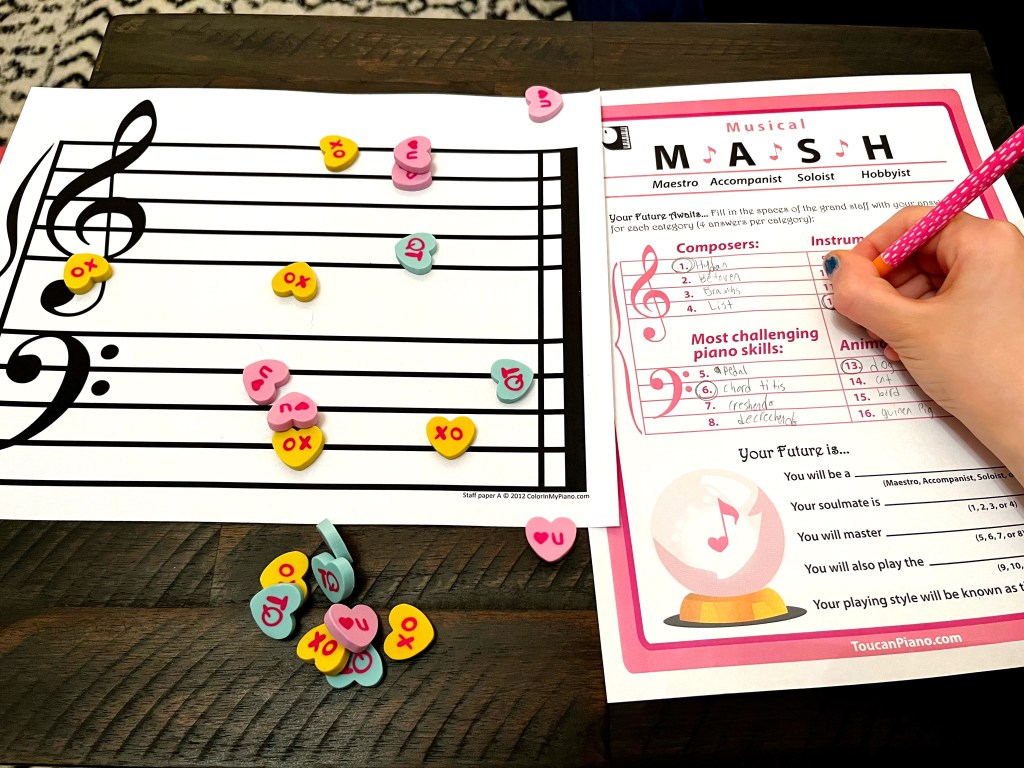
First have the student fill out the four spaces for each category. You can ask them to name the spaces of the grand staff as they write their answers in each space.

Hand them some mini-erasers (I’m using heart shaped ones for Valentine’s Day!). They should close their eyes while dropping the erasers onto the grand staff. They can drop them one by one or a few at a time (the teacher can call out when an eraser has landed on a space).

When they open their eyes they evaluate if any of the erasers landed on the spaces of the grand staff (for added drilling, you can have them name all the lines and spaces that the erasers landed on).

They then take note on the Musical MASH worksheet of where the erasers landed. Repeat the same procedure until the student has obtained an answer in all four categories.

In order to decide if the student will be a Maestro, Accompanist, Soloist, or Hobbyist, you can roll a die (for example, 1 = Maestro, 2 = Accompanist, 3 = Soloist, 4 = Hobbyist, 5/6 = Roll again) or use the traditional MASH spiral method (explained at MASH+). Circle their future career at the top of the page, under the title.

The student should then fill in the blanks at the bottom of the page with the answers to their future!

If you would like to play Musical MASH with your students, download it for free at the new Toucan Piano Shop! I am currently setting up the shop with new products, so if you are interested in staying up-to-date with the latest blogposts and shop updates, join the email list below (no spam, I promise!).

Let’s stay in touch, join the list!

As a “toucan” of our appreciation download a free set of note flashcards (link in our Welcome email)!
Processing…
Success! You're on the list.

I wrote a Book!

I’ve always loved to draw. Growing up, piano and art were my two favorite things to do. Come to think of it, not much has changed since then! I can’t watch TV without a sketchbook in my lap (one, because I love to draw and, two, because if I’m not actively doing something I will usually fall asleep while watching TV! lol). My dream was to write and illustrate my own graphic novel.

I finally did it!!!

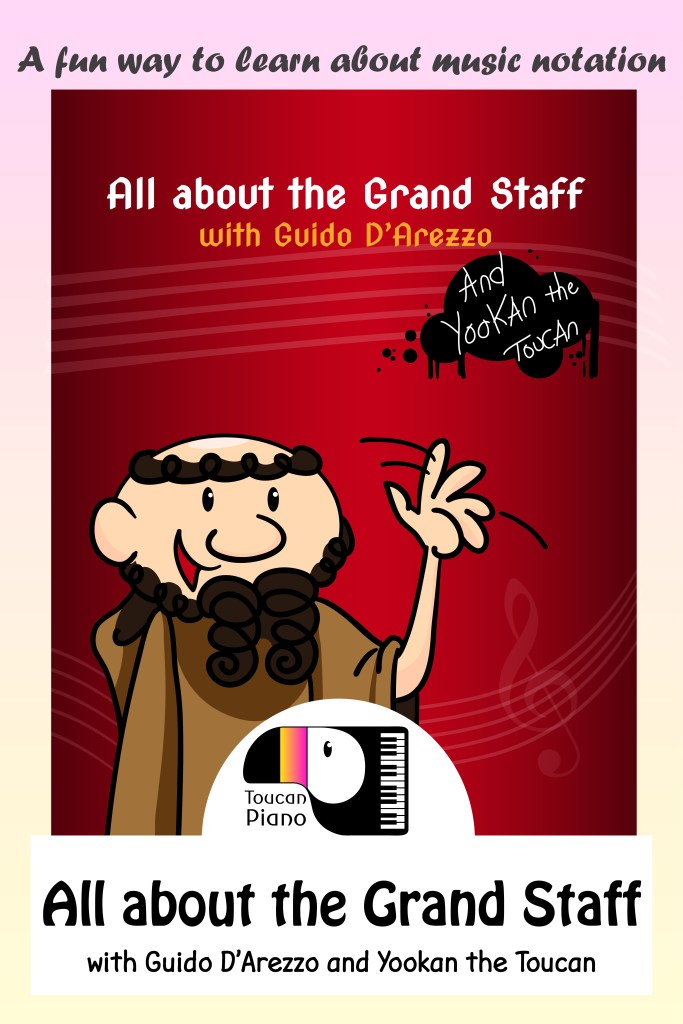
I usually teach the basics of the grand staff over the course of a few weeks to beginner students once they can identify all the keys on the piano and are playing off-staff pieces with ease. I break it up into bite size bits so we can play games to reinforce each new concept. This graphic novel follows the same progression I use to teach my students but with some history (hello, Guido D’Arezzo!), short exercises to reinforce concepts, and a little silliness tossed it (courtesy of Yookan the Toucan).

The story begins when Guido D’Arezzo (pronounced Gwee-doh Dah-ret-so), the medieval Italian monk who invented a system for writing down music, meets Yookan the Toucan. Guido helps Yookan learn about lines and spaces and how the grand staff is actually a map of the piano. Yookan, always the enthusiastic helper, uses Guido’s piano to demonstrate his understanding of each concept (let’s just say, that piano will never be quite the same!). The treble clef and bass clef are introduced along with anchor notes (bass F, middle C, and treble G) and the concept of stepping on the staff.

Interspersed throughout the book at a few key moments are short exercises for students to test their understanding. All answers are provided in the back of the book. These exercises provide natural break points in the story which makes it easy for teachers to assign pages for students to read at home.

It is also a great option for homeschoolers or anyone with an interest in learning the basics of musical notation. The story is presented in a sequential manner, each concept building upon the previous one, so that the reader can learn independently.

To say I’m feeling like a proud mama is an understatement! I loved writing this book and I truly hope that it will help piano students or anyone curious about how musical notation works for the piano. I’m already itching to write another one!

It is available on Amazon in both paperback and Kindle format (if you have Kindle Unlimited, you can read it for free!). Check it out here.

Let’s stay in touch, join the list!

As a “toucan” of our appreciation download a free set of note flashcards (link in our Welcome email)!

Processing…
Success! You're on the list.