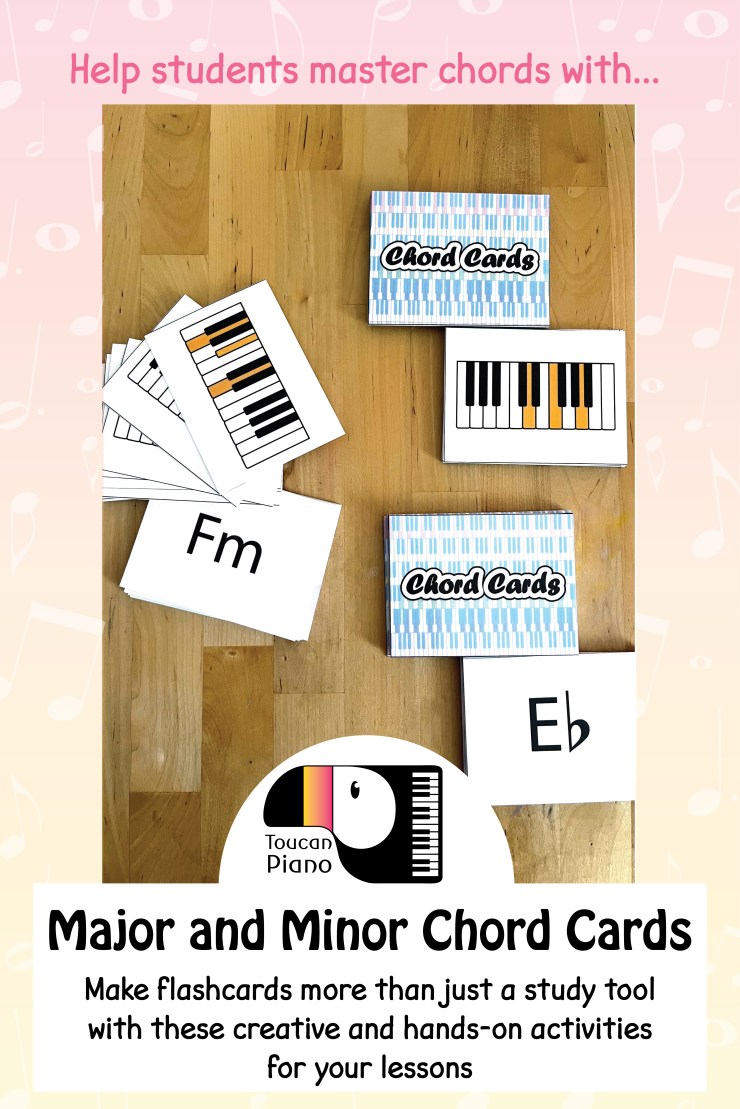
Chord Flashcards – How to Use them with your Students

I’m going to just come out and say it… I love flashcards!

Fingers making the shape of a heart hover over chord flashcards.

Flashcards are often stereotyped as being boring, repetitive, and only useful for basic memorization or geared towards younger kids. Some argue that they don’t suit creative learners or that digital tools have made them outdated. However, flashcards are extremely effective for active recall and the long-term retention of concepts.

And the best part? They have SO many uses! From interactive games and hands-on activities to group challenges, the possibilities are endless!

Sending flashcards home for students to drill (the Toucan Piano double-sided chord cards are a great option for home study!) is a fantastic way to reinforce their learning between lessons. But flashcards aren’t just for independent review — there are countless creative and engaging ways to use them during lesson time, helping students see just how much creative thinking can come from this simple tool!

The Toucan Piano major and minor chord flashcards are available as a free download in the shop here.

  1. Chord Activities
    1. Name that Chord
    2. Build a Chord
    3. Part of the Family
    4. Progressions
    5. Inversions
  2. Chord Games
    1. Chord Match/Memory
    2. Speed Chords
    3. Chord Relay
  3. Let’s stay in touch, join the list!

Chord Activities

Hands-on activities during lessons are a fantastic way to engage students in learning about chords. Taking just a few minutes during a lesson to review chords can reap enormous benefits over time… Students will gain confidence in playing chords, recognizing them in their music, and using them in their own improvisations and compositions.

Name that Chord

Students starting out with chords initially work on feeling the shape of chords, using the correct fingering, and identifying the difference in the sound produced by a major or minor chord.

Using the keyboard chord cards, draw a card from the deck. Have the student find the keys on the piano that match the card (start with either the right hand or the left hand). Have the student play the chord and then try to name it.

Taking it one step further, can the student then transform that chord into its major or minor version?

Chord cards sit on the piano while a piano students play a B minor chord.

Build a Chord

Another beginner activity, this has students trying to build the chord from its symbol.

Using the chord symbol cards, draw a card from the deck and have the student place mini-erasers or gems on the keys that constitute that chord.

Chord cards sit on the piano while a piano students uses gems to mark the keys that make up the chord of E flat major.

Part of the Family

Understanding which chords belong to a particular key family is an essential skill for coming up with chord progressions, improvising, and recognizing the harmonic progression in a piece.

Using the chord symbol cards, draw a card from the deck. The chord on the card is the “One” chord (I or i in Roman Numerals). Have the student write out the IV and V chords of the key.
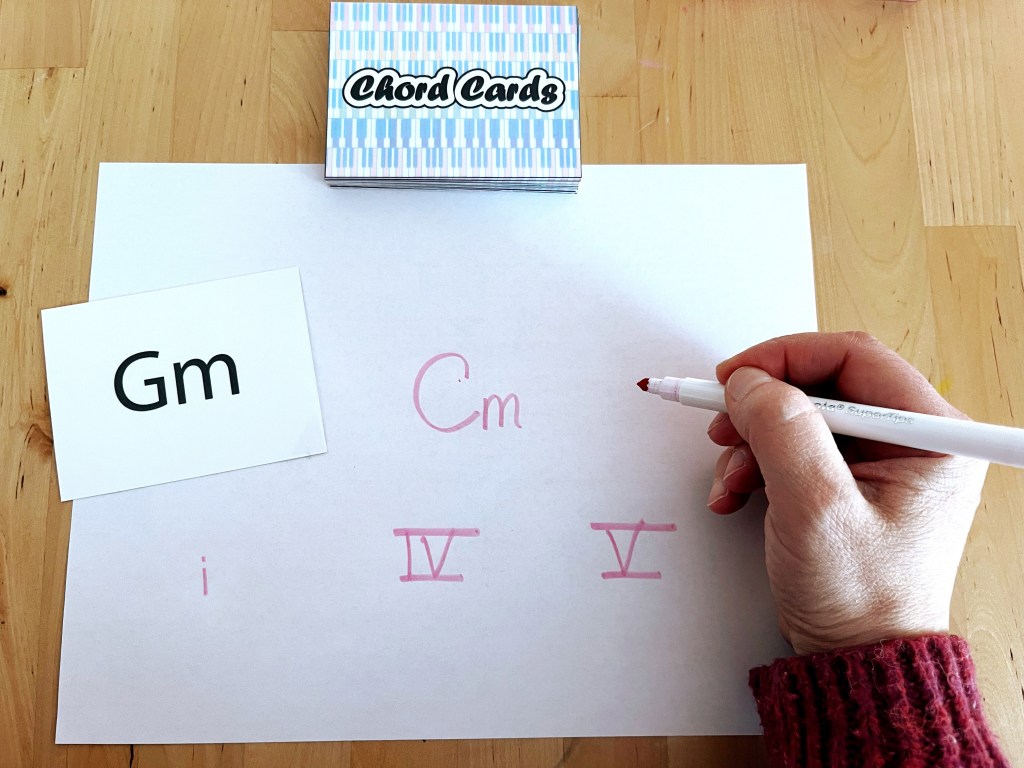
A piano student writes out the four and five chords in the key of G minor. A deck of chord cards sits on the table above the paper.

Progressions

Once students have a solid understanding of key families, they can experiment with building different chord progressions.

For added fun, have them also experiment with chords outside the key. Ask the student how that chord affects the progression? What sort of emotion or mood does it introduce? If you were to continue the chord progression from the new chord, which chord would make sense to use next?

Chord cards are placed on the piano. They outline a chord progression. The piano student is playing the progression, starting with the D major chord.

Inversions

Moving between chords is another essential skill for playing chords smoothly and with ease. Jumping from a root position chord to another can result in a large leap on the piano, which can be technically challenging for a student to manage. Additionally, these large jumps can create abrupt shifts in the sounds which, depending on the music, can negatively affect the overall mood.

Pick a chord progression. Have the student write out the chords. The student should then analyze the chords (what pitches do they have in common? Are any of the pitches neighbors?, etc.). From their observations, rewrite the chords in different inversions and play the chord progression. Experiment with different inversions. Which was easier to play? How did the inversions sound with the melody (if using a chord progression from a lead sheet)?

Thinking about inversions in this sense, turns the activity into a puzzle with multiple solutions!
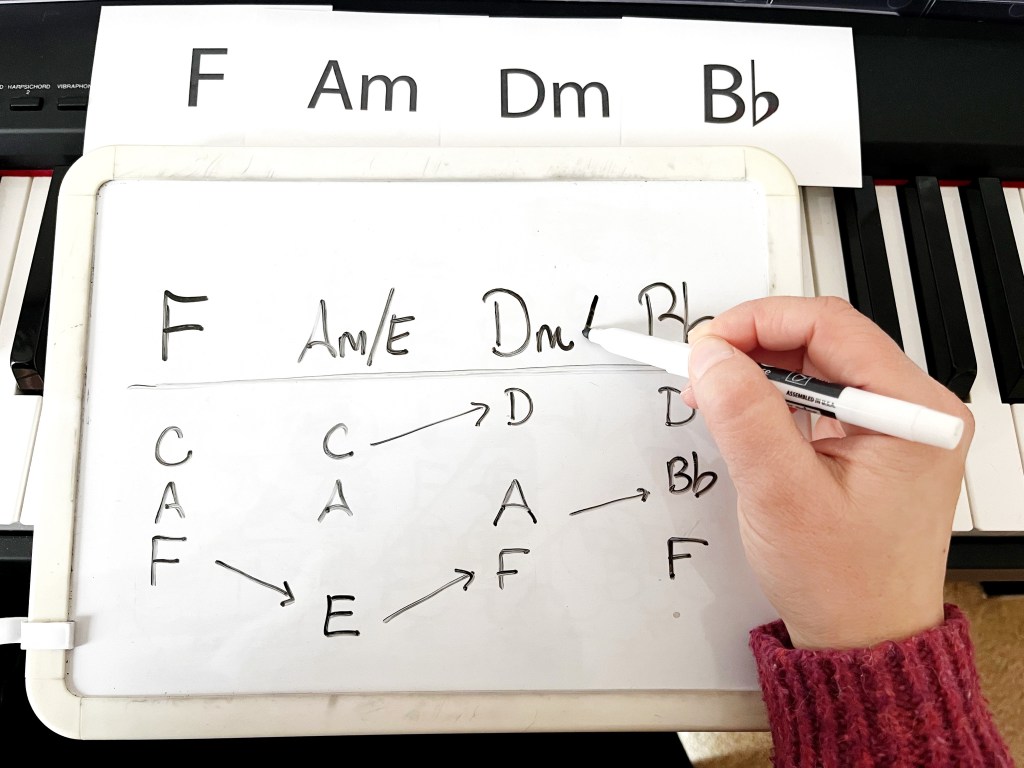
A chord progression is laid out on the piano. A piano student uses a whiteboard and dry erase marker to write out the chords and identify the best inversions to use for the chords.

Chord Games

Kids love games and they are a great way to test their knowledge! Here a few games that can be played with things you probably already have in your studion!

Chord Match/Memory

Using the keyboard chord cards and the chord symbols cards, select matching chords from each deck that the student is working on (for example, the C minor keyboard card and the C minor symbol card).
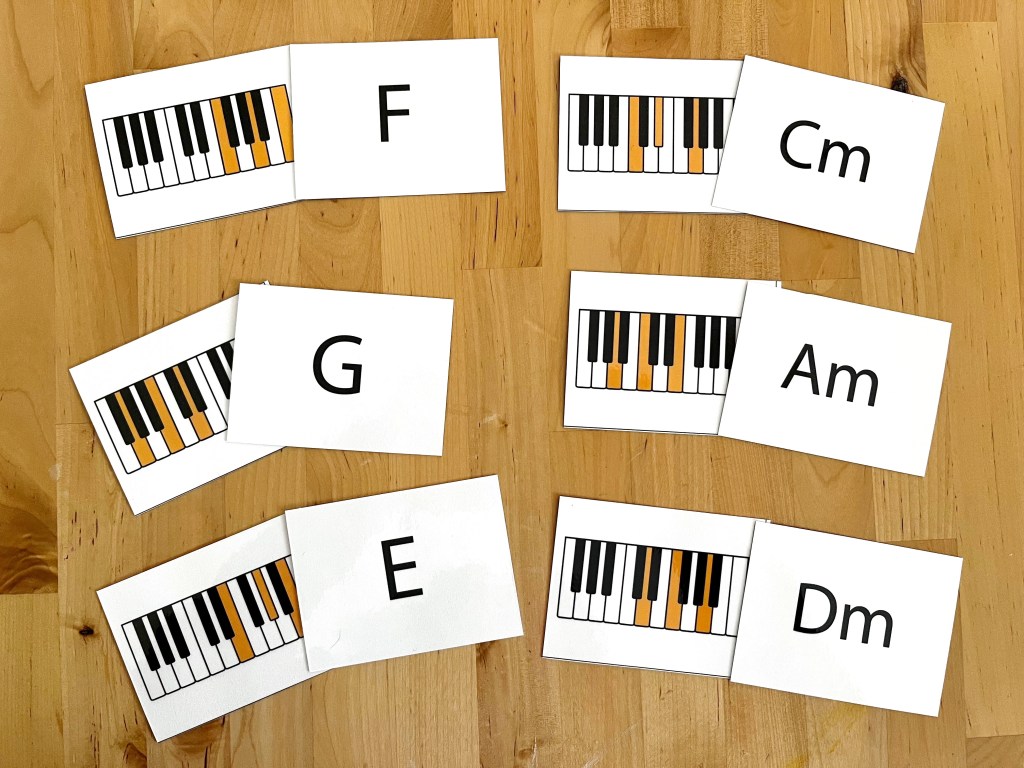
Chord flashcards are paired up on a table. The chord symbol matching the highlighted keys on the keyboard cards.

Lay them face down on a table. Play a game of Memory, where players take turns flipping over two cards, trying to make a match.
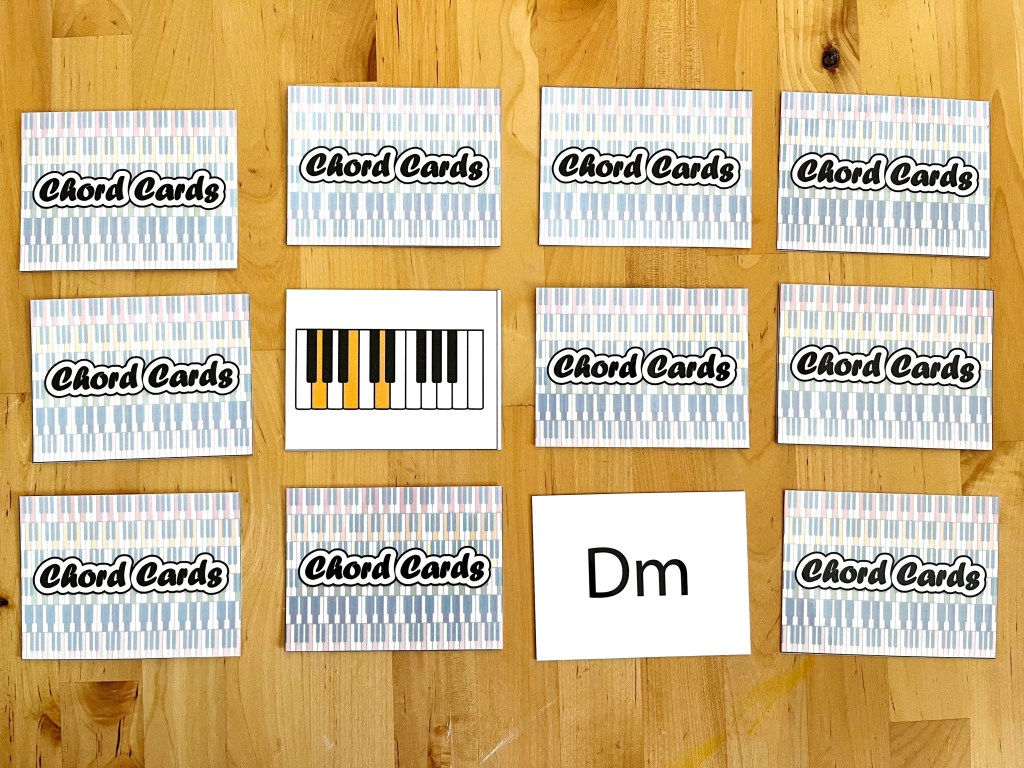
Two cards in a game of Memory are flipped over but do not match.

Whoever has the most matches at the end of the game, wins!

Speed Chords

This game uses the chord cards, a stopwatch, dry erase board and marker, and mini-erasers.

Player 1 draws a chord card while Player 2 controls the stopwatch. As soon as the Player 1 flips over the card, Player 2 should start the stopwatch.
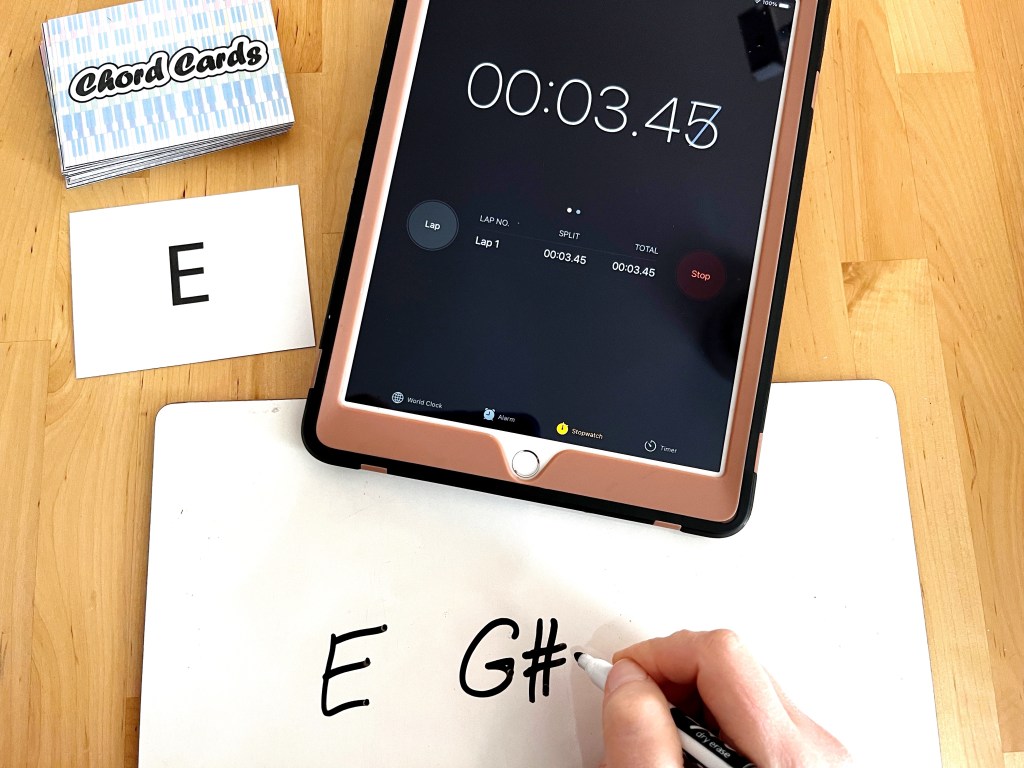
A piano student quickly writes down the notes of an E major chord as a stopwatch times them to see how long it takes.

Player 1 must write out the chord on the dry erase board as quickly as possible. When Player 1 says, “Done!” Player 2 should stop the stopwatch. Player 2 checks Player 1’s work. If the chord is correct, Player 2 tells Player 1 how long it took for them to write the chord. The number of seconds is how many mini-erasers Player 1 must stack. For example, if it took Player 1 five seconds to write out the chord, they should stack 5 mini-erasers.

A piano student stacks mini-erasers after completing an E major chord in 6 seconds.

If the chord is incorrect, Player 2 unpauses the stopwatch and Player 1 must try again!

When Player 1 has stacked their mini-erasers it is then Player 2’s turn and the above procedure is repeated for Player 2 (with Player 1 now being in charge of the stopwatch). Play continues back and forth, with players adding more mini-erasers to their towers each round.

Players should work fast because whoever’s tower falls over first loses!

Chord Relay

This is a fun group game! All you need are the chord cards, two dry erase boards, and two dry-erase markers.

Divide the group into two teams and have them sit in two lines. Give each team their own set of dry-erase board and marker.

The first player of each line should have the board and marker. The teacher hands a chord card to the first player of each team and says, “Go!” The two players must write down the pitches that make up their chord as quickly as possible.

When they have finished, they should pass the dry erase board and marker to the next player in line. The teacher should then give the second player a new chord card.

Play continues down the line until all the players from one team have had a turn. The teacher then checks their work. If all their chords are correct, they win the round. If not, the other team has a chance to finish up. When they are done, the teacher will check their work. If all of their chords are correct, they win. If not, the team with the fewest mistakes is the winner.

Explore more creative teaching ideas
  • Three-Chord Dash
    Boost your students’ chord skills with this fun, fast-paced game! In Three Chord Dash, students race to build their chords quickly and accurately. Who will be the fastest?! On your mark, get set, go!
  • Chord Snowblast
    Build chords and collect points while trying to avoid the snow blast! Kids will test their knowledge of building chords AND they will actually be hoping to get all the chords with sharps and flats!!

Let’s stay in touch, join the list!

As a “toucan” of our appreciation download a free set of note flashcards (link in our Welcome email)!

Processing…
Success! You're on the list.

We are a participant in the Amazon Services LLC Associates Program, an affiliate advertising program designed to provide a means for sites to earn advertising fees by advertising and linking to Amazon.com. As an Amazon Associate we earn from qualifying purchases.

Three Chord Dash – A Chord Building Game

At our last group lesson, we worked on our chord building skills! Some students were learning chords for the first time while others already had experience playing chords in their music. Three Chord Dash offered an even playing field for everyone and it was a blast to see them try to be the first to collect all of the pitches.

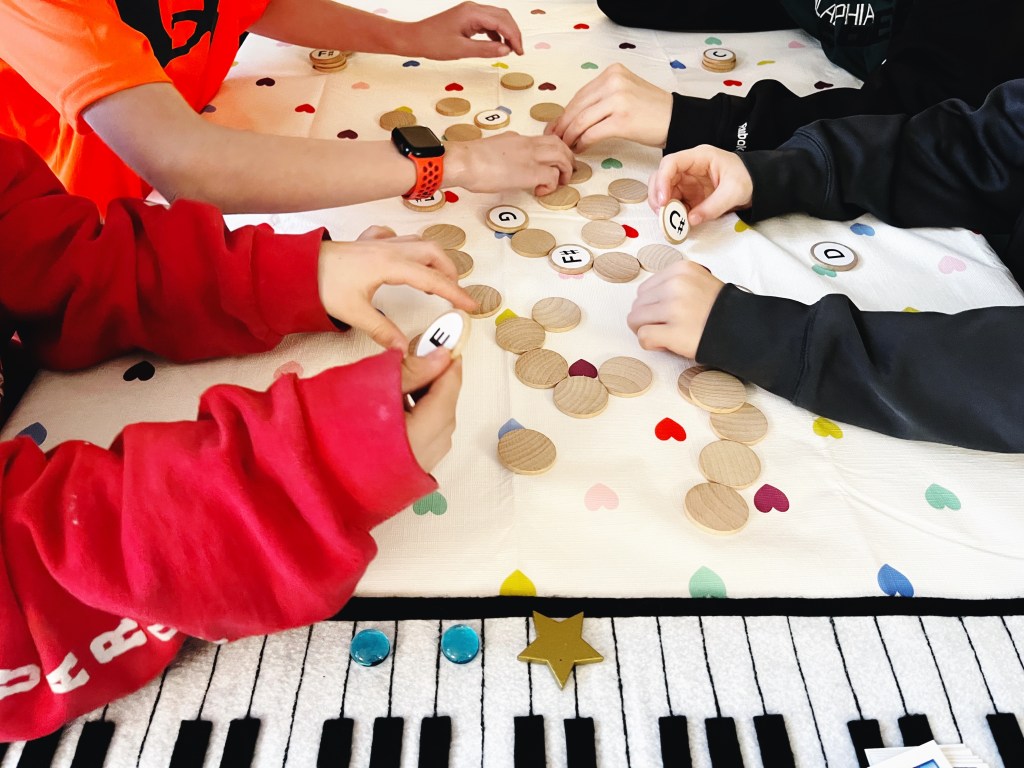
Piano students race to complete their chord by flipping over wooden circles with pitch names on them.
  1. To play, you will need
  2. Game Set-up
  3. How to Play
  4. Make it harder!
  5. How to Make the Wooden Circles with Pitch Names
  6. Let’s stay in touch, join the list!

Three Chord Dash is a versatile, fast-paced chord building game to help your students memorize the pitches that make up a given chord. It can be used in both private lessons or group lessons by students of all skill-levels (because it’s always a good idea to drill chords!). Students can be tested on any type of chord and/or inversion.

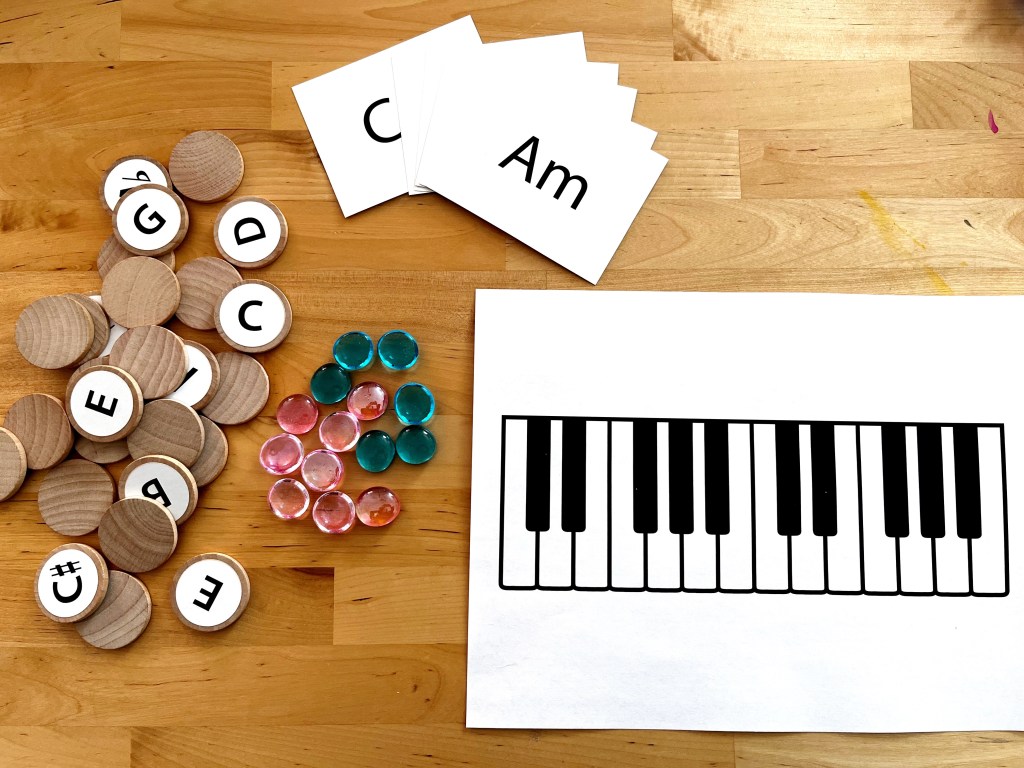
To play, you will need

  • Chord flashcards (I used mine, available in the Toucan Piano Shop for download). Alternatively, you can simply call out the chords you would like to drill or use an app like Decide Now! (Check out my blogpost on how to use the Decide Now! app)
  • Pitches on wooden circles
  • Keyboard print out (one for each player or team) – A great option are these dry erase keyboard/staff sheets (they are made from a cardstock-like material. They are double-sided, which make them great for a wide variety of tabletop games).
  • Mini-erasers, gems, or any other gamemarker (3 per player or 3 per team)
Supplies for a chord games are laid out on a table. The supplies include chord cards, a keyboard printout, wooden circles with pitches printed on them, and blue and pink gems.

If you’d like to see how I prepared the materials for the game, jump down here.

Game Set-up

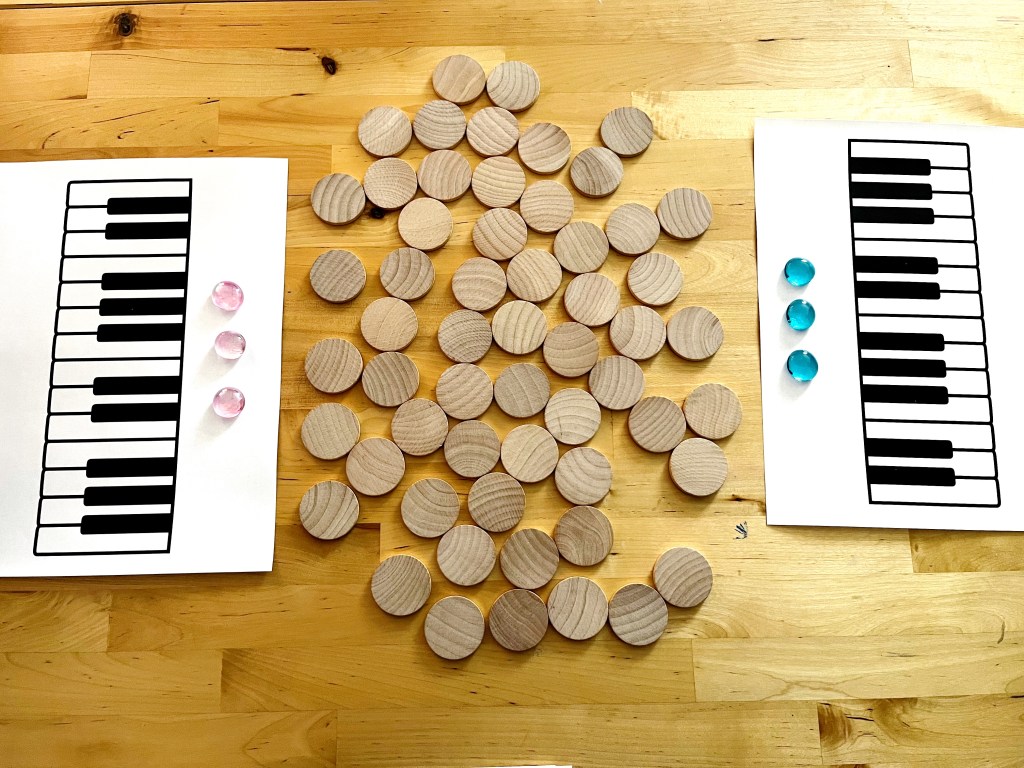
Give each player or team a keyboard print out and 3 gamemarkers (mini-erasers, gems, etc.).

The wooden circles should be placed in the center of the table, pitch side down. Scramble the wooden circles.

Three Chord Dash, a chord game, is set up on a table. Each team has a keyboard printout with 3 gems lined up along the top of the printout. Wooden circles are arranged at the center of the table between the two printables.

Shuffle the chord flashcards and place them to the side.

How to Play

The game will be explained for two players. To play with a group, each action explained below should be performed by the group working together.

The teacher flips over the top card of the chord flashcard pile.

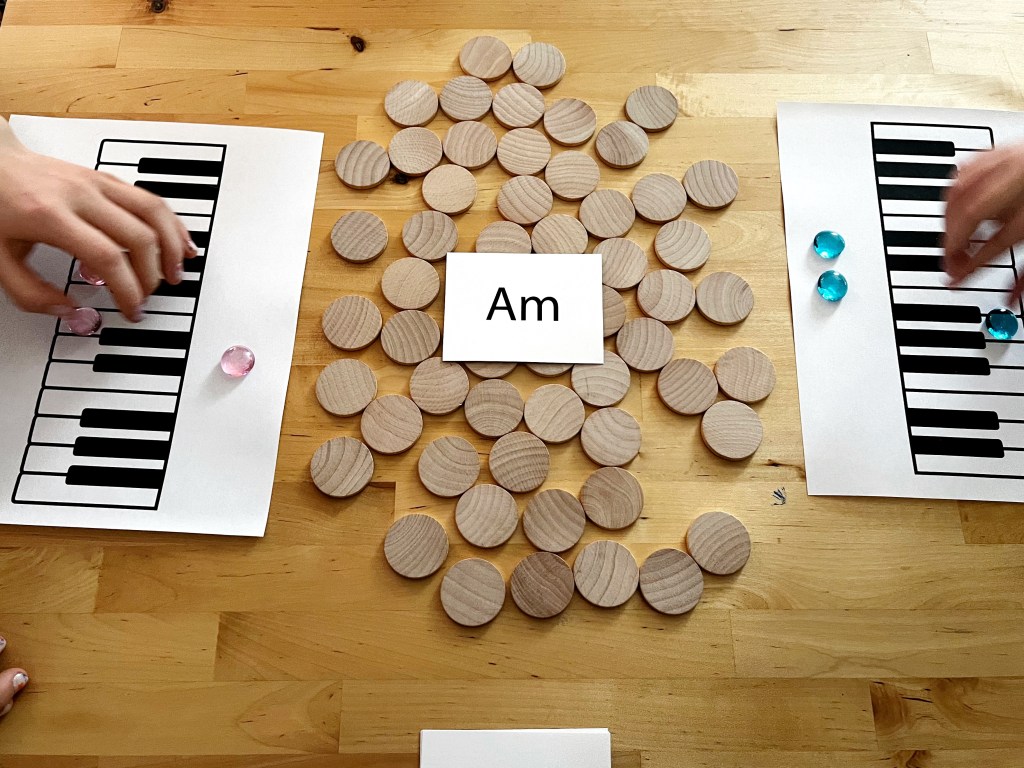
Players analyze the chord. Using the keyboard printable, players place a gamemarker on the each keys that makes up the chord. The teacher verifies their work and makes any corrections necessary.

Piano students place their gamemarkers on their keyboards to create an A minor chord.

It is now a race! Players simultaneously flip over the wooden circles to try to find the pitches they need to complete the chord. When a pitch is found, they place the circle in front of them and continue searching for the remaining pitches.

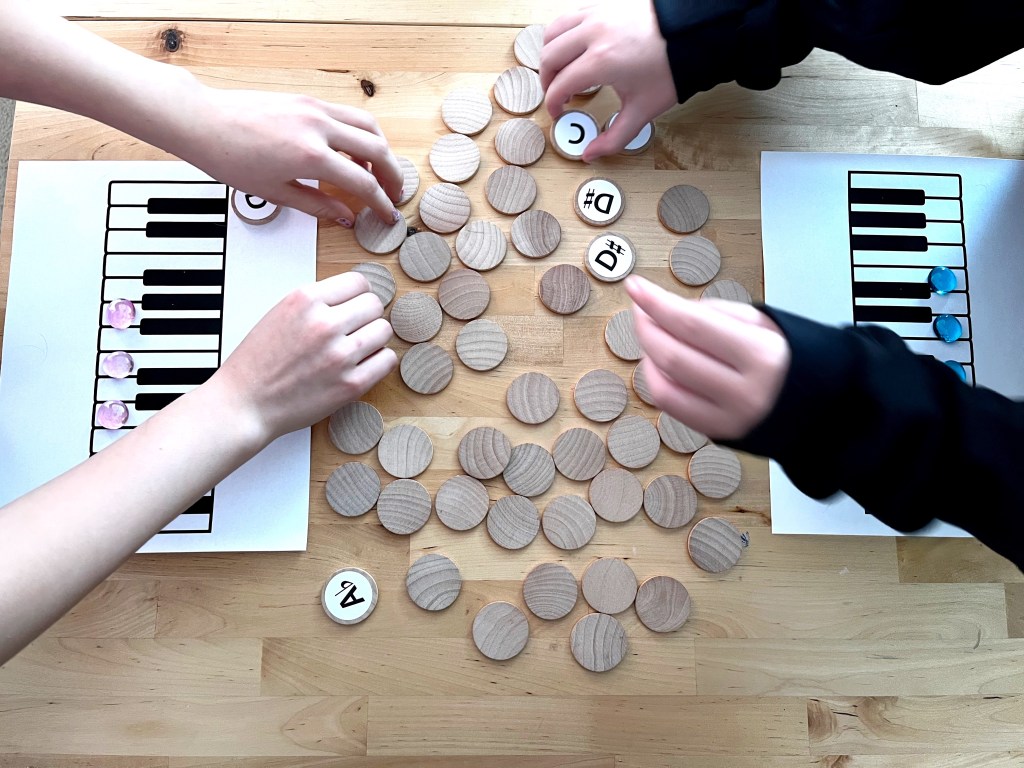
Players quickly turn over the wooden circles at the center of the table to reveal the pitches and attempt to find an A, a C, and an E.

The first player to complete the chord wins the round. The player who completes three chords first is the winner of the game!

The player on the left has completed their chord first.

Make it harder!

If your students are very familiar with chords, you can play Three Chord Dash without the keyboard printable and gamemarkers.

Simply flip over a chord card and start the race! Whoever successfully finds the correct pitches and lines them up properly wins the round.

Take it a step further and have students build the chords in a different inversion each round!

How to Make the Wooden Circles with Pitch Names

Kids love manipulatives and I use the wooden circles over and over again for a variety of games and activities at my studio. And they are very durable! Which is important in fast-paced games like Three Chord Dash since kids are frantically grabbing at them and flipping them over.

I purchased these 1.5″ wood coins in bulk (since I needed to create more than one of each pitch).

There are many different ways to the make the pitch circles. The simplest and quickest way is to use a permament marker and write the names of the pitches directly on the wood coins.

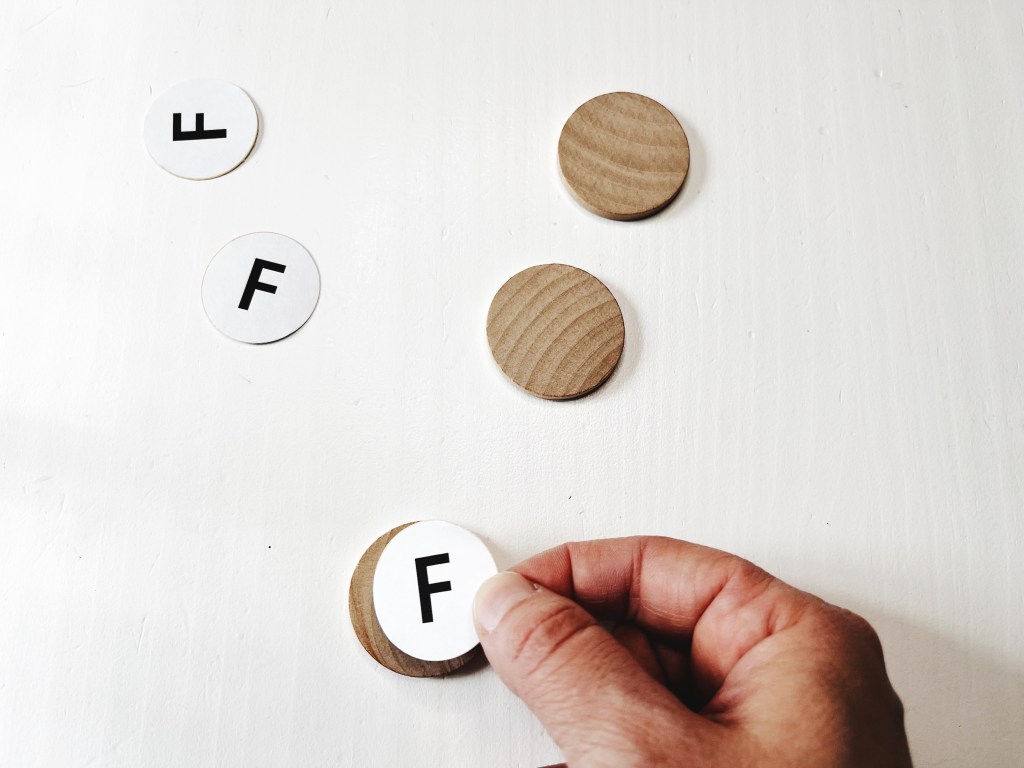
If you would prefer to have the pitches be printed, I used 2″x4″ Avery Shipping Labels. Three pitch names fit on each label (I used Adobe Illustrator to make the circles and align everything, but Avery has a template you can download from their website which would work just as well, minus the circles).

Cut out the individual labels.

Music pitches printed on label paper.

I then used a 1.25″ circle punch (I’ve used this brand in a different size) to cut out the individual pitches.

A 1.25 inch circle punch cuts out the pitches on the labels.

Since the labels are stickers, you can then remove the backing and stick them onto the wood coins.

The label with the pitch name is glued to a wood coin.

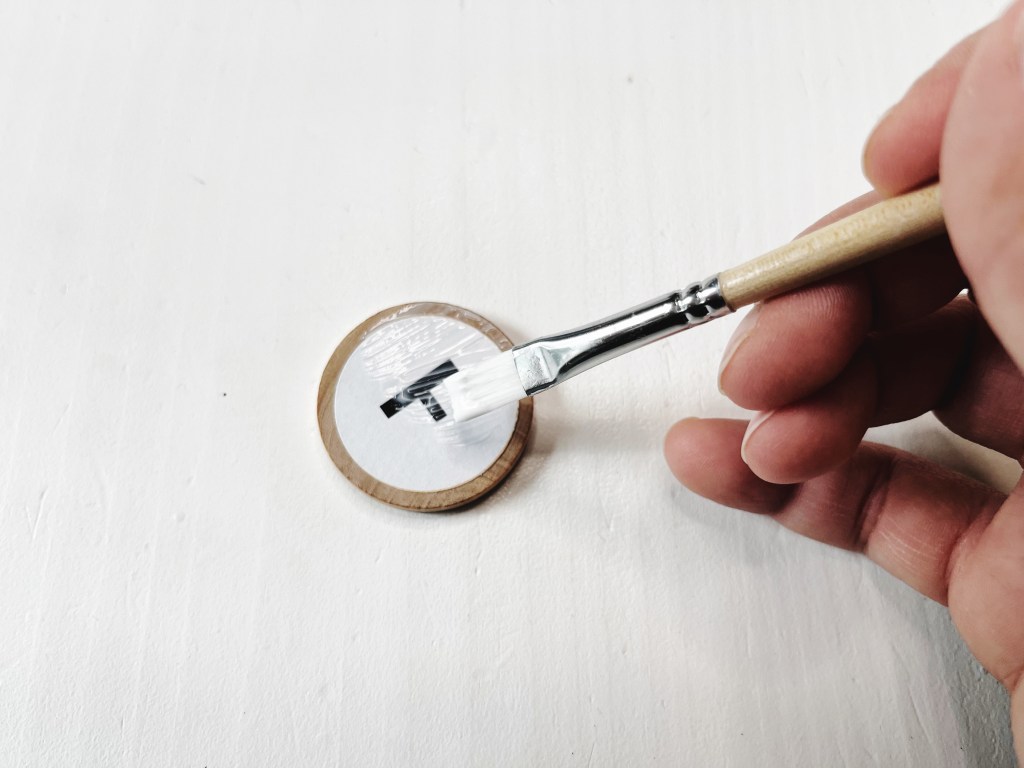
For added protection, I applied a layer of sealant (Mod Podge) over the sticker.

The top of the wood coin and label is sealed with Mod Podge.

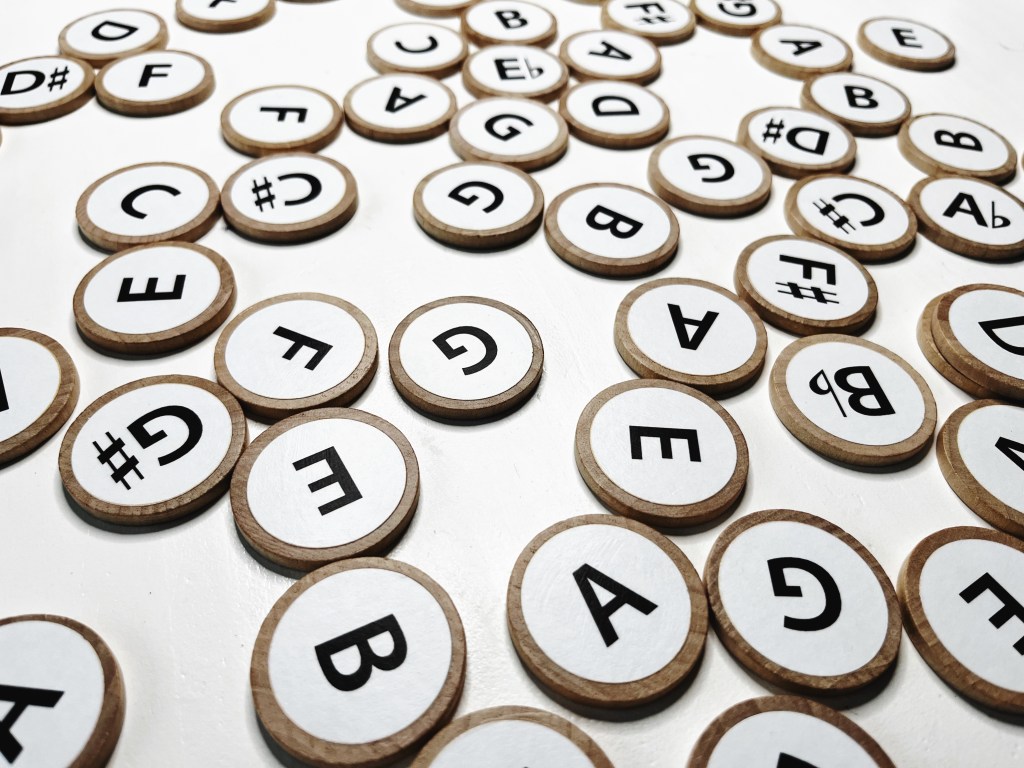
Make as many as you need!!

Wood coins with music pitches printed on them are arranged on a white table.

Explore more creative teaching ideas
  • Chords Cards – How to Use them with your Students
    I love flashcards!  They are extremely effective for active recall and the long-term retention of concepts. And the best part? They have SO many uses! From interactive games and hands-on activities to group challenges, the possibilities are endless!
  • Best in Pass
    Note-reading and fine motor skills combined! Students will race to be the first to match the letter ping-pong balls to the notes on their spoons. But there’s a twist! They cannot touch the balls with their hands.
  • Snowball Rhythm Game
    Who will be able to make the longest rhythm train before the dreaded “Busted!” stick is revealed?! Kids will practice their rhythms while also practicing their aim in this fun toss game.
  • Chord Snowblast
    Build chords and collect points while trying to avoid the snow blast! Kids will test their knowledge of building chords AND they will actually be hoping to get all the sharps and flats chords!!
  • Two Sides of the Same Coin
    A game about enharmonics that can be played in several different ways! Students will try to collect the most enharmonic pairs and hope that their coins don’t get stolen by another player.

Let’s stay in touch, join the list!

As a “toucan” of our appreciation download a free set of note flashcards (link in our Welcome email)!

Processing…
Success! You're on the list.

We are a participant in the Amazon Services LLC Associates Program, an affiliate advertising program designed to provide a means for sites to earn advertising fees by advertising and linking to Amazon.com. As an Amazon Associate we earn from qualifying purchases.
Eyes on the Music! Fun and Effective Strategies to Stop Students from Looking at Their Hands

Do your students constantly look down at their hands when their playing?

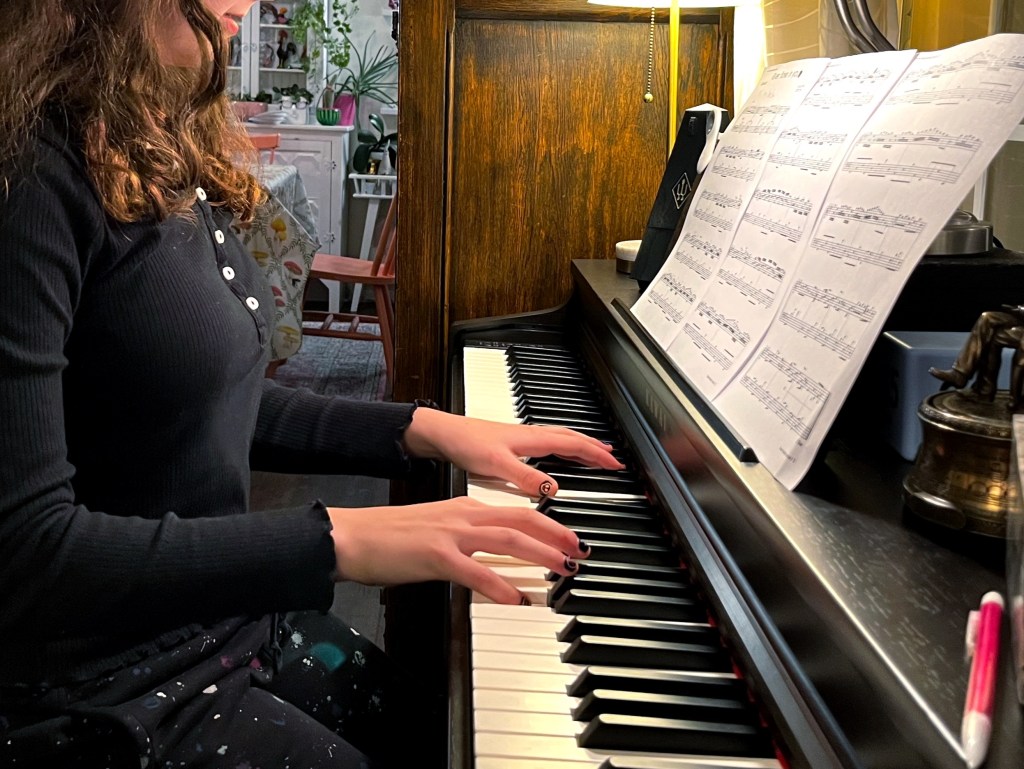
Beginner students will often look down at their hands because they don’t trust their fingers to navigate the keys soley by touch. In order to avoid mistakes, they look down from their music to visually find the next note they need to play. Their eyes become a crutch which delays the development of the spatial awareness and muscle memory they need to play the piano.

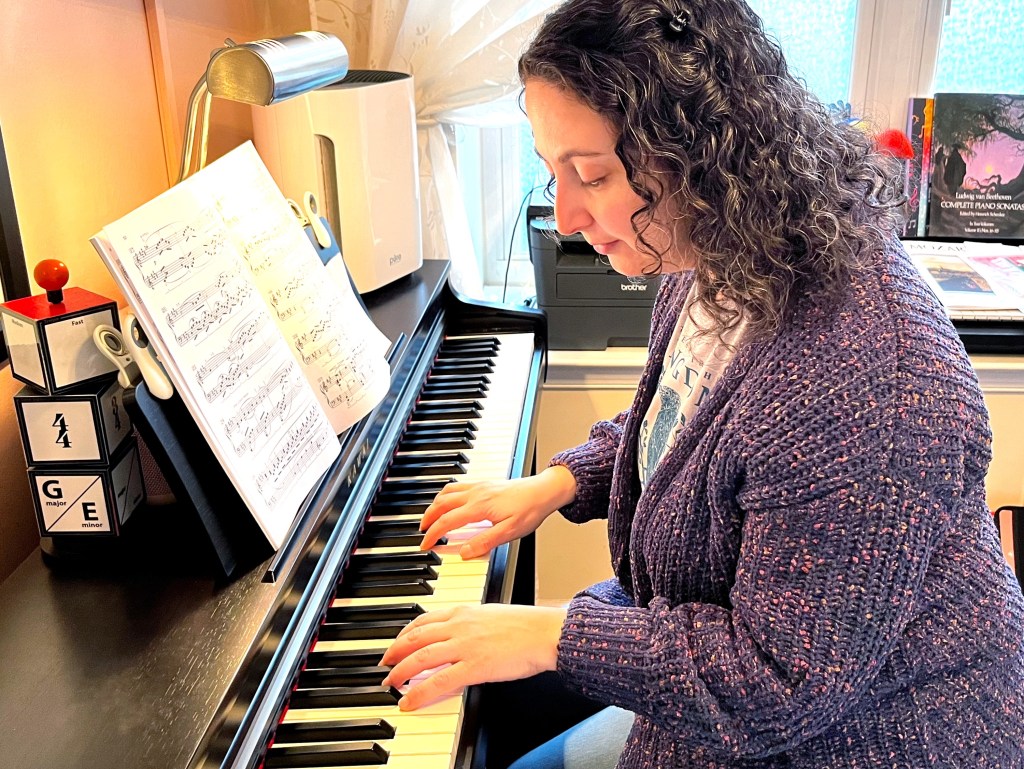
Piano student looks down at her hands while playing the piano.

  1. Why is it important for students to keep their eyes on the music?
  2. Exercises for Keyboard Awareness
  3. Practice Strategies to Keep Eyes on the Music
  4. Can Students EVER look down when playing?
  5. Let’s stay in touch, join the list!

As teachers, we want our students to trust their fingers, develop a deeper connection with the piano, and, ultimately, become confident pianists. To do so, we can use exercises during our lessons to help students build confidence in finding their way around the piano by touch, as well as suggest practice strategies that encourage them to stay focused on the music by blocking their view of the keys (because let’s face it, habits are very hard to break and sometimes we need a little helping hand… or beard! Or even a hoodie!!).

As teachers, we want our students to trust their fingers, develop a deeper connection with the piano, and, ultimately, become confident pianists.

A piano student confidently plays the piano while keeping their eyes on the music.

Why is it important for students to keep their eyes on the music?

In the beginning stages of learning a piece, we are teaching our fingers the movements and distances they need to navigate in order to play that particular piece. By constantly looking and placing our hands and fingers on the right keys we are not allowing our fingers to feel their way around the keyboard and learn how far they need to go to play. Just like a basketball player has to be able to dribble a ball without staring down at it, a pianist must be able to navigate the piano without looking down all the time.

Just like a basketball player has to be able to dribble a ball without staring down at it, a pianist must be able to navigate the piano without looking down all the time.

Another reason we don’t want to look down is because it cuts the flow of the music. The small amount of time it takes to look down at the hands and then look up again to find our place in the music is enough to miss a beat or two… or even more. Looking down becomes a crutch for students and introduces pauses in the music, which can become ingrained and end up compromising the overall flow and structure of the piece.

Exercises for Keyboard Awareness

1) What Key is that?

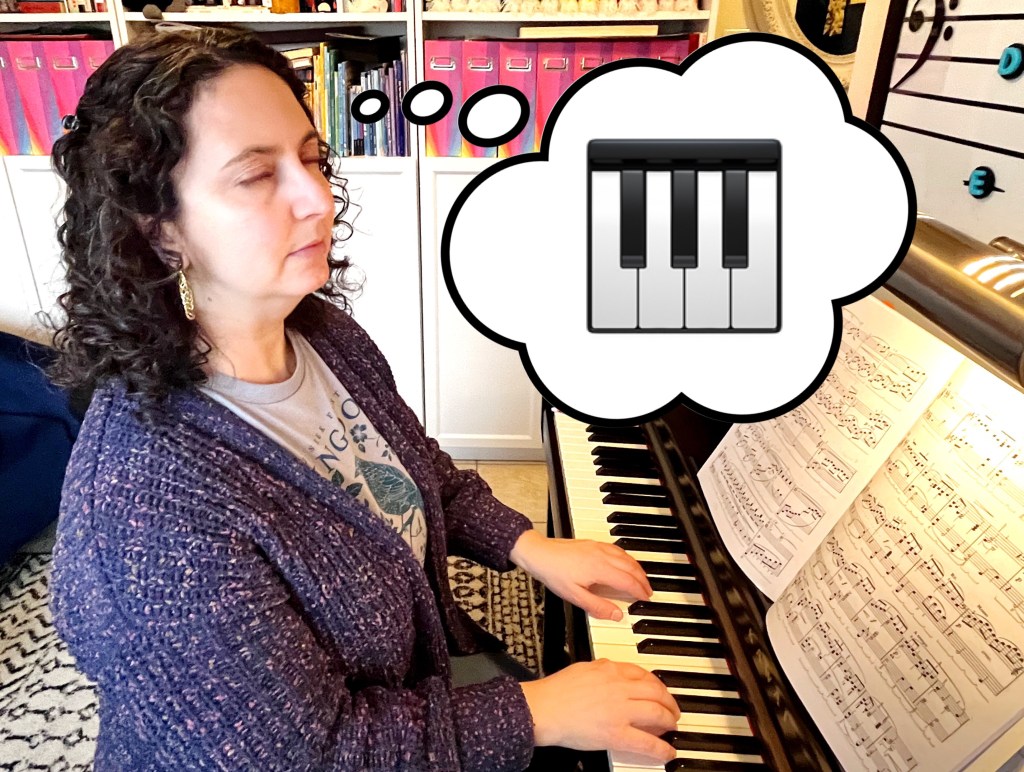
This is a great exercise for students to really think about what key each individual finger is resting on. Have the student find the starting position of their piece. Close their book and have the student close their eyes. Then ask them, “What key is finger 2 of your right hand sitting on?” When the student has answered, ask about a different finger, “What key is finger 4 of your left hand sitting on?” And so forth, alternating hands and scrambling the finger numbers you call on.

I encourage students to visualize the piano in their mind’s eye and tap the finger I’m asking about on the key (without actually playing it).

Piano student keeps eyes closed while visualizing the keys of the piano in her head.

As students become more confident, you can move their hands to random positions on the piano or increase the speed of your questions.

2) Find your Spot

This is a great exercise for students to feel how their arms are also an integral part of placing their hands on the piano (students often become hyperfixated on the fingers and hands and don’t realize how important everything from the wrist up is!). It also helps them to really feel the key patterns on the piano with their fingers.

Cover the piano keys. Open their book to the piece they are working on. Ask the student to place their hands on their head. Have them analyze the starting position of their piece. When they feel they are ready and have a mental image of where their hands should be placed on the piano, have them close their eyes.

Piano student closes her eyes and places her hands on her head while sitting at the piano.

Uncover the piano keys and tell them to find their starting position by just feeling their way around the piano. With their eyes still closed, the student will lower their hands and attempt to place their hands on the correct keys. When they think they have it, they can open their eyes and see if they are right.

3) One Small Leap…

A lot of beginner music has students playing in one position throughout the entire piece. This exercise helps students make small moves around the playing position to build awareness of the keys that are close by.

Have the student place their hands in the starting position of their piece, then ask them to close their eyes.

Give instructions such as:

  • Move your left hand thumb up a step. What key is it on now?
  • Move your right hand pinky up a step. What key is it on now?
  • Move your entire right hand down a step. Play and name all the keys your fingers are touching.
  • Move your entire left hand up a skip. Play and name all the keys your fingers are touching.
  • Cross the second finger of your right hand over your thumb. Play the key and name it. Then return your hand to the starting position.
  • Move finger 3 of your right hand onto the black key a half step below it. Play the key and name it.
  • Any other movement that is in their practice piece or variation you can think of.
A right hand on the piano crosses finger 2 over the thumb to play a B

Practice Strategies to Keep Eyes on the Music

Habits can be hard to break in general and if a student has become reliant on looking at their hands while playing, they may need some extra help to not peek… especially because sometimes they don’t even realize they are doing it!

So, how can we encourage students to keep their eyes on their music?

1) Cover the Student’s Hands with a Book

If a student is constantly looking down at their hands during a lesson, a quick fix is to hold a book over their hands, obstructing their view. Students are usually amazed with themselves that they can in fact play the piece withouth looking down!

Piano teacher holds a book over a piano students hands to obstruct their view of the keyboard.

This practice strategy can be used at home as well if a parent is available to help.

2) Use a “Beard”

The second strategy is both fun and effective. I saw a similar trick years ago online and when I saw this Santa beard at the store over the holidays I knew I had to have it for my studio. I extended the beard with some fleece.

A package containing a Santa beard and glasses disguise sits on a piano bench

The student puts on the glasses. Then the student tucks the end of the beard under their book on the book rack. The beard hides the student’s hands from view.

Piano student wears a beard connected to toy disguise glasses to obstruct her view of her hands while playing the piano.

It’s hilarious and it works! If you’d like to have a one of your own, you can use a pair of toy glasses and connect a piece of cloth to them.

3) Use a Hoodie worn Backwards

But what about home practice? You can’t always lend out your beard and a parent may not be available to sit with a student while they practice. In this case, the student can use something that is ubiquitous with kids nowadays… the hoodie!

A student plays the piano wearing a hoodie that is on backwards. The hood is lifted so the student cannot see their hands.

This trick works like a charm! Have the student turn their hoodie around, so that the hood is in front of them. The student then adjusts the hood so it is propped up. And there you go! They will not be able to see their hands when they play.

Can Students EVER look down when playing?

Yes! There is a time and place for everything. The real question becomes, “Is what I’m doing benefitting the music? Am I achieving the sound I want from the piano when I look down?”

In general, large leaps and difficult passages require more from us and we do look down at our hands to navigate these passages. BUT at this point, the music is usually memorized and/or looking down has become part of the how the pianist plays the piece. Looking down in this case is not a crutch but adds to the accuracy and flow of the music.

Pianist plays a piece by Beethoven while looking down at the keyboard.

Explore more creative teaching ideas
  • Slurs & Ladders: The Recital Prep Game
    If there is one game my students beg to play year after year (and sometimes when we don’t even have a recital anytime soon!) is this recital prep game. It’s a great de-stressor and it shows students how prepared they are to perform while also injecting some fun and joy back into those recital pieces that may be sounding a little tired.
  • Top Practice Tools Every Piano Student should Have: #4 Recording Device
    When used strategically, a recording device can help students gain valuable insight into their playing and progress faster! I’m sharing my favorite recording equipment and different ways students can use recording themselves as a practice tool to improve their playing.
  • Top Practice Tools Every Piano Student should Have: Curiosity
    Curiosity is the catalyst that gets students to start learning the piano in the first place and can be exactly what’s needed to keep them going for the long haul. Why is it so important and how do we keep it going? What if I don’t play an instrument, but want to encourage my child in their practicing? Check out all the answers plus download a free printable for parents!

Let’s stay in touch, join the list!

As a “toucan” of our appreciation download a free set of note flashcards (link in our Welcome email)!

Processing…
Success! You're on the list.

We are a participant in the Amazon Services LLC Associates Program, an affiliate advertising program designed to provide a means for sites to earn advertising fees by advertising and linking to Amazon.com. As an Amazon Associate we earn from qualifying purchases.
Summer Piano Listening List

This summer I’m sending my piano students home with the Summer 60: 60 Days of Piano Music! The goal is for them to listen to a piece most days over summer vacation and complete the entire list by the end of August.

It is SO immensely important for students to listen to music and it’s often one of the things that get lost in the shuffle of life. But the summer, the time of long car rides and barbeques, basically demands music! So why not add a little piano music into the mix?!

The Summer 60 is divided into six categories:

  • Top 20 Sizzlers: 20 pieces for solo piano that most people would recognize even if they don’t listen to classical music
  • Baroque Beach Bonanza: A selection of eight pieces from the Baroque period with pieces by J.S. Bach, Arcangelo Corelli, George Frideric Handel, Georg Philipp Telemann, Jean-Philippe Rameau, Dietrich Buxtehude, and Domenico Scarlatti
  • Classical Campfire Concert: A selection of eight pieces from the Classical period with pieces by C.P.E. Bach, J.C. Bach, Muzio Clementi, Luigi Boccherini, Christoph Willibald Gluck, Joseph Haydn, and Carl Czerny
  • Red-Hot Romantic Remix: A selection of eight pieces from the Romantic period with pieces by John Field, Felix Mendelssohn, Clara Schumann, Edvard Grieg, Modest Mussorgsky, Antonin Dvorak, Sergei Rachmaninoff, and Amy Beach
  • Modern Midsummer Melodies: A selection of eight pieces from the Modern period with pieces by Igor Stravinsky, Sergei Prokofiev, Alexander Scriabin, Maurice Ravel, Arnold Schoenberg, Heitor Villa-Lobos, Bela Bartok, and Dmitri Shostakovich
  • Contemporary Summer Coda: A selection of eight pieces from the Contemporary period with pieces by Philip Glass, Gyorgy Ligeti, Unsuk Chin, Luciano Berio, Lera Auerbach, Errolyn Wallen, Ludovico Eunadi, and Takeshi Kokayashi.

You might be asking, where’s Beethoven, Mozart, Chopin, Brahms, and all the other heavy-hitters?! They are in the Top 20 Sizzlers!! I decided, in order to have a wide variety of composers and music, anyone who was in the Top 20 Sizzlers wouldn’t be added to the period selections (with the sole exception of J.S. Bach because we ALWAYS make an exception for Bach!).

A list of piano music lays on the grass in the sun next to a pair of toucan sunglasses and a colorful beach ball.

Each piece on the list is around 5 minutes (or less! Only a few are longer) so it should be easy to squeeze a quick listen in among all the fun summer activities! Some great times to listen are while driving around town, while winding down before bed, while setting the table, and before practicing (wink! wink! Summer is a fantastic time for practicing!!).

Students can listen to the pieces in any order (but listening to them in order does give them an idea of how piano music has changed over the centuries, which is really neat!). When they’ve listened to a piece, they can check the box next to the piece and rate the piece on the emoji scale on the right:

  • Frowny face: Ugh… I never want to hear that again
  • Straight face: That was good, but not my favorite
  • Smiley face: That was fantastic! Why did it have to end?!

The emoji scale can help students to figure out their musical taste!

Summer 60: 60 Days of Piano Music is available as a printable download in the Toucan Piano Store. Happy listening!!

Explore more creative teaching ideas
  • Rhythm Olympics
    Students will go for gold in the Rhythm Olympics, a multi-level multi-week rhythm game! Students compete in 5 rhythm sporting events in the hopes of collecting all 5 gold medals and being crowned a Rhythm Olympics champion!!!
  • Slurs & Ladders: The Recital Prep Game
    If there is one game my students beg to play year after year (and sometimes when we don’t even have a recital anytime soon!) is this recital prep game. It’s a great de-stressor and it shows students how prepared they are to perform while also injecting some fun and joy back into those recital pieces that may be sounding a little tired.
  • Music Friendship Bracelets
    Colorful friendship bracelets make great student gifts for your next recital or they could be a craft for your students to make at a group lesson or studio event! They are colorful, easy to make, and show off our piano pride!

Let’s stay in touch, join the list!

As a “toucan” of our appreciation download a free set of note flashcards (link in our Welcome email)!

Processing…
Success! You're on the list.

We are a participant in the Amazon Services LLC Associates Program, an affiliate advertising program designed to provide a means for sites to earn advertising fees by advertising and linking to Amazon.com. As an Amazon Associate we earn from qualifying purchases.
The Ultimate Piano Recital Prep Game

If there is one game that my students ask for and can’t wait to play each and every year, it is our recital prep game! I bust out this game at our last lesson before the recital and we have a great time putting their recital pieces through the wringer (with a lot of laughter along the way!).

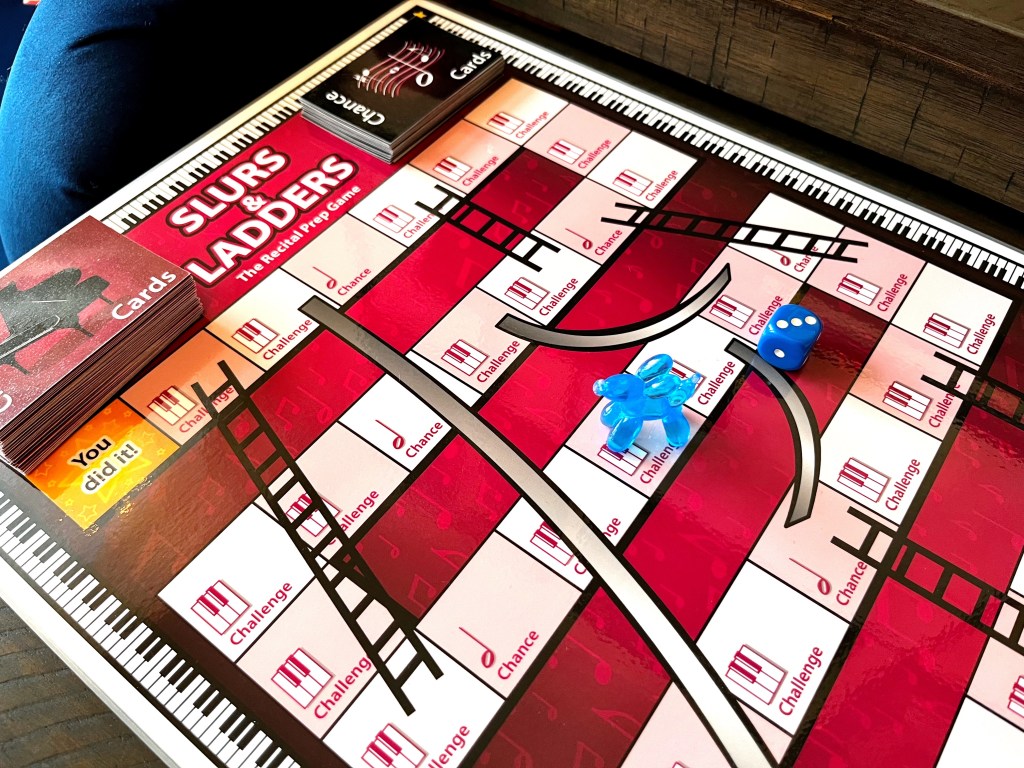
Slurs and Ladders, the piano recital prep game, sits on a wood table along with a blue balloon dog game marker and a blue die.

I’ve found this game to be a great de-stressor for my students. It shows them that they are prepared for the recital and adds some fun back into their pieces after having spent so much time preparing them.

I use it as a studio-wide game to see which student can score the most points (I usually announce the results at the recital and the winner gets a little prize). And since it is a game of chance and completely independent of skill level, a kindergartener and a high school student have the same odds of winning!

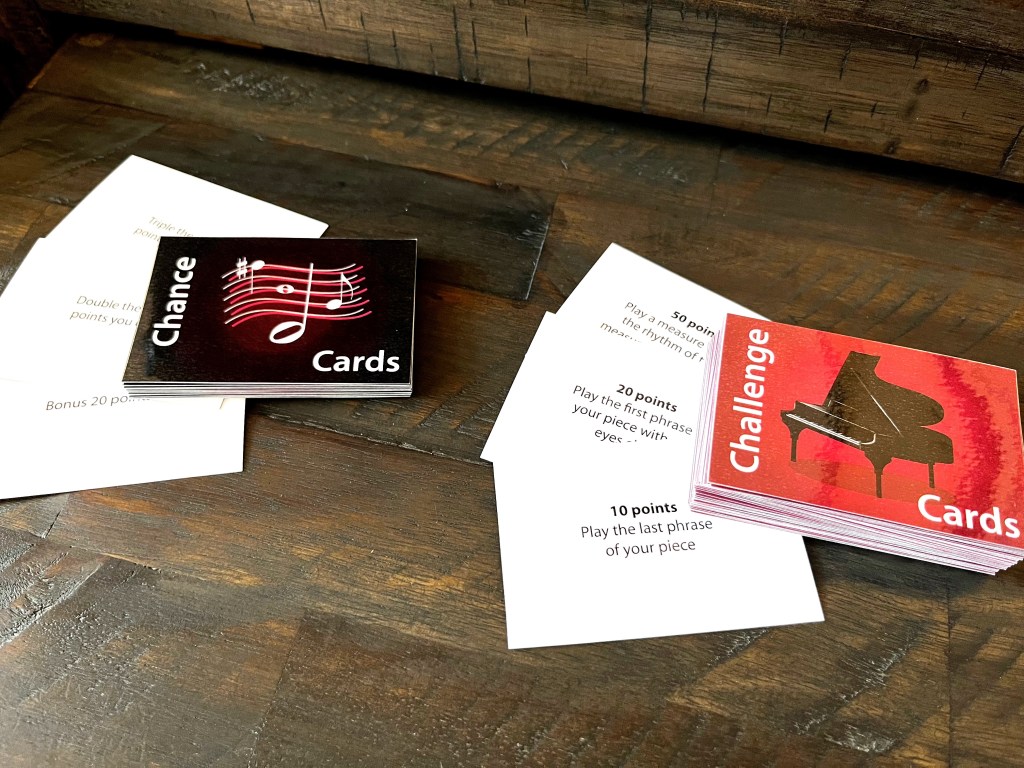
The game is called Slurs and Ladders – The Recital Prep Game and works a lot like the game “Chutes and Ladders”. It comes with a gameboard (2 sizes), 40 Challenge cards, 20 Chance cards, and instructions as well as a document explaining each Challenge card. Slurs and Ladders is available for purchase in the Toucan Piano Store.

Challenge and chance cards sit on a dark wood table

How to Play

To play you will need:

  • The Slurs and Ladders gameboard
  • Deck of Challenge cards
  • Deck of Chance cards
  • 1 Die
  • 1 Gamemarker

This is a single player game. The student will work their way up the board and collect as many points as they can before reaching the last space on the board. The teacher will keep track of the points the student earns and add them up at the end of the game.

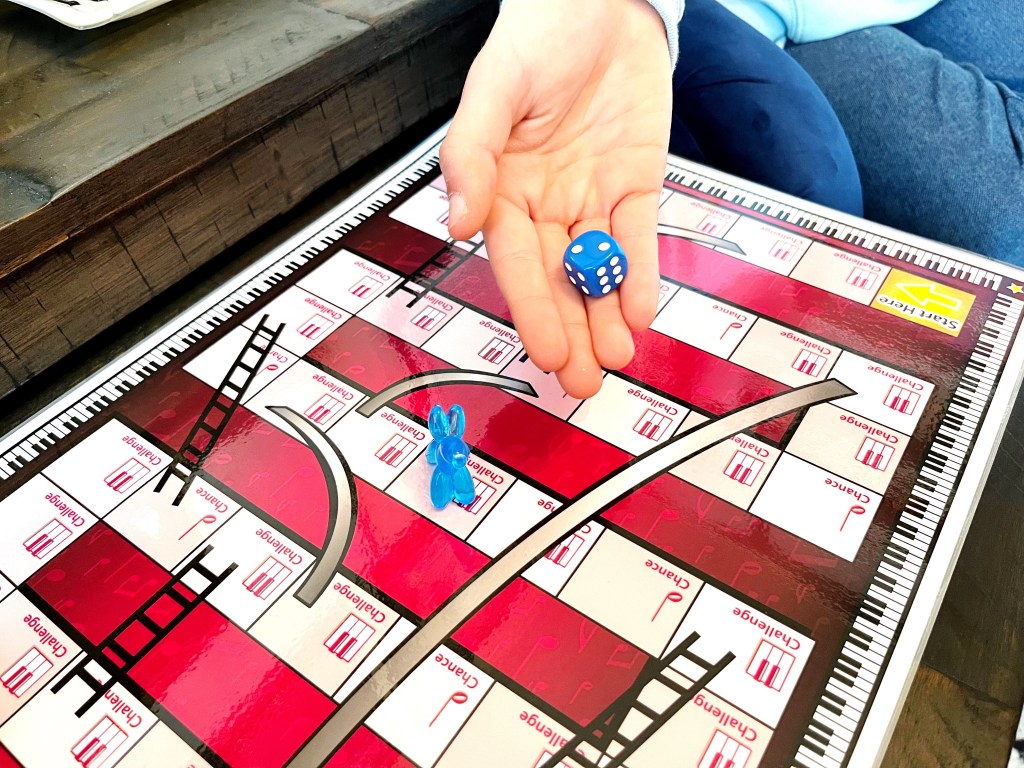
Piano student rolls a blue die while playing the recital prep game, Slurs and Ladders.

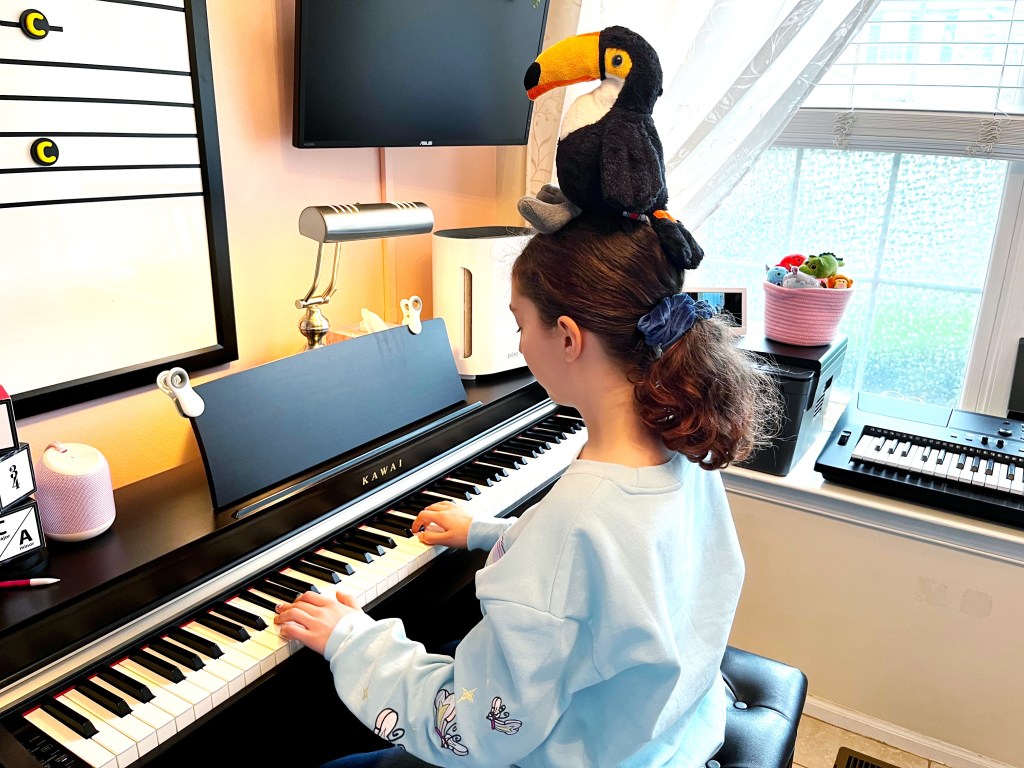
The student rolls the die and moves their gamemarker the corresponding number of spaces on the gameboard. If the student lands on a Challenge card space, the student takes the top card from the deck, reads the challenge, then executes the challenge on their recital piece (for example, “Play your piece while doing squats”). Once the student has completed the challenge, the teacher writes down the number of points from the card and play continues.

Piano student plays the piano while balancing a stuffed toucan on her head.

Some challenges are musical, some are meant to get your student’s adrenaline pumping, some are meant to throw them off track and have them try to recover, and some are to remind them of recital etiquette. In the Slurs and Ladders download there is a document explaining each challenge.

If the student lands on a Chance card space, the student takes the top card from the deck, and reads the chance card. Chance cards can give students free points or move them on the board.

If a student lands at the base of a ladder, the student must first do the Challenge/Chance card before climbing the ladder. Once the student has climbed the ladder, they will then do the Challenge/Chance card at the top of the ladder before rolling the die again.

If a student lands at the top of a slur, the student must first do the Challenge/Chance card before sliding down the slur. Once the student has reached the bottom of the slur, they will then do the Challenge/Chance card at the base of the slur before rolling the die again.

A student plays the piano with their arms crossed.

This game has been a hit year after year with my students (we have been playing it for 6 years now!!!) and their eyes light up each time they see it waiting for them when they walk in for their lesson.

Slurs and Ladders is available for purchase in the Toucan Piano Store. I hope your students get a kick out of it as much as mine have!

Explore more creative teaching ideas
  • Positive Notes: Recital Encouragement
    Spread some positivity and encouragement to your students this recital season with these adorable Positive Notes! They will help remind them of how hard they work and how much you believe in them.
  • How to Bow at a Piano Recital
    You’ve just finished playing your piano recital pieces and now the audience is clapping, what do you do now??! It’s time to take a bow and enjoy the adulation for all the hard work you put into learning your pieces. Here’s the step-by-step on nailing the perfect piano recital bow!
  • Music Friendship Bracelets
    Colorful friendship bracelets make great student gifts for your next recital or they could be a craft for your students to make at a group lesson or studio event! They are colorful, easy to make, and show off our piano pride!

Let’s stay in touch, join the list!

As a “toucan” of our appreciation download a free set of note flashcards (link in our Welcome email)!

Processing…
Success! You're on the list.

We are a participant in the Amazon Services LLC Associates Program, an affiliate advertising program designed to provide a means for sites to earn advertising fees by advertising and linking to Amazon.com. As an Amazon Associate we earn from qualifying purchases.
Sweet Words: Valentine’s Note-Reading Game

Who doesn’t love to hear Sweet Words?! The right words can make us feel all warm and fuzzy inside!

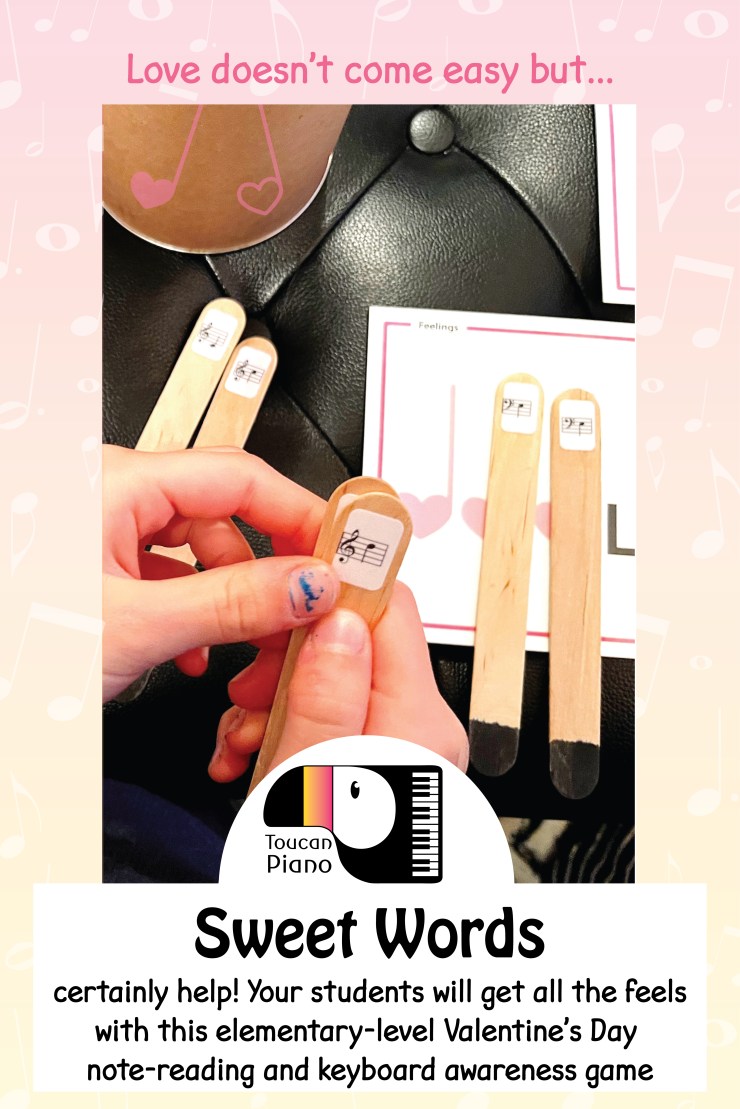
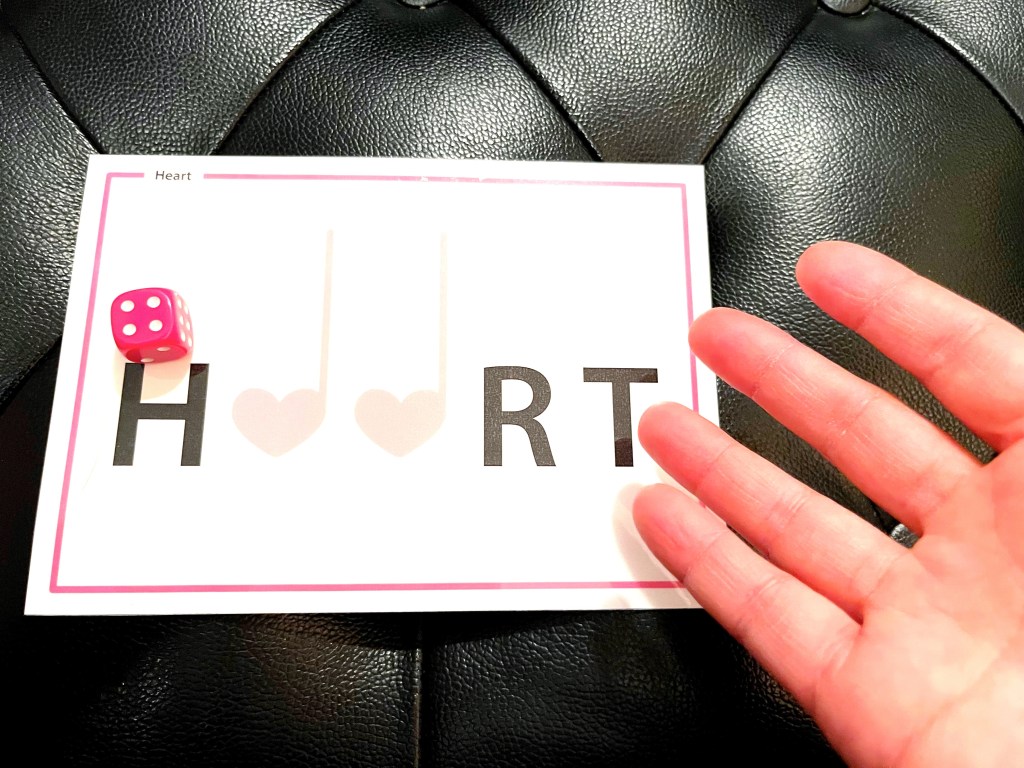
This Valentine’s Day your elementary level students can get all the feels with Sweet Words a note-reading and keyboard awareness game. But love doesn’t come easy… these sweet words are missing letters! Who will be able to find their missing letters and complete their word first? Students will have fun reading the notes on the staff (or naming the white keys on the piano) to try to fill in the missing letters of their sweet word first.

I play this game every year with my students (I use it with my older students as well as a quick review game and to check how fast they are recognizing the notes!). We spent all of last week playing and had a blast!

A piano student rolls a pink die on top of a card that reads "Heart" but has letters missing.

For an easy twist on the game, I have each player draw 3 cards. Each player picks one card to start with and can only move onto their next card once they have filled in their first card. It ups the stakes quite a bit and adds an extra layer of excitement to the game!

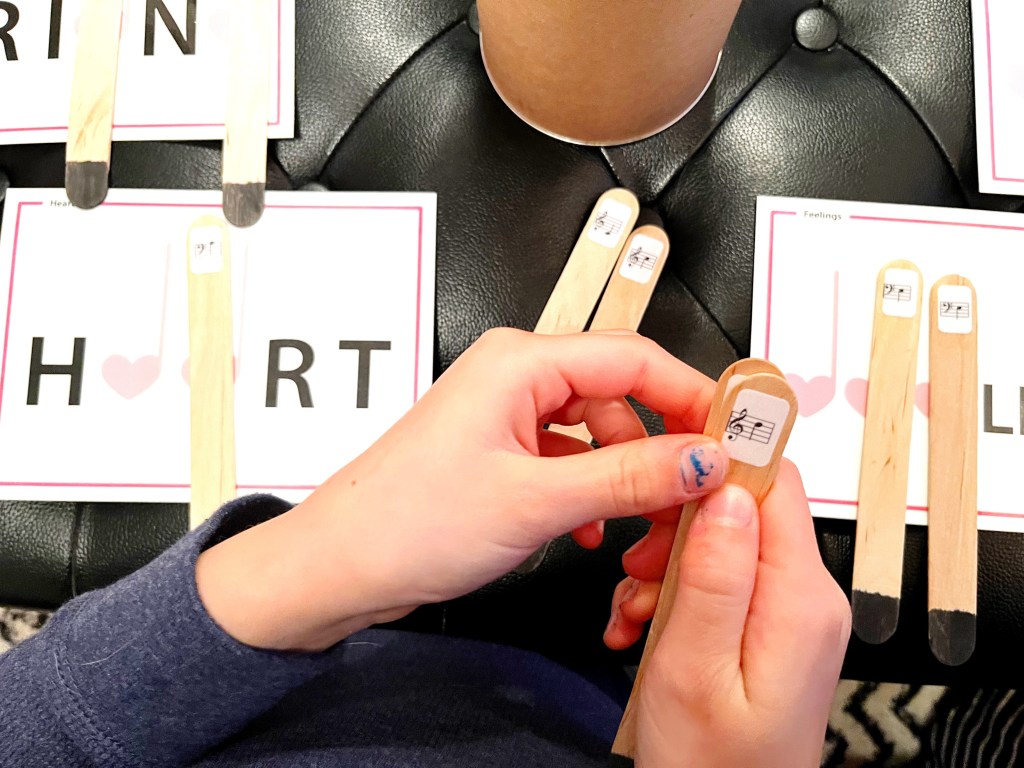
A piano student reads and sorts through popsicle sticks with music notes written on them trying to find a match for one of the Valentine's words.

Another twist I like to use (especially for my high energy students) it to replace the die for a toss game (like the one I use for my Snowball Rhythm Game – the one I use is out of stock but this one on Amazon is a great alternative and can be used throughout the entire year!). Depending on which hole they land the snowball in will determine how many note cards they will get.

I like to use my popsicle stick notes because I have 3 different sets and can drill specific subsets of notes with my students. Sweet Words comes with all the note and keyboard cards needed for playing. Plus they are pink (nothing screams Valentine’s Day more than the color pink!).

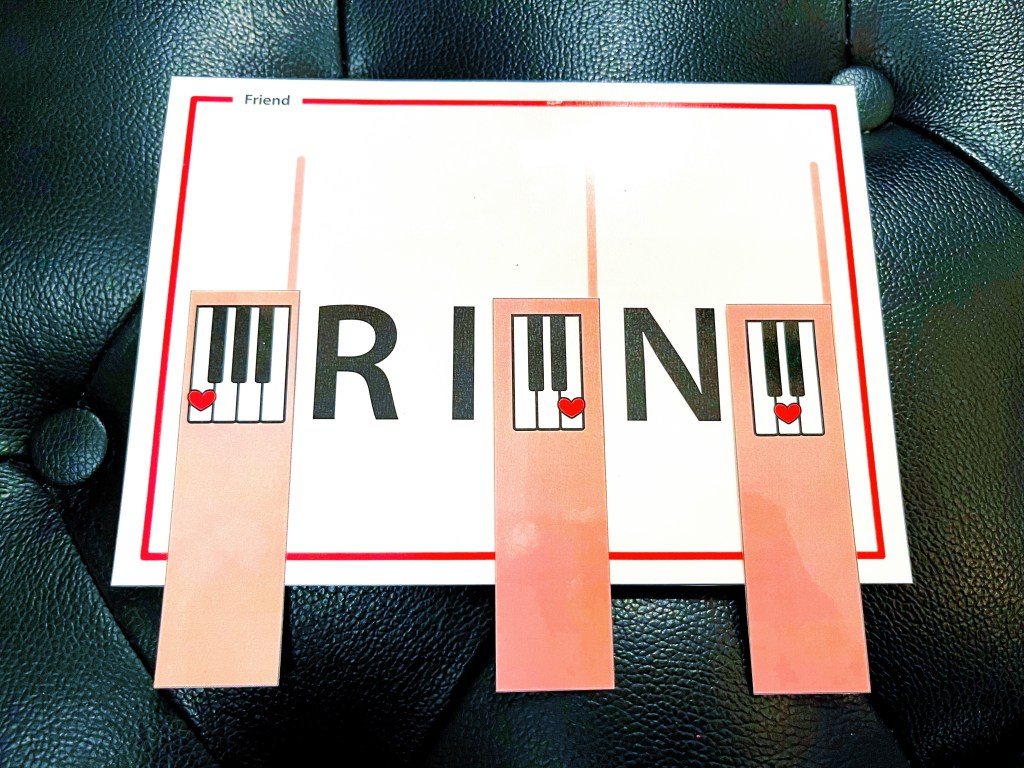
A card with the word "Friend" written in both piano keys and letters sits on a black piano bench.

As I mentioned, I played this game last week with all my students and something funny happened. I always ask my students to draw my cards for me (that way no one can complain about the words we get). I shuffle all the cards then I fan out the deck with the cards face down for the student to select their cards and mine. No joke, three different students on the same day drew “Cupid”, “Date”, and “Baby” for me at random. There are 20 cards in the deck, what are the odds?! I don’t know what the universe is trying to tell me! Lol

Sweet Words is available for purchase in the Toucan Piano store. I hope your students enjoy it as much as mine do!

Happy Valentine’s Day!

Explore more creative teaching ideas
  • Valentine’s Day Round-Up
    Make Valentine’s Day special for your students with free downloadable piano-themed Valentine’s cards and lots of music theory games that will have your students seeing hearts!
  • I Can Heart-ly Wait for the Punchline
    A heart themed laugh-out-loud note reading game. I love this game because not only do students have to think about keyboard geography, they also have to be able to associate the notes with their exact location on the piano. 
  • Sky High Love
    The rhythms get longer as the heart towers get higher! Whose tower will remain standing in the end?! This adrenaline-inducing rhythm game is a great way to kick-off a lesson and get the energy up.
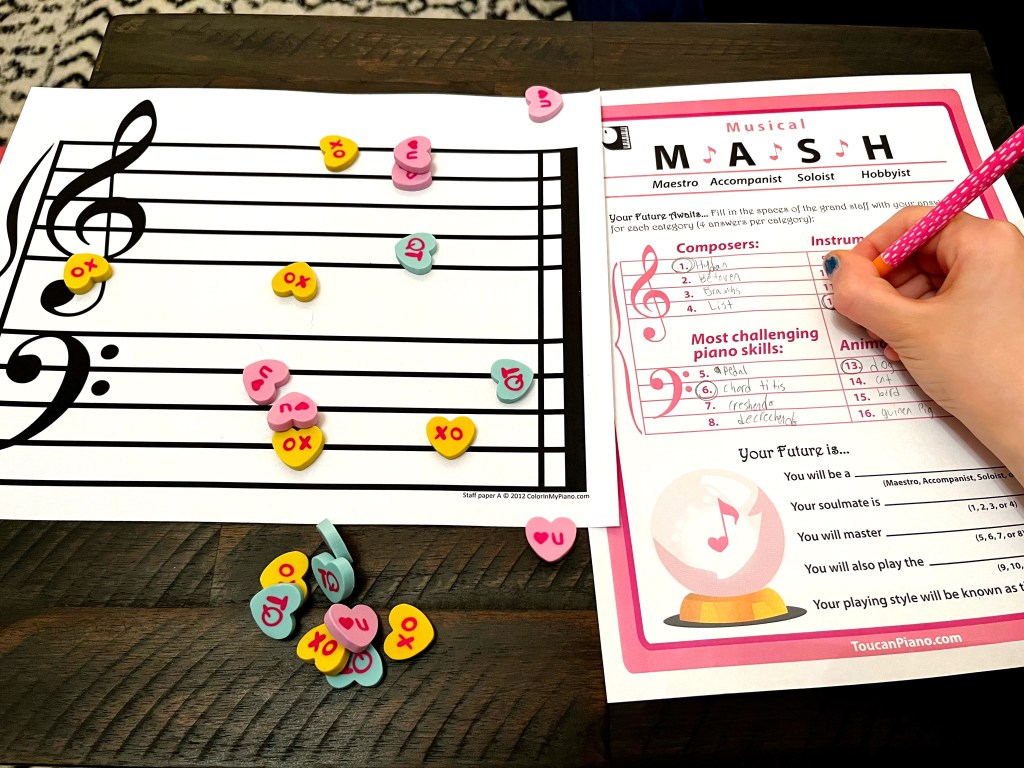
  • Musical M.A.S.H
    This free printable game tests your student’s knowledge of the spaces on the grand staff. It’s a fast, easy game to play, and will predict your student’s musical future with hilarious results!
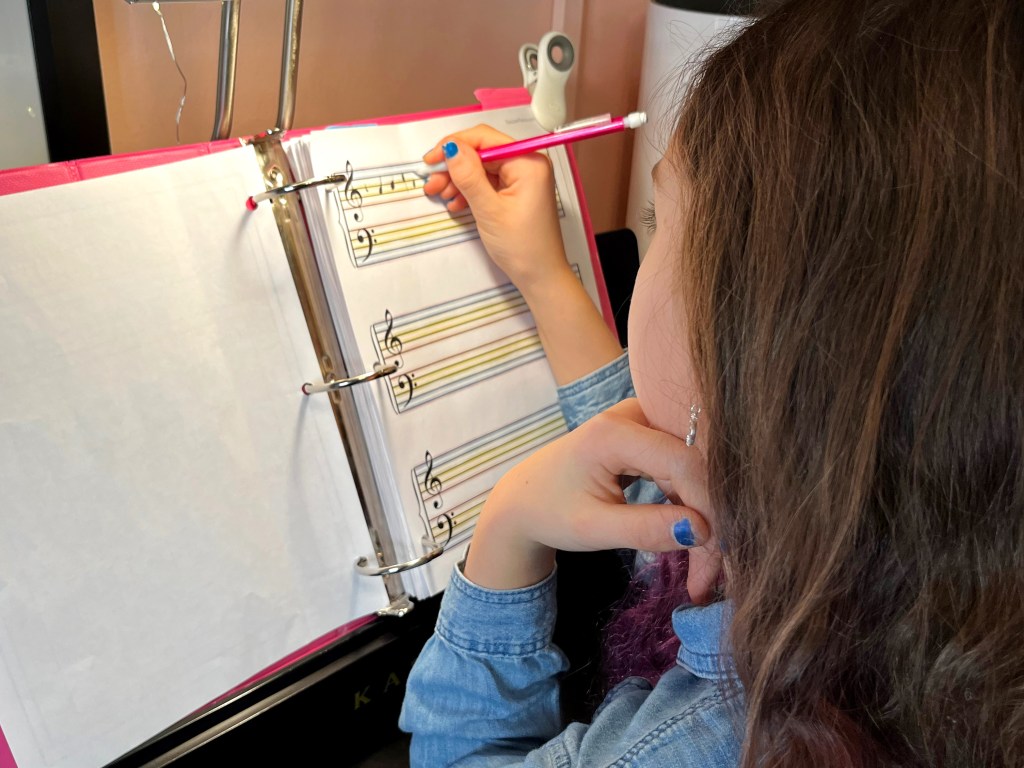
  • Rainbow Manuscript Paper
    This colorful manuscript paper is available in the Toucan Piano shop as a free printable! They are available in three sizes, so they can be used for a variety of ages and activities, like writing out original compositions, explaining music theory concepts, music dictation, games, and so much more!

Let’s stay in touch, join the list!

As a “toucan” of our appreciation download a free set of note flashcards (link in our Welcome email)!

Processing…
Success! You're on the list.

Piano Valentine’s Day Cards and Games

Whether you love or hate Valentine’s Day, I think we can all agree that celebrating love and showing appreciation for each other is always a good thing! Every Valentine’s Day I like to encourage my students with a little piano-themed Valentine and some games to let them know how much I care about them, their music journey, and helping them grow their love for making music.

Here I’m sharing some of the Valentine’s Day cards I’ve given my students as well as games that I pull out every year to play with my students! I hope you find something that inspires you this Valentine’s Day. Check out the

Here I’m sharing some of the Valentine’s Day cards I’ve given my students as well as games that I pull out every year to play with my students! I hope you find something that inspires you this Valentine’s Day. Check out the Toucan Piano Store for more piano teaching resources and music theory games.

Valentine’s Day Cards

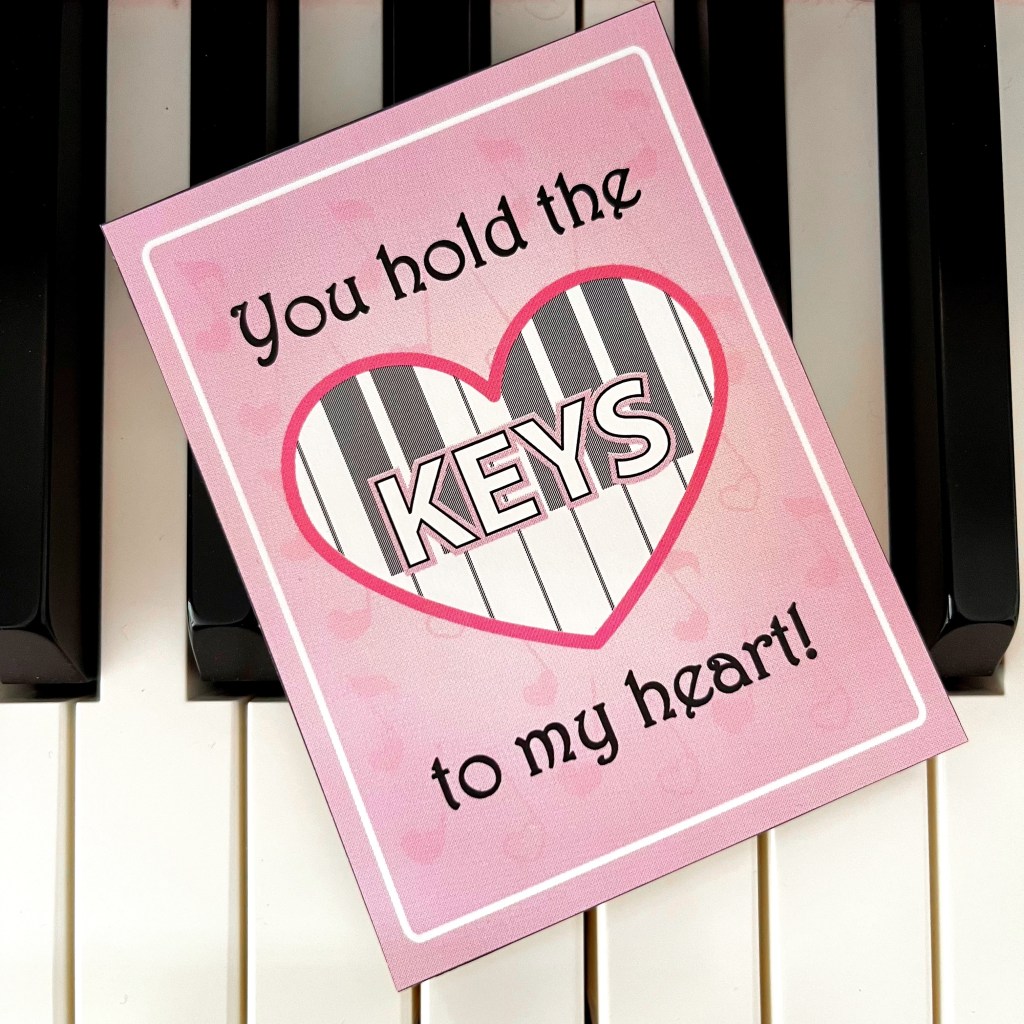
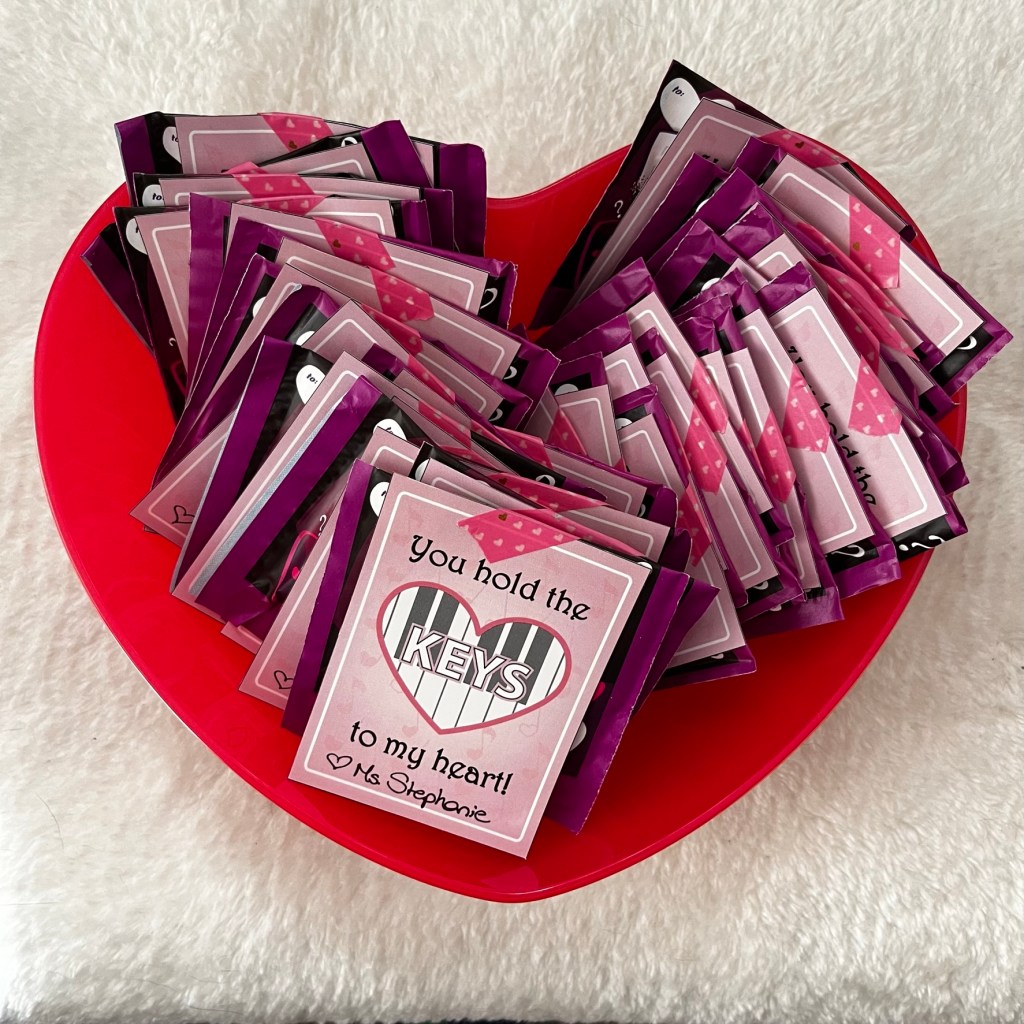
I love coming up with Valentine’s day cards for my students! The first one I ever made was my “You Hold the Keys to My Heart” Valentine (I love a good music pun!). I handed them out with a small piece of candy during Valentine’s Day week. You can download this free printable here.

A pink Valentine's Day Card sits on top of the keys of a piano. They card reads "You hold the keys to my heart".
Piano-themed Valentine's day cards sit inside a heart-shaped bowl.

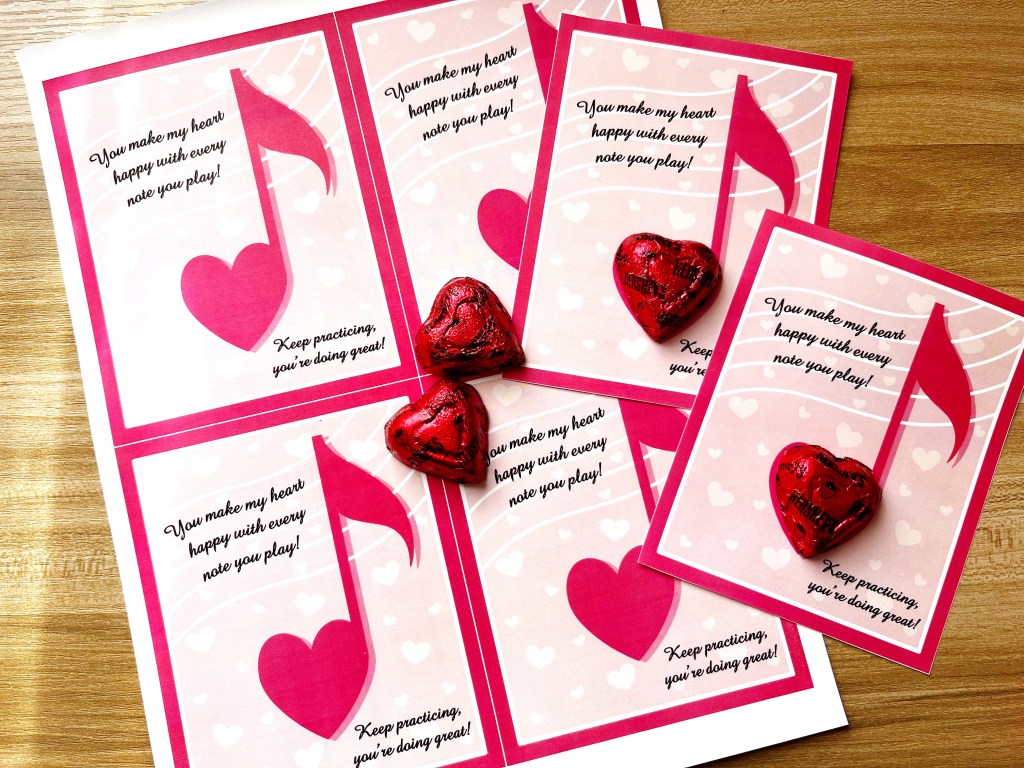
This year I wanted to make a new Valentine that I could attach a heart-shaped chocolate to. The result was my “You Make my Heart Happy with Every Note you Play!” Valentine. I attached a Hershey’s Strawberry Cream Heart to the center of the heart-shaped note with double sided tape. They have been a hit so far! You can download this free printable here.

Music themed Valentines with heart shaped chocolates sitting on a wooden table.

Valentine’s Day Rhythm Games

The Path to Your Heart: A Would-You-Rather Rhythm Game

This one is a favorite with my students and I pull it out every year! The Path to Your Heart combines both the fun of “would you rather” questions with rhythm exercises. It is a great game for in-person lessons, online lessons, group lessons, and even classrooms! Check out the blogpost for more information.

A would you rather question printed on a sheet of paper is laying on a wooden table. The sheet has two possible answers accompanied by rhythm notes. A drumstick held by a piano teacher points to a rhythm on the sheet.

Sky-High Love

I love fun and easy games that use things I already have around my studio! For this Valentine’s Day game, I used my rhythm popsicle sticks and mini heart-shaped erasers. It’s so simple and the kids absolutely love it! The record so far for the most eraser stacked at my studio is 31!! I’m excited to see if anyone will beat the record this year. For more information on how to play check out the video below or the blogpost.

Valentine’s Day Note Reading Games

Sweet Words

Everyone loves hearing sweet words! But these sweet words are missing letters… Who will be able to find their missing letters and complete their word first? Students will have fun reading the notes on the staff (or naming the white keys on the piano) to try to fill in the missing letters of their sweet word(s) first. Check out the blogpost for Sweet Words here.

The word "Friend" is spelled out using keyboard cards and letters.

I Can Heart-ly Wait for the Punchline

What is better than a joke?! Well, a music-themed joke, of course! I love introducing my students to music theory jokes, especially when I can mix in some music theory. I love this game in particular because not only do students have to think about keyboard geography, they have to be able to associate the notes with their exact location on the piano. Check out the full blogpost for more information.

Piano student plays a note-reading game based on music theory jokes.

Musical M.A.S.H.

Did you play MASH (Mansion, Apartment, Shack, House) when you were a kid? All it required was a piece of paper and a pencil! My friends and I would spend countless recesses trying to find out if we would marry our crushes, have 20 kids while living in a mansion (we all wanted the mansion, of course) and driving a Ferrari! This Valentine’s Day my students and I are playing the musical version of M.A.S.H. (maestro, accompanist, soloist, hobbyist) that I created. We will be drilling our knowledge of the spaces on the grand staff while figuring out our musical futures!

Musical M.A.S.H. is available as a free download in the Toucan Piano Shop. You can read more about it here.

Other Valentine’s Day Resources

Rainbow Manuscript Paper

We are in the season of hearts and rainbows – Valentine’s Day and St. Patrick’s Day – and what better way to show your love for someone than with an original piece of music! The rainbow manuscript paper is available in the Toucan Piano shop as a free printable! Print as many as you like for your students. You can read more about how I use the rainbow manuscript paper with my students here.

Piano student composes an original song on a piece of rainbow manuscript paper.

The Die of Destiny

Sometimes, when the weather is miserable or after a tiring day at school, a student will walk into my studio without their usual bounce in their step. I’ve found that a little silliness and a dash of chance gets them in the mood to pull out their piano books and play music. This quick lesson starter only takes a minute and gets students in the mood to play! Check out the blogpost here.

Explore more creative teaching ideas
  • Chord Snowblast
    Cast away the winter blues and have fun reviewing chords with Chord Snowblast! Build chords and collect points while trying to avoid the snow blast! Kids will test their knowledge of building chords AND they will actually be hoping to get all the chords with sharps and flats!!
  • Two Sides of the Same Coin
    This St. Patrick’s day see if your students have the luck of the Irish! Two Sides of the Same Coin is a game about enharmonics that can be played in several different ways! Students will try to collect the most enharmonic pairs and hope that their coins don’t get stolen by another player (or the Leprechaun!).
  • Pot of Gold Rhythm Game
    Students love this easy rhythm game for beginner/elementary level students. The value of each rhythm note or rest will determine how many coins go into the pot. Who can fill their pot the fastest?! This game can be adapted for any time of the year or use mini-cauldrons for a fun Halloween or St. Patrick’s Day game.

Let’s stay in touch, join the list!

As a “toucan” of our appreciation download a free set of note flashcards (link in our Welcome email)!

Processing…
Success! You're on the list.

Don’t Miss a Beat

Rhythm and meter are fundamental components of music that all students need to continuously work at… even though they more often than not complain about it. As teachers, it can be hard to find a game that grows with a student or can be played by multiple students at different levels at the same time (in the case of a group lesson or piano party).

Don’t Miss a Beat! is a fun multi-level rhythm game that you can play with ALL of your students in your studio. With 136 rhythm cards in the deck, it covers the basics from quarter, half and whole notes all the way up to more complicated rhythms such as triplets, sixteenth notes, dotted eighth notes and their combinations. It also covers three different time signatures: 3/4, 4/4, and 6/8. It can be purchased in the Toucan Piano Store.

Piano teacher measures the height of a large stack of rhythm cards from the games Don't Miss a Beat!

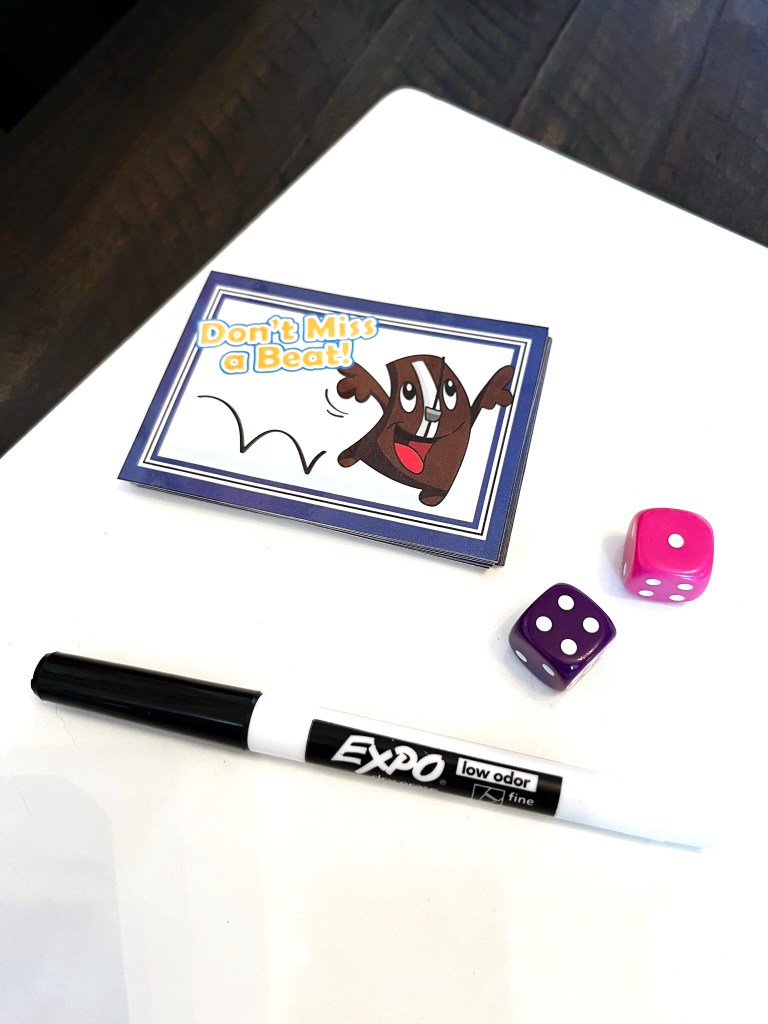
All you need to play are the Don’t Miss a Beat! cards, dice (one for each player), and a white board and dry erase marker (or paper and pencil). Players take turns drawing a card from the deck and try to figure out how many beats are missing in the measure.

Students must analyze the time signature and figure out how to successfully complete the measure using their knowledge of rhythm note and rest values.

Don't Miss a Beat! rhythm card deck sits on top of a whiteboard and next to a pair of dice and a black dry-erase marker.
Piano student writes the correcting counting under a rhythm sequence on a white board.

Check out the game in action:

If students need an extra challenge, Don’t Miss a Beat! comes with two printable challenge dice. When using the dice in the game, the player must use the rolled rhythm to help complete the measure. This helps to keep students from resorting to the same rhythms over and over again.

Variation of the Game for Students at Different Skill Levels

Don’t Miss a Beat! can be adapted to students at different skill levels. Simply create a deck of rhythm cards for each student based on the rhythms they know and what you would like them to drill.

To play, player 1 draws a card from his/her deck, analyzes the measure and determines how many beats are missing. Both players try to roll that number. For example, if the measure is missing 2 beats, the players must roll a 2.

If player 1 rolls a 2 first, then player 1 will complete the measure by writing out a rhythm sequence that satisfies the time signature. Then player 1 will clap and count the measure to earn a point.

However, if player 2 rolls the 2 first, player 1 has been blocked and the round is over. Player 2 now draws a card from his/her deck and the same procedure is repeated.

Whoever collects 5 points first wins.

Don’t Miss a Beat! is available for purchase in the Toucan Piano Store by clicking here.

Explore more creative teaching ideas
  • Sky High Love
    The rhythms get longer as the heart towers get higher! Whose tower will remain standing in the end?! This adrenaline-inducing rhythm game is a great way to kick-off a lesson and get the energy up.
  • Compose a Ringtone
    Ringtones are helpful but what if we could make them special too?! This is a fun and quick project that even the most reluctant students can get behind.
  • Rainbow Manuscript Paper
    This colorful manuscript paper is available in the Toucan Piano shop as a free printable! They are available in three sizes, so they can be used for a variety of ages and activities, like writing out original compositions, explaining music theory concepts, music dictation, games, and so much more!

Let’s stay in touch, join the list!

As a “toucan” of our appreciation download a free set of note flashcards (link in our Welcome email)!

Processing…
Success! You're on the list.

We are a participant in the Amazon Services LLC Associates Program, an affiliate advertising program designed to provide a means for sites to earn advertising fees by advertising and linking to Amazon.com. As an Amazon Associate we earn from qualifying purchases.

How to Make your Own Music Theory Dice

Music Theory dice are a great tool to have in your piano teacher arsenal! They can be used for a variety of activities within a lesson, including:

  • Review music theory concepts
  • Play music theory games
  • Test your student’s knowledge on a specific concept
  • Propose challenges for a student
  • Compose

There are many pre-made options available on the market but I love the flexibility of a DIY set of music theory dice. I can cater them to a specific game and I can cover WAY more concepts (there may not always be pre-made dice available for what I would like to work on with my students).

I’m going to share two different dice you could try out: one is a reusable option and the other is a semi-permanent solution which can be used over over again (but can always be changed up if you’d like).

Reusable Music Theory Dice

The reusable option is a dry-erase die which can be easily used over and over again for whatever concept you with to work on with your students.

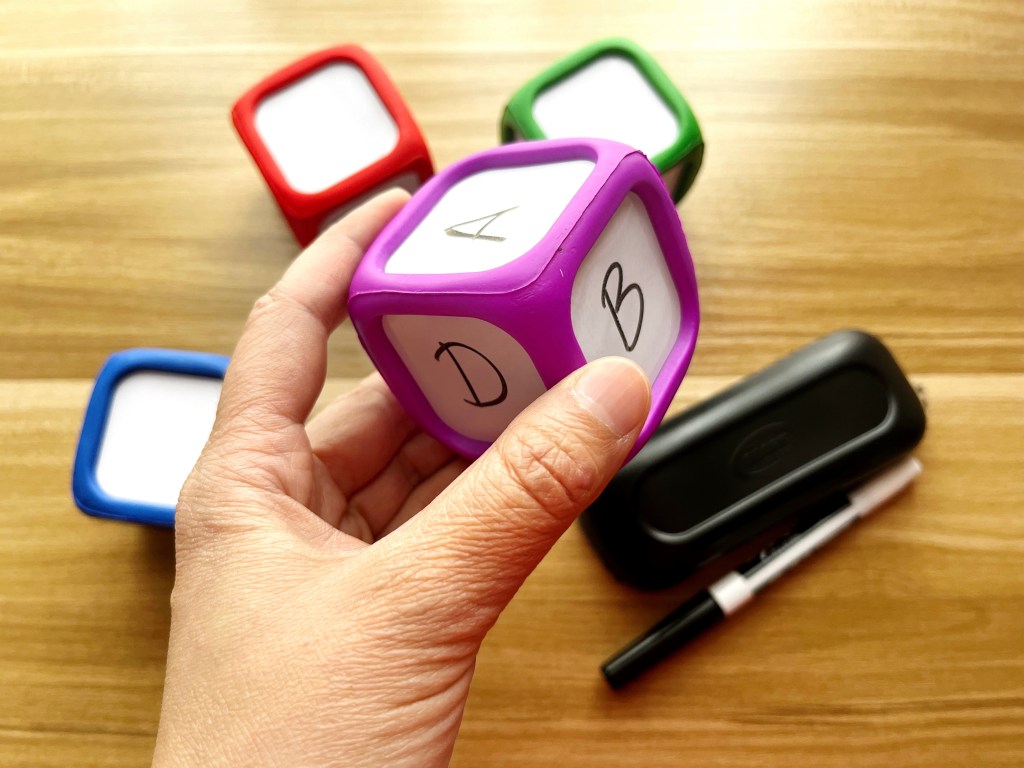
Hand holding a purple dry erase die with the letters A, B and D written on its sides in black marker. In the background are three other dice (a red one, a blue one and a green one) along with a dry-erase marker and eraser.

I especially like this particular dry-erase dice set because the whiteboard of the dice is lower and therefore protected by the colored elevated borders. This keeps what is written on the whiteboard from being rubbed off when the dice are rolled and also gives kids a good place to hold the dice so their fingers don’t erase the text.

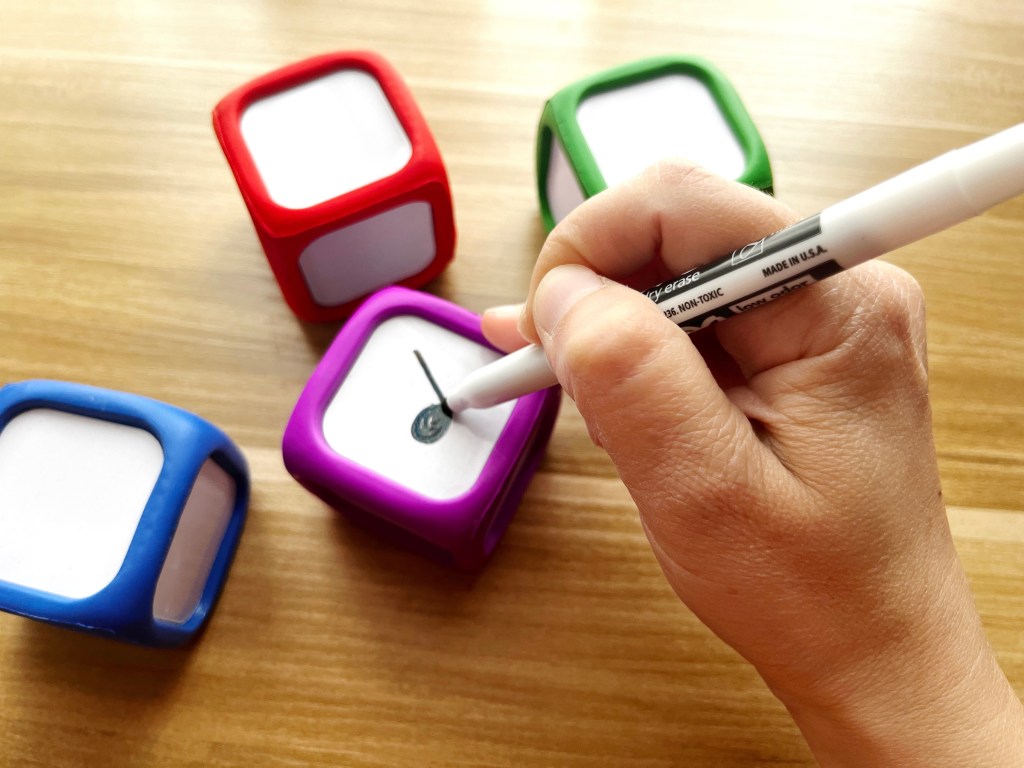
A hand holds a black dry-erase marker. It is drawing a quarter note on a purple dry-erase die. Three other dice sit in the background, a blue one, a red one, and a green one.

They are also great for younger kids since they are bigger and easy for them to handle.

Semi-Permanent Music Theory Dice

This is an excellent option for things you would like to use over and over again. I use these blank dice and labels.

15 blank white dice sit on a lighten wood table along with a page of 2 inch by 4 inch white labels.

I just write (or print out) the concept I want to drill on the label, cut it down to size, and stick it to the blank die. You can use a single label to cover all the sides of a die… and still have a lot leftover to use later.

Three pictures show the process of creating a music theory die. The first step shows a hand drawing a quarter note in black pen on a white label. The second step shows scissors cutting out the quarter note. The third step is to stick the label with the quarter note onto the blank die.

If I plan to use the die a lot, I also apply a layer of Mod Podge to protect the labels.

A hand holding a paint brush is applying a layer of Mod Podge sealant to the surface of a die.

If I ever need to change out the concept, it’s just a matter of peeling the label off the die.

With the dice all ready to go, it’s game time!!

Explore more creative teaching ideas
  • The Die of Destiny
    Speaking of dice, the Die of Destiny is a fun lesson starter when a student walks into my studio without their usual bounce in their step. I’ve found that a little silliness and a dash of chance gets them in the mood to pull out their piano books and play music!
  • Sky High Love
    Whose tower will remain standing in the end?!
    This adrenaline-inducing rhythm game is a great game to play with a homemade set of rhythm dice (just replace the rhythm sticks with dice!). AND it’s a great way to kick-off a lesson and get the energy up.

Let’s stay in touch, join the list!

As a “toucan” of our appreciation download a free set of note flashcards (link in our Welcome email)!

Processing…
Success! You're on the list.

We are a participant in the Amazon Services LLC Associates Program, an affiliate advertising program designed to provide a means for sites to earn advertising fees by advertising and linking to Amazon.com. As an Amazon Associate we earn from qualifying purchases.

How to Bow at a Piano Recital

You’ve just finished playing your piano recital pieces and now the audience is clapping, what do you do now??! It’s time to take a bow and enjoy the adulation for all the hard work you put into learning your pieces.
Bowing isn’t hard but it can be a little nerve-racking for a self-conscious or shy student. It’s important to practice bowing in the weeks leading up to the recital so that you feel totally comfortable and at ease with the process.
You can find a free printable summarizing how to bow at the Toucan Piano shop. It’s a great way to remind your students how to bow and to encourage them to practice bowing before a recital.
Why all the fuss about bowing?

There are many reasons to care about how you bow. A bow is a silent exchange between a performer and the audience. It’s a moment for each to recognize the other. It is a special moment and it should be savored and enjoyed.

A bow shows appreciation and respect for the audience. Nobody is obligated to clap for a performer.

Applause is a gift the audience is giving to the performer to show how much they enjoyed their performance.

A proper bow also shows self-respect. You have dedicated countless hours to your instrument and spent weeks or even months preparing your recital piece(s).

A nice bow is a way to give the music and your hard work the dignity they deserve.

I will go over a few different options for bowing, but first the basics!

The Basics

I teach my students five rules that all bows must have no matter which one they end up choosing:

1. Feet should always be together

A solid foundation for your bow is key. Your feet should be facing forward and the insides of your feet should be gently touching. It is not necessary for the heels to touch because this can cause tension in the knees and glute muscles. Your body should be relaxed when bowing, too much tension can throw off your balance.

Feet toghether in black ballet flats facing forward. Standing on a black and white rug.

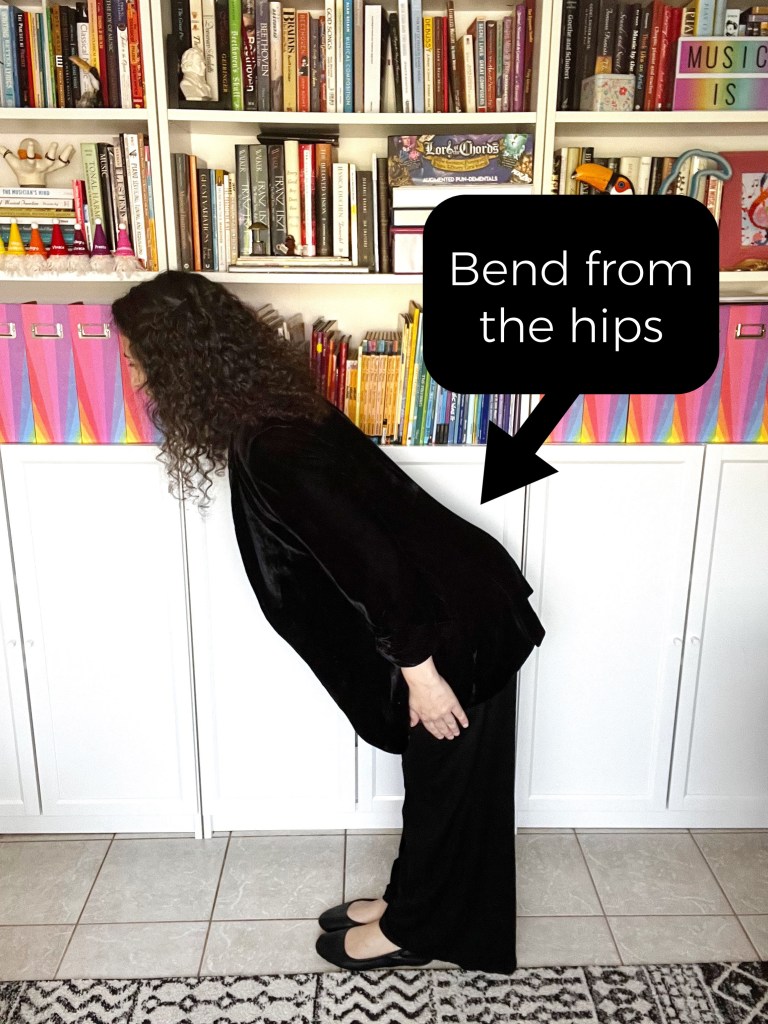
2. Bend from the Hips

Your body should bend at the hip joints, not from the back, the neck, or the knees. The bow from the hips should be deep enough that your gaze will fall upon your feet without having to look down.

Woman with curly brown hair, dressed in black pants and blazer, bending at the hips to show the proper body position for bowing.

3. Knees and Back should be Straight

Both your knees and back should be straight throughout the process of bowing. A curled back and bent knees gives the impression of a stomachache and bad posture.

Woman with curly brown hair, dressed in black pants and blazer, bending with a straight back and straight knees to show the proper body position for bowing.

4. Count Slowly to 3

The bow should look intentional and not rushed. As you are bending forward, slowly count to 3. Since your back is straight, your eyes will be facing forward and by the count of 3 you should see your feet. Then slowly count to 3 again as you return to an upright position.

5. Always Smile at the End of the Bow

This is your big moment!! Enjoy it! When you are finished bowing, smile to your audience.

Woman with curly brown hair, dressed in a black jumpsuit and blazer smiling at the the camera.

The Bow

I teach my students three different bows and let them pick which one they like best. The three options follow all the basic rules above and differ only in what the performer decides to do with their hands. Try them all out and see which one feels the most natural to you!

Bow no. 1

Place your hands at your sides. Your arms should be relaxed and your hands in an open position (no fists) with your palms in contact with your outer thighs. As you bow, your elbows will bend slightly so your hands do not move much from where you placed them on your legs.

Woman with curly brown hair, dressed in a black jumpsuit and blazer with her hands at her sides to show proper hand placement when bowing. Front view.
Woman with curly brown hair, dressed in a black jumpsuit and blazer with her hands at her sides to show proper hand placement when bowing. Side view.

Bow no. 2

Place your hands on the front of your thighs. Your arms should be relaxed and your hands in an open position (no fists) with your palms in contact with your legs. As you bow, your elbows will bend slightly so your hands do not move much from where you placed them on your thighs.

Woman with curly brown hair, dressed in a black jumpsuit and blazer with her hands at on her legs to show proper hand placement when bowing. Front view.
Woman with curly brown hair, dressed in a black jumpsuit and blazer with her hands at on her legs to show proper hand placement when bowing. Side view.

Bow no. 3

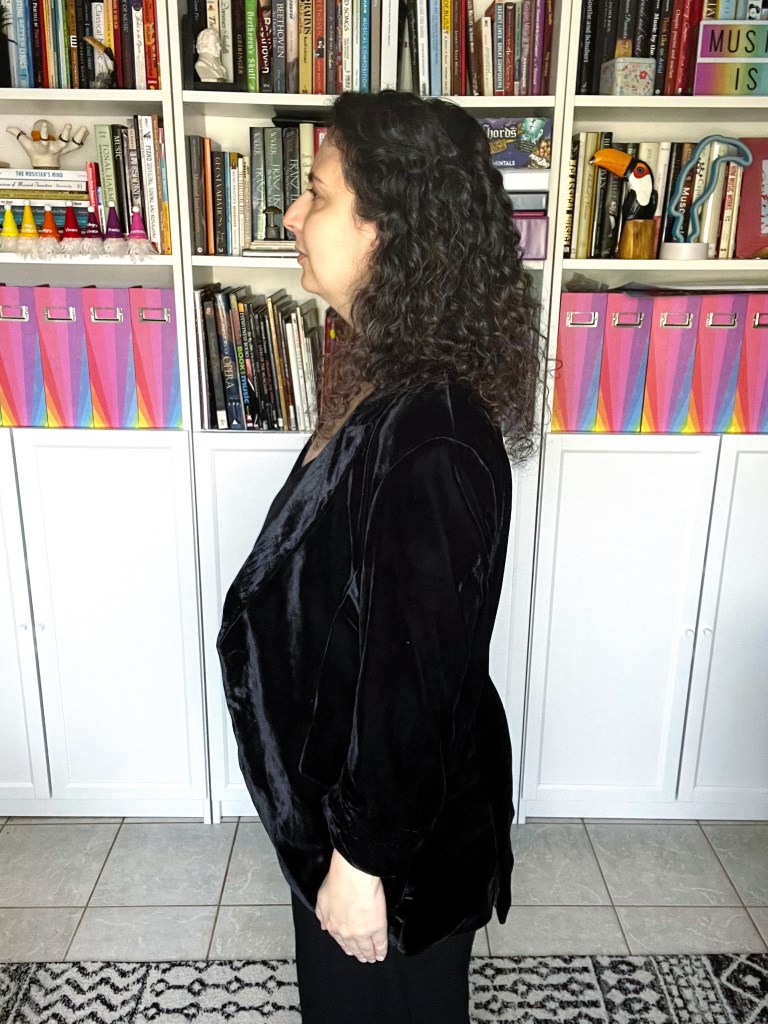
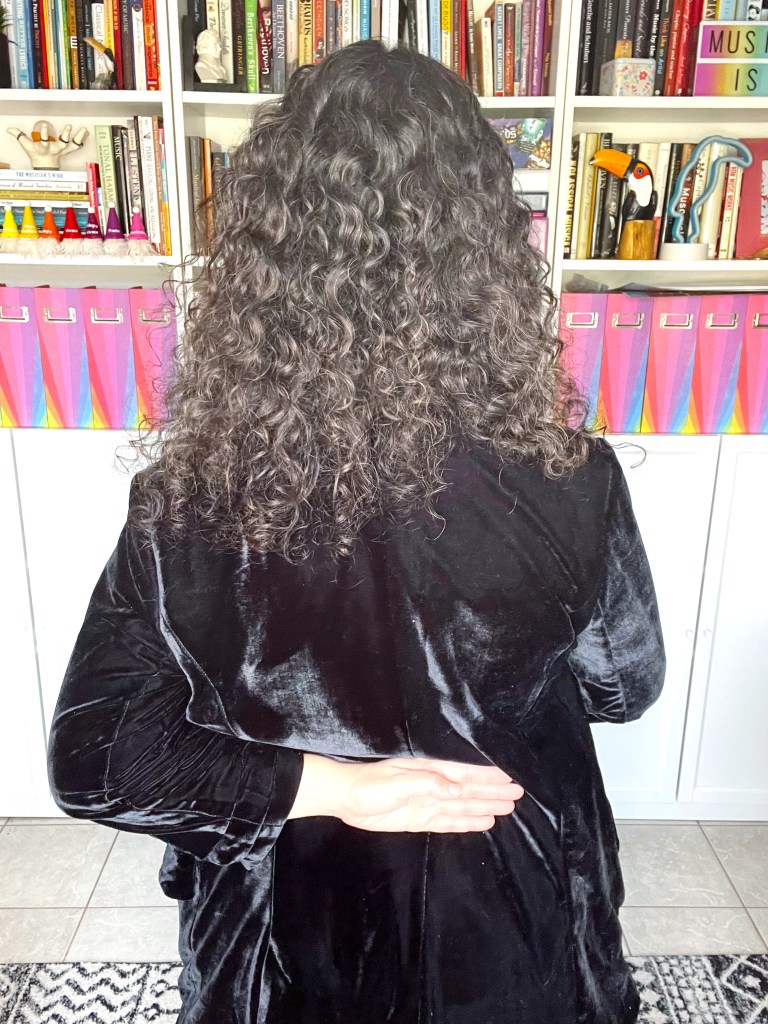
This is the bow most of my students end up picking! Place one open hand on your stomach. Your palm should be in contact with your body. Your other hand will be placed behind you so the back of your hand is touching the middle of your back (open hand, palm facing away from your body). Your arms and shoulders should remain relaxed as you bow.

Woman with curly brown hair, dressed in a black jumpsuit and blazer with her hand on her stomach to show proper hand placement when bowing. Front view.
Woman with curly brown hair, dressed in a black jumpsuit and blazer with her hand on her back to show proper hand placement when bowing. Back view.

Practicing your bow is of fundamental importance!

In a situation like a recital, where our nerves can sometimes get the best of us, it’s important to have routines that we can rely on to help us. There is nothing more intimidating than getting up from the bench and having hundreds of eyes looking straight at you. If you practice bowing, your body will remember what to do and it will be easier to just follow through on the big day.

After every practice session in the weeks leading up to the recital, take a bow as you leave the piano. Make it a habit to practice your bow and you will see how natural and comfortable you will feel bowing at the recital!

Even though we rehearse our bows before our recitals, some interesting bows tend to sneak in during our rehearsals! Here are some of my favorite ways NOT to bow.

You can download a summary of this blog post for your students at the Toucan Piano Shop.

Explore more creative teaching ideas
  • Rainbow Manuscript Paper
    This colorful manuscript paper is available in the Toucan Piano shop as a free printable! They are available in three sizes, so they can be used for a variety of ages and activities, like writing out original compositions, explaining music theory concepts, music dictation, games, and so much more!
  • Compose a Ringtone
    Ringtones are helpful but what if we could make them special too?! This is a fun and quick project that even the most reluctant students can get behind.
  • Chord Snowblast
    Build chords and collect points while trying to avoid the snow blast! Kids will test their knowledge of building chords AND they will actually be hoping to get all chords with sharps and flats!!

Let’s stay in touch, join the list!

As a “toucan” of our appreciation download a free set of note flashcards (link in our Welcome email)!

Processing…
Success! You're on the list.

We are a participant in the Amazon Services LLC Associates Program, an affiliate advertising program designed to provide a means for sites to earn advertising fees by advertising and linking to Amazon.com. As an Amazon Associate we earn from qualifying purchases.