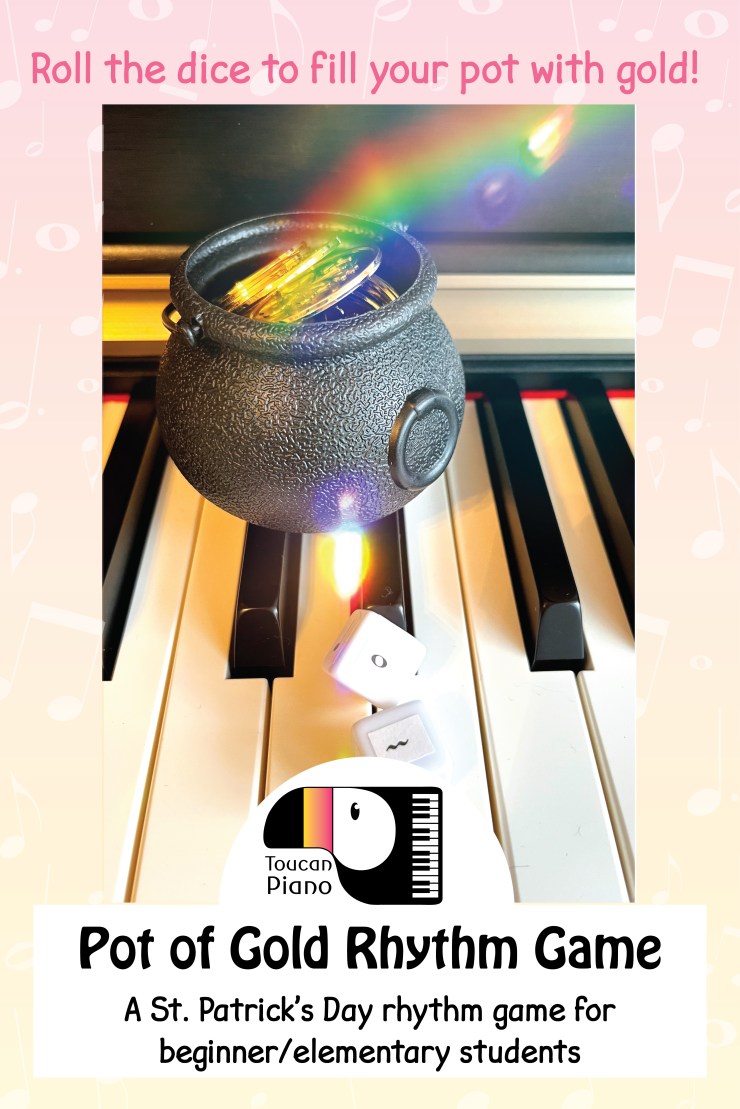
Pot of Gold: Rhythm Game

Happy St. Patrick’s Day!!! If you are looking for a last minute game to play with your beginner/elementary students with things you probably already have on hand, this simple rhythm game fits the bill! This game is great all year round, all you have to do is change the game markers.

For the St. Patrick’s day version of this game I am using 40 gold coins, mini pots/cauldrons (also great for Halloween games!), and rhythm note/rest dice. I made the dice by gluing note and rest stickers on the sides of a blank die. Check out my blog post on how to make your own music theory dice!

pot of gold coins with rhythm dice

The student rolls his/her rhythm die and names the note or rest it lands on.
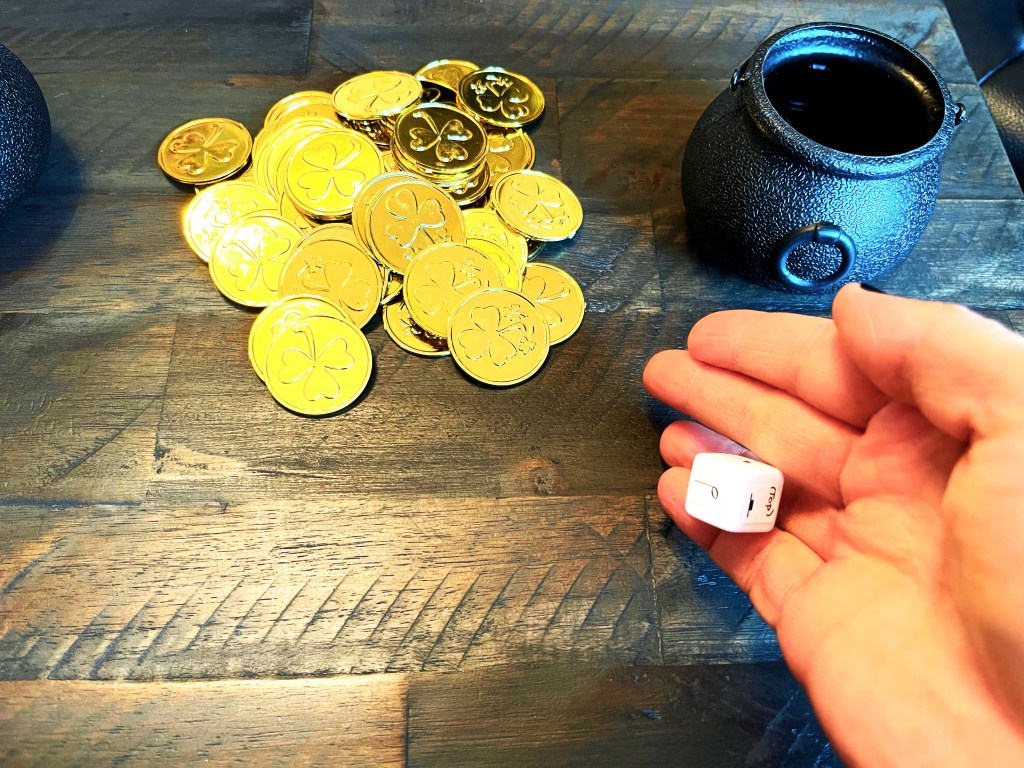
pot of gold coins with hand rolling rhythm die dice

The student should then determine the number of beats the note/rest gets and put the corresponding number of gold coins in his/her pot.

Half note rhythm die dice with two gold coins

For example, if the student rolled a half note, he/she should then place 2 gold coins in their pot.

hand placing gold coins in a pot cauldron

It is now the teacher’s turn. The teacher follows the same procedure above.

The first player to collect 20 gold coins in their pot wins!

For students who enjoy some adrenaline and intense competition, instead of taking turns, both players roll and fill their pots at the same time. When played this way, the game is turned into a race to see who will fill their pot first!

This is a fast-paced game which is great to play when you have less than 5 minutes to fill at the end of a lesson. And there is just something so satisfying about dropping the gold coins in the pots!

For more St. Patrick’s Day fun, check out Two Sides of the Same Coin in the Toucan Piano Shop. For three different ways to play it, check out the blog post Two Sides of the Same Coin.

Let’s stay in touch, join the list!

As a “toucan” of our appreciation download a free set of note flashcards (link in our Welcome email)!

Processing…
Success! You're on the list.

We are a participant in the Amazon Services LLC Associates Program, an affiliate advertising program designed to provide a means for sites to earn advertising fees by advertising and linking to Amazon.com. As an Amazon Associate we earn from qualifying purchases.
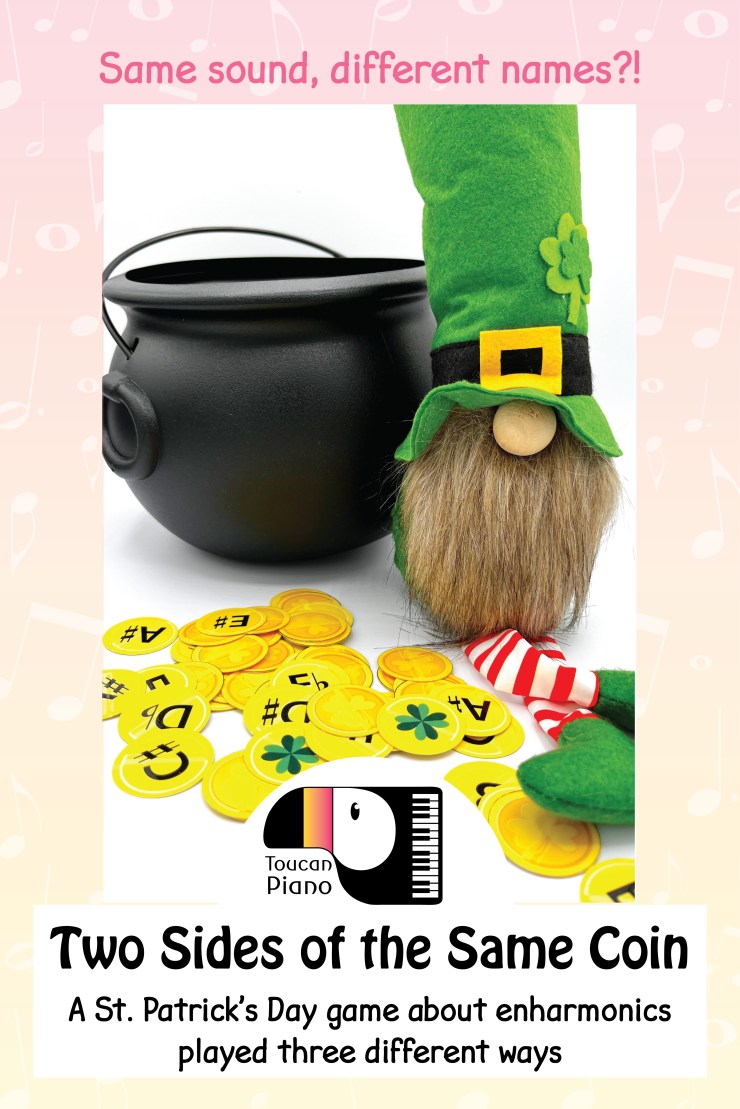
Two Sides of the Same Coin

St. Patrick’s Day is just around the corner and although I’m not Irish (but I do wear green on St. Paddy’s), I love the joy surrounding this holiday! Delicious food, great music, rainbows, and little mischief (courtesy of the Leprechaun)! What’s not to love?!

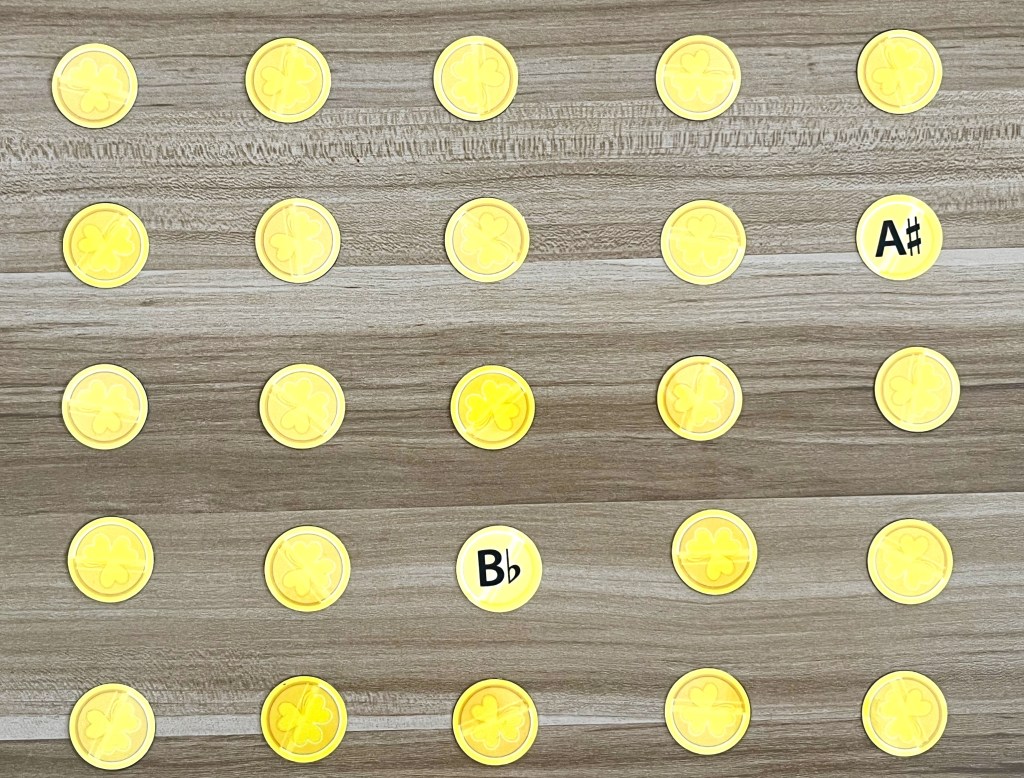
I always play games with my students during St. Patrick’s week and today I wanted to share a versatile game about enharmonics called Two Sides of the Same Coin (available in the Toucan Piano Shop)! It can be played at least three different ways with many different combinations of coins to put your students’ knowledge of sharps and flats to the test!

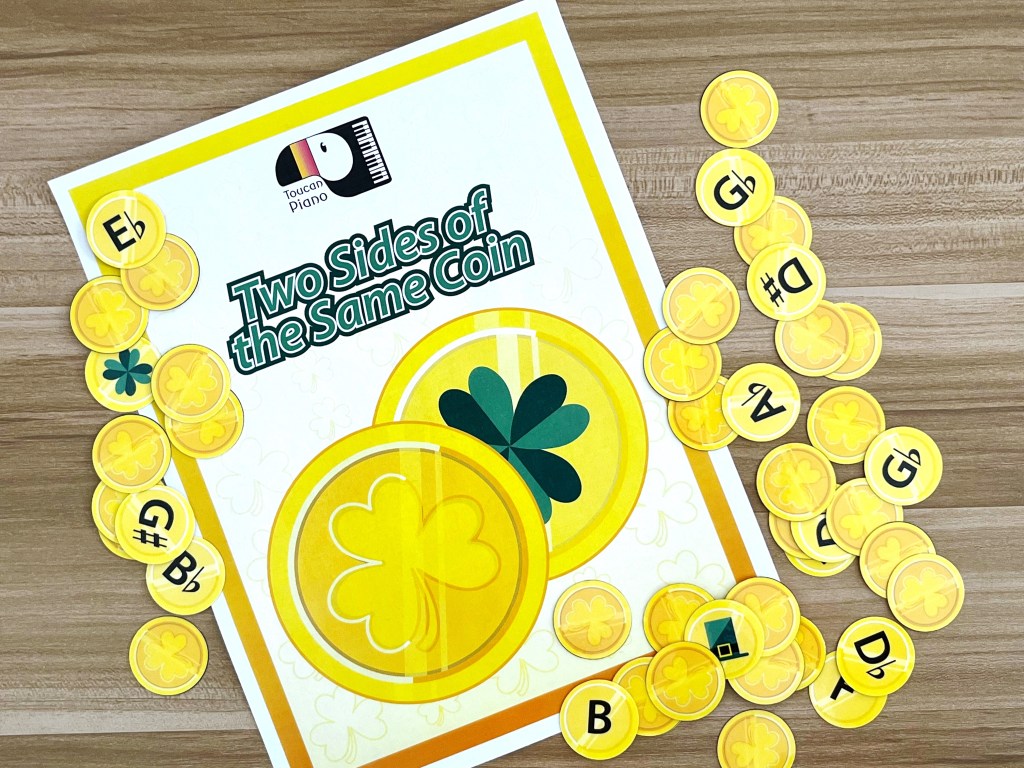
st patricks day piano game using gold note coins

As I mentioned, there are multiple ways to play this game based on your student’s level and what you would like to work on with them. The first is trying to create enharmonic pairs by drawing coins from a container (I used a cauldron/pot because it’s St. Patrick’s Day!). Detailed instructions are included in the game download. Here is a short reel of a student and I playing it:

Another way to play the game is as a Memory game. Place the coins face down with the golden shamrocks facing up. The student flips over two coins to see if they get a match. If they get a match, they keep the coins in their pile and go again. If they don’t get a match, it’s then the teacher’s turn. If the teacher gets a match, the teacher keeps the coins and goes again. If the teacher does not find a match, then it’s the student’s turn. Go back and forth taking turns looking for matching pairs until all the coins have been claimed. The player with the most coins at the end wins!

st patricks day memory piano game using gold coins

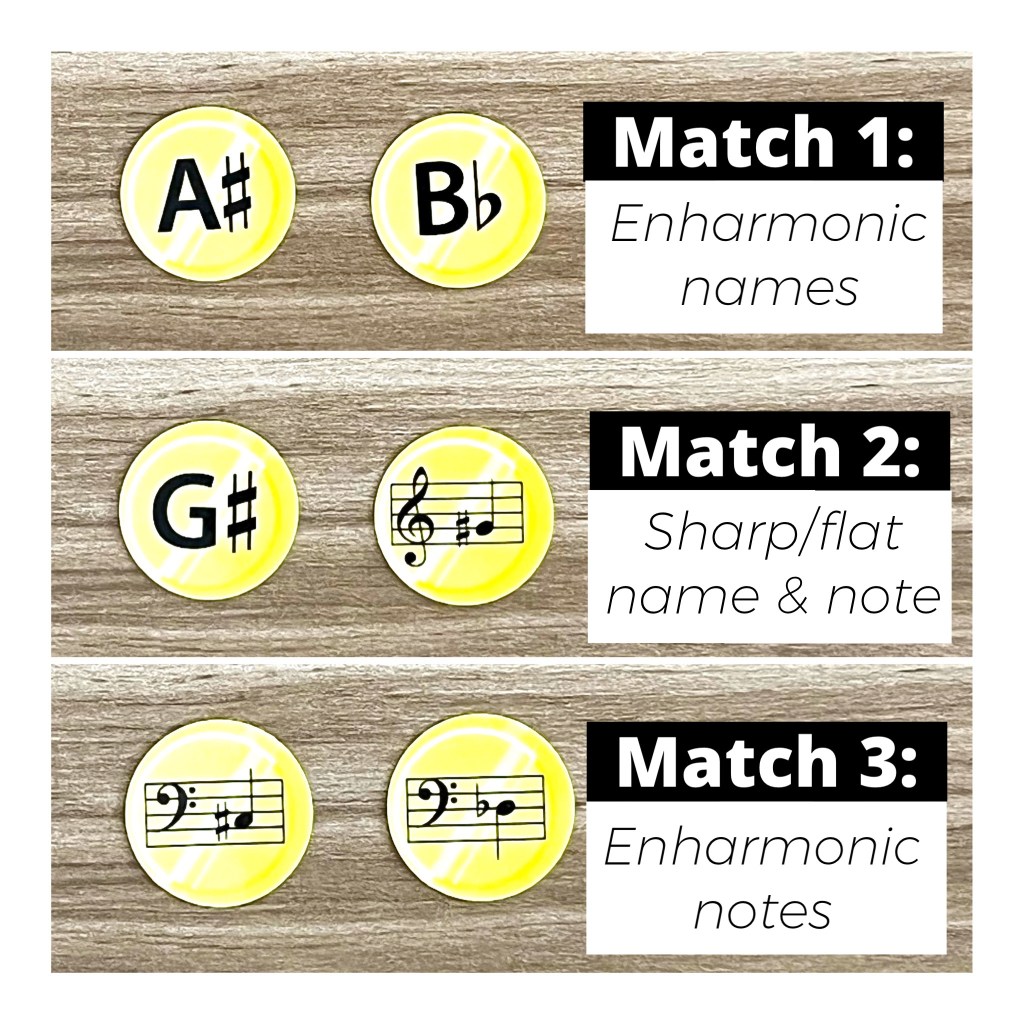
Matches can be any combination of coins you would like to drill:

  • Match the enharmonic names
  • Match the notes to their names (this version would be for students who are just learning to identify sharps and flats)
  • Match the enharmonic notes on the staff
st patricks day memory piano game gold coin notes and names matches

Another game to play is Mystery Note! The teacher chooses a key on the piano but does not tell the student which one it is. The teacher then sets a timer for 1 minute. The student has 1 minute to pull coins out of the container and play the corresponding keys on the piano to try to discover the mystery note. For example, the student pulls out an A-sharp, so the student must play the A-sharp on the piano in order to pull out another coin. If the student finds the mystery key, he/she must then name that key’s enharmonic in order to win! For example, the mystery key was C-sharp. The student pulls a C-sharp coin out of the container and plays the correct key on the piano. The teacher then says, “You’ve found the mystery note, what is the enharmonic of C-sharp?” The student must then say D-flat to win. For this version of the game, I would suggest using a smaller set of note coins depending on the student’s level and ease in naming notes on the staff.

Here is a reel of me challenging myself to find a note I chose at random! It was fun (and intense!… a minute goes by quickly)!! More competitive students will love the rush!

Two Sides of the Same Coin in available in the Toucan Piano Shop. I hope you have fun playing it with your students and may your day be touched by a bit of Irish luck!

Let’s stay in touch, join the list!

As a “toucan” of our appreciation download a free set of note flashcards (link in our Welcome email)!

Processing…
Success! You're on the list.

I Can Heart-ly Wait for the Punchline!

Valentine’s day is a month-long affair at my studio! As I tell my students, it’s a holiday that celebrates pink, I need to milk it for all it’s worth.

We’ve played a few different note-reading games this month and this one in particular had me giggling long after I had memorized all the punchlines for the jokes. It was so much fun to introduce a lot of my students to music theory jokes. From puns to just plain silly jokes, it was so funny to see the wide range of expressions on their faces when they “got” it (most called them “Dad jokes” but they laughed all the same! Because Dad jokes are hilarious!).

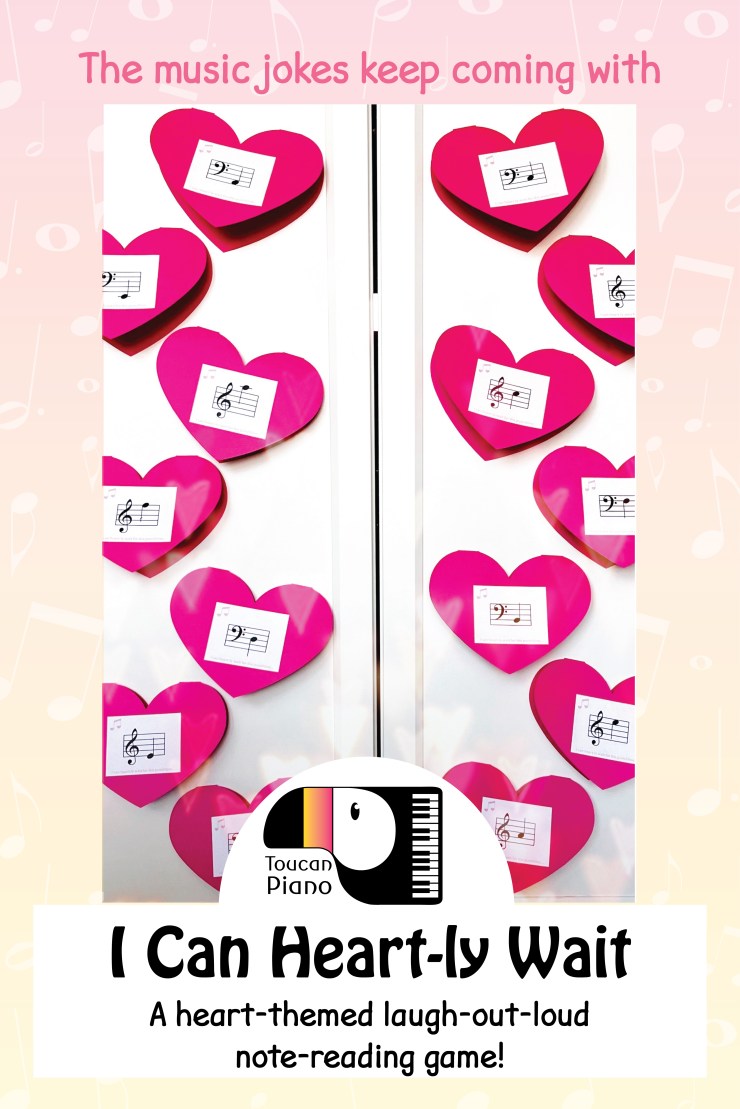
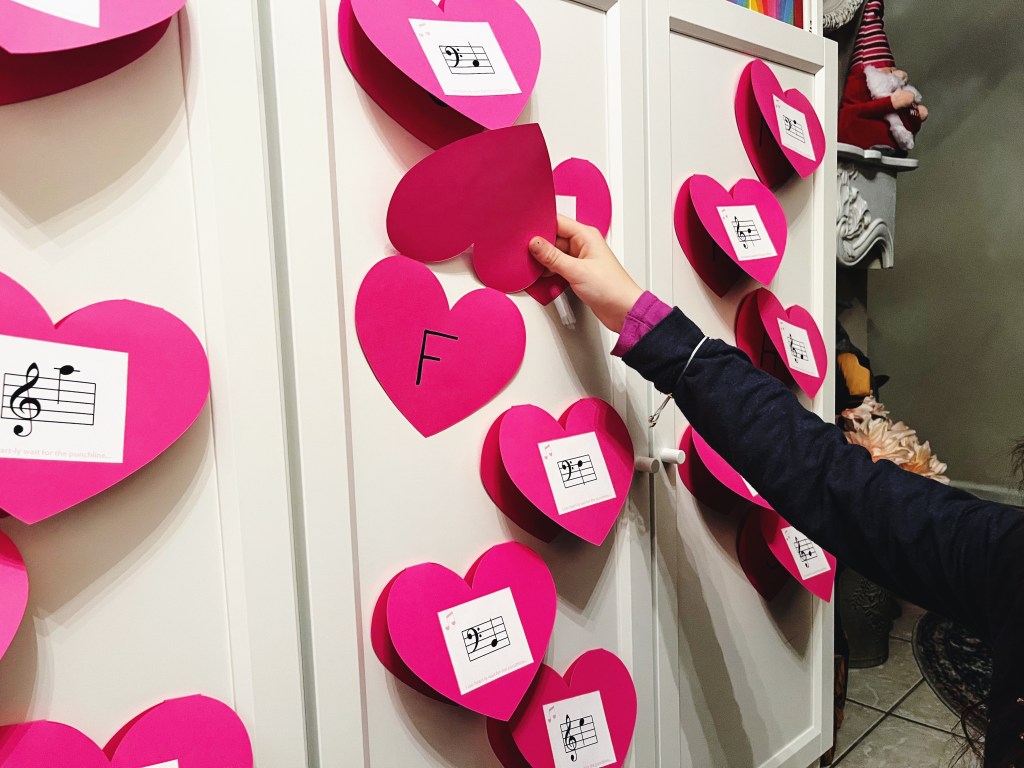
I wanted to go all out with this game so that it would be a decoration for my studio space as well as a game (I’m also sharing an easier way to play it up below). I wanted my student to be curious about it when they walked in. I cut out hearts and folded them in half; on the outside was a note on the staff and on the inside was a letter of the alphabet. Here is a reel I posted of how I made them:

I loved the way it turned out!!

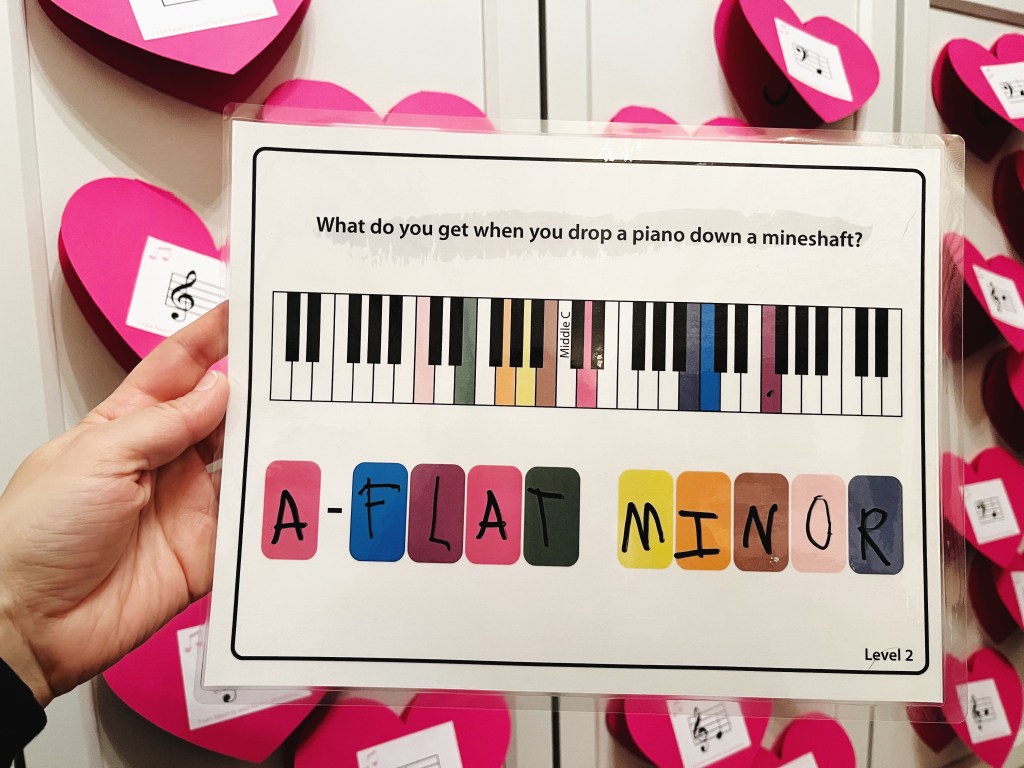
To play, I had my students randomly pick a joke:

I would have them read the setup of the joke and then I’d explain that the punchline is written out as a series of colored rectangles that they have to decode. Each color corresponds to a key on the keyboard picture. We would then pick a color and find the key on the keyboard printout (for example, blue is Middle C). Then they had to find that note on my wall of hearts to reveal the letter that goes in the punchline.

They would then write that letter inside the colored rectangle.

Once all the notes had been found and all the colored rectangles had been filled in, they would tell me their joke!

Here is another reel of me playing this game with a student:

I love this game because not only do students have to think about keyboard geography, they have to be able to associate the notes with their exact location on the piano. A tip I always started with was, “Look at the clef first!” because often they would find the correct line or space but the clef was wrong. They caught on quickly!

I have this game available in my shop: I Can Heart-ly Wait for the Punchline. It comes with 10 jokes for students to decode as well as all the hearts. The hearts are double-sided, one side has the note and the other, the letter of the alphabet, so set-up is much easier. I would love to hear what you think if you decide to play this game with your students! We had a blast!

Let’s stay in touch, join the list!

As a “toucan” of our appreciation download a free set of note flashcards (link in our Welcome email)!

Processing…
Success! You're on the list.

Musical MASH: A Note Reading Game that Predicts the Future

Did you play MASH (Mansion, Apartment, Shack, House) when you were a kid? All it required was a piece of paper and a pencil! My friends and I would spend countless recesses trying to find out if we would marry our crushes, have 20 kids while living in a mansion (we all wanted the mansion, of course) and driving a Ferrari! It was loads of fun and provided a lot of good laughs! If you want to check out the original game, MASH+ has all the details.

This Valentine’s Day my students and I are playing the musical version of MASH (maestro, accompanist, soloist, hobbyist) that I created! We will be drilling our knowledge of the spaces on the grand staff while figuring out our musical futures!

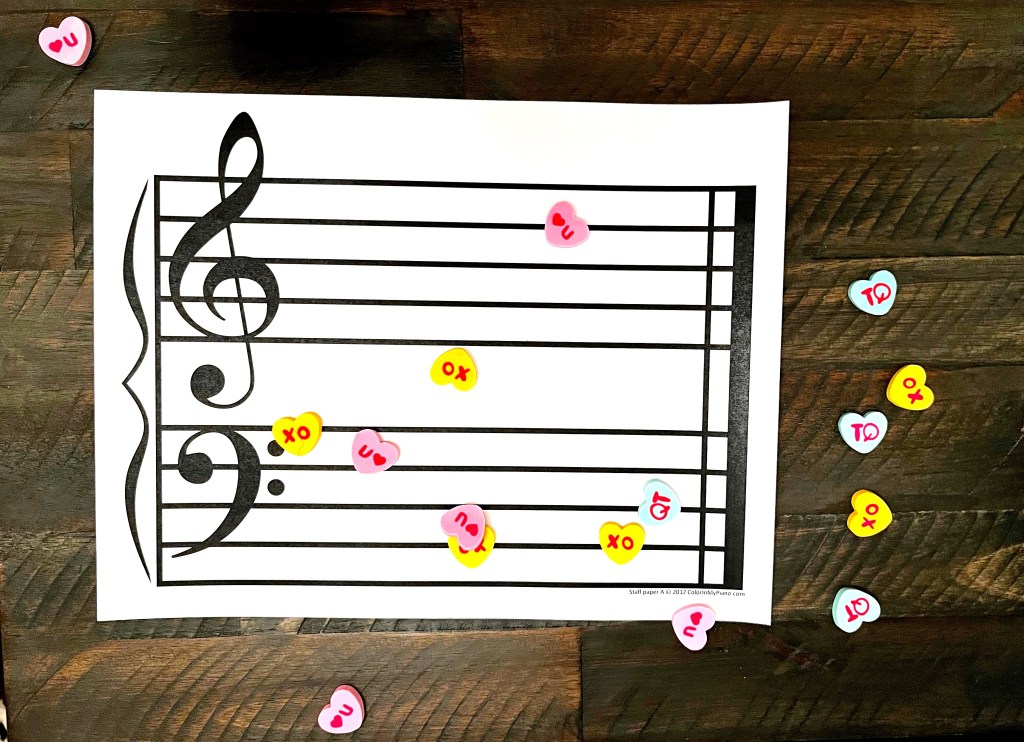
It’s a fast, easy game to play, and has already given us some funny results! I am using a print-out of the grand staff and some mini-erasers in my example here but it could also be played with a floor staff and beanbags or at the piano (see the instructions in the download for details).

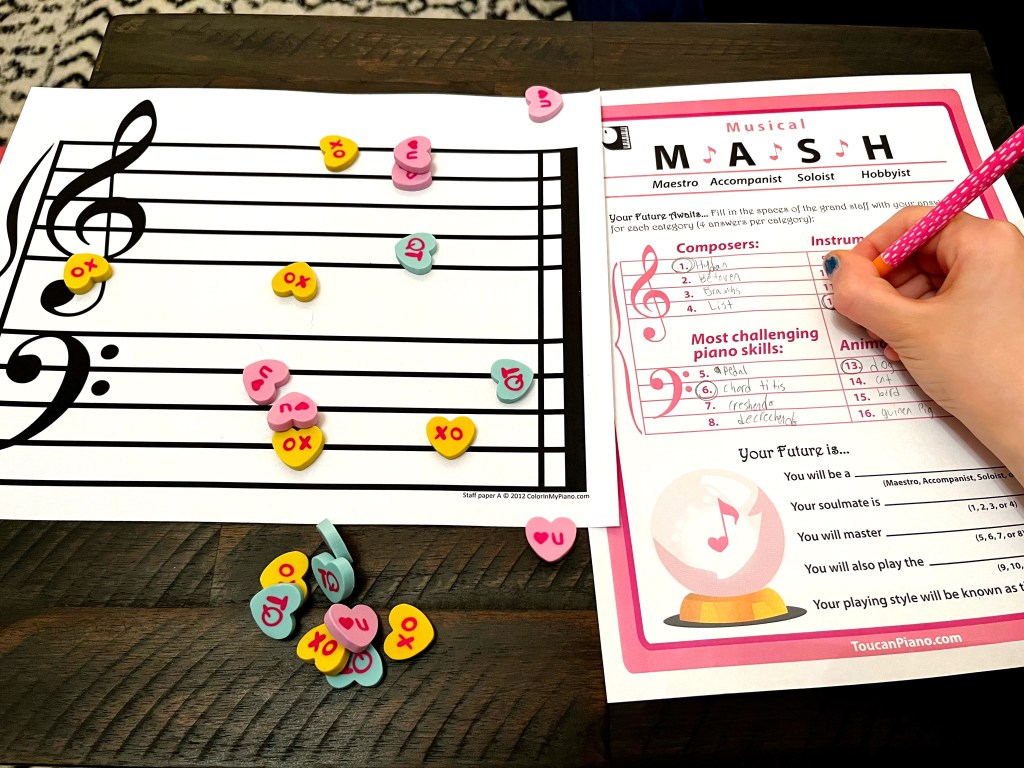
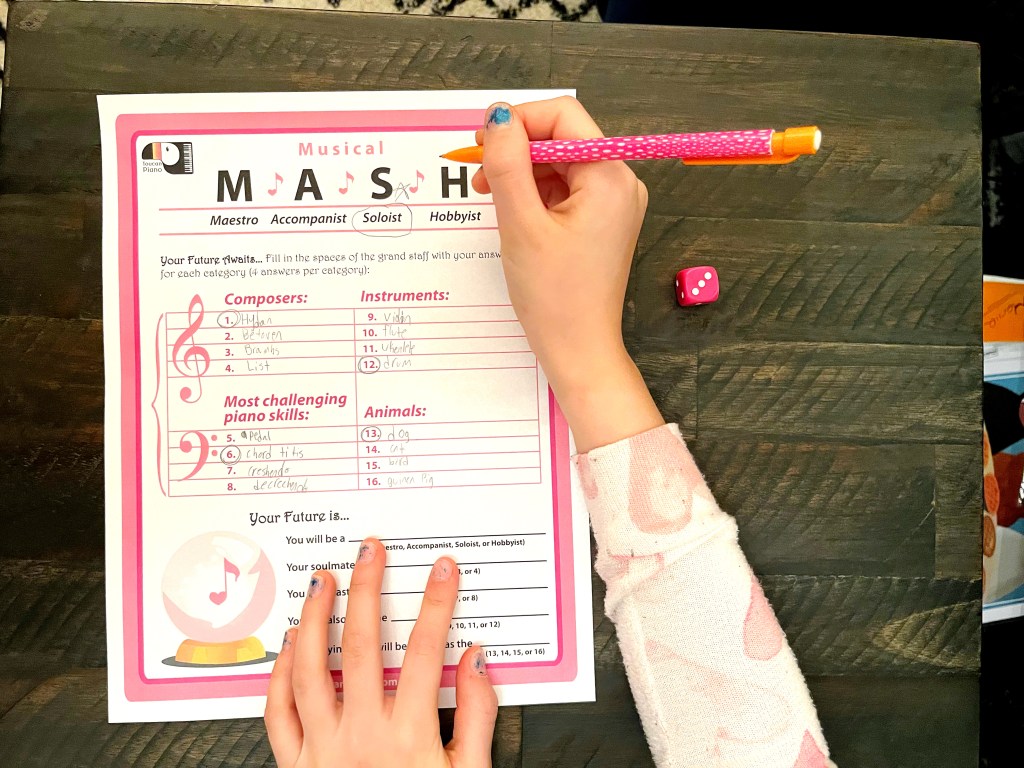
First have the student fill out the four spaces for each category. You can ask them to name the spaces of the grand staff as they write their answers in each space.

Hand them some mini-erasers (I’m using heart shaped ones for Valentine’s Day!). They should close their eyes while dropping the erasers onto the grand staff. They can drop them one by one or a few at a time (the teacher can call out when an eraser has landed on a space).

When they open their eyes they evaluate if any of the erasers landed on the spaces of the grand staff (for added drilling, you can have them name all the lines and spaces that the erasers landed on).

They then take note on the Musical MASH worksheet of where the erasers landed. Repeat the same procedure until the student has obtained an answer in all four categories.

In order to decide if the student will be a Maestro, Accompanist, Soloist, or Hobbyist, you can roll a die (for example, 1 = Maestro, 2 = Accompanist, 3 = Soloist, 4 = Hobbyist, 5/6 = Roll again) or use the traditional MASH spiral method (explained at MASH+). Circle their future career at the top of the page, under the title.

The student should then fill in the blanks at the bottom of the page with the answers to their future!

If you would like to play Musical MASH with your students, download it for free at the new Toucan Piano Shop! I am currently setting up the shop with new products, so if you are interested in staying up-to-date with the latest blogposts and shop updates, join the email list below (no spam, I promise!).

Let’s stay in touch, join the list!

As a “toucan” of our appreciation download a free set of note flashcards (link in our Welcome email)!

Processing…
Success! You're on the list.

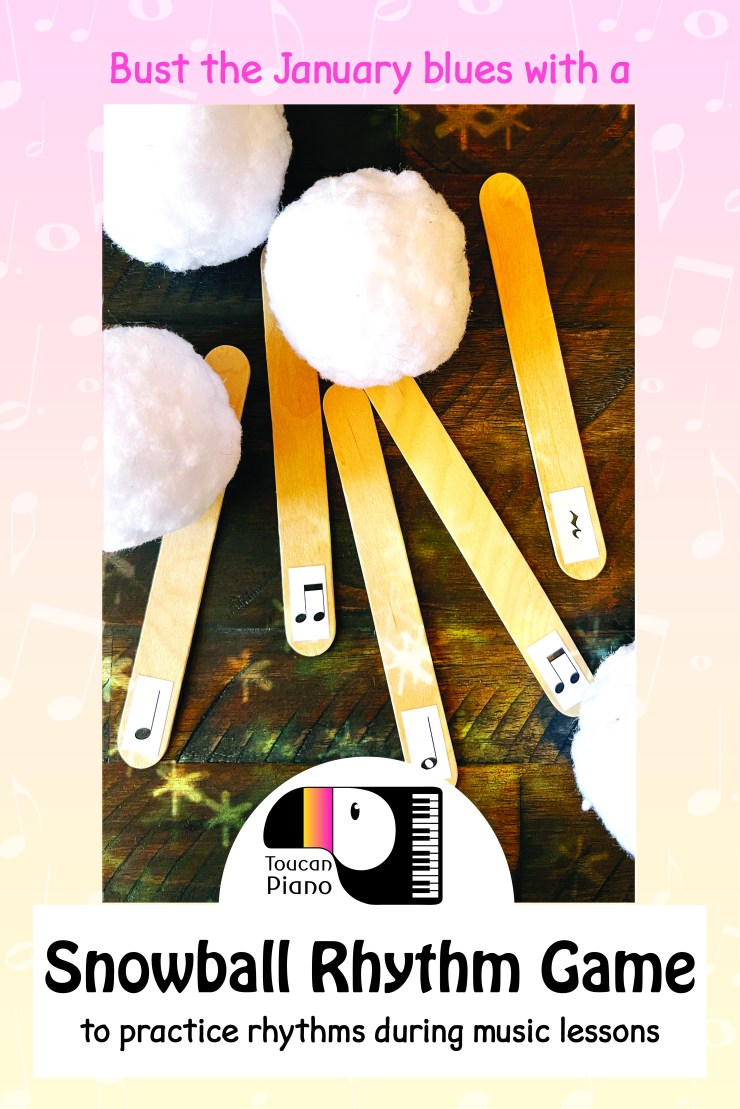
Snowball Rhythm Game

One of my favorite rhythm games to play with my students is Busted! from the Stay Tuned! blog. It’s easy to put together, easy to play, and a lot of fun!

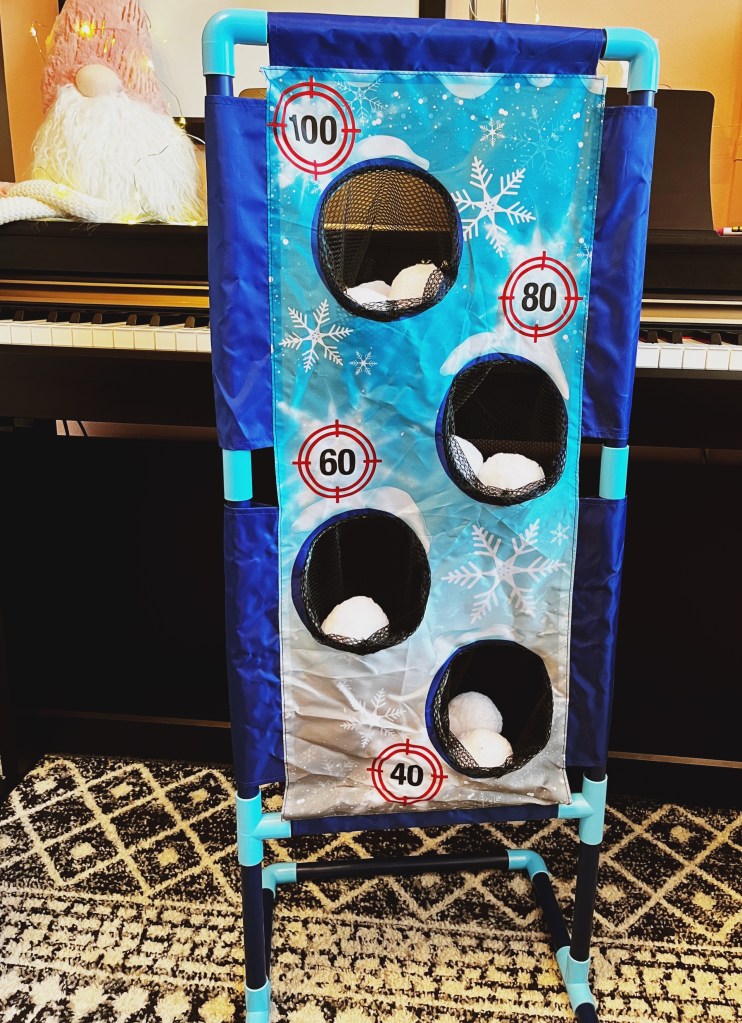
Every now and then I like to change it up a bit to keep it fresh. And that’s where snowballs come into play! I found my snowball toss game at Walmart marked down after the holidays and thought it would be a fun way to kick off my lessons after Winter Break (but any target-type game will work). It was a huge hit!! The kids have been asking to play it for the past couple of weeks and it’s been fun to dust off our rhythm skills after two months of Christmas Carols (we start in November, the day after Halloween!).

Here is a similar game from Amazon that works just as great and can be used for any season of the year!

Here’s how we played it:

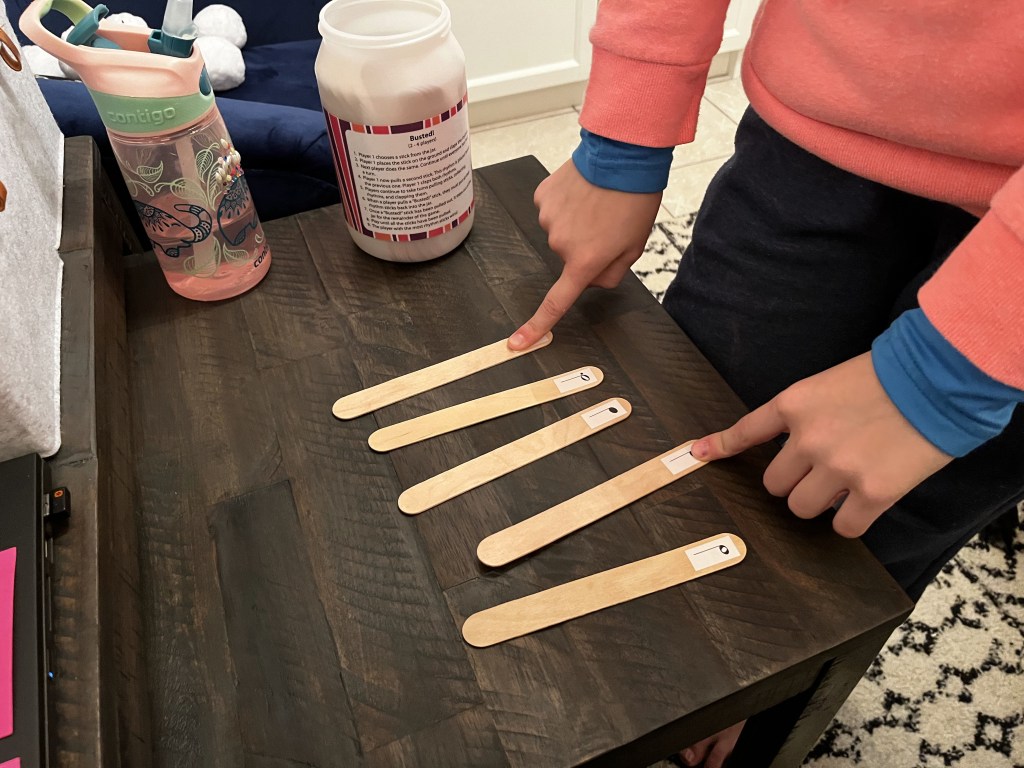
Place all the rhythm sticks inside the container along with only one “Busted!” stick.

Each player gets two chances to land a snowball in a hole before it’s the other person’s turn.

The first player (I always let the student go first), tosses a snowball at the board.

If the snowball lands inside one of the holes, the player removes the number of rhythm sticks corresponding to the hole the snowball landed in (for example, 40 hole = 2 rhythm sticks, 60 hole = 3 rhythm sticks, 80 hole = 4 rhythm sticks, 100 hole = 5 rhythm sticks). The player lays out the sticks to create a rhythm sequence. If the player already has sticks from a previous turn, the new sticks are placed after the last stick of the previous sequence, thus creating a longer rhythm sequence.

In order to earn the points, the player must clap and count the rhythm sequence correctly.

Then it is the next player’s turn. Repeat the same instructions.

Play continues until someone pulls out the “Busted!” stick and the game ends.

The total score of each player is calculated and the player with the highest score wins.

The game is more fast-paced then traditional Busted! (which can take awhile to play depending on how many rhythm sticks you used) and the kids had an absolute blast! It would be a fun game to play at piano party, buddy lesson, or a group lesson.

I plan on using this same game board for other games, I want to get some mileage out of it (and improve my aim!! I learned that my sweet spot is the 80 points hole, but I can’t seem to get the snowballs in any other hole! lol). It will most definitely be back and revamped!

Let’s stay in touch, join the list!

As a “toucan” of our appreciation download a free set of note flashcards (link in our Welcome email)!

Processing…
Success! You're on the list.

We are a participant in the Amazon Services LLC Associates Program, an affiliate advertising program designed to provide a means for sites to earn advertising fees by advertising and linking to Amazon.com. As an Amazon Associate we earn from qualifying purchases.
I wrote a Book!

I’ve always loved to draw. Growing up, piano and art were my two favorite things to do. Come to think of it, not much has changed since then! I can’t watch TV without a sketchbook in my lap (one, because I love to draw and, two, because if I’m not actively doing something I will usually fall asleep while watching TV! lol). My dream was to write and illustrate my own graphic novel.

I finally did it!!!

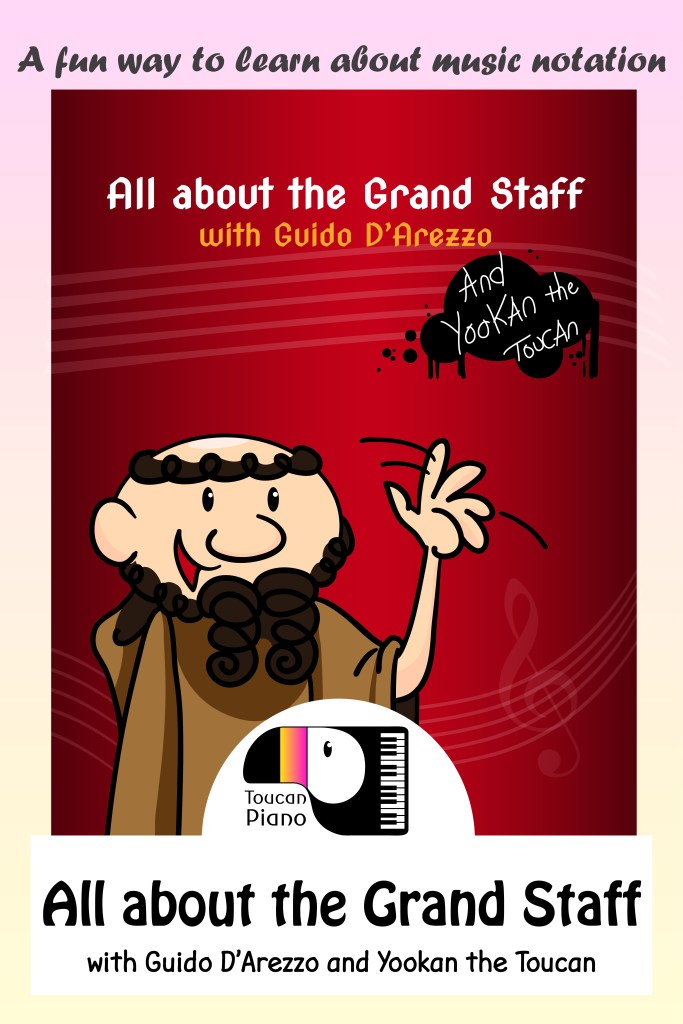
I usually teach the basics of the grand staff over the course of a few weeks to beginner students once they can identify all the keys on the piano and are playing off-staff pieces with ease. I break it up into bite size bits so we can play games to reinforce each new concept. This graphic novel follows the same progression I use to teach my students but with some history (hello, Guido D’Arezzo!), short exercises to reinforce concepts, and a little silliness tossed it (courtesy of Yookan the Toucan).

The story begins when Guido D’Arezzo (pronounced Gwee-doh Dah-ret-so), the medieval Italian monk who invented a system for writing down music, meets Yookan the Toucan. Guido helps Yookan learn about lines and spaces and how the grand staff is actually a map of the piano. Yookan, always the enthusiastic helper, uses Guido’s piano to demonstrate his understanding of each concept (let’s just say, that piano will never be quite the same!). The treble clef and bass clef are introduced along with anchor notes (bass F, middle C, and treble G) and the concept of stepping on the staff.

Interspersed throughout the book at a few key moments are short exercises for students to test their understanding. All answers are provided in the back of the book. These exercises provide natural break points in the story which makes it easy for teachers to assign pages for students to read at home.

It is also a great option for homeschoolers or anyone with an interest in learning the basics of musical notation. The story is presented in a sequential manner, each concept building upon the previous one, so that the reader can learn independently.

To say I’m feeling like a proud mama is an understatement! I loved writing this book and I truly hope that it will help piano students or anyone curious about how musical notation works for the piano. I’m already itching to write another one!

It is available on Amazon in both paperback and Kindle format (if you have Kindle Unlimited, you can read it for free!). Check it out here.

Let’s stay in touch, join the list!

As a “toucan” of our appreciation download a free set of note flashcards (link in our Welcome email)!

Processing…
Success! You're on the list.