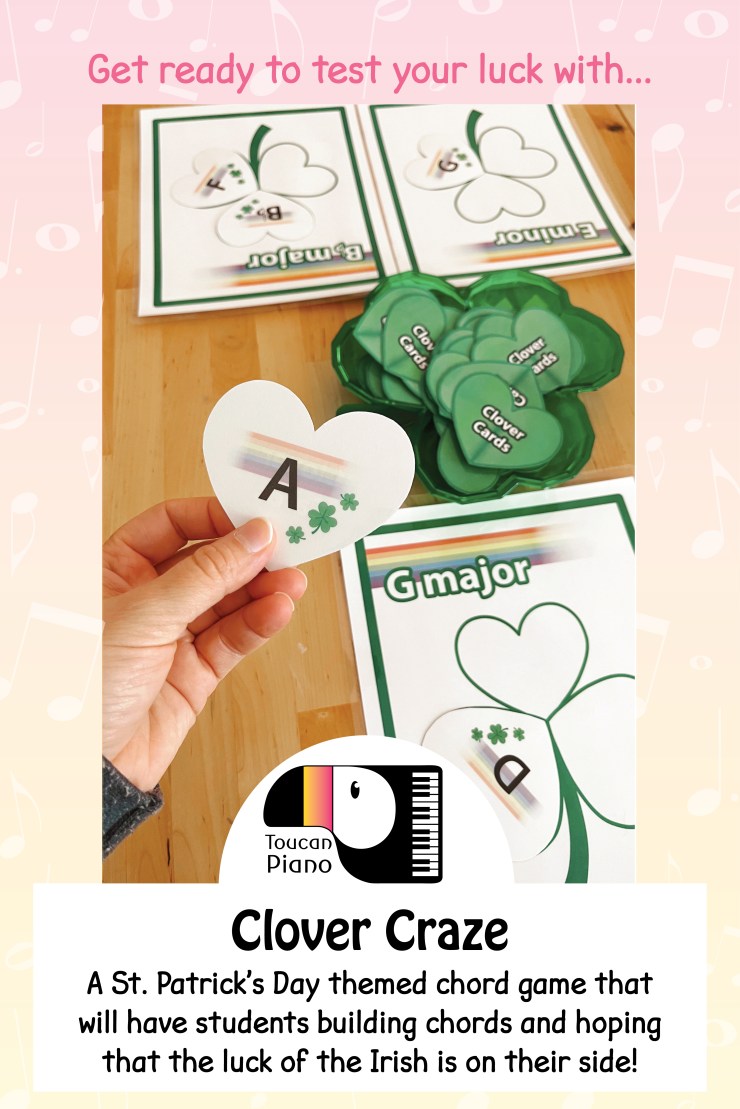
Clover Craze: A St. Patrick’s Day Chord Game

You know you have a good game when your piano students end the game by saying, “That was so fun!” A parent even joined in to play during his son’s lesson (all three of us played). He had a blast!

The chord game Clover Craze is displayed on a wood table. A leprechaun-gnome holding a "Happy Be Lucky" signs lays next to the chord gameboards. Clover cards are organized in a clover-shaped bowl.

Clover Craze is a chord building game where students test their knowledge of major and minor chords (12 total) while trying to complete their gameboards. But there’s a twist – and players could end up with WAY more clovers than they bargained for! 

Clover Craze is available for purchase in the Toucan Piano Store.

The game starts innocently enough with each player drawing a gameboard. The teacher and student go over the notes that make up each of the chords. Then they take turns drawing Clover Cards to see if they can find the notes they need to complete their chords.

Two players play Clover Craze. A player draws a Clover Card from the clover-shaped bowl.

But there are wildcards mixed in with the notes and they’ve been touched by the mischievous leprechauns! The wildcards are meant to shake things up and bring the craze to Clover Craze.

A player draws another chord gameboard.

What I love about Clover Craze is that it has students working on multiple chords at once (players start with one but that changes quickly thanks to the wildcards!). They have to really think about each note that they draw and check every chord to see if it belongs to one of them. The record so far is a student working simultaneously with 7 chords (that student won the game and got a kick out of managing all their gameboards)!

What I love about Clover Craze is that it has students working on multiple chords at once (players start with one but that changes quickly thanks to the wildcards!).

My students and I played Clover Craze the entire week leading up to St. Patrick’s Day. Several students came back the following week asking to play again (which make me SO happy!).
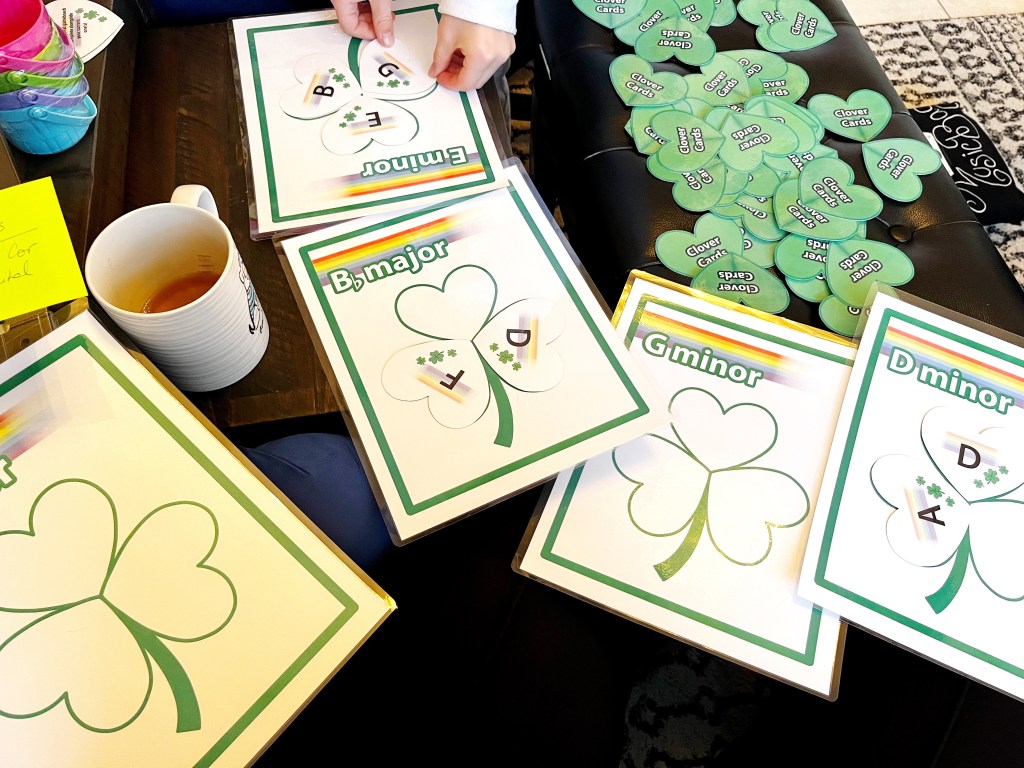
A piano student completes his chord during a piano lesson, thus winning Clover Craze.

Clover Craze is available for purchase in the Toucan Piano Store.

Explore more creative teaching ideas
  • St. Patrick’s Day Piano Games
    Bring the luck of the Irish into your piano lessons this St. Patrick’s Day with fun and engaging music theory games that make learning feel like a celebration!
  • Musical Madness – A Basketball-Inspired Music Appreciation Competition
    Your students will experience the thrill of the competition as composers are pitted against each other in a March Madness-style showdown! This interactive approach not only introduces students to classical music and composer but also fosters critical listening skills and helps develop personal musical preferences.
  • Prac-Tris: A Videogame-Inspired Practice Challenge
    Music teachers often wish their students would to step up their practice game. So why not turn it into an actual game? And not just any game, but a videogame-inspired practice game? Prac-Tris will have your students stacking practice days as they work their way to the top… of the board and their musical mastery!

Let’s stay in touch, join the list!

As a “toucan” of our appreciation download a free set of note flashcards (link in our Welcome email)!

Processing…
Success! You're on the list.

We are a participant in the Amazon Services LLC Associates Program, an affiliate advertising program designed to provide a means for sites to earn advertising fees by advertising and linking to Amazon.com. As an Amazon Associate we earn from qualifying purchases.
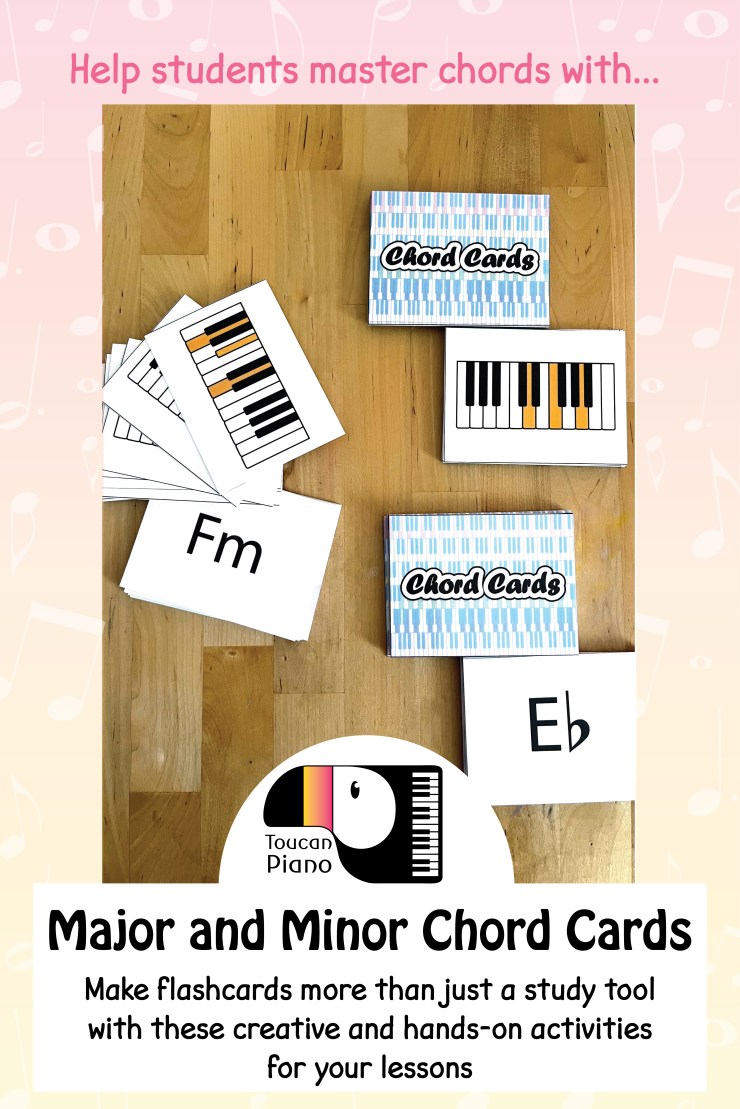
Chord Flashcards – How to Use them with your Students

I’m going to just come out and say it… I love flashcards!

Fingers making the shape of a heart hover over chord flashcards.

Flashcards are often stereotyped as being boring, repetitive, and only useful for basic memorization or geared towards younger kids. Some argue that they don’t suit creative learners or that digital tools have made them outdated. However, flashcards are extremely effective for active recall and the long-term retention of concepts.

And the best part? They have SO many uses! From interactive games and hands-on activities to group challenges, the possibilities are endless!

Sending flashcards home for students to drill (the Toucan Piano double-sided chord cards are a great option for home study!) is a fantastic way to reinforce their learning between lessons. But flashcards aren’t just for independent review — there are countless creative and engaging ways to use them during lesson time, helping students see just how much creative thinking can come from this simple tool!

The Toucan Piano major and minor chord flashcards are available as a free download in the shop here.

  1. Chord Activities
    1. Name that Chord
    2. Build a Chord
    3. Part of the Family
    4. Progressions
    5. Inversions
  2. Chord Games
    1. Chord Match/Memory
    2. Speed Chords
    3. Chord Relay
  3. Let’s stay in touch, join the list!

Chord Activities

Hands-on activities during lessons are a fantastic way to engage students in learning about chords. Taking just a few minutes during a lesson to review chords can reap enormous benefits over time… Students will gain confidence in playing chords, recognizing them in their music, and using them in their own improvisations and compositions.

Name that Chord

Students starting out with chords initially work on feeling the shape of chords, using the correct fingering, and identifying the difference in the sound produced by a major or minor chord.

Using the keyboard chord cards, draw a card from the deck. Have the student find the keys on the piano that match the card (start with either the right hand or the left hand). Have the student play the chord and then try to name it.

Taking it one step further, can the student then transform that chord into its major or minor version?

Chord cards sit on the piano while a piano students play a B minor chord.

Build a Chord

Another beginner activity, this has students trying to build the chord from its symbol.

Using the chord symbol cards, draw a card from the deck and have the student place mini-erasers or gems on the keys that constitute that chord.

Chord cards sit on the piano while a piano students uses gems to mark the keys that make up the chord of E flat major.

Part of the Family

Understanding which chords belong to a particular key family is an essential skill for coming up with chord progressions, improvising, and recognizing the harmonic progression in a piece.

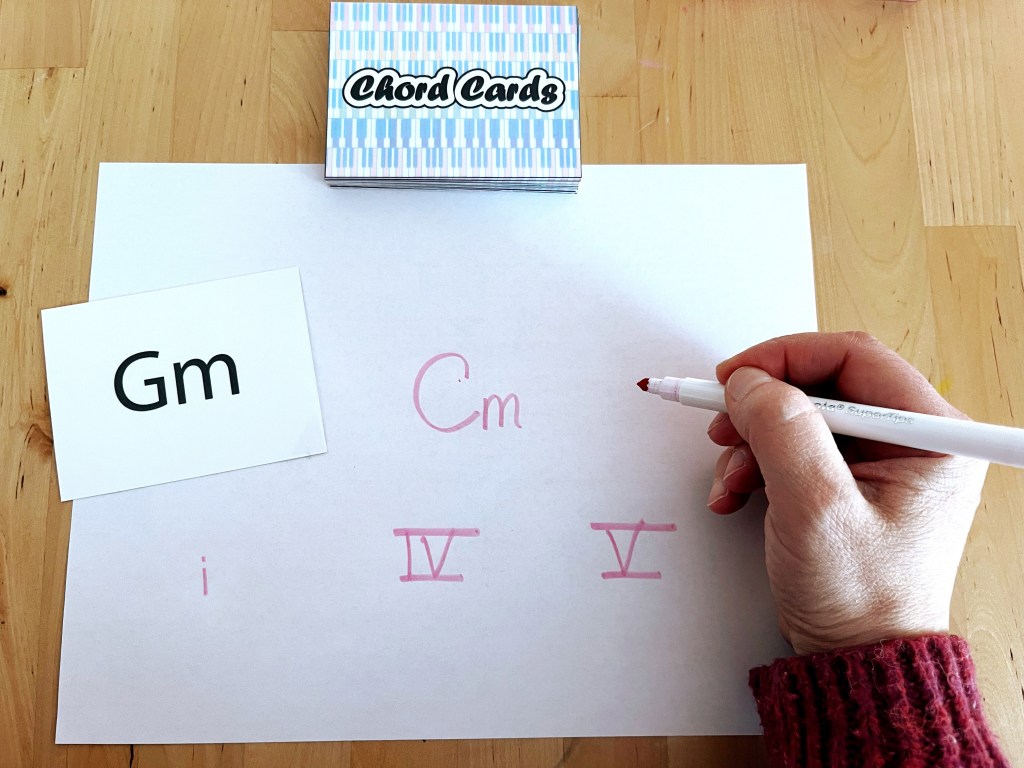
Using the chord symbol cards, draw a card from the deck. The chord on the card is the “One” chord (I or i in Roman Numerals). Have the student write out the IV and V chords of the key.

A piano student writes out the four and five chords in the key of G minor. A deck of chord cards sits on the table above the paper.

Progressions

Once students have a solid understanding of key families, they can experiment with building different chord progressions.

For added fun, have them also experiment with chords outside the key. Ask the student how that chord affects the progression? What sort of emotion or mood does it introduce? If you were to continue the chord progression from the new chord, which chord would make sense to use next?

Chord cards are placed on the piano. They outline a chord progression. The piano student is playing the progression, starting with the D major chord.

Inversions

Moving between chords is another essential skill for playing chords smoothly and with ease. Jumping from a root position chord to another can result in a large leap on the piano, which can be technically challenging for a student to manage. Additionally, these large jumps can create abrupt shifts in the sounds which, depending on the music, can negatively affect the overall mood.

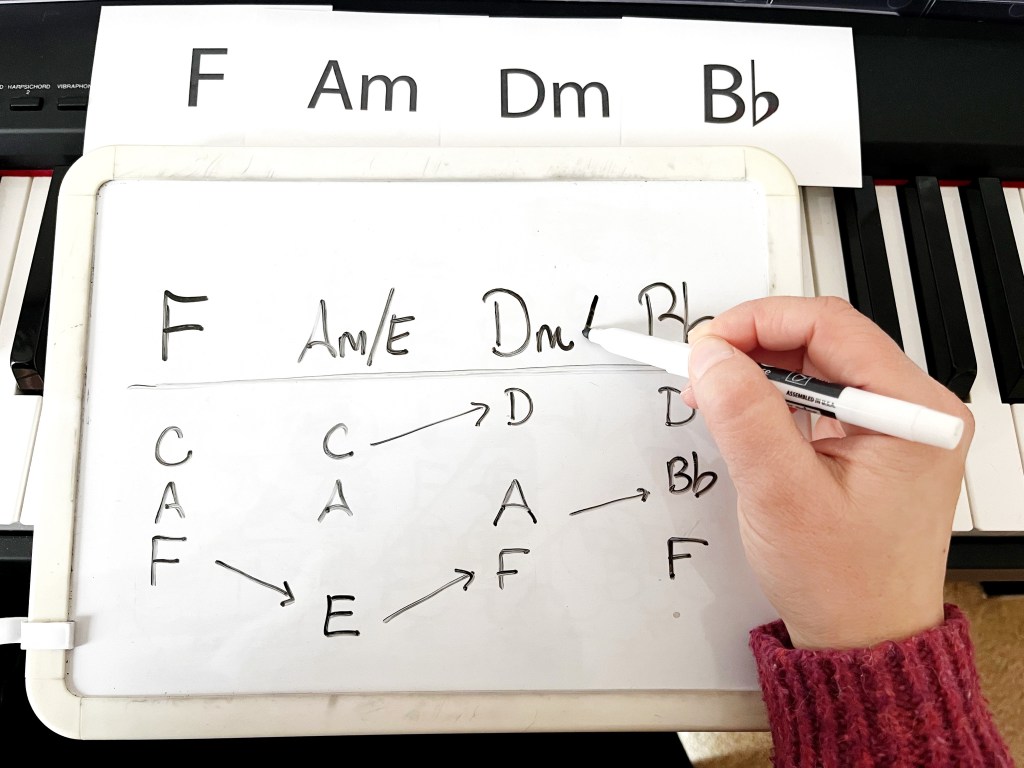
Pick a chord progression. Have the student write out the chords. The student should then analyze the chords (what pitches do they have in common? Are any of the pitches neighbors?, etc.). From their observations, rewrite the chords in different inversions and play the chord progression. Experiment with different inversions. Which was easier to play? How did the inversions sound with the melody (if using a chord progression from a lead sheet)?

Thinking about inversions in this sense, turns the activity into a puzzle with multiple solutions!

A chord progression is laid out on the piano. A piano student uses a whiteboard and dry erase marker to write out the chords and identify the best inversions to use for the chords.

Chord Games

Kids love games and they are a great way to test their knowledge! Here a few games that can be played with things you probably already have in your studion!

Chord Match/Memory

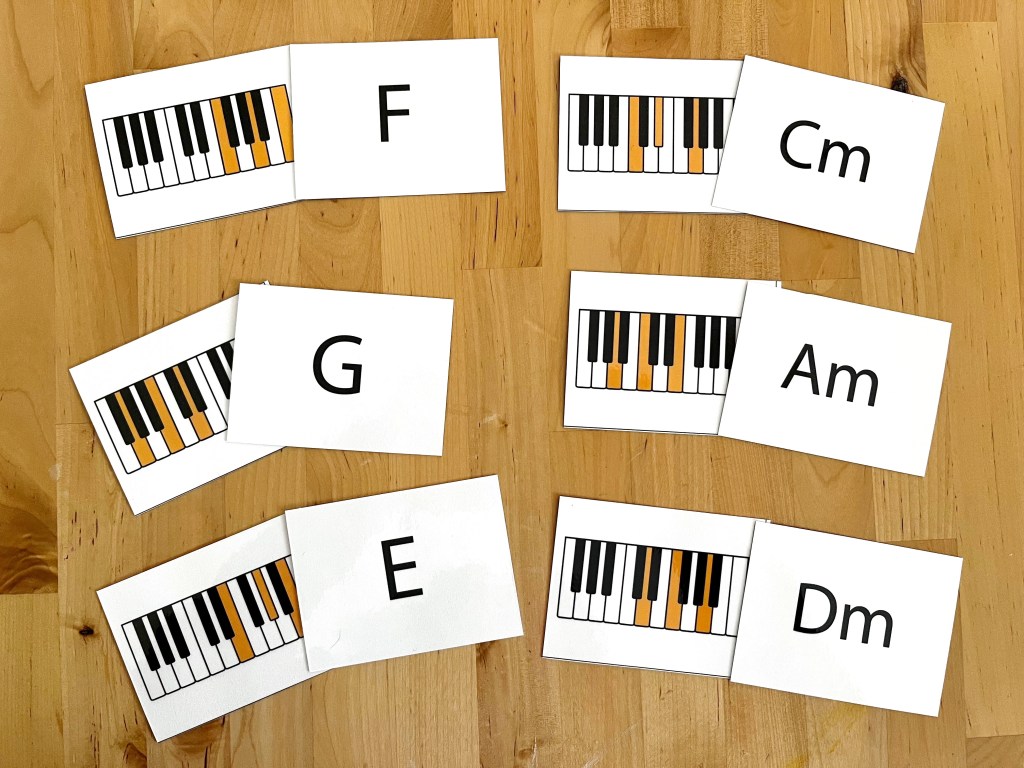
Using the keyboard chord cards and the chord symbols cards, select matching chords from each deck that the student is working on (for example, the C minor keyboard card and the C minor symbol card).

Chord flashcards are paired up on a table. The chord symbol matching the highlighted keys on the keyboard cards.

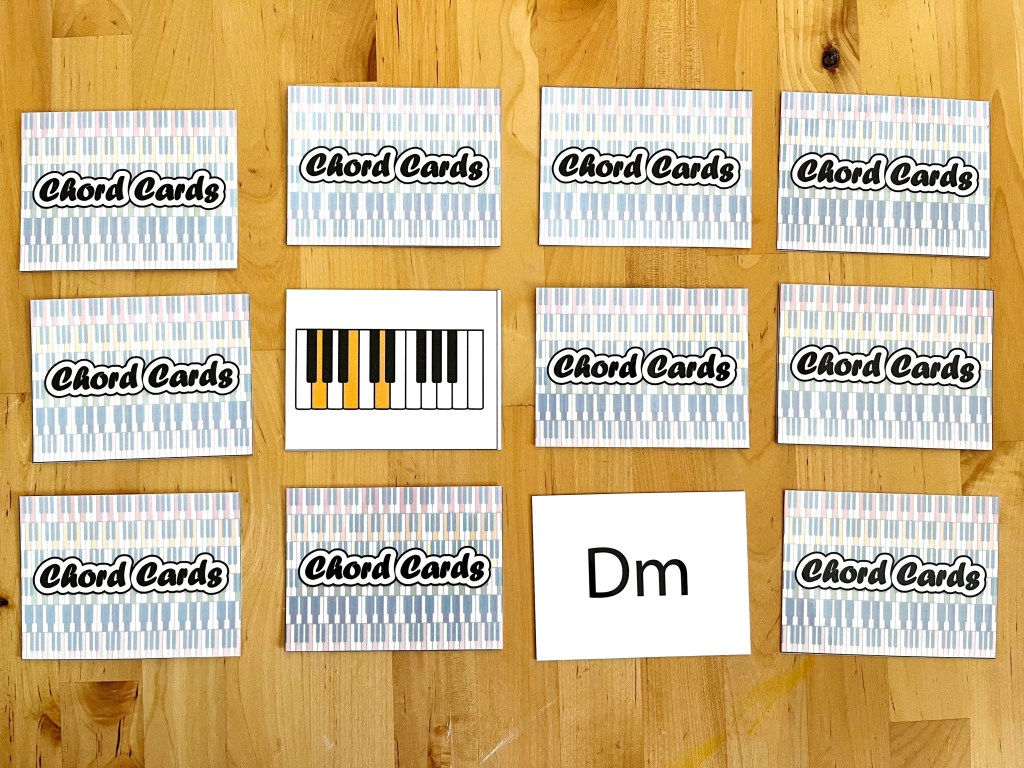
Lay them face down on a table. Play a game of Memory, where players take turns flipping over two cards, trying to make a match.

Two cards in a game of Memory are flipped over but do not match.

Whoever has the most matches at the end of the game, wins!

Speed Chords

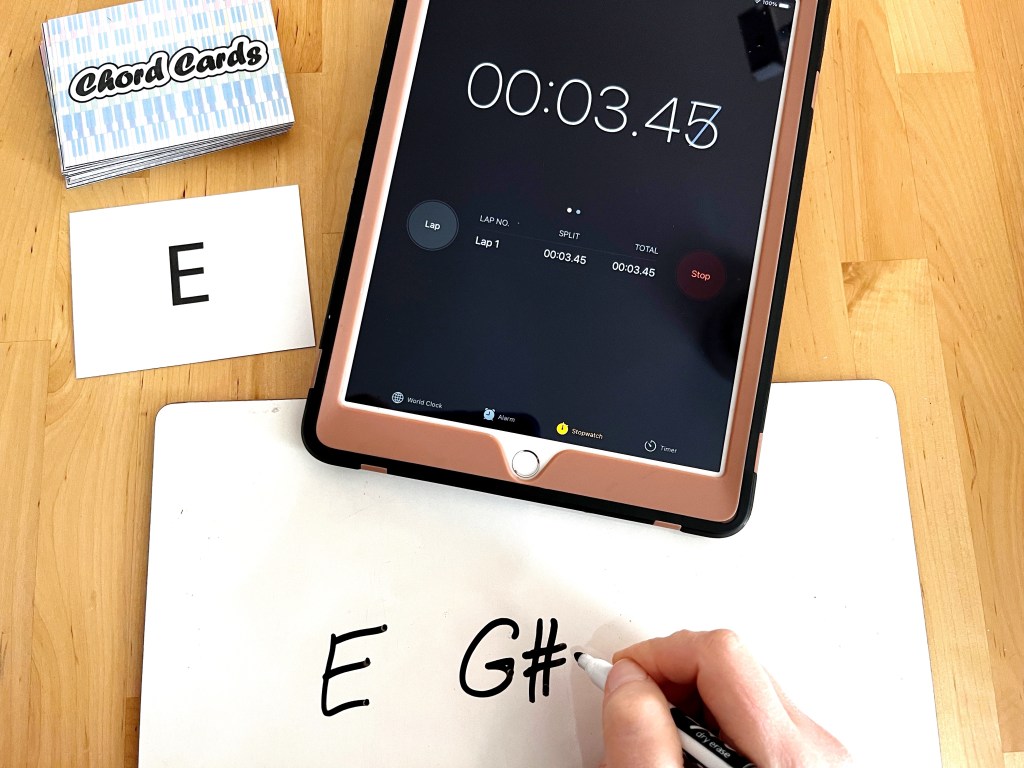
This game uses the chord cards, a stopwatch, dry erase board and marker, and mini-erasers.

Player 1 draws a chord card while Player 2 controls the stopwatch. As soon as the Player 1 flips over the card, Player 2 should start the stopwatch.

A piano student quickly writes down the notes of an E major chord as a stopwatch times them to see how long it takes.

Player 1 must write out the chord on the dry erase board as quickly as possible. When Player 1 says, “Done!” Player 2 should stop the stopwatch. Player 2 checks Player 1’s work. If the chord is correct, Player 2 tells Player 1 how long it took for them to write the chord. The number of seconds is how many mini-erasers Player 1 must stack. For example, if it took Player 1 five seconds to write out the chord, they should stack 5 mini-erasers.

A piano student stacks mini-erasers after completing an E major chord in 6 seconds.

If the chord is incorrect, Player 2 unpauses the stopwatch and Player 1 must try again!

When Player 1 has stacked their mini-erasers it is then Player 2’s turn and the above procedure is repeated for Player 2 (with Player 1 now being in charge of the stopwatch). Play continues back and forth, with players adding more mini-erasers to their towers each round.

Players should work fast because whoever’s tower falls over first loses!

Chord Relay

This is a fun group game! All you need are the chord cards, two dry erase boards, and two dry-erase markers.

Divide the group into two teams and have them sit in two lines. Give each team their own set of dry-erase board and marker.

The first player of each line should have the board and marker. The teacher hands a chord card to the first player of each team and says, “Go!” The two players must write down the pitches that make up their chord as quickly as possible.

When they have finished, they should pass the dry erase board and marker to the next player in line. The teacher should then give the second player a new chord card.

Play continues down the line until all the players from one team have had a turn. The teacher then checks their work. If all their chords are correct, they win the round. If not, the other team has a chance to finish up. When they are done, the teacher will check their work. If all of their chords are correct, they win. If not, the team with the fewest mistakes is the winner.

Explore more creative teaching ideas
  • Three-Chord Dash
    Boost your students’ chord skills with this fun, fast-paced game! In Three Chord Dash, students race to build their chords quickly and accurately. Who will be the fastest?! On your mark, get set, go!
  • Chord Snowblast
    Build chords and collect points while trying to avoid the snow blast! Kids will test their knowledge of building chords AND they will actually be hoping to get all the chords with sharps and flats!!

Let’s stay in touch, join the list!

As a “toucan” of our appreciation download a free set of note flashcards (link in our Welcome email)!

Processing…
Success! You're on the list.

We are a participant in the Amazon Services LLC Associates Program, an affiliate advertising program designed to provide a means for sites to earn advertising fees by advertising and linking to Amazon.com. As an Amazon Associate we earn from qualifying purchases.

Three Chord Dash – A Chord Building Game

At our last group lesson, we worked on our chord building skills! Some students were learning chords for the first time while others already had experience playing chords in their music. Three Chord Dash offered an even playing field for everyone and it was a blast to see them try to be the first to collect all of the pitches.

Piano students race to complete their chord by flipping over wooden circles with pitch names on them.
  1. To play, you will need
  2. Game Set-up
  3. How to Play
  4. Make it harder!
  5. How to Make the Wooden Circles with Pitch Names
  6. Let’s stay in touch, join the list!

Three Chord Dash is a versatile, fast-paced chord building game to help your students memorize the pitches that make up a given chord. It can be used in both private lessons or group lessons by students of all skill-levels (because it’s always a good idea to drill chords!). Students can be tested on any type of chord and/or inversion.

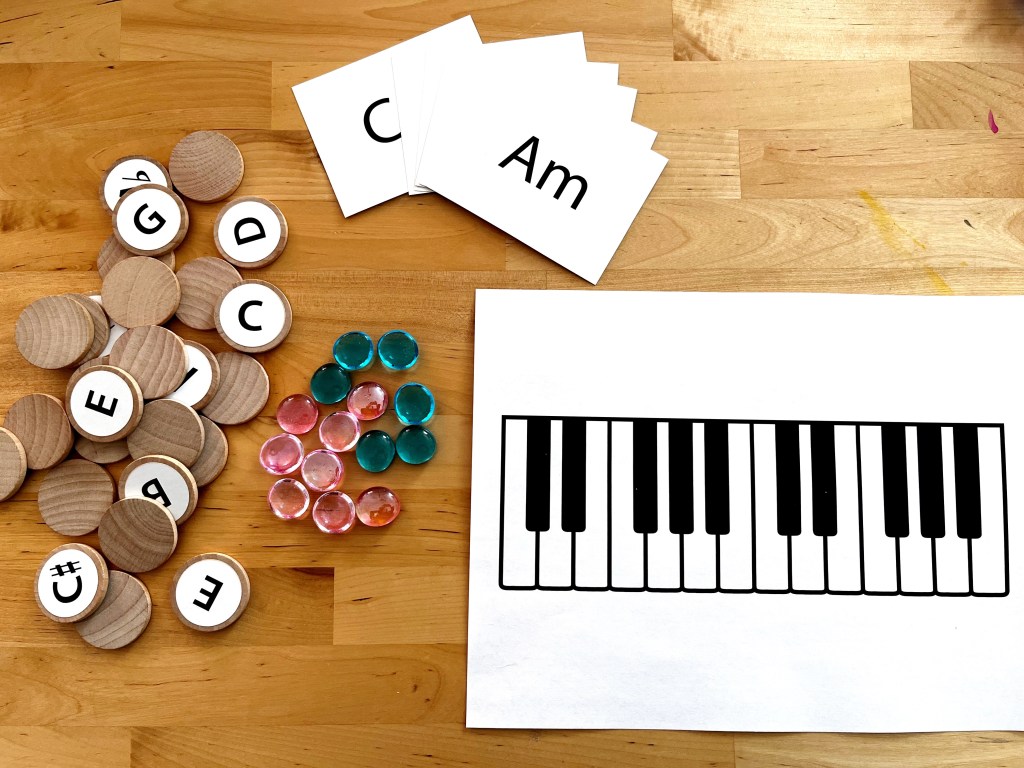
To play, you will need

  • Chord flashcards (I used mine, available in the Toucan Piano Shop for download). Alternatively, you can simply call out the chords you would like to drill or use an app like Decide Now! (Check out my blogpost on how to use the Decide Now! app)
  • Pitches on wooden circles
  • Keyboard print out (one for each player or team) – A great option are these dry erase keyboard/staff sheets (they are made from a cardstock-like material. They are double-sided, which make them great for a wide variety of tabletop games).
  • Mini-erasers, gems, or any other gamemarker (3 per player or 3 per team)
Supplies for a chord games are laid out on a table. The supplies include chord cards, a keyboard printout, wooden circles with pitches printed on them, and blue and pink gems.

If you’d like to see how I prepared the materials for the game, jump down here.

Game Set-up

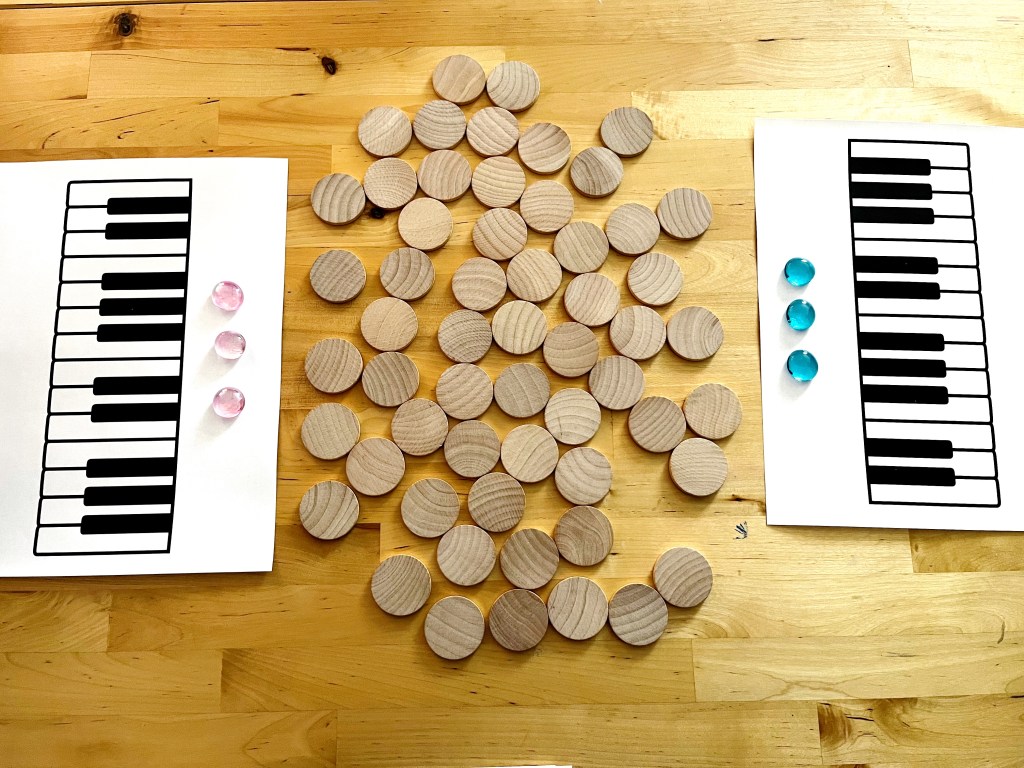
Give each player or team a keyboard print out and 3 gamemarkers (mini-erasers, gems, etc.).

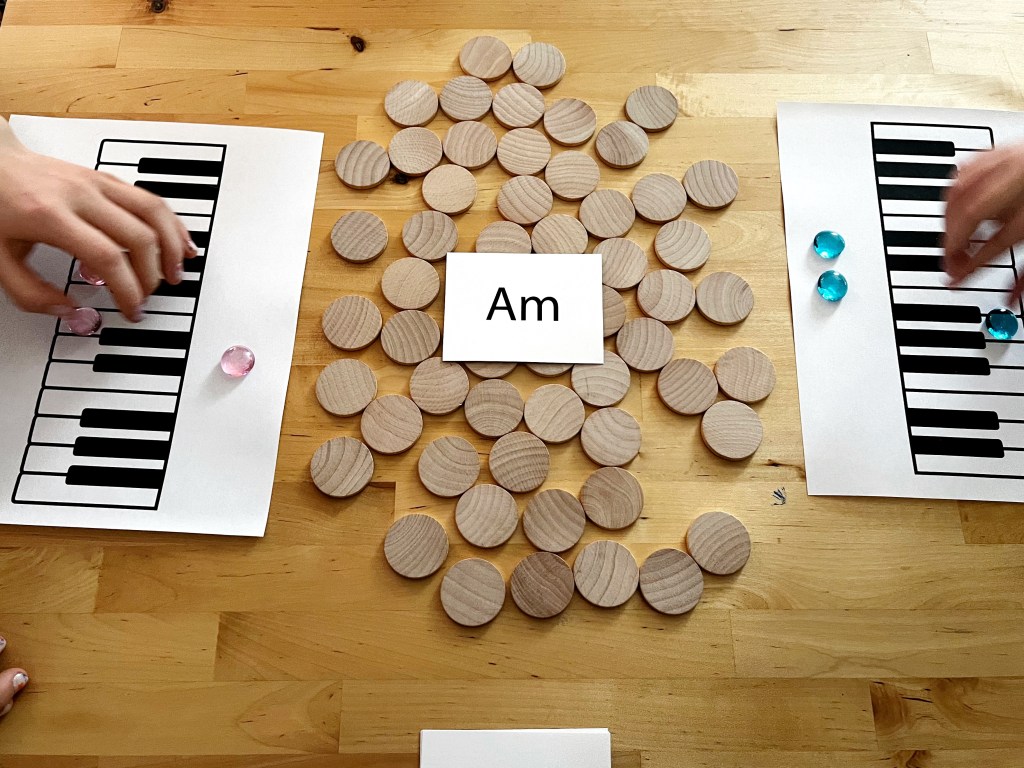
The wooden circles should be placed in the center of the table, pitch side down. Scramble the wooden circles.

Three Chord Dash, a chord game, is set up on a table. Each team has a keyboard printout with 3 gems lined up along the top of the printout. Wooden circles are arranged at the center of the table between the two printables.

Shuffle the chord flashcards and place them to the side.

How to Play

The game will be explained for two players. To play with a group, each action explained below should be performed by the group working together.

The teacher flips over the top card of the chord flashcard pile.

Players analyze the chord. Using the keyboard printable, players place a gamemarker on the each keys that makes up the chord. The teacher verifies their work and makes any corrections necessary.

Piano students place their gamemarkers on their keyboards to create an A minor chord.

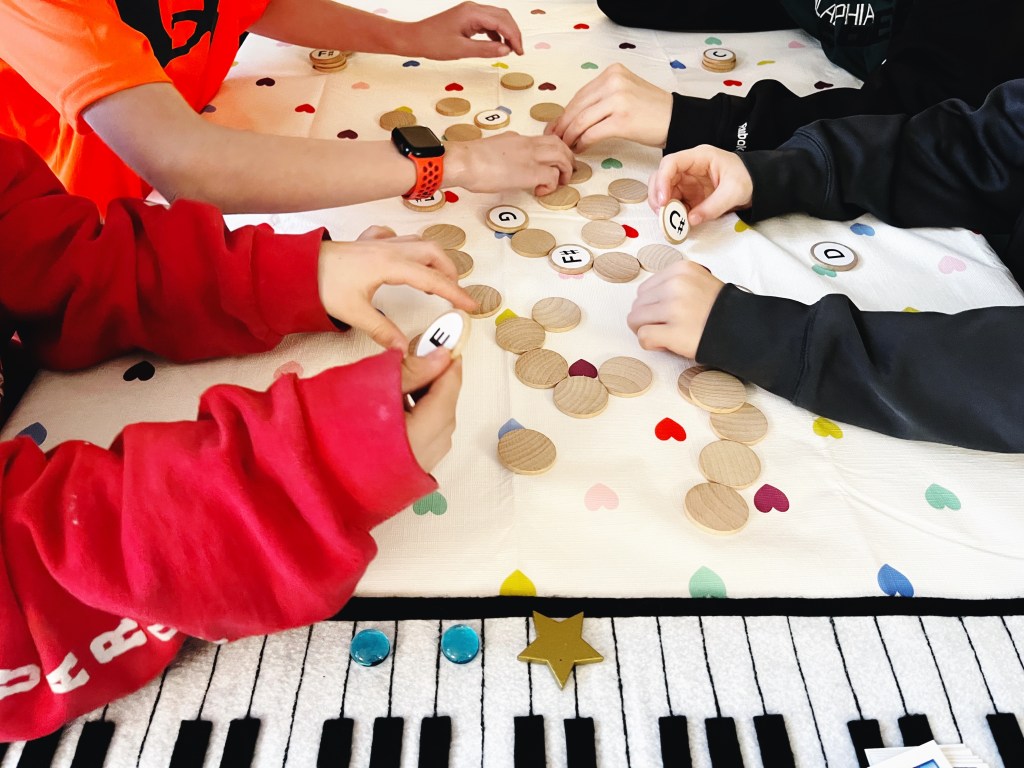
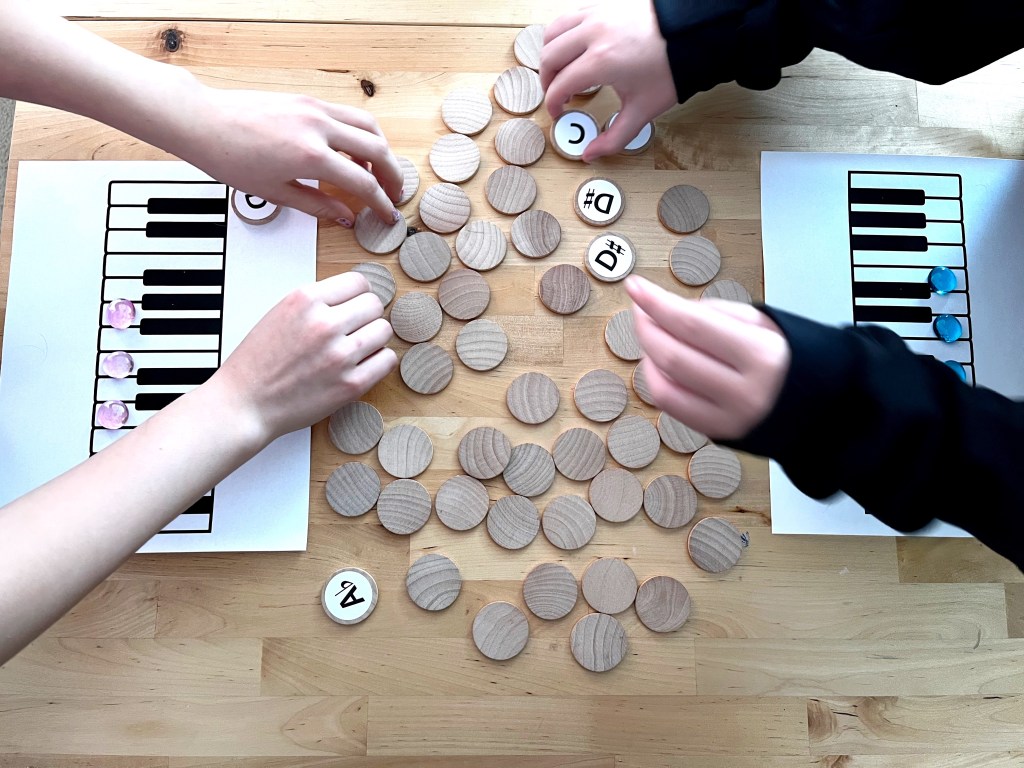
It is now a race! Players simultaneously flip over the wooden circles to try to find the pitches they need to complete the chord. When a pitch is found, they place the circle in front of them and continue searching for the remaining pitches.

Players quickly turn over the wooden circles at the center of the table to reveal the pitches and attempt to find an A, a C, and an E.

The first player to complete the chord wins the round. The player who completes three chords first is the winner of the game!

The player on the left has completed their chord first.

Make it harder!

If your students are very familiar with chords, you can play Three Chord Dash without the keyboard printable and gamemarkers.

Simply flip over a chord card and start the race! Whoever successfully finds the correct pitches and lines them up properly wins the round.

Take it a step further and have students build the chords in a different inversion each round!

How to Make the Wooden Circles with Pitch Names

Kids love manipulatives and I use the wooden circles over and over again for a variety of games and activities at my studio. And they are very durable! Which is important in fast-paced games like Three Chord Dash since kids are frantically grabbing at them and flipping them over.

I purchased these 1.5″ wood coins in bulk (since I needed to create more than one of each pitch).

There are many different ways to the make the pitch circles. The simplest and quickest way is to use a permament marker and write the names of the pitches directly on the wood coins.

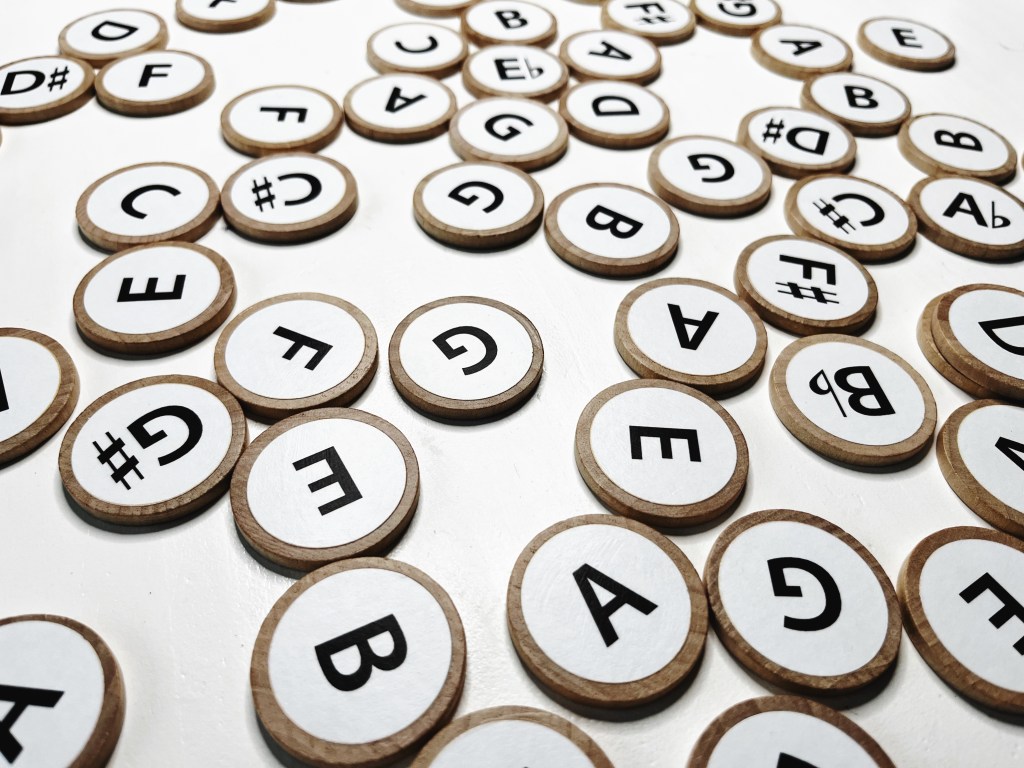
If you would prefer to have the pitches be printed, I used 2″x4″ Avery Shipping Labels. Three pitch names fit on each label (I used Adobe Illustrator to make the circles and align everything, but Avery has a template you can download from their website which would work just as well, minus the circles).

Cut out the individual labels.

Music pitches printed on label paper.

I then used a 1.25″ circle punch (I’ve used this brand in a different size) to cut out the individual pitches.

A 1.25 inch circle punch cuts out the pitches on the labels.

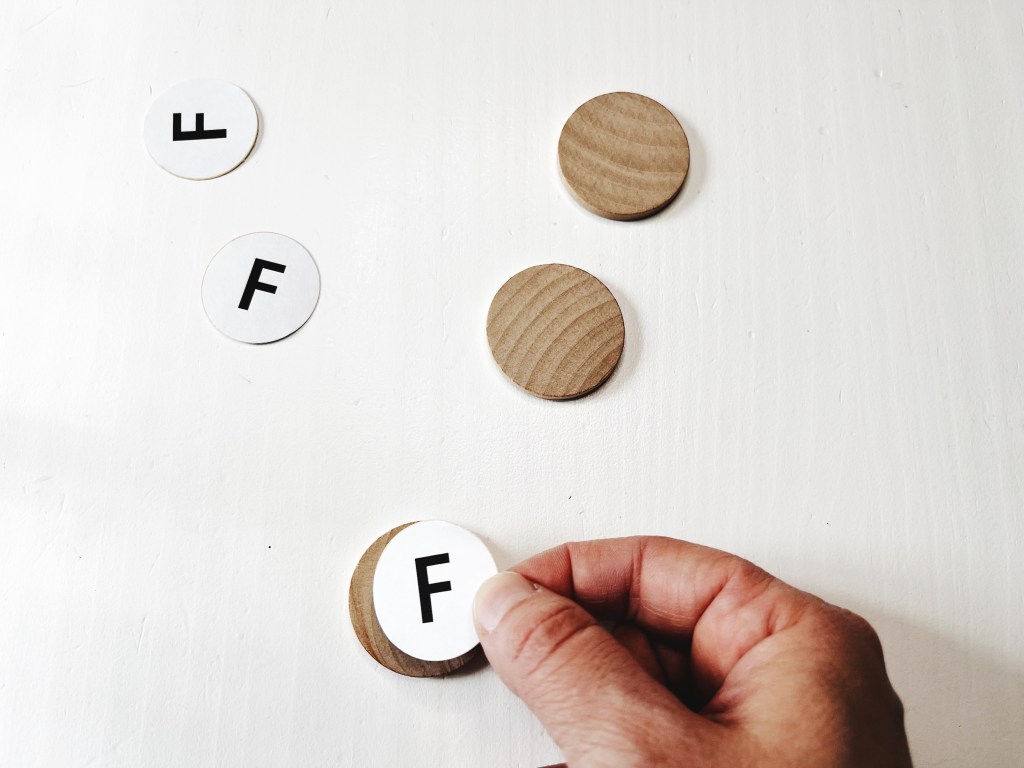
Since the labels are stickers, you can then remove the backing and stick them onto the wood coins.

The label with the pitch name is glued to a wood coin.

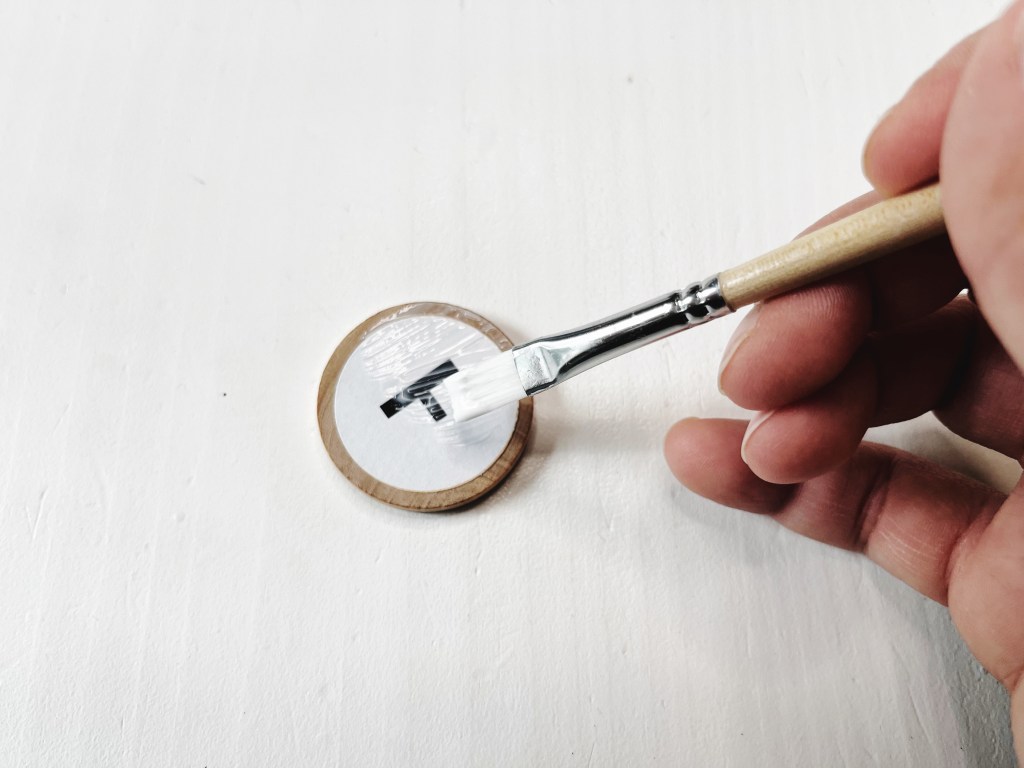
For added protection, I applied a layer of sealant (Mod Podge) over the sticker.

The top of the wood coin and label is sealed with Mod Podge.

Make as many as you need!!

Wood coins with music pitches printed on them are arranged on a white table.

Explore more creative teaching ideas
  • Chords Cards – How to Use them with your Students
    I love flashcards!  They are extremely effective for active recall and the long-term retention of concepts. And the best part? They have SO many uses! From interactive games and hands-on activities to group challenges, the possibilities are endless!
  • Best in Pass
    Note-reading and fine motor skills combined! Students will race to be the first to match the letter ping-pong balls to the notes on their spoons. But there’s a twist! They cannot touch the balls with their hands.
  • Snowball Rhythm Game
    Who will be able to make the longest rhythm train before the dreaded “Busted!” stick is revealed?! Kids will practice their rhythms while also practicing their aim in this fun toss game.
  • Chord Snowblast
    Build chords and collect points while trying to avoid the snow blast! Kids will test their knowledge of building chords AND they will actually be hoping to get all the sharps and flats chords!!
  • Two Sides of the Same Coin
    A game about enharmonics that can be played in several different ways! Students will try to collect the most enharmonic pairs and hope that their coins don’t get stolen by another player.

Let’s stay in touch, join the list!

As a “toucan” of our appreciation download a free set of note flashcards (link in our Welcome email)!

Processing…
Success! You're on the list.

We are a participant in the Amazon Services LLC Associates Program, an affiliate advertising program designed to provide a means for sites to earn advertising fees by advertising and linking to Amazon.com. As an Amazon Associate we earn from qualifying purchases.

Chord Snowblast

March is known for coming in like a lion and going out like a lamb (meaning that the beginning of the month tends to exhibit all the characteristics of winter – with its frigid temperatures, ice, and snow – but by the end of the month winter is gone and you can feel spring in the air). Well, not this year! This week winter came back with a vengeance.

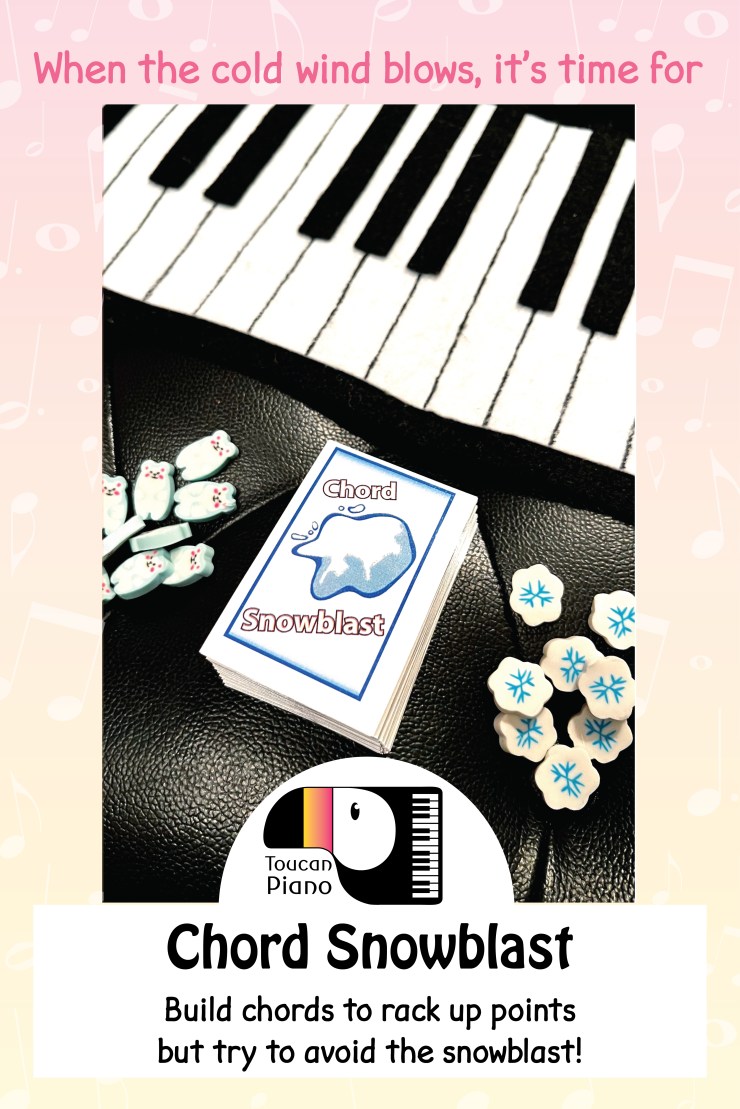
When the weather throws you curve balls, there is really only one thing to do… match your piano chord games to the weather! And Chord Snowblast was the perfect choice! Chord Snowblast is a piano game that covers all the major and minor chords but the teacher can select the chords most appropriate for the student’s level.

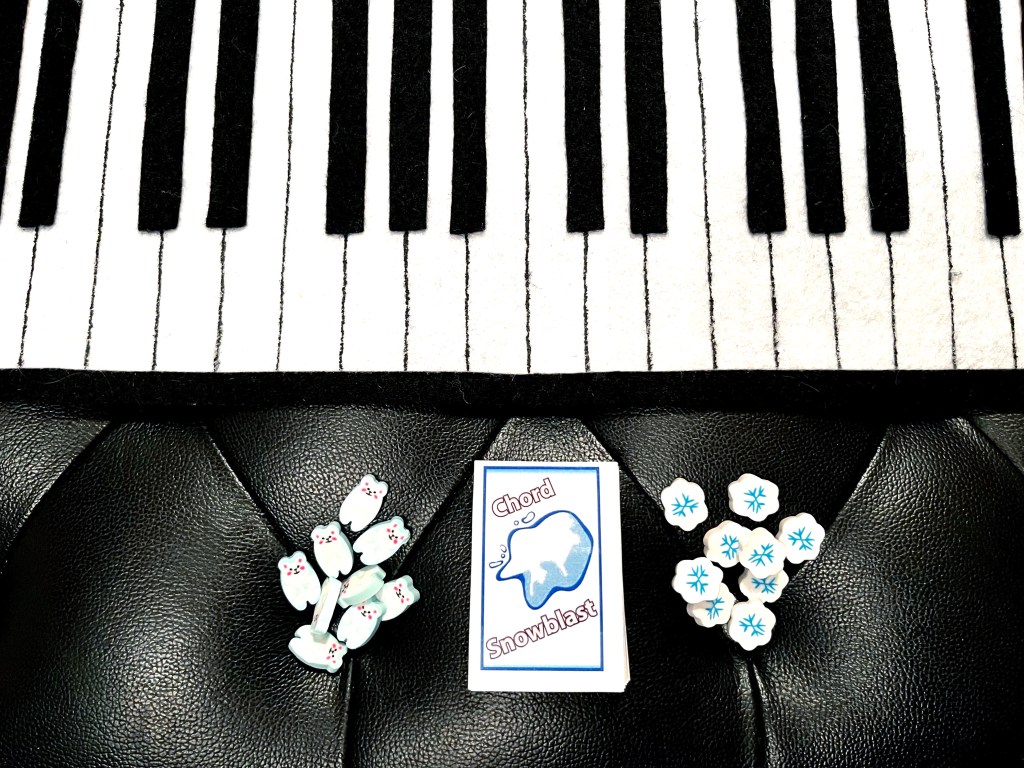
piano keyboard snow snowball card stack about music chords with snowflake and polar bear erasers game markers

We even pulled out the polar bear and snowflake erasers to make our chords. Given the weather in the Instagram post below, they would have been right at home!

Players take turns drawing cards from the pile. Each card has a chord that the player must build on the piano (or in our case, a felt keyboard) using the mini-erasers. I also had my students play the chord on the piano after they were done building it.

piano keyboard snow snowball card stack about music chords with snowflake and polar bear erasers game markers minor chord

Here is a student in action:

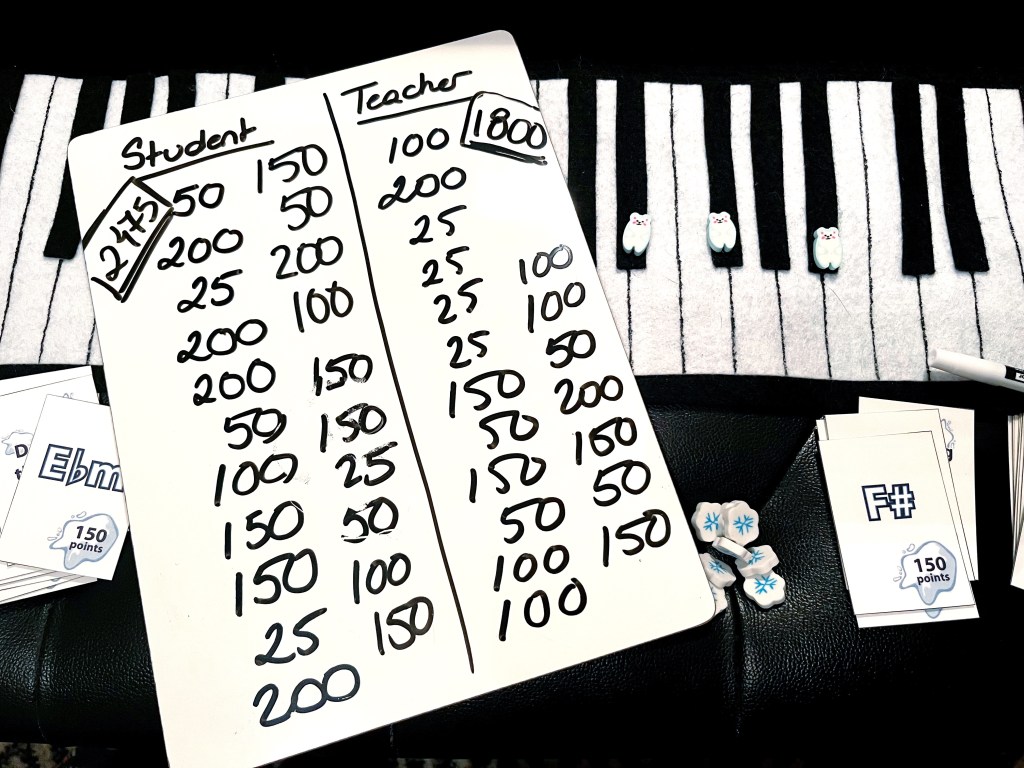
Each chord is worth a certain number of points. Once the chord is built successfully, the player writes down the number of points he/she earned that round. The “harder” the chord (meaning the more sharps/flats in a chord), the more points to be earned!

This student wanted to play through the whole deck and she squashed me!! I felt I should have given her bonus points as well because she was calling out enharmonic chords (for example, B-sharp major and C major) whenever she saw them! I was SO impressed!

polar bear erasers on piano keyboard forming a minor chord with scoreboard with points breakdown and point totals

Watch out for the wildcards mixed into the deck! Especially the Avalanche card… how many chords can you build in 1 minute?! Here was my 30-second attempt (I love how my student is cheering me on!):

This game available in the Toucan Piano Shop: Chord Snowblast. It comes with 42 chord cards and 12 wildcards. It’s great for individual or group lessons to reinforce major and minor chords.

I would love to hear what you think if you decide to play this game with your students. We had a blast and almost – almost! – forgot about how cold it was outside.

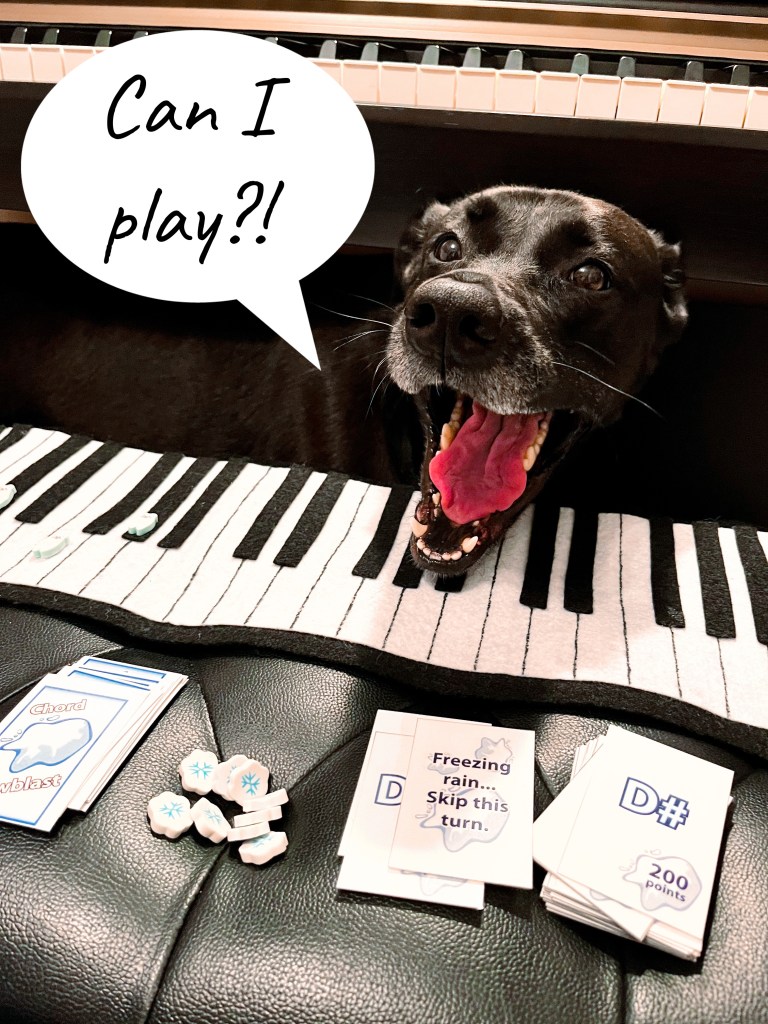
black labrador retriever lab mix dog wants to play chord card game at the piano keyboard with speech bubble saying can i play

Let’s stay in touch, join the list!

As a “toucan” of our appreciation download a free set of note flashcards (link in our Welcome email)!

Processing…
Success! You're on the list.

We are a participant in the Amazon Services LLC Associates Program, an affiliate advertising program designed to provide a means for sites to earn advertising fees by advertising and linking to Amazon.com. As an Amazon Associate we earn from qualifying purchases.