Rainbow Manuscript Paper

This month my students are working on their own compositions. I love seeing their creativity come to life through their music! But nothing stops creativity in its tracks more quickly than a blank piece of paper. In our case, a blank piece of manuscript paper.
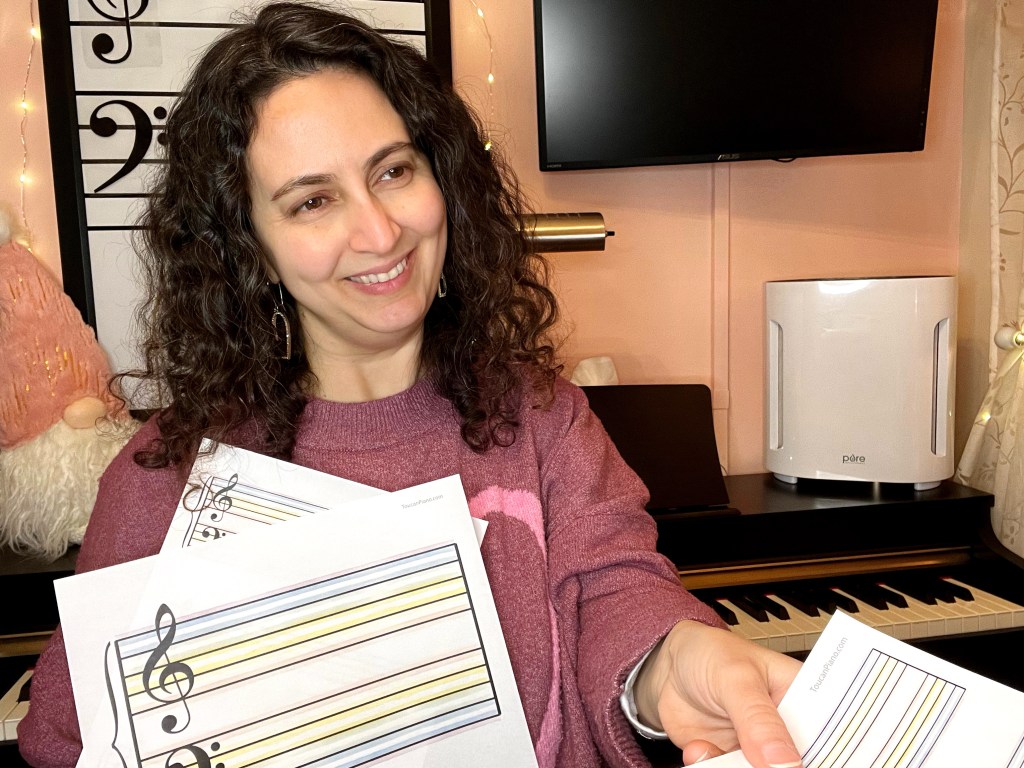
Piano teacher smiling while handing a student a sheet rainbow colored manuscript paper

Since we are in the season of hearts and rainbows – Valentine’s Day and St. Patrick’s! – I couldn’t help but make rainbow grand staff music sheets for them to work with.

It’s just enough color to take away some of the starkness of the blank staff but not enough to distract from the actual music making. My younger students have loved them!
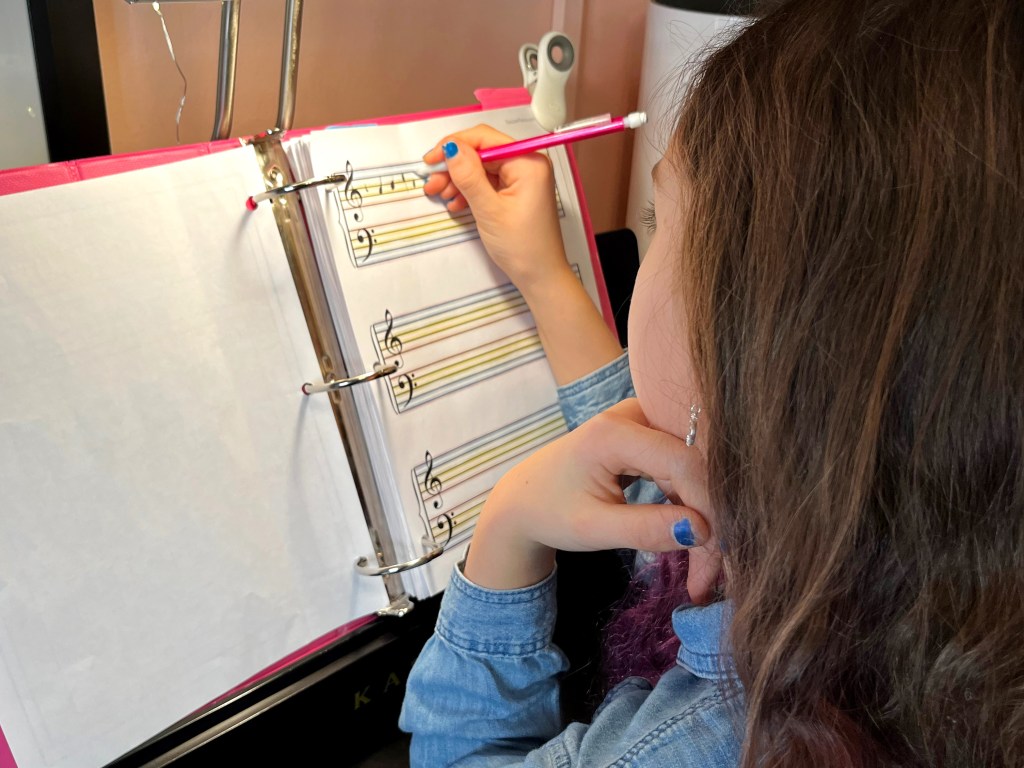
Young piano student with her hand on her chin is writing music notes on a sheet of rainbow colored manuscript paper with a pink mechanical pencil

The rainbow manuscript paper is available in the Toucan Piano shop as a free printable! Print as many as you like for your students.

They are available in three sizes, so they can be used for a variety of ages and activities, like:

  • Writing out original compositions
  • Explaining music theory concepts
  • Music dictation
  • Games
  • Writing out exercises for students to do at home
  • Write the final copy of a composition to gift to a parent on Valentine’s day
  • And so much more!
Child with blue nail polish is writing music notes on a sheet of rainbow colored manuscript paper

I hope that the rainbow manuscript paper helps bring smiles to your students’ faces and gets the music flowing!

For more teaching resources and piano teaching games, check out the Toucan Piano shop.

Let’s stay in touch, join the list!

As a “toucan” of our appreciation download a free set of note flashcards (link in our Welcome email)!

Processing…
Success! You're on the list.

We are a participant in the Amazon Services LLC Associates Program, an affiliate advertising program designed to provide a means for sites to earn advertising fees by advertising and linking to Amazon.com. As an Amazon Associate we earn from qualifying purchases.
Chord Snowblast

March is known for coming in like a lion and going out like a lamb (meaning that the beginning of the month tends to exhibit all the characteristics of winter – with its frigid temperatures, ice, and snow – but by the end of the month winter is gone and you can feel spring in the air). Well, not this year! This week winter came back with a vengeance.

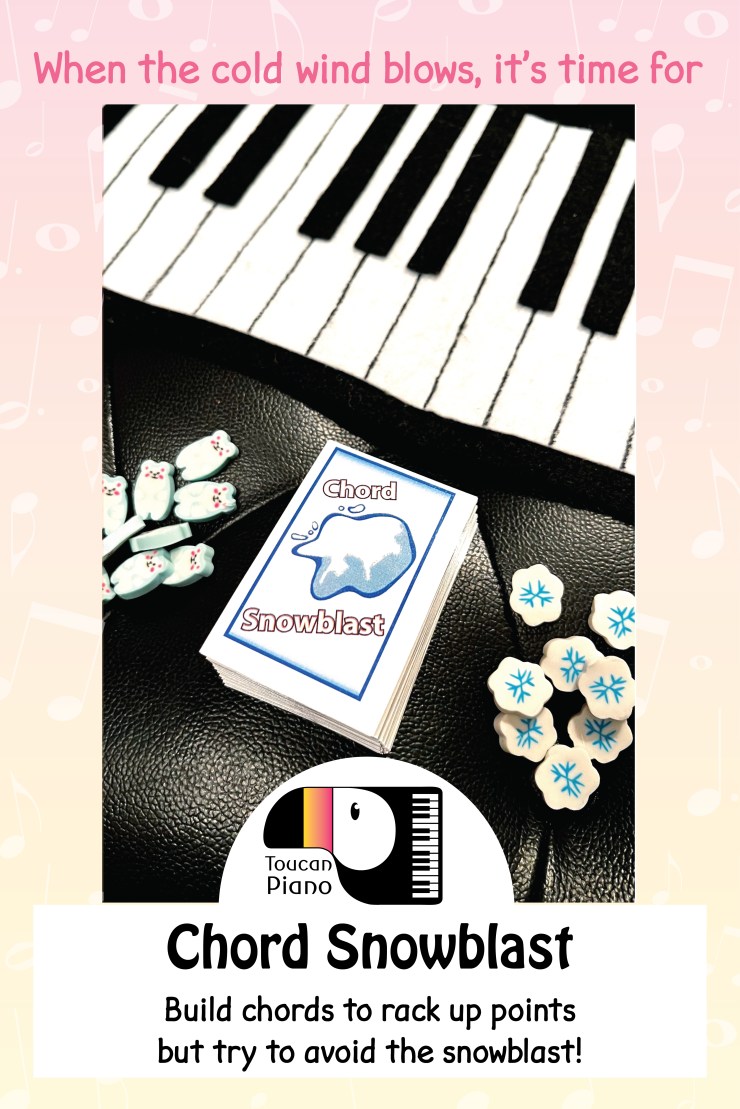
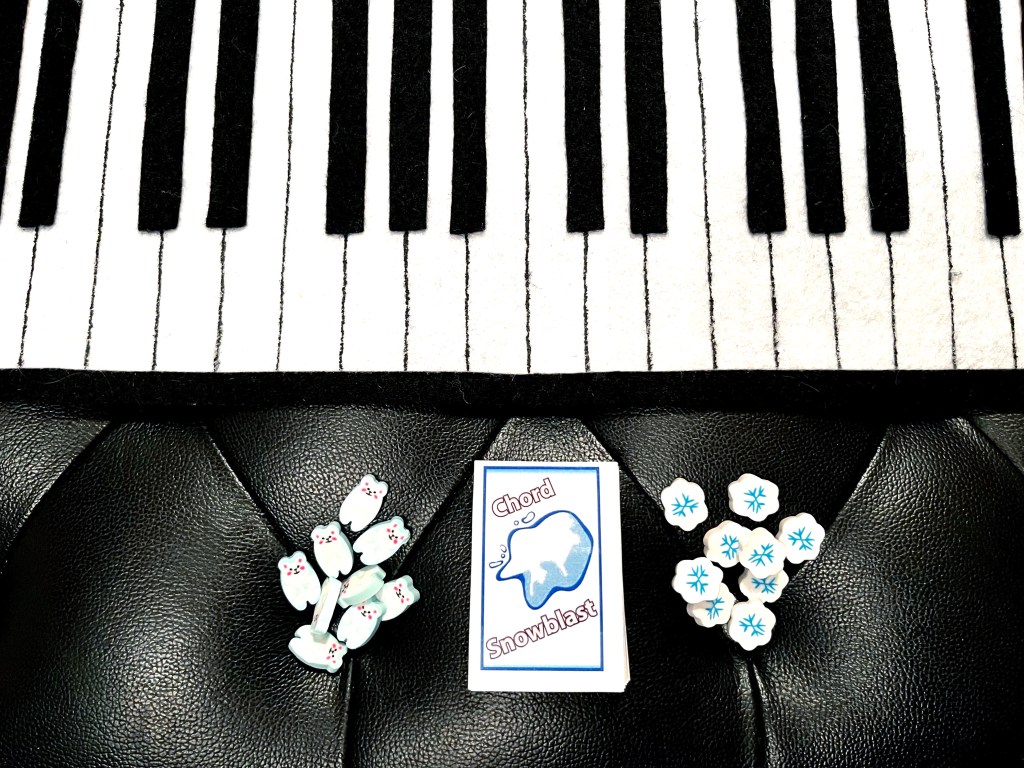
When the weather throws you curve balls, there is really only one thing to do… match your piano chord games to the weather! And Chord Snowblast was the perfect choice! Chord Snowblast is a piano game that covers all the major and minor chords but the teacher can select the chords most appropriate for the student’s level.

piano keyboard snow snowball card stack about music chords with snowflake and polar bear erasers game markers

We even pulled out the polar bear and snowflake erasers to make our chords. Given the weather in the Instagram post below, they would have been right at home!

Players take turns drawing cards from the pile. Each card has a chord that the player must build on the piano (or in our case, a felt keyboard) using the mini-erasers. I also had my students play the chord on the piano after they were done building it.

piano keyboard snow snowball card stack about music chords with snowflake and polar bear erasers game markers minor chord

Here is a student in action:

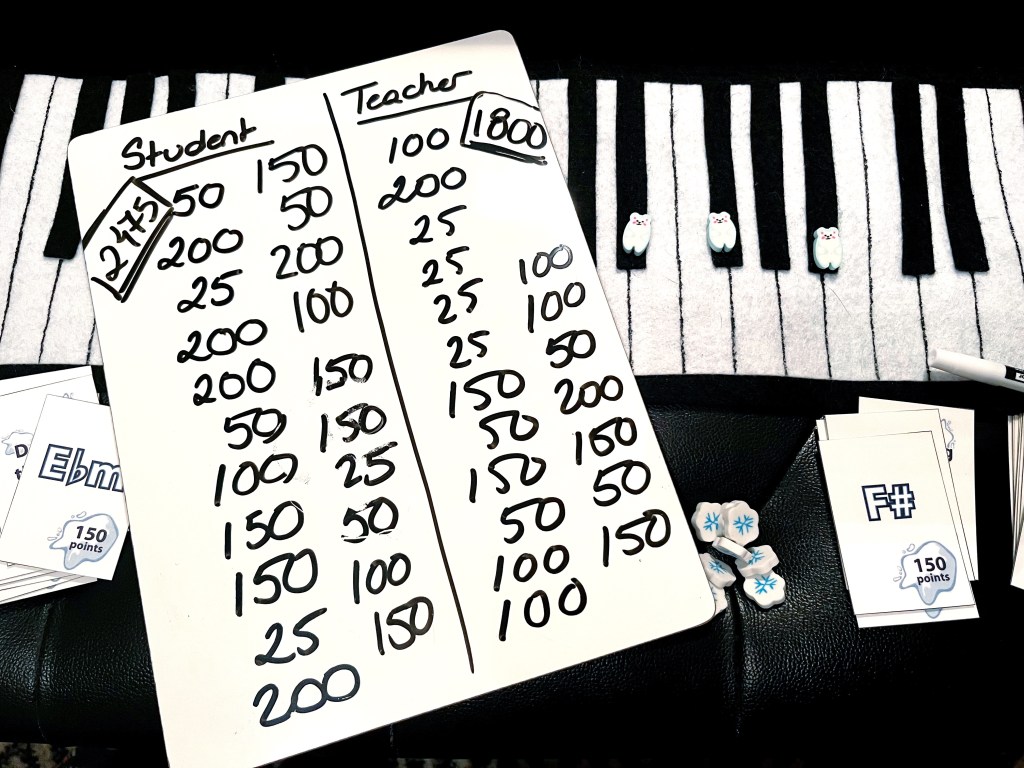
Each chord is worth a certain number of points. Once the chord is built successfully, the player writes down the number of points he/she earned that round. The “harder” the chord (meaning the more sharps/flats in a chord), the more points to be earned!

This student wanted to play through the whole deck and she squashed me!! I felt I should have given her bonus points as well because she was calling out enharmonic chords (for example, B-sharp major and C major) whenever she saw them! I was SO impressed!

polar bear erasers on piano keyboard forming a minor chord with scoreboard with points breakdown and point totals

Watch out for the wildcards mixed into the deck! Especially the Avalanche card… how many chords can you build in 1 minute?! Here was my 30-second attempt (I love how my student is cheering me on!):

This game available in the Toucan Piano Shop: Chord Snowblast. It comes with 42 chord cards and 12 wildcards. It’s great for individual or group lessons to reinforce major and minor chords.

I would love to hear what you think if you decide to play this game with your students. We had a blast and almost – almost! – forgot about how cold it was outside.

black labrador retriever lab mix dog wants to play chord card game at the piano keyboard with speech bubble saying can i play

Let’s stay in touch, join the list!

As a “toucan” of our appreciation download a free set of note flashcards (link in our Welcome email)!

Processing…
Success! You're on the list.

We are a participant in the Amazon Services LLC Associates Program, an affiliate advertising program designed to provide a means for sites to earn advertising fees by advertising and linking to Amazon.com. As an Amazon Associate we earn from qualifying purchases.

Pot of Gold: Rhythm Game

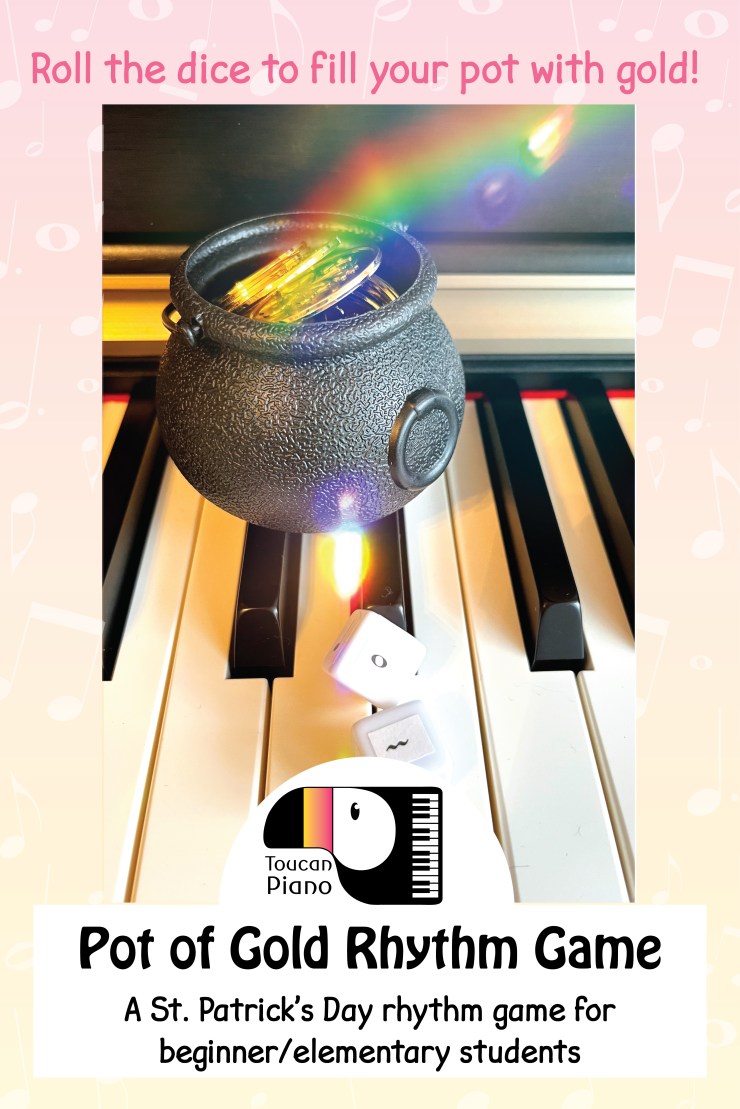
Happy St. Patrick’s Day!!! If you are looking for a last minute game to play with your beginner/elementary students with things you probably already have on hand, this simple rhythm game fits the bill! This game is great all year round, all you have to do is change the game markers.

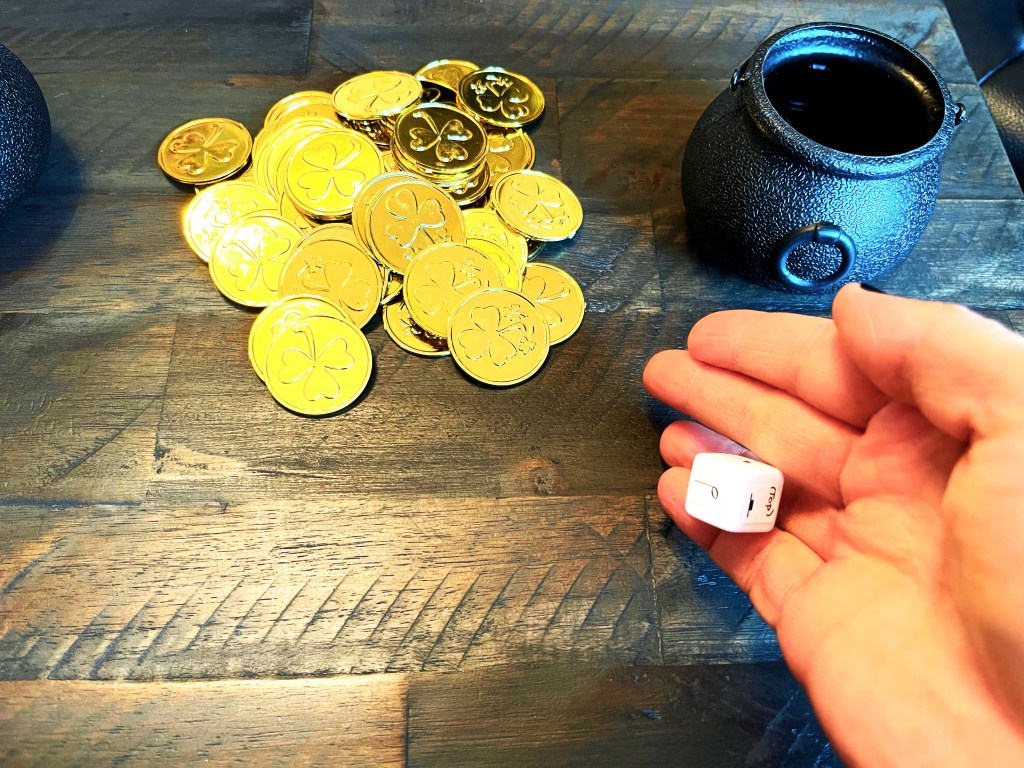
For the St. Patrick’s day version of this game I am using 40 gold coins, mini pots/cauldrons (also great for Halloween games!), and rhythm note/rest dice. I made the dice by gluing note and rest stickers on the sides of a blank die. Check out my blog post on how to make your own music theory dice!

pot of gold coins with rhythm dice

The student rolls his/her rhythm die and names the note or rest it lands on.

pot of gold coins with hand rolling rhythm die dice

The student should then determine the number of beats the note/rest gets and put the corresponding number of gold coins in his/her pot.

Half note rhythm die dice with two gold coins

For example, if the student rolled a half note, he/she should then place 2 gold coins in their pot.

hand placing gold coins in a pot cauldron

It is now the teacher’s turn. The teacher follows the same procedure above.

The first player to collect 20 gold coins in their pot wins!

For students who enjoy some adrenaline and intense competition, instead of taking turns, both players roll and fill their pots at the same time. When played this way, the game is turned into a race to see who will fill their pot first!

This is a fast-paced game which is great to play when you have less than 5 minutes to fill at the end of a lesson. And there is just something so satisfying about dropping the gold coins in the pots!

For more St. Patrick’s Day fun, check out Two Sides of the Same Coin in the Toucan Piano Shop. For three different ways to play it, check out the blog post Two Sides of the Same Coin.

Let’s stay in touch, join the list!

As a “toucan” of our appreciation download a free set of note flashcards (link in our Welcome email)!

Processing…
Success! You're on the list.

We are a participant in the Amazon Services LLC Associates Program, an affiliate advertising program designed to provide a means for sites to earn advertising fees by advertising and linking to Amazon.com. As an Amazon Associate we earn from qualifying purchases.
Musical Madness

I think as teachers we all wish our students listened to more music, especially piano music. I assign listening homework every now and then and, before Covid, we would do a Composer of the Month (we would spend that month learning about a specific composer’s life, the period he/she lived in, and his/her music). We put “Composer on the Month” on hiatus while we were all virtual because of the logistics of getting the print-outs to everyone (it was a lot of stuff). But since resuming in-person lessons, I’ve found out that the kids really miss it and want to bring it back… and this is where March’s Musical Madness comes in!

I have so many students who love to play basketball so I decided to jump on the March Madness bandwagon and do a little competition of our own. Over the next month and a half we are going to be embarking on weekly showdowns between two great composers of classical music to see who will come out on top and be our first “Composer of the Month” of 2022! We will also have our first piano party since 2019 to celebrate the end of Musical Madness!

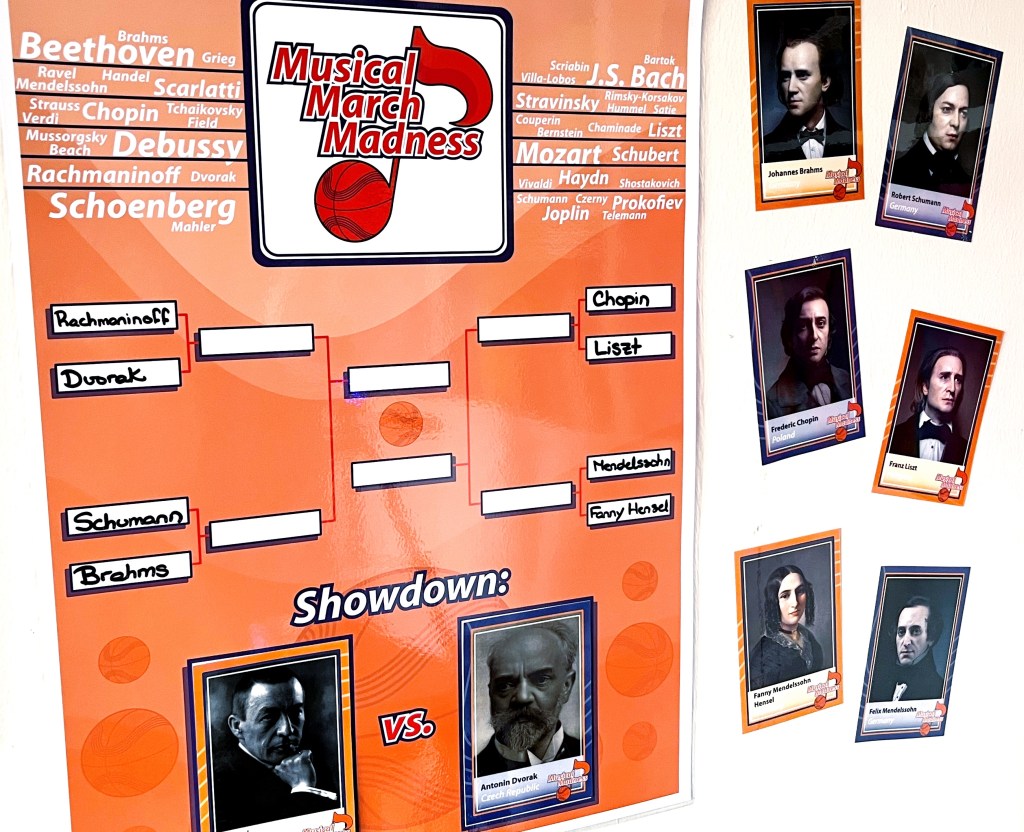
I chose to focus on the Romantic composers (because my brain hurt when trying to narrow all of the classical periods down to 8 composers!), more specifically Chopin, Liszt, R. Schumann, Brahms, Felix Mendelssohn, Fanny Mendelssohn Hensel, Dvořák, and Rachmaninoff. Other groups of composers I thought of focusing on were female composers, impressionist composers, and living composers… I feel I will definitely be revisiting these groups in the future for other music appreciation events.

Musical Madness: Romantic Composers. (All composer portraits were found on Google. Some of the portraits are by artist Hadi Karimi. You can check out his amazing series of portraits of classical composers at https://hadikarimi.com/ )

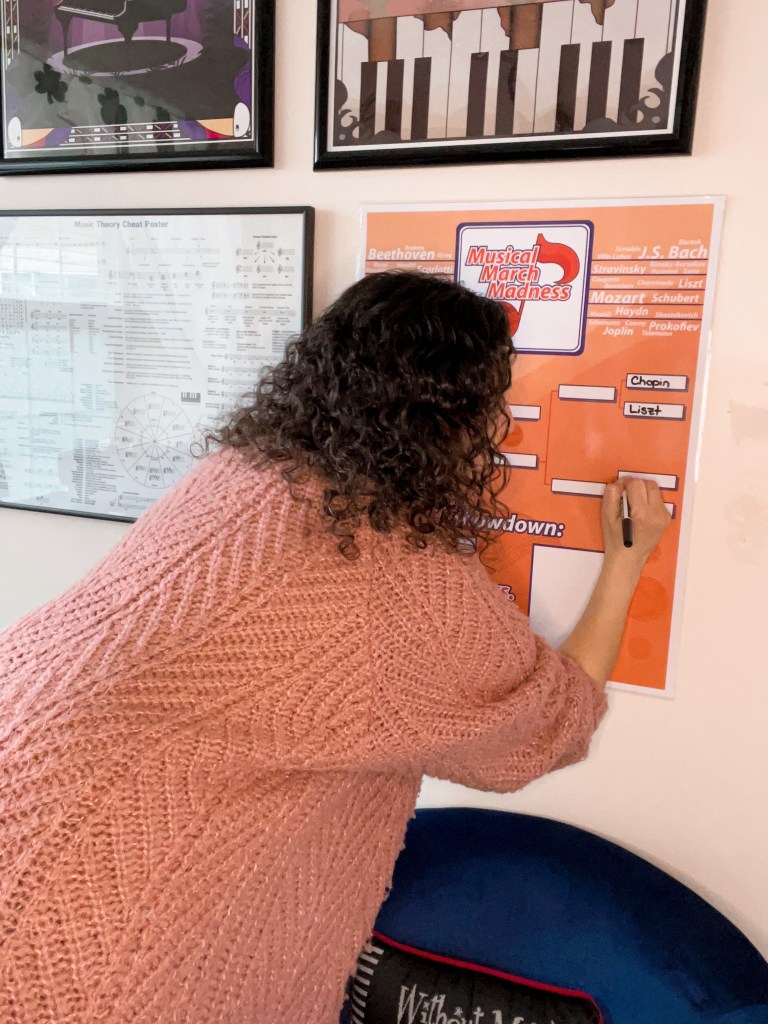
I made a frame for the portraits of the composers I chose so that they would resemble basketball cards (do kids still collect cards??). And then I wrote their names in the brackets of our Musical Madness poster.

Each week two composers will face off to see who will make it to the next round. At my lessons I will give a quick introduction to that week’s composers to spark my students’ curiosity. Then I will send an email to all my piano families with one piano piece by each of the composers (I try to keep each piece under 5 minutes). My students will listen to the pieces at home and choose their favorite between the two. At their next lesson, they will give their vote to their favorite. The composer with the most votes moves on to the next round and the loser is out. Our first showdown is between Sergei Rachmaninoff and Antonín Dvořák!

I’m just glad I’m not the one voting… this is really hard!

I taped the composer cards to the poster so I can swap them out each week. The composers waiting to jump into the competition are taped to the wall next to the poster. I’m very excited to see which composer will take it all!

If you would like to play your own version on Musical Madness and bring some beautiful music into your students’ homes, the poster and blank composer cards are available in the Toucan Piano Shop. I made three different poster sizes (with cards that fit each size) to best fit your needs: letter size (if you want to print it out for each of your students to have their own copy), 12″ x 18″, and 18″ x 24″. All three sizes come with your purchase. I hope you have as much fun as we are having!

Let’s stay in touch, join the list!

As a “toucan” of our appreciation download a free set of note flashcards (link in our Welcome email)!

Processing…
Success! You're on the list.

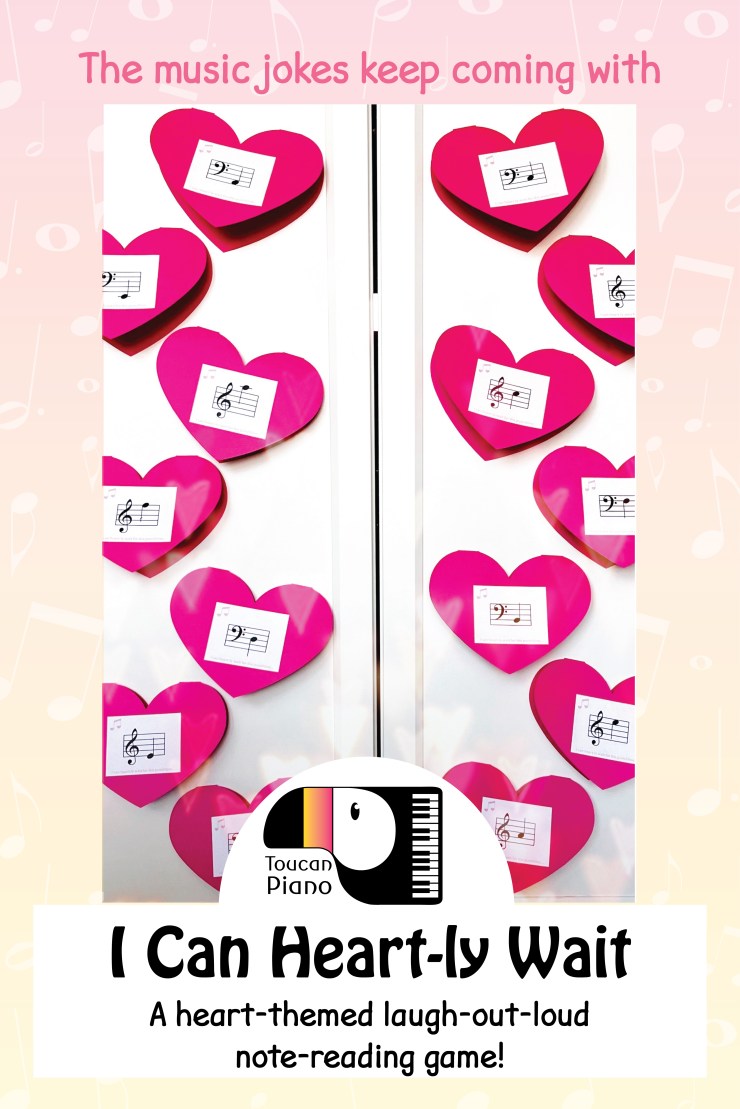
I Can Heart-ly Wait for the Punchline!

Valentine’s day is a month-long affair at my studio! As I tell my students, it’s a holiday that celebrates pink, I need to milk it for all it’s worth.

We’ve played a few different note-reading games this month and this one in particular had me giggling long after I had memorized all the punchlines for the jokes. It was so much fun to introduce a lot of my students to music theory jokes. From puns to just plain silly jokes, it was so funny to see the wide range of expressions on their faces when they “got” it (most called them “Dad jokes” but they laughed all the same! Because Dad jokes are hilarious!).

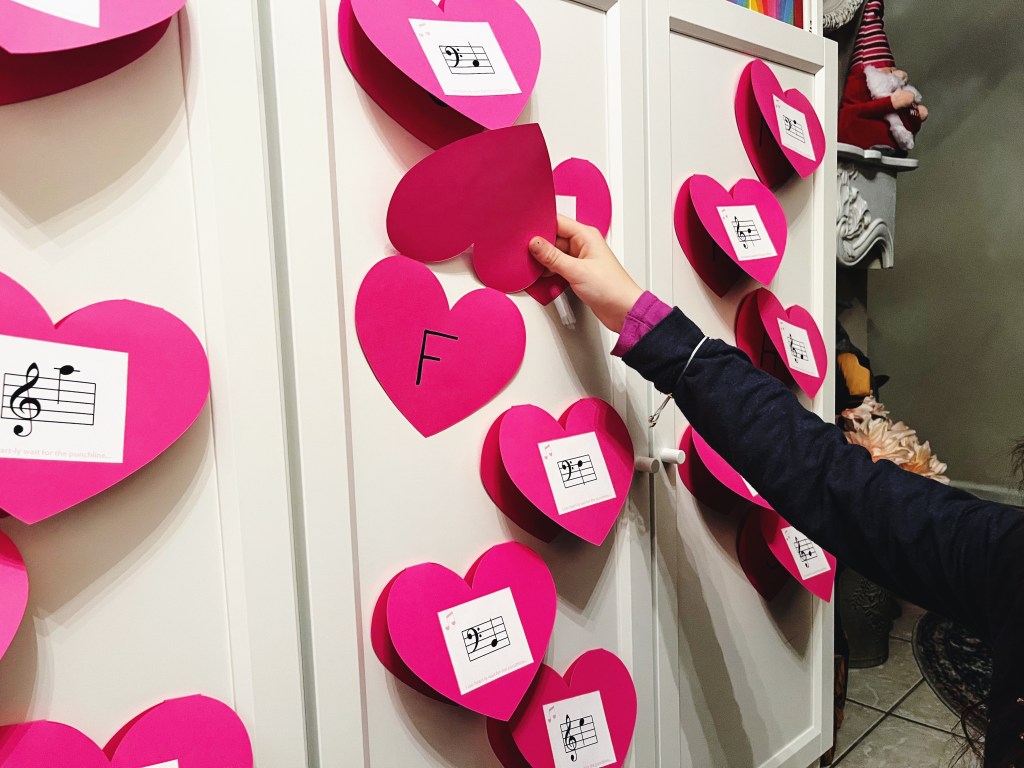
I wanted to go all out with this game so that it would be a decoration for my studio space as well as a game (I’m also sharing an easier way to play it up below). I wanted my student to be curious about it when they walked in. I cut out hearts and folded them in half; on the outside was a note on the staff and on the inside was a letter of the alphabet. Here is a reel I posted of how I made them:

I loved the way it turned out!!

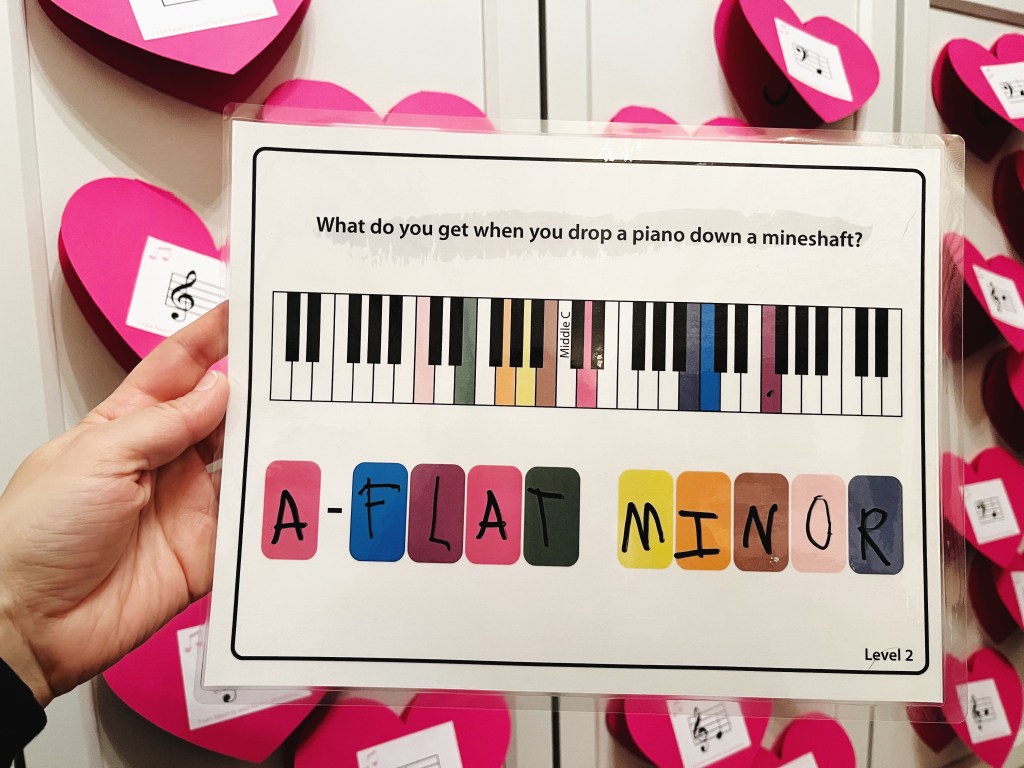
To play, I had my students randomly pick a joke:

I would have them read the setup of the joke and then I’d explain that the punchline is written out as a series of colored rectangles that they have to decode. Each color corresponds to a key on the keyboard picture. We would then pick a color and find the key on the keyboard printout (for example, blue is Middle C). Then they had to find that note on my wall of hearts to reveal the letter that goes in the punchline.

They would then write that letter inside the colored rectangle.

Once all the notes had been found and all the colored rectangles had been filled in, they would tell me their joke!

Here is another reel of me playing this game with a student:

I love this game because not only do students have to think about keyboard geography, they have to be able to associate the notes with their exact location on the piano. A tip I always started with was, “Look at the clef first!” because often they would find the correct line or space but the clef was wrong. They caught on quickly!

I have this game available in my shop: I Can Heart-ly Wait for the Punchline. It comes with 10 jokes for students to decode as well as all the hearts. The hearts are double-sided, one side has the note and the other, the letter of the alphabet, so set-up is much easier. I would love to hear what you think if you decide to play this game with your students! We had a blast!

Let’s stay in touch, join the list!

As a “toucan” of our appreciation download a free set of note flashcards (link in our Welcome email)!

Processing…
Success! You're on the list.

Musical MASH: A Note Reading Game that Predicts the Future

Did you play MASH (Mansion, Apartment, Shack, House) when you were a kid? All it required was a piece of paper and a pencil! My friends and I would spend countless recesses trying to find out if we would marry our crushes, have 20 kids while living in a mansion (we all wanted the mansion, of course) and driving a Ferrari! It was loads of fun and provided a lot of good laughs! If you want to check out the original game, MASH+ has all the details.

This Valentine’s Day my students and I are playing the musical version of MASH (maestro, accompanist, soloist, hobbyist) that I created! We will be drilling our knowledge of the spaces on the grand staff while figuring out our musical futures!

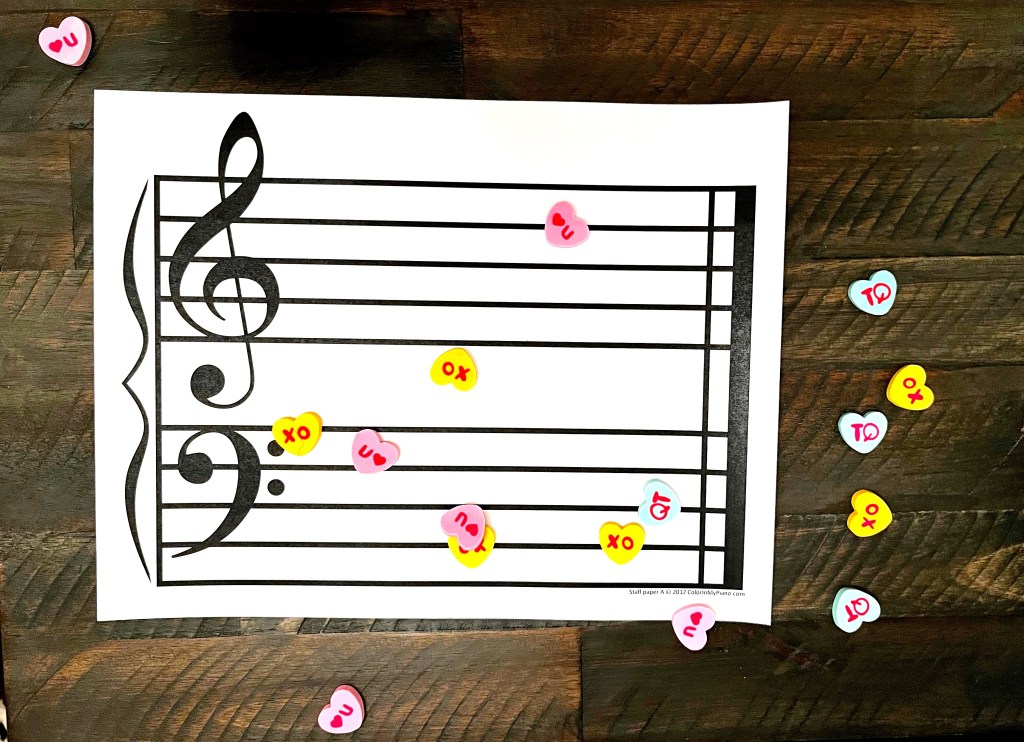
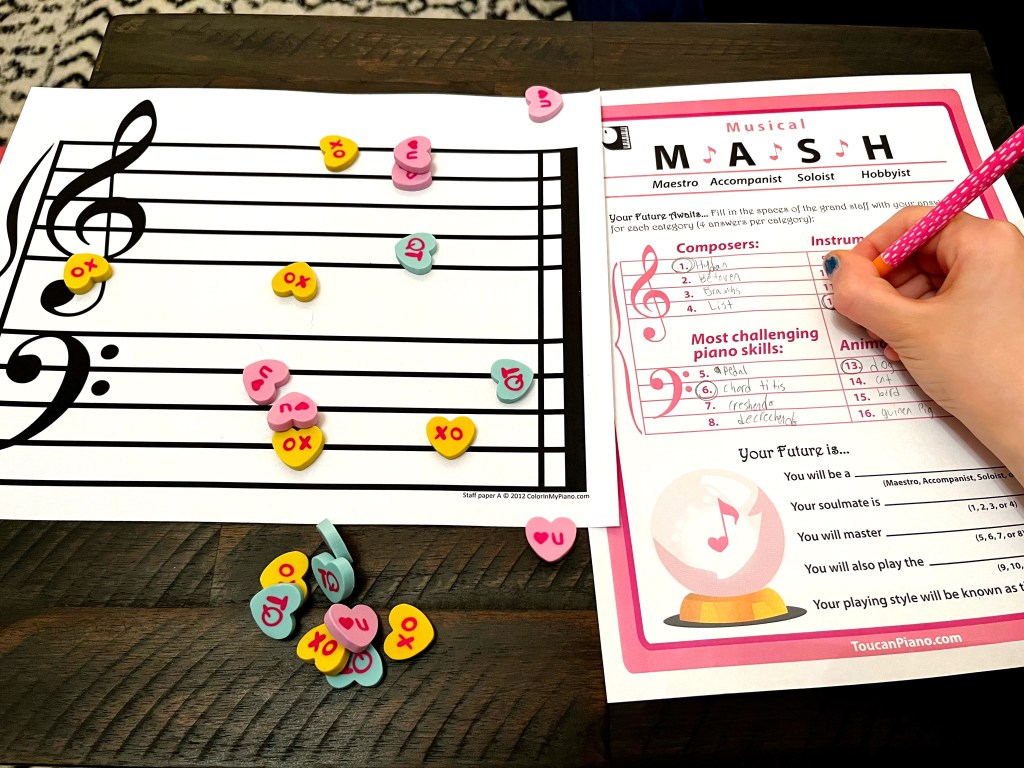
It’s a fast, easy game to play, and has already given us some funny results! I am using a print-out of the grand staff and some mini-erasers in my example here but it could also be played with a floor staff and beanbags or at the piano (see the instructions in the download for details).

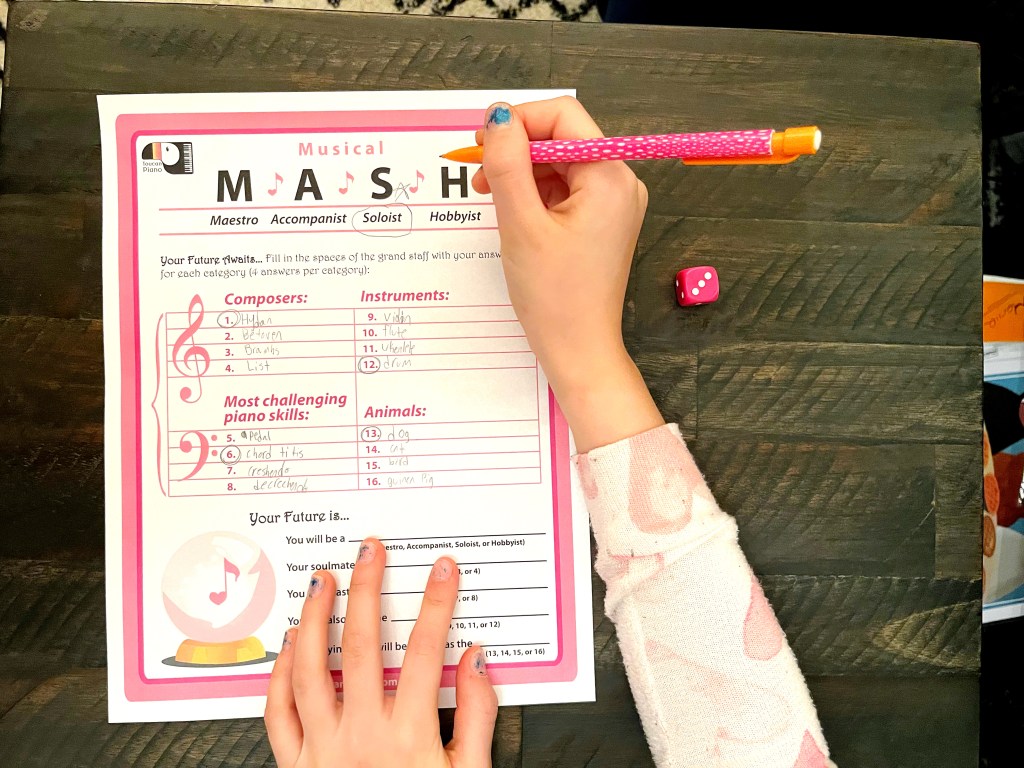
First have the student fill out the four spaces for each category. You can ask them to name the spaces of the grand staff as they write their answers in each space.

Hand them some mini-erasers (I’m using heart shaped ones for Valentine’s Day!). They should close their eyes while dropping the erasers onto the grand staff. They can drop them one by one or a few at a time (the teacher can call out when an eraser has landed on a space).

When they open their eyes they evaluate if any of the erasers landed on the spaces of the grand staff (for added drilling, you can have them name all the lines and spaces that the erasers landed on).

They then take note on the Musical MASH worksheet of where the erasers landed. Repeat the same procedure until the student has obtained an answer in all four categories.

In order to decide if the student will be a Maestro, Accompanist, Soloist, or Hobbyist, you can roll a die (for example, 1 = Maestro, 2 = Accompanist, 3 = Soloist, 4 = Hobbyist, 5/6 = Roll again) or use the traditional MASH spiral method (explained at MASH+). Circle their future career at the top of the page, under the title.

The student should then fill in the blanks at the bottom of the page with the answers to their future!

If you would like to play Musical MASH with your students, download it for free at the new Toucan Piano Shop! I am currently setting up the shop with new products, so if you are interested in staying up-to-date with the latest blogposts and shop updates, join the email list below (no spam, I promise!).

Let’s stay in touch, join the list!

As a “toucan” of our appreciation download a free set of note flashcards (link in our Welcome email)!

Processing…
Success! You're on the list.

What music means to us…

I’m sure if you do a quick Google search you will find countless articles, blogposts, books, etc. on this subject by people who are far more qualified than I am to talk about the impact of music on the brain and memory. This post is going to be a bit more personal because we all have certain composers, pieces, artists, songs, lyrics, and albums that have had a great impact on our lives and are intrinsically tied in with ourselves, our hearts, our thoughts, and our memories.

All these “deep thoughts” were triggered on Friday morning (January 21, 2022) when I woke up to find out that my favorite (now I mean favorite favorite) singer had passed away on Thursday night… Meat Loaf. I spent the morning rush telling my daughter about the first Cd of his I got when I was 13 (which was also my first Cd ever) and rocking out to his music on the way to school… only to find myself in tears on the drive home alone. I’m a sentimental person by nature but I never cry when I hear of famous people I like passing on. I say a prayer for their families and friends for comfort and peace and maybe spend a little time thinking about all the good they brought into this world, depending on who it was… but Meat Loaf was different. And as the music played on, I couldn’t sing along anymore because of the tears streaming down my face.

Every album of Meat Loaf’s I can place in a time of my life and he has been the soundtrack to so many moments of my life… The music transports me back so vividly it seems like I’m seeing photographs or videos in my mind. I’ve always felt that he and Beethoven stand side-by-side in my heart… and I laugh to myself at all the similarities they share in their complex, larger-than-life personalities which were always on full display in their music. The passion is always palpable and the musical story is always a ride worth taking.

Which got me thinking about the music I have played throughout the years… music that has ignited my passion for the piano and pushed me forward to continue playing and learning and growing. So I decided to launch a little challenge for myself and anyone who would like to play along.

As piano teachers I feel we get very caught up in our students’ music… researching music for them, staying up-to-date with all the new music being published, composing new music for them, guiding them to play the music they love… It’s easy, for me at least, to lose sight sometimes of the direction of my own practice and the music I want to play.

As I mentioned in my Holiday Gift Guide post, I encourage my students to curate a collection of favorite pieces. Pieces that they have mastered and loved and can easily revisit anytime they feel the urge to just play! For this purpose, I suggested having a special folder to collect them all in so they are all in one place.

I want to spend a little time at the beginning of this year, revisiting pieces that have meant something to me in this long relationship I’ve had with the piano… pieces I’ve discovered and loved from the very beginnings of my studies at age 7 to today. I will post prompts starting on Monday, Feb. 7, 2022 and share them on my Instagram as I go. There will be a total of 7 prompts, one each day leading up to Valentine’s Day (short and sweet!). If you’d like to play along, please tag me and/or use the hashtag #toucanpianomemories so I can find them! I want to see them and maybe we can all discover some new pieces or remember long-forgotten ones.

It’s not meant to be a collection of virtuosic pieces… oftentimes virtuosic pieces don’t touch our hearts the same way “easier” pieces do. As I remind my students, good music is not defined by its level of difficulty but by the feelings it stirs inside. I’m hoping this will give me some added enthusiasm, direction, and focus for 2022 in my own practicing.

And Meat Loaf… thank you for the music, the memories, and everything in-between. Heaven couldn’t wait for you any longer and I hope you and Jim Steinman are rocking out together with the bands of angels. And for anyone curious, my first Cd was “Bat out of Hell II: Back into Hell”. My Dad picked it up for me at Root Records while he was running errands in downtown Florianopolis (Brazil). I remember him picking me up from my friend’s house and handing it to me as I sat in the backseat. I poured over all the lyrics on the drive home and ran to my Mom’s office to listen to it (it was the only room that had a Cd player). I know all the songs by heart and even used a line of “Life is a Lemon” in my essay for the entrance exam for UFSC (Federal University of Santa Catarina). It is my favorite Cd to this day; it is pure perfection in my heart.

Let’s stay in touch, join the list!

As a “toucan” of our appreciation download a free set of note flashcards (link in our Welcome email)!

Processing…
Success! You're on the list.

Music Ornament Craft

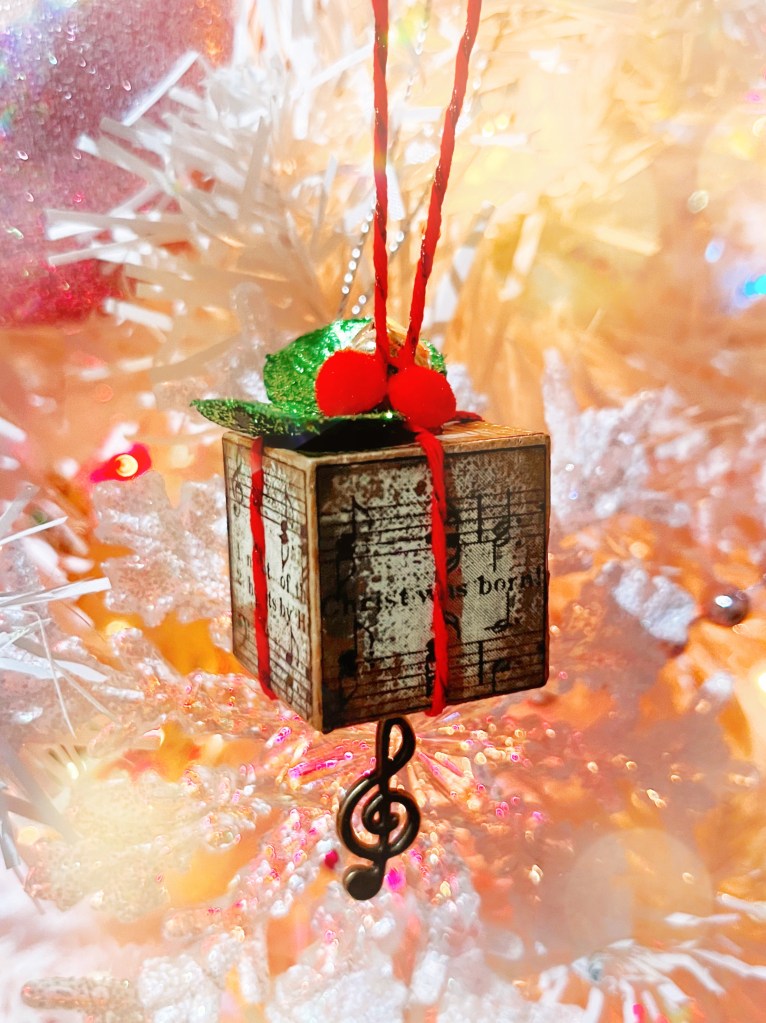
Every year I make an ornament for my students as a gift during the Holiday season. I try to make it music-related or a tie-in with a practice challenge we are working on in December. I gift it to them during our last lesson before our winter break. I love to hear how they use the ornaments on their trees every year and how they enjoy watching their collection grow! It always warms my heart!

This year I was inspired by an ornament I found on Pinterest (unfortunately it doesn’t appear to be available for purchase anymore on Etsy). I wanted to put my own twist on it and add a little more color and musical elements. I made a total of 40 ornaments and the final cost was roughly $1/ornament, including the use of coupons and store promotions (plus the time to make them. It did take me several hours, so that’s definitely a consideration to factor in!).

For this craft you will need:
– Vintage sheet music (I found some free vintage sheet music online and printed it out)
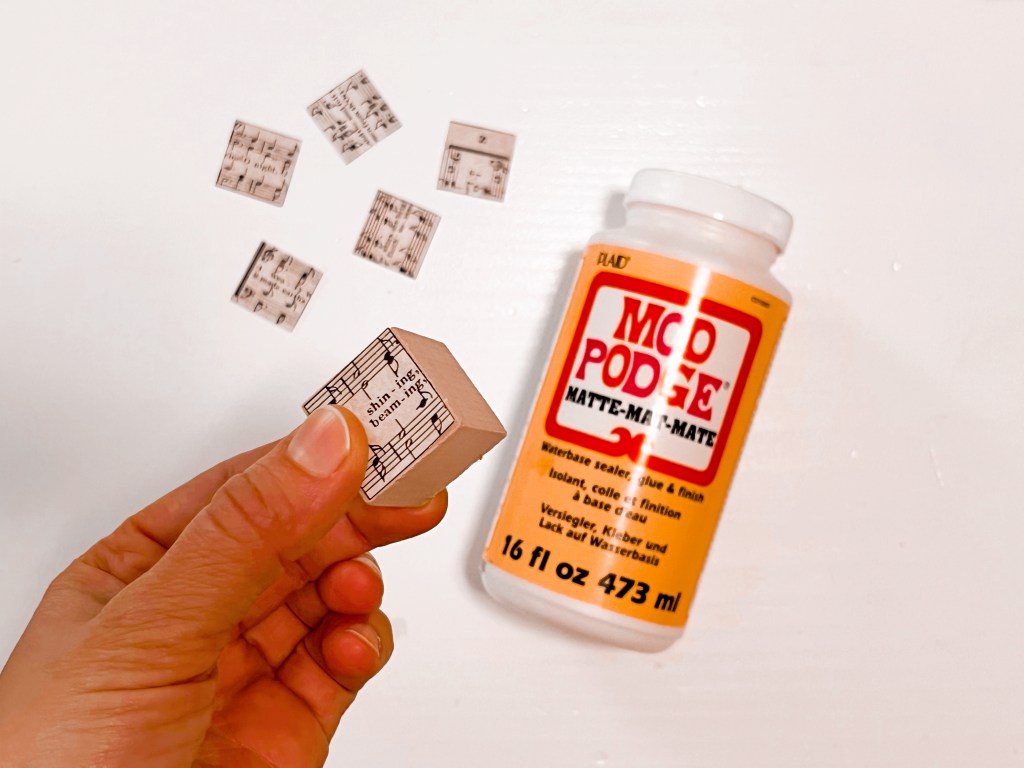
1 inch unfinished wood craft cubes
Mod Podge or white glue
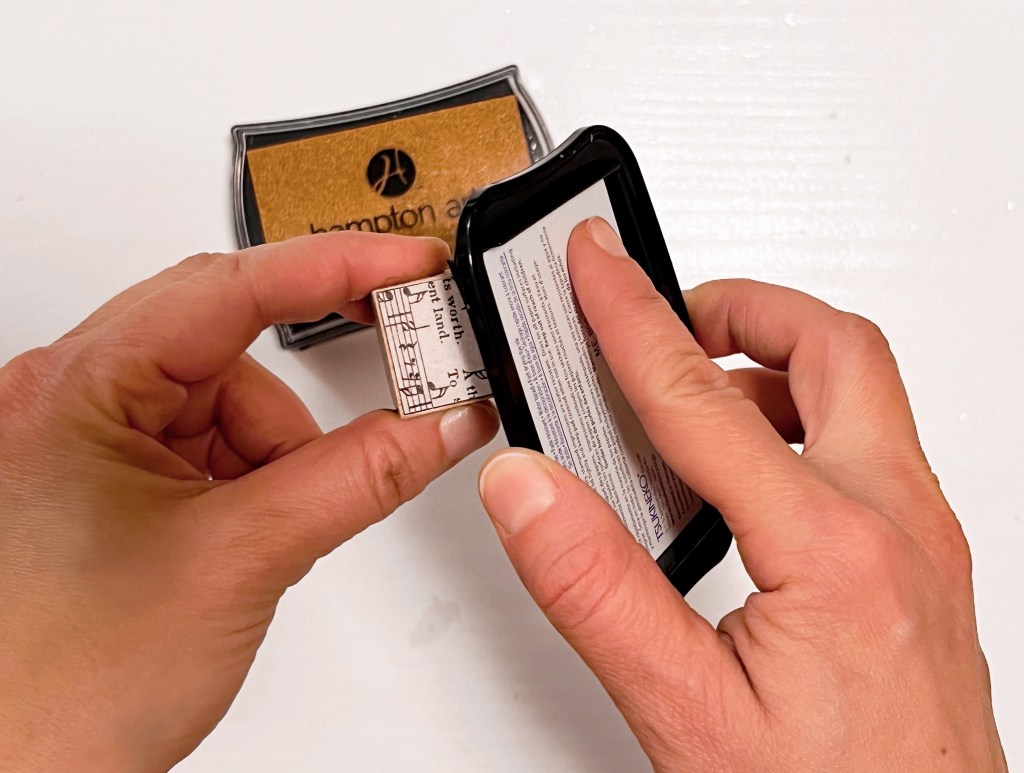
– Stamp pad(s) of your choice (I used rich cocoa and gold)
Thin ribbon
Treble clef charms
Mini jingle bells (10 mm in diameter)
Mini red pom-poms (5 mm in diameter)
– Seasonal greenery (I chose glittery green leaves)
Hot glue gun and glue

Cut the vintage sheet music into 0.95″ (2.40 cm) squares. You will need 6 squares per wood cube.

Use the Mod Podge (or white glue) to adhere the sheet music squares onto the sides of the wood cube.

Once the glue has dried, use the stamp pad(s) to age the paper. I started with the rich cocoa stamp pad, lightly working from the edges inwards. I did all six sides, then went over the cube a second time, this time with the gold stamp pad to give it more depth (and this is the point that my fingers became a rich cocoa in the pictures! lol).

I decided to seal the ink with a layer of Mod Podge for added protection. This step is optional, but it does give the cube a nice shine, so I was happy to put in the extra time.

String the treble clef charm through the ribbon and wrap the ribbon around the cube like you would wrap a ribbon around a present. Make sure that the charm stays on the side that you want to be the bottom. I added a dot of hot glue to secure the charm to the bottom of the cube. Tie a knot at the top of the cube, making sure that the ribbon is taut against all the sides of the cube.

Then tie a knot with the ends of the ribbon to create a large loop with which to hang the ornament to the tree.

Add embellishments, such as greenery, pom-poms, and a mini jingle bell, to the top of the cube using hot glue. Try to distribute the embellishments in a way to hide the knot on the top of the cube.

The music ornament is all done! I made mine in three different colors: green, red, and blue. I was so happy with the way they turned out. I can’t wait to give them to my students!

Let’s stay in touch, join the list!

As a “toucan” of our appreciation download a free set of note flashcards (link in our Welcome email)!

Processing…
Success! You're on the list.

We are a participant in the Amazon Services LLC Associates Program, an affiliate advertising program designed to provide a means for sites to earn advertising fees by advertising and linking to Amazon.com. As an Amazon Associate we earn from qualifying purchases.
25 Piano Gifts for the Musician in your Life

Is it just me or does the Holiday season speed up every year?! Somehow Christmas is just two weeks away and many people are trying to find last minute gifts that are both meaningful and useful.

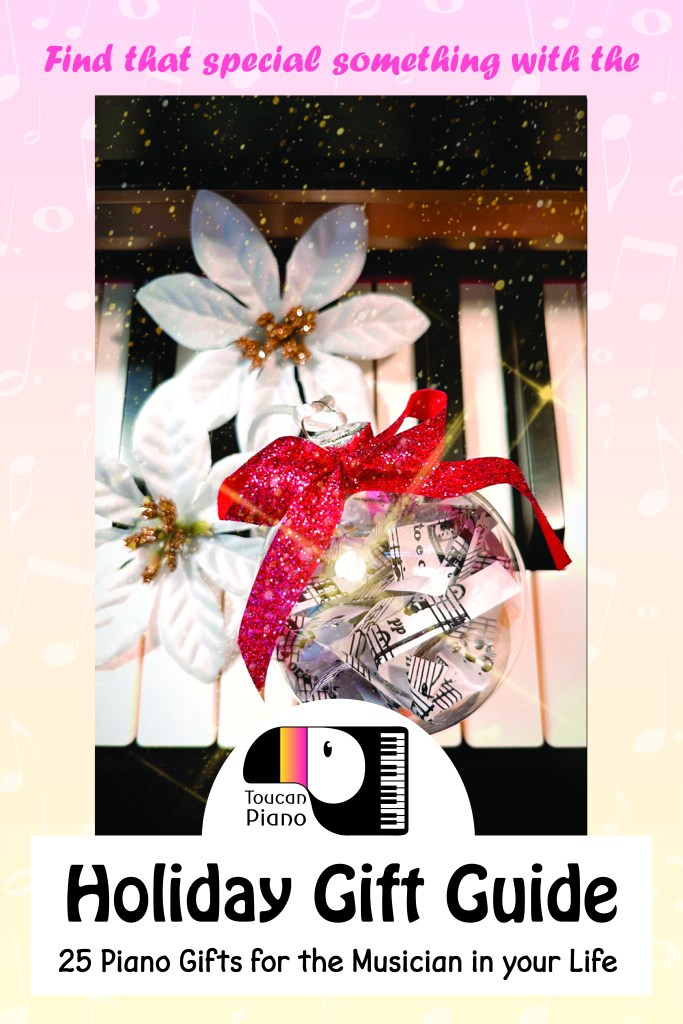
Toucan piano holiday gift guide

Every year I send out piano-related gift suggestions to my piano families. It’s a nice way for parents to encourage and recognize all the hard work their kids put into practicing (because, unfortunately, the piano doesn’t always get the same sort of fanfare as sports and other extra-curricular activities). The list is always a mixture of useful and fun stuff and the kids always enjoy showing me the piano gifts they received when they come back from our Holiday break.

Everything on this list I’ve either purchased for myself, have had students purchase, or is currently on my wish list (in case anyone’s looking for a last minute gift for me! lol).

Here are my top picks for this year!

CDs

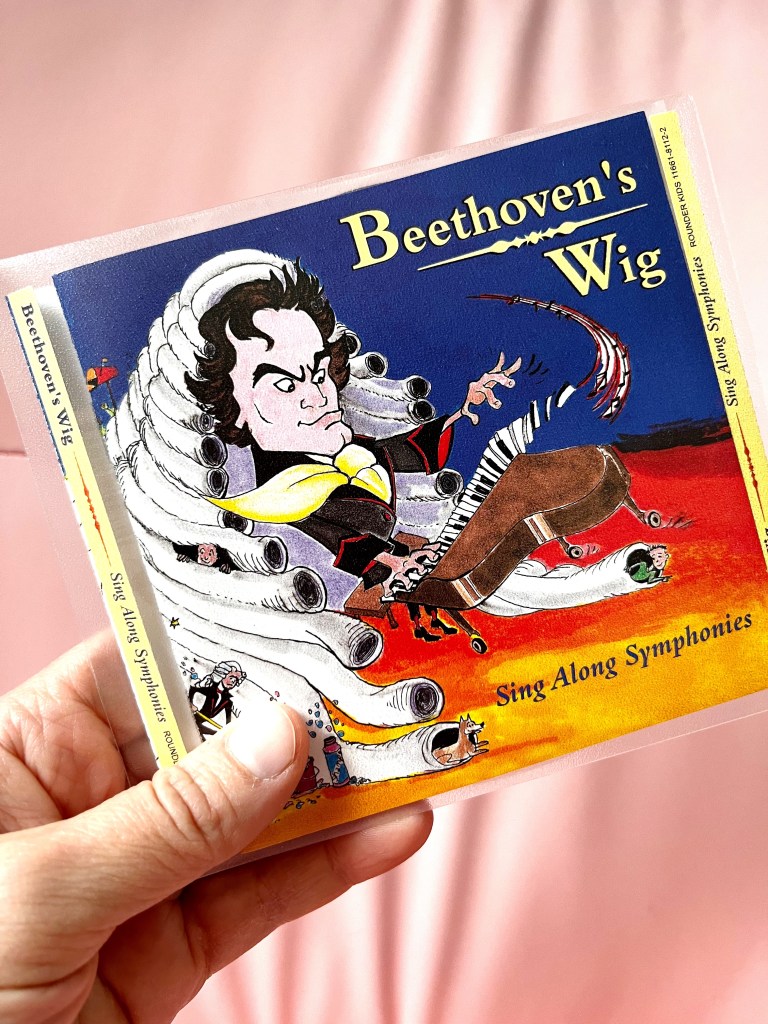
Beethoven’s Wig – The title song of this Cd has always been a favorite among my students (we watch the video every year at our annual Beethoven’s Birthday Bash! You can watch is here.). The other songs on the Cd are equally as fun and is an entertaining (and hilariously silly) first exposure to some of the great masterworks of classical music. The Cd also includes the original version (without the lyrics) of each piece.

Carnival of the Animals – The Kanneh-Masons – The incredibly talented Kanneh-Mason family comes together for a beautiful performance of Camille Saint-Saens “Carnival of the Animals” as well as a selection of several other favorites.

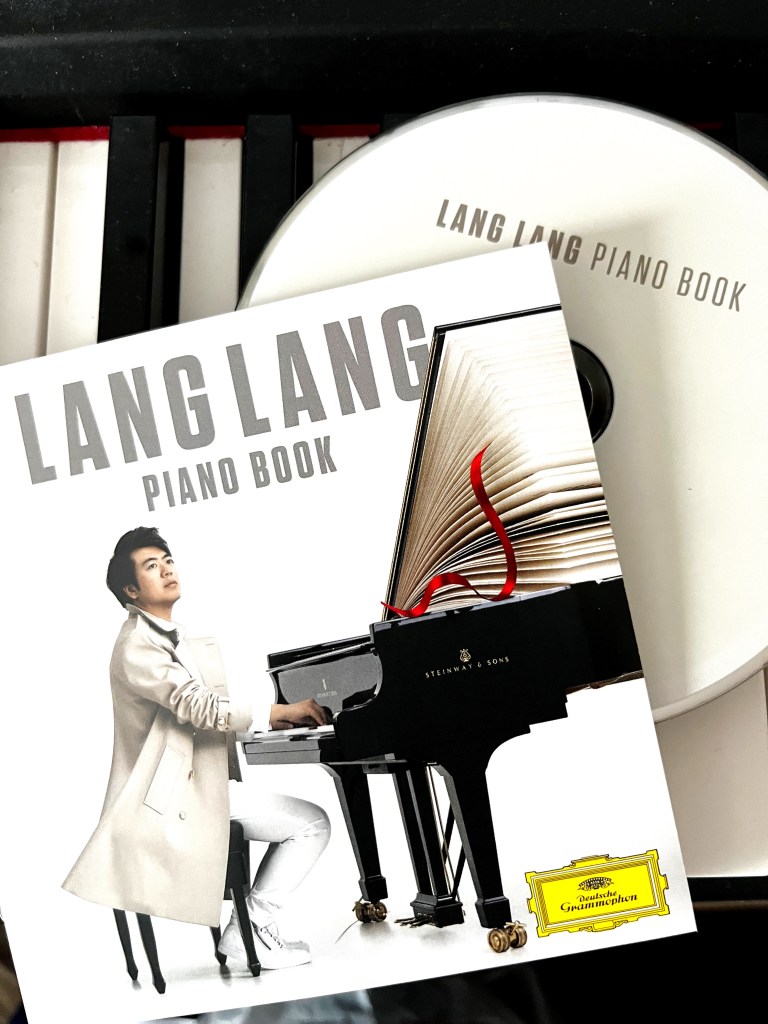
Lang Lang “Piano Book” – Lang Lang recorded his favorite piano pieces from his childhood. These short masterworks for the piano are some of the most popular ever composed for the piano and most students run into them at one point or another. It’s a great selection of music to inspire students to keep practicing!

Helen Marlais’ Real Music for Kids – A beautiful compilation of short solo piano pieces. Many of these pieces are a student’s first dive into the rich world of classical music.

Practice/Lesson Helpers

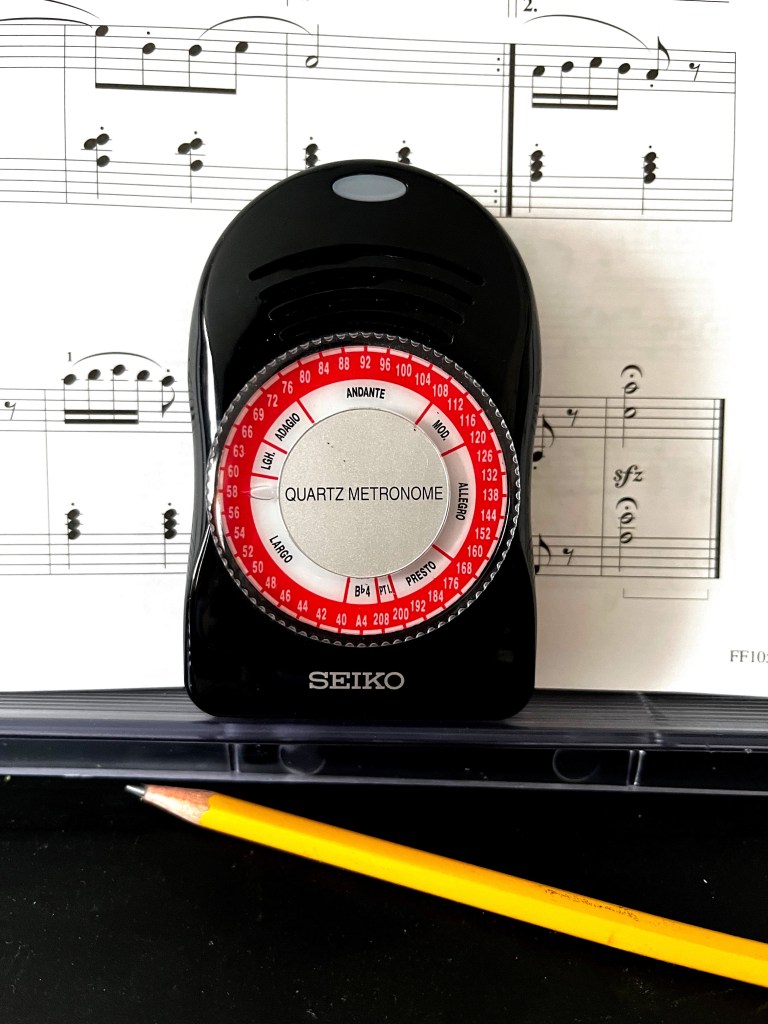
Metronome – The friend and nemesis of all musicians! It is always a useful tool to have at the piano. This metronome is a great size and has volume control (my mom for one could not stand the ticking sound of the metronome!). I loved it so much that I bought several to use with the children’s band at my church.
Metronomes are essential for practice and came in at no. 3 on my list of the Top 7 Practice Tools Every Piano Student Should Have.

Music Book Clip – There’s nothing worse than being in the middle of playing a piece and watching the book slowly shutting! This book holder will help keep those books laying flat on the book rack.

Manuscript Paper – A perfect sized notebook for writing down compositions. It has a nice wide staff (easier for kids to write music on), 100 pages, and is 8.5 x 11 inches.
Manuscript paper is incredibly versatile and important for any piano student which is why it took the No. 2 spot on my list of Top 7 Practice Tools Every Piano Student Should Have.

Sheet Music Folder – I love the idea of students curating a folder of their favorite pieces. Pieces that they have mastered and loved and can easily revisit anytime they feel the urge to just play! This folder is a perfect place to put these pieces. The plastic sheet protectors keep those precious favorites safe as they are played over and over again!

Treble Clef Photo Holder – I usually send my students home with a sticky note listing their practice pieces of the week. This sticky note lives on the cover of their method book or binder. But this little photo holder would be a perfect place to put the sticky note at home! If placed on the piano, it would be a quick and easy way for students to reference what they need to practice each week.

Books

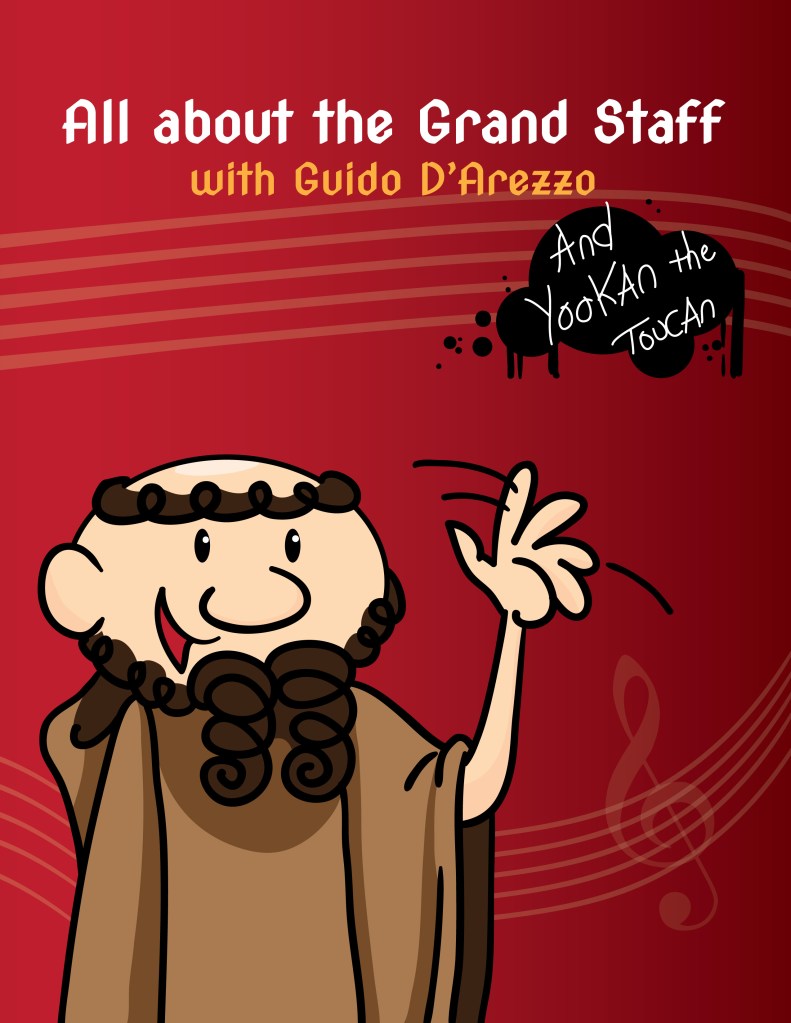
All About the Grand Staff with Guido D’Arezzo and Yookan the Toucan – Shameless plug of my book! It is a great choice for students who are just starting to learn to read music on the grand staff. My daughter has been playing for years and she picks up this book at least once a month to read for fun! She’s my biggest and best cheerleader! For more on my book, visit my blogpost about it.

When Step met Skip – An adorable adventure of steps and skips on the staff sure to entertain beginning music readers.

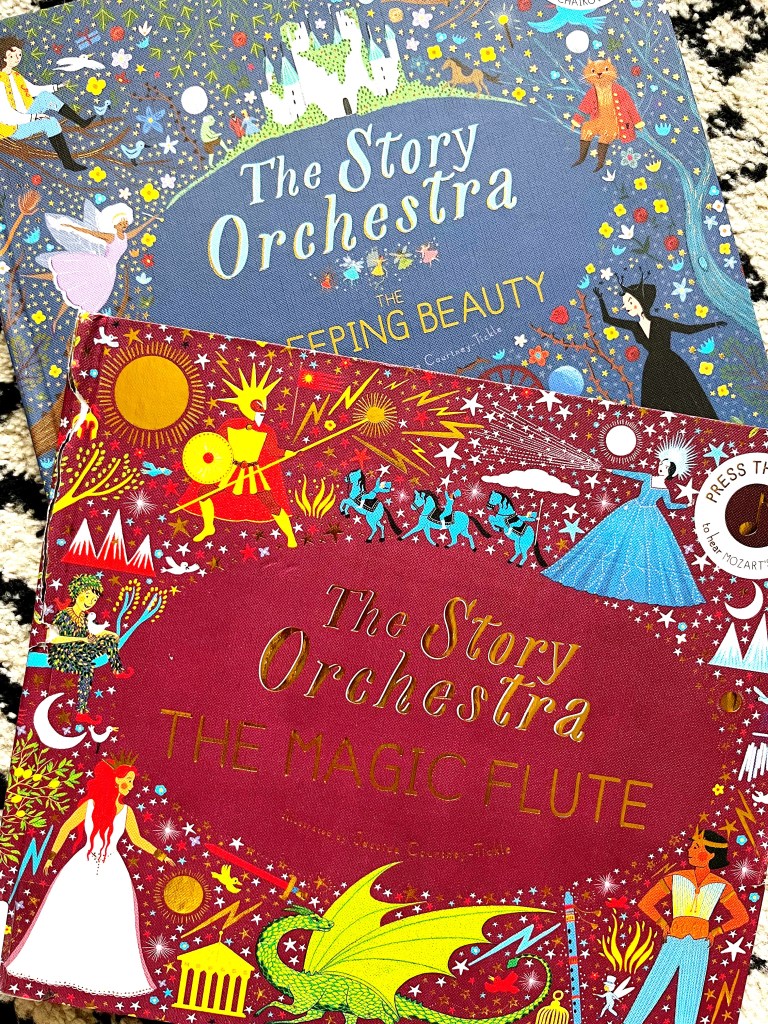
The Story of the Orchestra: The Nutcracker – I love “The Nutcracker” (our ever growing collection of nutcrackers can attest to that! We are getting close to 20!!) and this gorgeously illustrated telling of “The Nutcracker” is a beautiful way to share Tchaikovsky’s music with kids! Children can press the buttons on the side of the books to hear Tchaikovsky’s music played on each page of the story. I currently have “Sleeping Beauty” and “The Magic Flute” from this collection and plan on adding “The Nutcracker” very soon!

Clara Schumann, Pianist and Composer – Clara Schumann deserves all the attention and recognition she has been receiving in recent years. In the heavily male-dominated world of classical music, she is an inspiration to young girls. This chapter book dives into her life and long career dazzling audiences all across Europe with her music.

T-Shirts

A little humor, a lot of keys, and mega dose of style!

Piano Necktie T-shirt

88 Keys, 10 Fingers, No problem! 

Piano Girl

Retro Piano heart

Rock Paper Scissors Piano

My Piano is Calling

Fun Stuff

Nanoblock Grand Piano – For the lego enthusiast! The bricks (as small a 4 mm x 5 mm!!) require some precise construction skills. You can purchase it as part of an instrument set or individually.

Composer Socks – Keep your toes warm (and inspired) while you play the pedal! Two composers are available:
Beethoven
Mozart

Make your Own Music Box – For the composer! They can immortalize their music (and practice writing notes on the treble staff!) with this very cool little kit. Once they are done punching out their piece on the paper strip, they can play it on the music box. Extra paper strip refills are sold separately.

Piano Purse  – Seriously, how cute is this?!!

Piano Earrings

Music Pasta – I thought this was hilarious! It’s quite pricey for pasta, but you could make a whole music-themed family dinner out it.

Let’s stay in touch, join the list!

As a “toucan” of our appreciation download a free set of note flashcards (link in our Welcome email)!

Processing…
Success! You're on the list.

We are a participant in the Amazon Services LLC Associates Program, an affiliate advertising program designed to provide a means for sites to earn advertising fees by advertising and linking to Amazon.com. As an Amazon Associate we earn from qualifying purchases.
I wrote a Book!

I’ve always loved to draw. Growing up, piano and art were my two favorite things to do. Come to think of it, not much has changed since then! I can’t watch TV without a sketchbook in my lap (one, because I love to draw and, two, because if I’m not actively doing something I will usually fall asleep while watching TV! lol). My dream was to write and illustrate my own graphic novel.
I finally did it!!!

I usually teach the basics of the grand staff over the course of a few weeks to beginner students once they can identify all the keys on the piano and are playing off-staff pieces with ease. I break it up into bite size bits so we can play games to reinforce each new concept. This graphic novel follows the same progression I use to teach my students but with some history (hello, Guido D’Arezzo!), short exercises to reinforce concepts, and a little silliness tossed it (courtesy of Yookan the Toucan).

The story begins when Guido D’Arezzo (pronounced Gwee-doh Dah-ret-so), the medieval Italian monk who invented a system for writing down music, meets Yookan the Toucan. Guido helps Yookan learn about lines and spaces and how the grand staff is actually a map of the piano. Yookan, always the enthusiastic helper, uses Guido’s piano to demonstrate his understanding of each concept (let’s just say, that piano will never be quite the same!). The treble clef and bass clef are introduced along with anchor notes (bass F, middle C, and treble G) and the concept of stepping on the staff.

Interspersed throughout the book at a few key moments are short exercises for students to test their understanding. All answers are provided in the back of the book. These exercises provide natural break points in the story which makes it easy for teachers to assign pages for students to read at home.

It is also a great option for homeschoolers or anyone with an interest in learning the basics of musical notation. The story is presented in a sequential manner, each concept building upon the previous one, so that the reader can learn independently.

To say I’m feeling like a proud mama is an understatement! I loved writing this book and I truly hope that it will help piano students or anyone curious about how musical notation works for the piano. I’m already itching to write another one!

It is available on Amazon in both paperback and Kindle format (if you have Kindle Unlimited, you can read it for free!). Check it out here.

Let’s stay in touch, join the list!

As a “toucan” of our appreciation download a free set of note flashcards (link in our Welcome email)!

Processing…
Success! You're on the list.