Top 7 Practice Tools Every Piano Student Should Have: #7 Mini-Erasers

Piano students don’t need a lot of accessories to practice… a quality instrument and sheet music is enough! But there are a few tools that make a practice session easier and more effective (and oftentimes more fun and engaging!).

I’m counting down my Top 7 Piano Practice Tools I think every student should have when they are on the bench (plus a bonus one at the end that you might not expect!).

Coming in at number 7 are:

Mini-Erasers

I have a weakness for mini-erasers! They are so cute and so incredibly useful at the same time. Every time I pass the Target Dollar Spot or am wandering around the craft store, I look for new ones to add to my collection. I have mini-erasers for every season, every holiday, and everything in-between! I like to think that my students appreciate my attention to detail and my desire to match our games and activities with the time of year.

A large variety of mini-erasers are sorted and organized into small bins. The erasers include snails, dinosaurs, starts, unicorns, dogs, dolphins, turtles, fish, and apples.

All of my students receive practice pouches when they start lessons (the cost is included in their Registration fee). Inside each pouch is: a music pencil, a mechanical pencil, 2 highlighters, a set of 6 rainbow barrel monkeys (all the colors of the rainbow, because we care about rainbow order!), 2 dice, and mini-erasers.
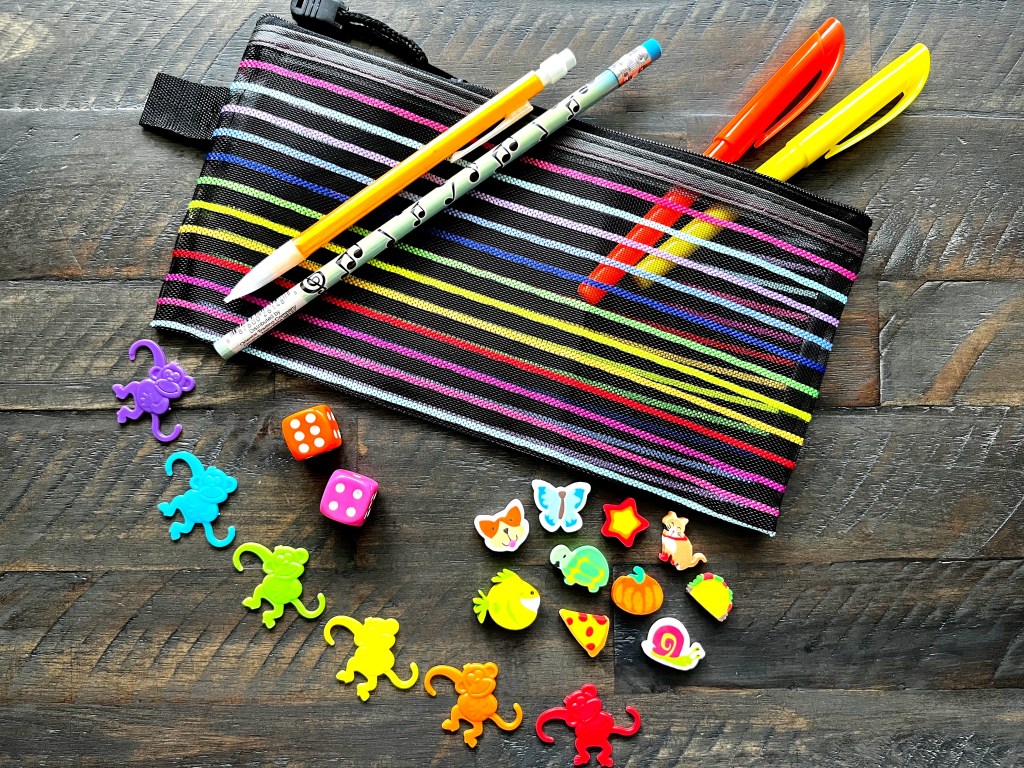
Black rainbow piano practice pouch lays on a wood table with its contents spread out around it: orange highlighter, yellow highlighter, mechanical pencil, music pencil, two dice, rainbow barrel monkey, mini-erasers.

All of the items in the pouch are meant to be used at home for their practicing during the week and if we need to do a virtual lesson for any reason.

The mini-erasers are one of the items from the pouch that get used the most! As I said before, they are adorable but also very useful. During our lesson we go over how the student will use them at home during their practice time (based on what they need to work on that week).

Use Mini-Erasers at home for:

Finger Warm-Ups

This is a very simple exercise but SO effective at helping students gain control over their fingers and build speed.

Place your hand on the fall board of the piano or on a table. Your hand should be held in a proper piano hand posture. Place five erasers on the fall board or table, one in front of each finger.
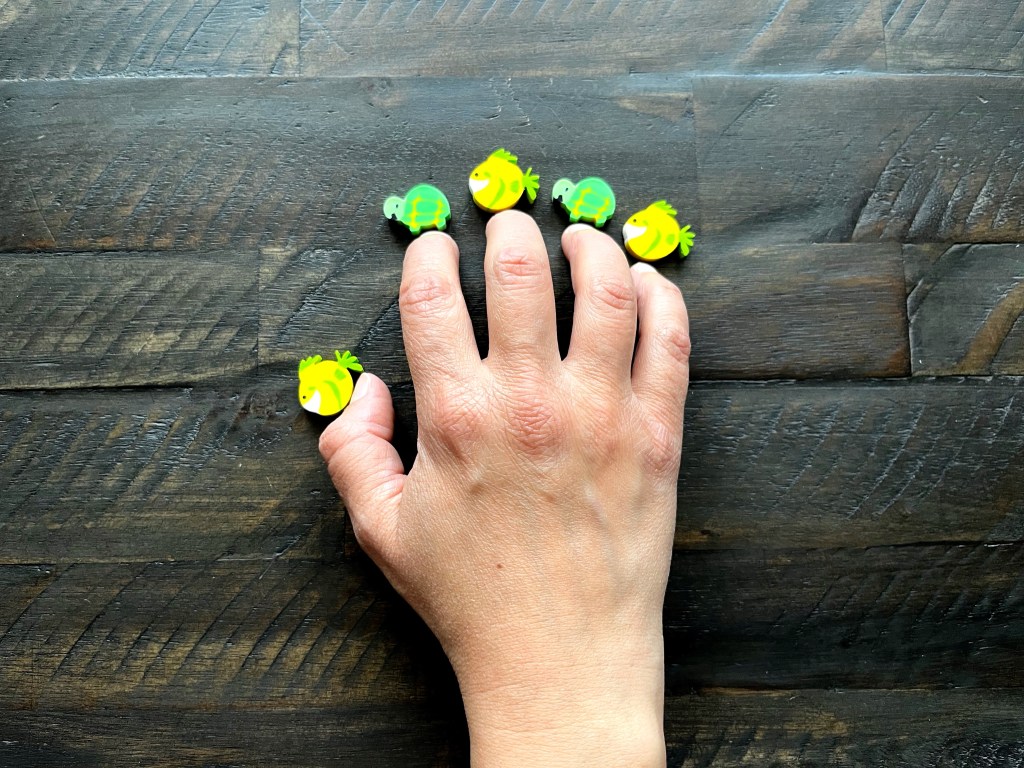
A hand sits on a table with five erasers placed in front of each finger.

One by one the fingers should kick the eraser that is sitting in front of them. When a finger is kicking, the other fingers should remain in the their positions and the hand should maintain its posture.

A hand sits on a table with five erasers placed in front of each finger. The index finger is extended having kicked the eraser away.

Do this exercise twice for each hand.

Hand Posture Exercise

This exercise is done at the piano to work on keeping the palm of the hand parallel to the keys.

Place your hand on the piano in the starting position of your practice piece. Your hand should be held in a proper piano hand posture. Place a mini-eraser on top of your hand (I suggest placing it between the 3rd and 4th finger).

A blue dolphin mini-eraser sits on the back of a hand while playing the piano.

Play your piece with the eraser on top of your hand. If your hand shape changes (wrist sags, hand leans towards the pinky, wrist lifts too high, etc.), the eraser will fall off your hand and you need to start over.
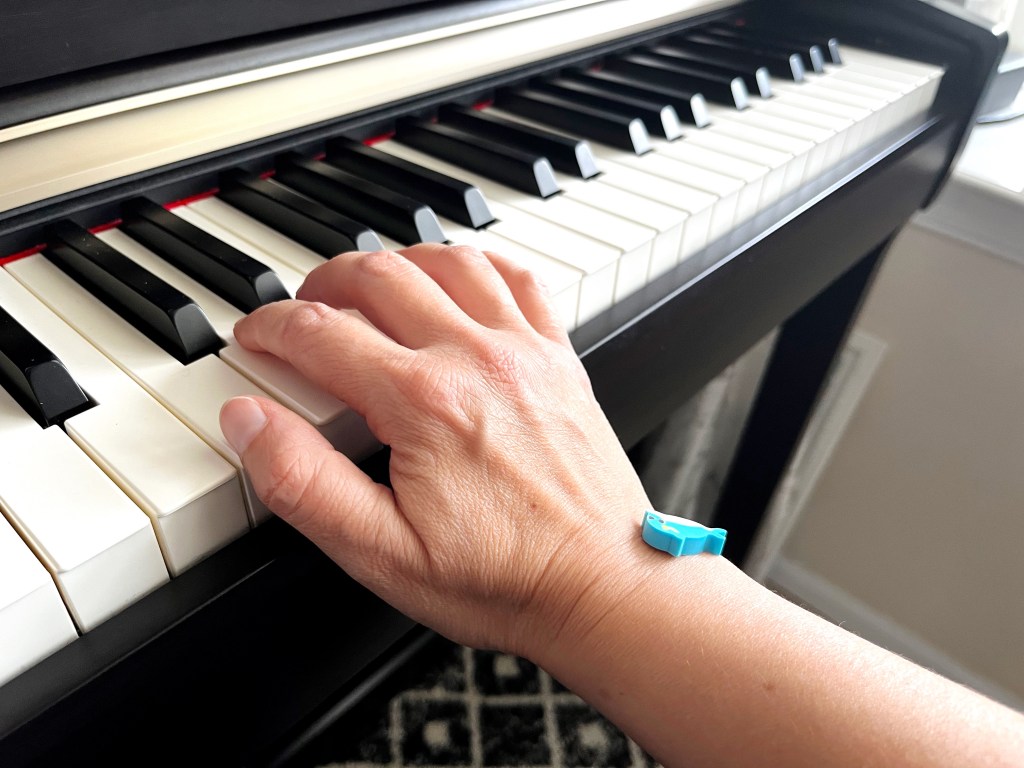
A blue dolphin min-eraser fell off the back of the hand due to poor hand posture at the piano, a sagging wrist.

The eraser gives the student immediate feedback on their hand posture and helps them focus their attention on proper posture when playing. Proper postures sometimes falls to the wayside because the student is SO focused on all the other things vying for their attention, like pitch, rhythm, and dynamics.

This is not a “quiet hand”/finger independence exercise and should only be used for drawing a beginner student’s attention to their hand posture. It can be used for a phrase or passage where the student is losing the shape of their hand. As students progress in their studies, the hand needs to be in constant motion when we play, changing its shape to handle the music and requiring ample support from the wrist, arms and shoulders for proper technique without tension. Trying to keep the hand in a fixed position at all times will cause strain, tension, and possibly injury.

Counting Correct Repetitions

I encourage my students to work on their music is smaller sections and to aim for accuracy on each repetition. At home they can use the mini-erasers (or barrel monkeys) to play a little game with themselves and keep track of the number of times they play a section correctly.

They must play a section three times in a row without a mistake in order to move onto the next section. The key thing here is “in a row”. If a student plays a section 10 times and plays it correctly on the 3rd, 7th and 10th try (3 times but not in a row),that indicates that the student’s brain and hands are still very confused about what needs to be played. When the hands “get it” they should be able to repeat it.

To play, the student places three mini-erasers on the left side of their music.

Three mini-erasers sit to the left of sheet music on a piano.

If they play their section correctly, one of the erasers is moved to the right side of their music. If they play their section correctly again, another eraser is moved to the right side of their music. If, however, they make a mistake when playing their section, ALL the erasers must be moved back to the left side of their music and the student must start over again.
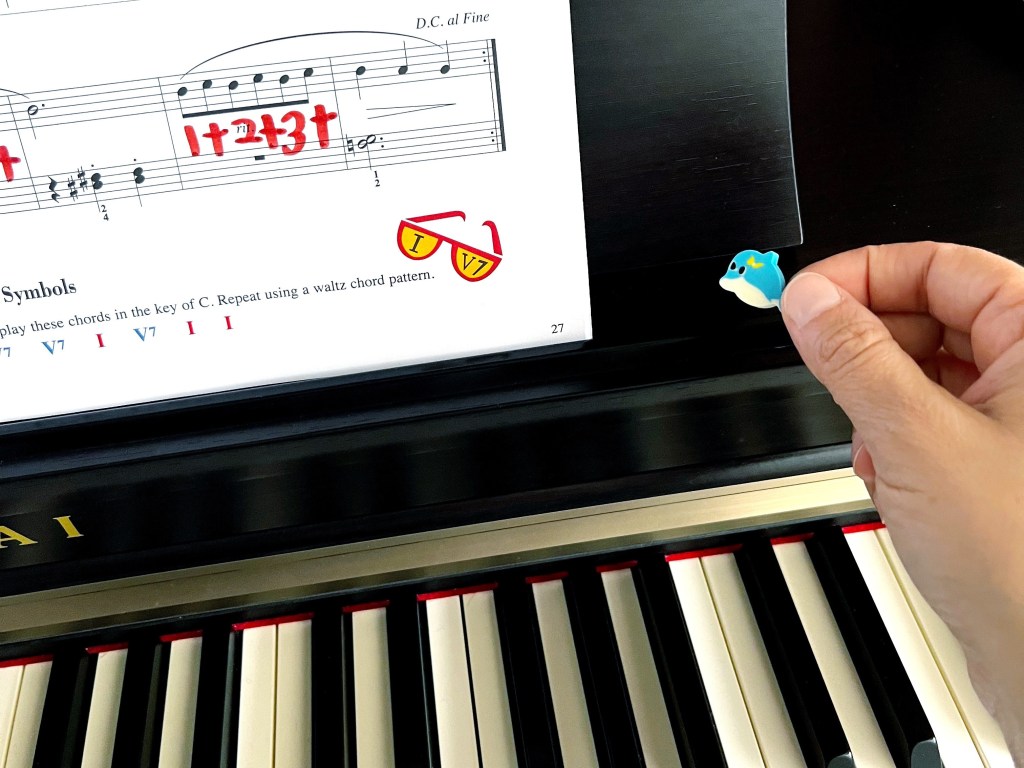
A blue dolphin mini-eraser is moved to the right side of some sheet music on the piano.

Fixing a Wrong Note

When a student is trying to fix a wrong note in their music, we always circle or highlight the note in the score to give them a visual reminder to be careful with that note.

A treble C is highlighted in orange.

But sometimes muscle memory take over and the note proves hard to fix, especially if the student was playing it incorrectly all week.

A mini-eraser can help! Place a mini-eraser on the key the student needs to play and have them place their finger on top of the eraser. This extra tactile reminder will usually fix the problem. Once the student has played the section correctly a few times with the eraser, the student should remove the eraser and try to play without it.

A mini-eraser sits under the fingertip of the ring finger.

Practicing in Sections

Breaking a piece down into smaller sections is a very efficient way for a student to work through and master a piece. Since the amount of music the student needs to focus on is smaller, the student will feel less overwhelmed and can give the difficulties of each section the amount of attention and focus they require.

Mini-erasers can add a bit of fun (and chance!) to practicing in sections! During your lesson time, divide up the student’s piece into sections with their assistance. Next assign each section to a mini-eraser. For example, line 1 is the pizza eraser, line 2 is the cupcake eraser, etc. Have the student label each section (either with the name of the eraser or a quick drawing).

Piano student draws a turtle at the beginning of a practice session.

When the student sits down to practice at home, they will reach inside their practice pouch and randomly pull out an eraser. The student will then work on the section assigned to that eraser. When their practice session is over, they should leave the eraser on the piano (so they remember which section they practiced).

A hand pulls a turtle mini-eraser out of a pencil pouch.

The next day, they will play through the sections they already worked on (indicated by the erasers on the piano) and then select a new eraser from their practice pouch.

If their piece has more sections than days of the week, the student can pull out more than one eraser per day.

Practice Challenges

Kids love a good challenge! Around recital time, especially, I like to give my students extra challenges to give them confidence in their mastery of their pieces. But challenges can be used all year round and mini-erasers can help!

Start by assigning a challenge to each mini-eraser. For example:

  • Pizza eraser: Play with your eyes closed
  • Cupcake eraser: Play at twice the performance tempo
  • Sloth eraser: Play from memory at HALF the performance tempo
  • Drum eraser: Tap out the rhythms of your piece
  • Glasses eraser: Play your piece for someone (family, friend, etc.)
  • Flower eraser: Play your piece pianissimo

When the student sits down to practice at home, they will reach inside their practice pouch and randomly pull out an eraser. The student will then do the challenge assigned to that eraser.

Improvisation Activities

Beginner students love exploring the sounds and capabilities of the piano. So why not use mini-erasers to encourage exploration at home?

They can pick or choose at random a mini-eraser from their practice pouch. At home, they will spend a few minutes of their practice time each day, coming up with sounds that describe the eraser they selected. For example, if they pulled out a lion eraser, they can explore loud sounds on the low end of the piano and even come up with a story for their music.

To make it even more fun, let them choose the eraser without telling you! Then at their lesson they can line up their erasers on the piano and you have to guess which eraser their music describes.
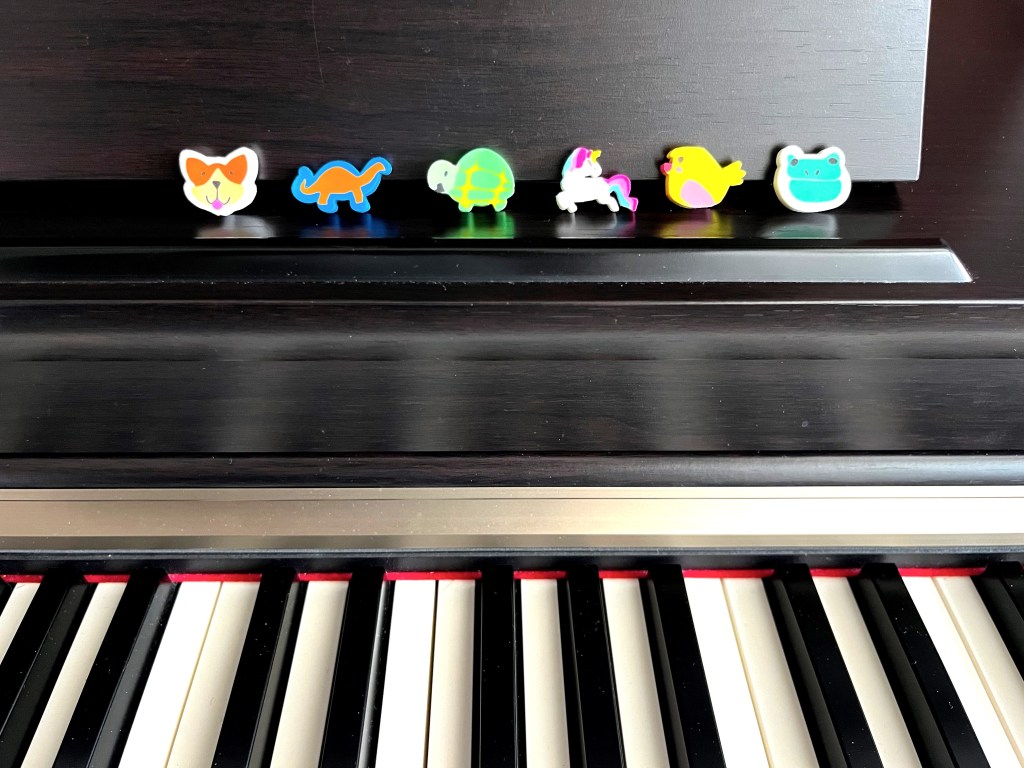
6 animal mini-erasers are lined up along the book rack of a piano.

For younger and beginner students, I would recommend using animal mini-erasers. As their skills increase and they learn more, you can bust out some non-animal erasers to inspire improvisation and composition (how fun – and a challenge! – would it be to work on writing music about pizza?!).

Practice Rewards

If you use rewards to encourage practicing at your studio, these mini-erasers can be a fun addition to your arsenal! Students can earn “Piano Pets” every time they complete a certain number of practice days. Their Piano Pets can sit on their pianos at home and they can work on growing their Piano Pet family (or earning-food themed erasers to “feed” them)!

Two piano eraser pets sit on the piano surrounded by food erasers.

And there we have it!

The number 7 practice tool every piano student should have. Next up is the Number 6 Practice Tool for effective practicing!

Explore more creative teaching ideas
  • Sky High Love
    Sky High Love is a great game to use mini-erasers during lesson time! The rhythms get longer as the heart towers get higher! Whose tower will remain standing in the end?! This adrenaline-inducing rhythm game is a great way to kick-off a lesson and get the energy up.
  • Chord Snowblast
    A real howler in July! Are you longing for cooler temperatures this summer? Bust out Chord Snowblast (an the mini-erasers) for a cool piano game that covers all the major and minor chords!

Let’s stay in touch, join the list!

As a “toucan” of our appreciation download a free set of note flashcards (link in our Welcome email)!

Processing…
Success! You're on the list.

We are a participant in the Amazon Services LLC Associates Program, an affiliate advertising program designed to provide a means for sites to earn advertising fees by advertising and linking to Amazon.com. As an Amazon Associate we earn from qualifying purchases.

Don’t Miss a Beat

Rhythm and meter are fundamental components of music that all students need to continuously work at… even though they more often than not complain about it. As teachers, it can be hard to find a game that grows with a student or can be played by multiple students at different levels at the same time (in the case of a group lesson or piano party).

Don’t Miss a Beat! is a fun multi-level rhythm game that you can play with ALL of your students in your studio. With 136 rhythm cards in the deck, it covers the basics from quarter, half and whole notes all the way up to more complicated rhythms such as triplets, sixteenth notes, dotted eighth notes and their combinations. It also covers three different time signatures: 3/4, 4/4, and 6/8. It can be purchased in the Toucan Piano Store.

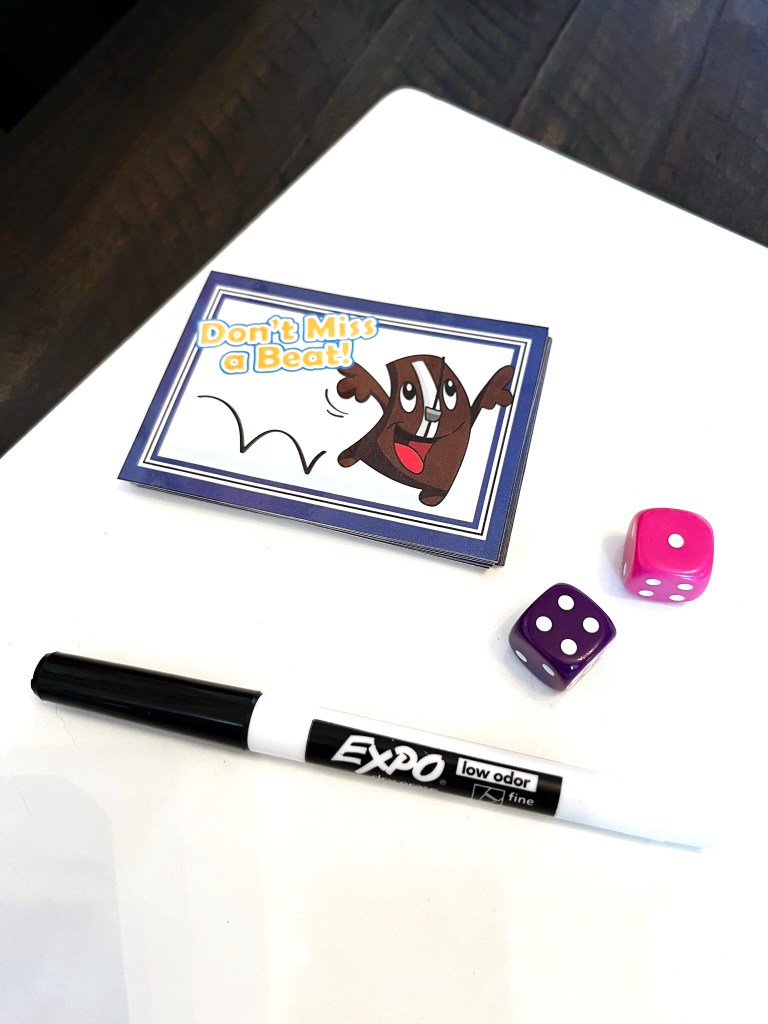
Piano teacher measures the height of a large stack of rhythm cards from the games Don't Miss a Beat!

All you need to play are the Don’t Miss a Beat! cards, dice (one for each player), and a white board and dry erase marker (or paper and pencil). Players take turns drawing a card from the deck and try to figure out how many beats are missing in the measure.

Students must analyze the time signature and figure out how to successfully complete the measure using their knowledge of rhythm note and rest values.

Don't Miss a Beat! rhythm card deck sits on top of a whiteboard and next to a pair of dice and a black dry-erase marker.
Piano student writes the correcting counting under a rhythm sequence on a white board.

Check out the game in action:

If students need an extra challenge, Don’t Miss a Beat! comes with two printable challenge dice. When using the dice in the game, the player must use the rolled rhythm to help complete the measure. This helps to keep students from resorting to the same rhythms over and over again.

Variation of the Game for Students at Different Skill Levels

Don’t Miss a Beat! can be adapted to students at different skill levels. Simply create a deck of rhythm cards for each student based on the rhythms they know and what you would like them to drill.

To play, player 1 draws a card from his/her deck, analyzes the measure and determines how many beats are missing. Both players try to roll that number. For example, if the measure is missing 2 beats, the players must roll a 2.

If player 1 rolls a 2 first, then player 1 will complete the measure by writing out a rhythm sequence that satisfies the time signature. Then player 1 will clap and count the measure to earn a point.

However, if player 2 rolls the 2 first, player 1 has been blocked and the round is over. Player 2 now draws a card from his/her deck and the same procedure is repeated.

Whoever collects 5 points first wins.

Don’t Miss a Beat! is available for purchase in the Toucan Piano Store by clicking here.

Explore more creative teaching ideas
  • Sky High Love
    The rhythms get longer as the heart towers get higher! Whose tower will remain standing in the end?! This adrenaline-inducing rhythm game is a great way to kick-off a lesson and get the energy up.
  • Compose a Ringtone
    Ringtones are helpful but what if we could make them special too?! This is a fun and quick project that even the most reluctant students can get behind.
  • Rainbow Manuscript Paper
    This colorful manuscript paper is available in the Toucan Piano shop as a free printable! They are available in three sizes, so they can be used for a variety of ages and activities, like writing out original compositions, explaining music theory concepts, music dictation, games, and so much more!

Let’s stay in touch, join the list!

As a “toucan” of our appreciation download a free set of note flashcards (link in our Welcome email)!

Processing…
Success! You're on the list.

We are a participant in the Amazon Services LLC Associates Program, an affiliate advertising program designed to provide a means for sites to earn advertising fees by advertising and linking to Amazon.com. As an Amazon Associate we earn from qualifying purchases.
How to Set up and Use the Decide Now! App for Piano Lessons

Who doesn’t love the thrill of a little game of chance?! Kids really get into reviewing concepts when a game is involved. Add in the lure of technology and they are sold!

Games of chance often are based around drawing a card, rolling dice, or spinning a wheel. The latter is especially fun… Kids, young and old, have loved playing games like Wheel of Fortune, The Price is Right, and The Game of Life for decades. There is something about watching a wheel of chance slowly come to a stop while hoping it will land on the option you want.

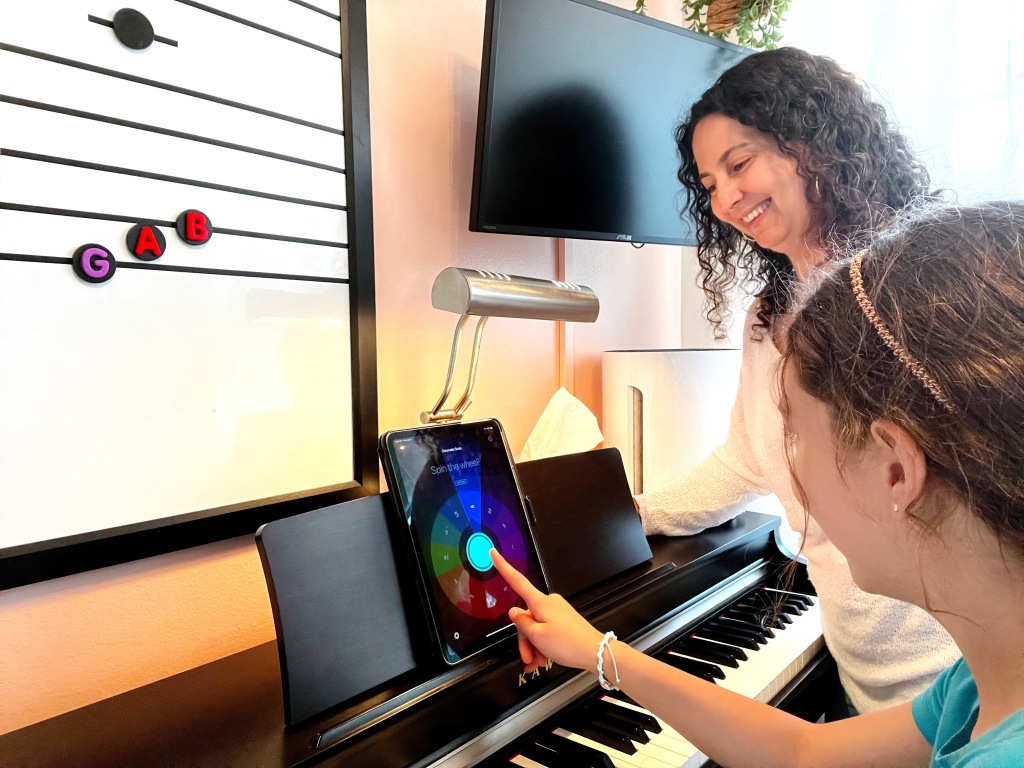
Piano teacher stands next to a piano as a student prepares to tap the screen of a tablet with a rainbow colored wheel of fortune on it.

I use the Decide Now! app to bring the fun of a wheel of chance into my piano lessons. It is a fantastic tool for music lessons whether you teach in person or online (I found it enormously useful when I was teaching virtually during the pandemic). I love its versatility, since it allows me to create any wheel I can think of. I’ve used it for a multitude of things in my lessons:

  • music theory games (you can create a wheel for any concept you want to drill with your students! From finding keys on the piano, to intervals, chords, roman numerals, keys… the sky is the limit!)
  • tempo markings
  • transposing music (create a wheel with the names of different keys)
  • composing music (choose a form, a key, a rhythmic motive, etc.)
  • challenges (play with your eyes closed, sing the melody while playing the left hand accompaniment, etc.)

It can also substitute dice in any game you play with your students. Although I do love using dice for activities (the sensory appeal of dice is very satisfying as well!). But I like to have a variety of options and Decide Now! also allows me to write things that I would not be able to fit on the face of a die.

For a great compilation of ideas on how to incorporate Decide Now! into your lessons, I recommend Leila Viss’ 50 Ways to Use Decide Now!

Examples of Decide Now! Wheels

Here are a few wheels I have come up with to use during my lessons:

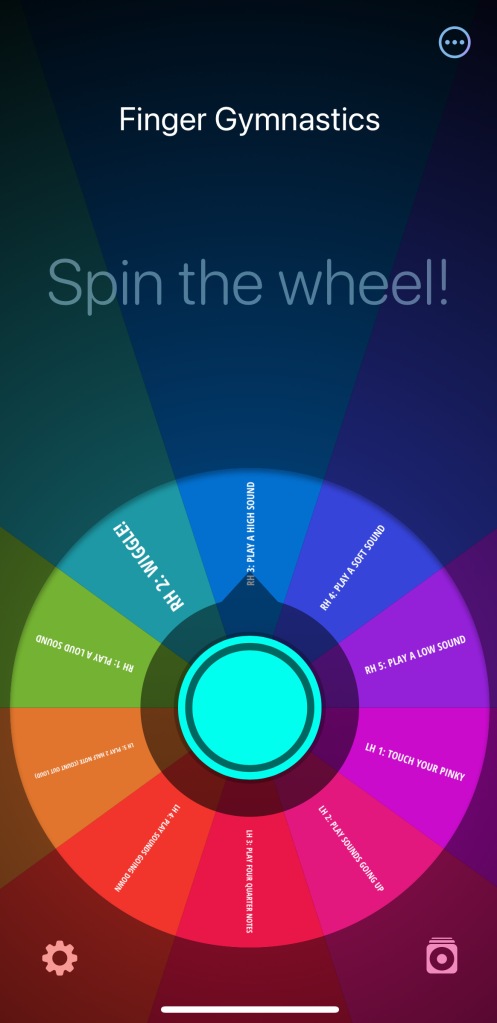
A rainbow colored wheel of fortune sits under the words Spin the wheel! The name of the wheel is Finger Gymnastics.

Finger Gymnastics

This is a fun game to help beginner students remember their finger numbers. Each finger has to do something different. My wheel has:

  • LH 1: Touch your pinky
  • LH 2: Play sound going up the piano
  • LH 3: Play four quarter notes
  • LH 4: Play sounds going down the piano
  • LH 5: Play 2 half notes and count out loud
  • RH 1: Play a loud (Forte) sound
  • RH 2: Wiggle your finger
  • RH 3: Play a high sound
  • RH 4: Play a soft (Piano) sound
  • RH 5: Play a low sound
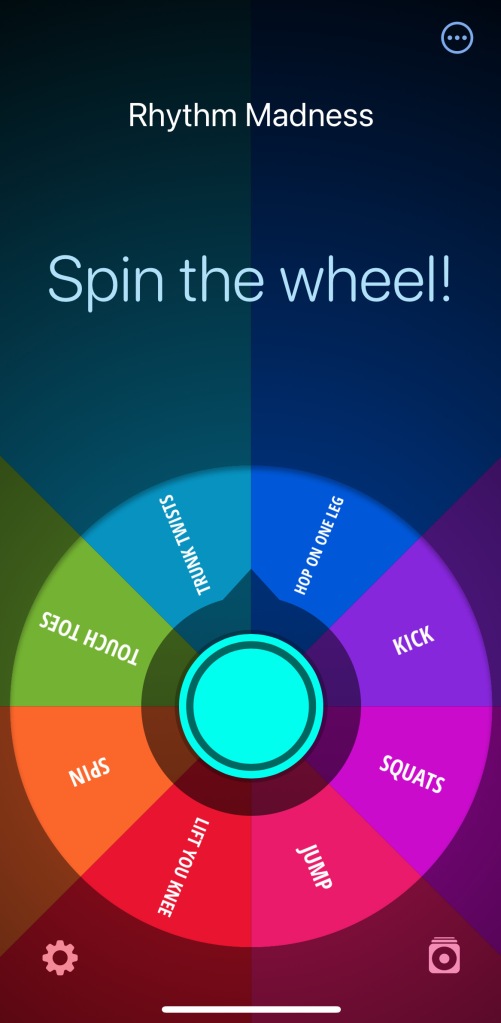
A rainbow colored wheel of fortune sits under the words Spin the wheel! The name of the wheel is Rhythm Madness.

Rhythm Madness

This is a fun game for kids to either play along with the metronome (to feel the steadiness of the beat) or to work on specific rhythm sequences. The student has to do the instruction on the wheel either in synch with the metronome or in rhythm with a pre-determined rhythmic sequence. My wheel has:

  • Squats
  • Jump
  • Lift your knee
  • Spin
  • Touch your toes
  • Trunk twists
  • Hop on one leg
  • Kick

This game always gets the kids laughing! And sometimes I join in and, let me tell you, it’s a workout!!

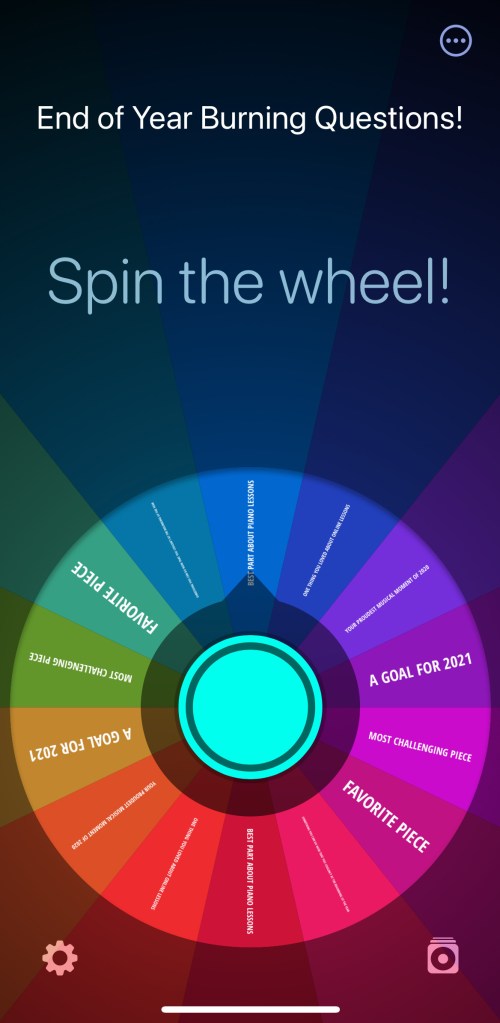
A rainbow colored wheel of fortune sits under the words Spin the wheel! The name of the wheel is End of Year Burning Questions.

End of Year Burning Questions!

This is a fun little end of lesson game to play as students are heading off to break. I have included in my wheel:

  • Most challenging piece
  • Favorite piece
  • Something you can do now that you couldn’t do at the beginning of the year
  • Best part about taking piano lessons
  • Once thing you loved about your lessons
  • Your proudest musical moment
  • A goal for next year
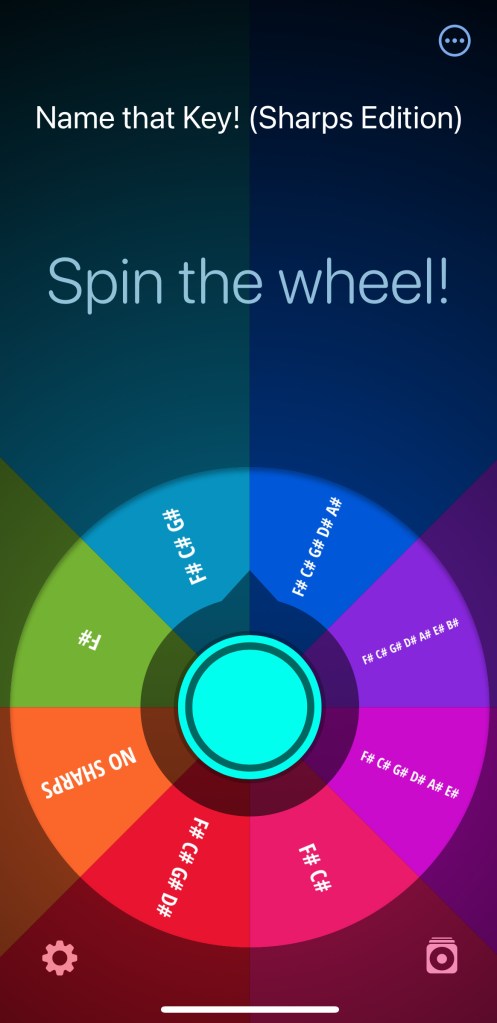
A rainbow colored wheel of fortune sits under the words Spin the wheel! The name of the wheel is Name that Key! (Sharps Edition).

Name that Key! (Sharps Edition)

The student has to name the key (you decide if it’s major or minor before spinning) based on the sharps. The labels for the wheels wedges are:

  • No sharps
  • F#
  • F# C#
  • F# C# G#
  • F# C# G# D#
  • F# C# G# D# A#
  • F# C# G# D# A# E#
  • F# C# G# D# A# E# B#

How to Set Up Decide Now!

You can download the Decide Now! app from Google Play or the Apple App store for a small fee (I receive nothing from recommending this app, I just really like it).

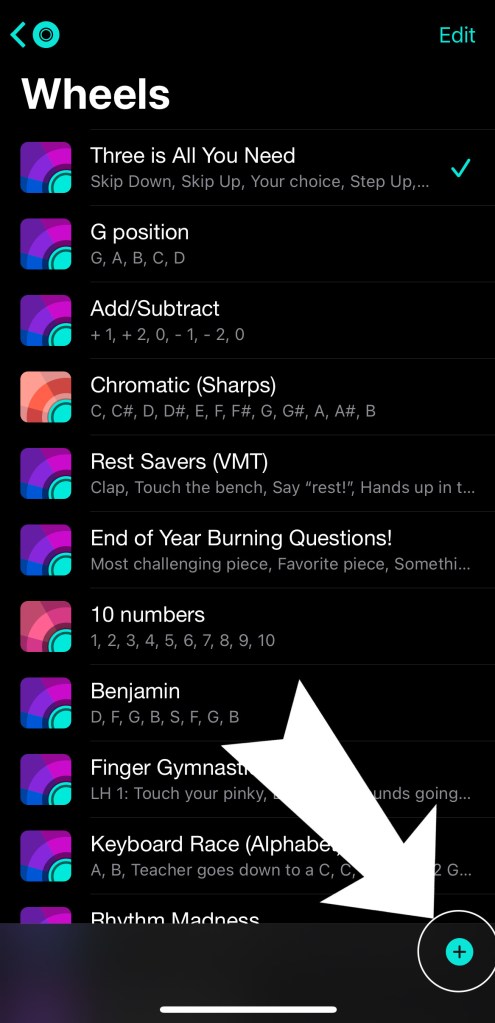
When you open the app, the last wheel that you used will be on the home screen. To create a new wheel or to select a different wheel you have already created, tap on the “File” button in the bottom right-hand corner. A list of all the wheels you have created will appear.

To create a new wheel, tap on the + button at the bottom right-hand corner.

A rainbow colored wheel of fortune sits under the words Spin the wheel! The name of the wheel is Three is All you Need. A white arrow points to the bottom of the picture indicating how to access other wheels.
A list of wheels of fortune. A white arrow points to the bottom where the user can create a new wheel.

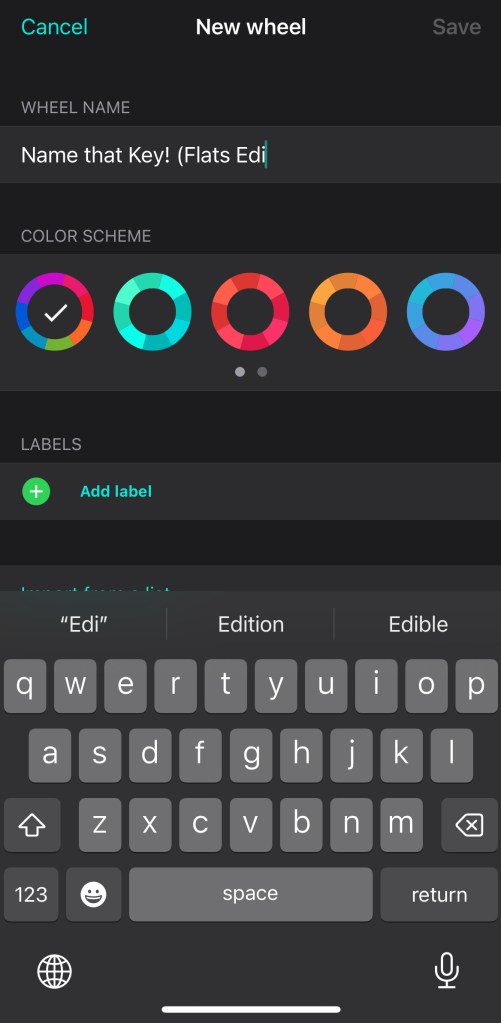
The first thing to do is create a name for your new wheel. Tap on the “Wheel name” rectangle and type in its name. I like to use descriptive names (as opposed to catchy names) to make it easier to find when I need to drill a specific concept. When you are done typing, just tap “Return” on the keyboard.

Menu for creating a new wheel of fortune.

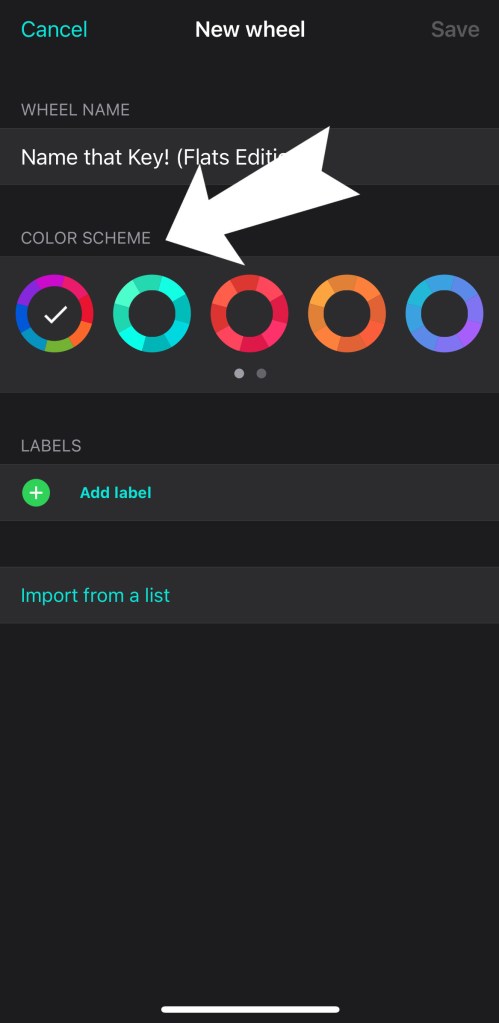
You can then choose the Color Scheme of your wheel. The color scheme determines the colors of the wedges of the wheel. Just tap on the color you’d like to use.

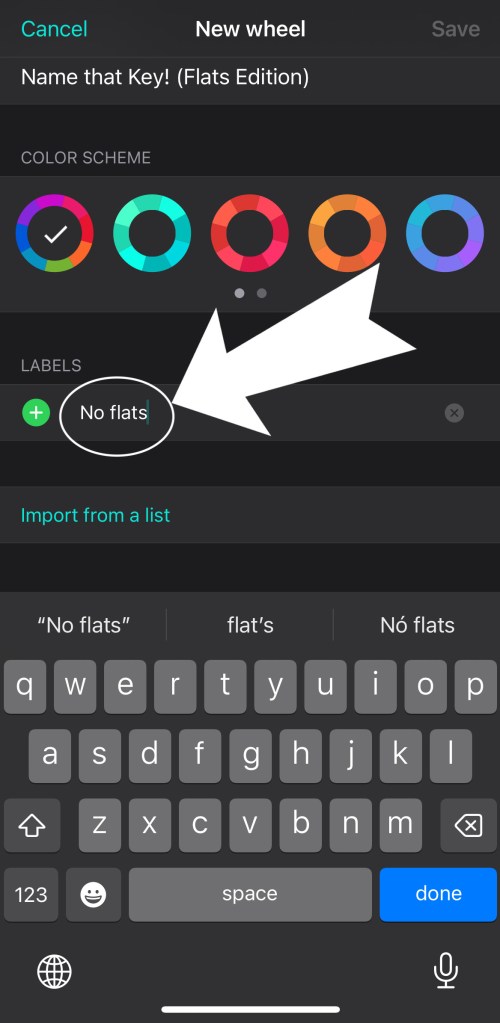
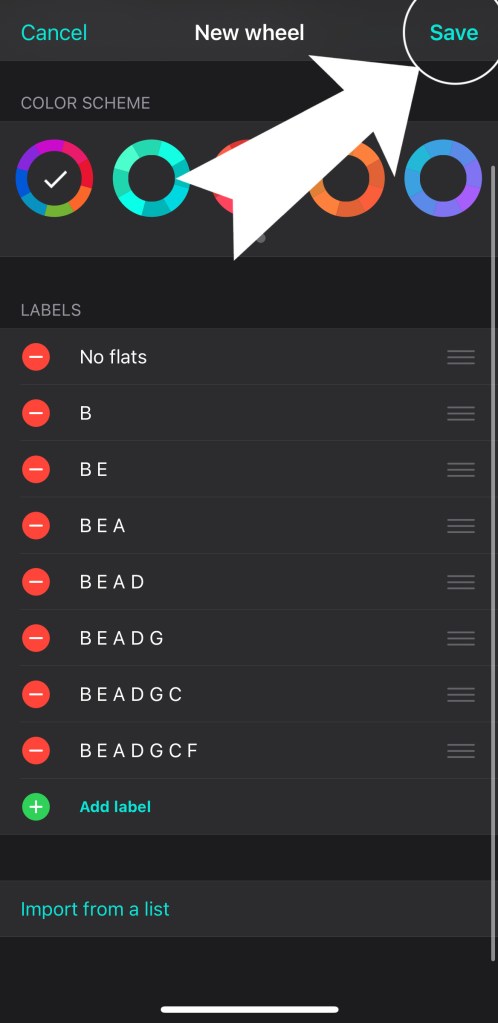
Next it’s time to add the labels for each wedge of the wheel. Tap on the rectangle next to the green “+ Add label” and type in the label for the first wedge.

When you are done typing, tap “Return” on the keyboard and another label will appear. Keep adding labels to the wedges until you have all the labels you need.

To edit a label, simply tap on the label and type.

When you are finished creating your wheel, tap “Save” at the top right-hand corner.

Your new wheel now appears at the top of your list of wheels. To select a wheel to play, simply tap on the title of the wheel. The wheel will open and it’s ready to play.

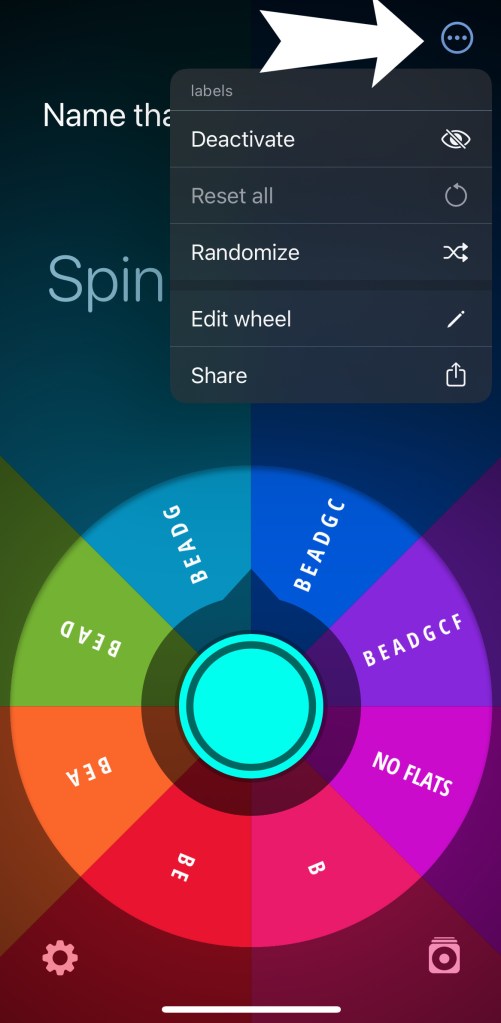
If you would like to change the order in which the wedges appear on the wheel, tap the three dots in the top right-hand corner and select “Randomize”.

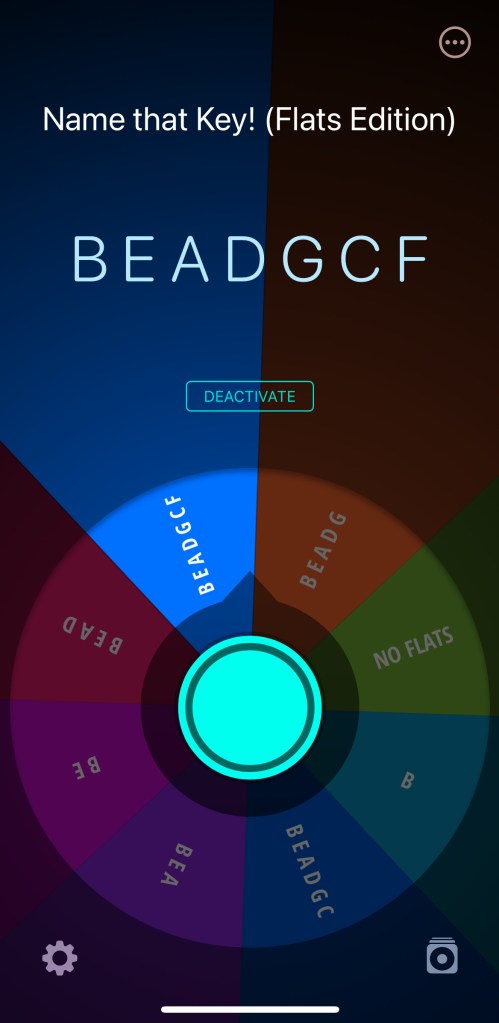
To spin the wheel, tap on the circle at the center of the wheel.

When the wheel stops spinning, the selected wedge of the wheel will light up and the text inside the wedge will appear below the title of the wheel (in this case, “B E A D G C F”). Note that a “Deactivate” button also appeared. You can deactivate the wedge by tapping on the Deactivate button. When a wedge is deactivated, the wheel will not land on that wedge. This can be useful if a student has already mastered that particular concept and you want to focus on the others or if you are having a student complete tasks one-by-one.

To reactivate a wedge(s), just tap on the “Reset All” button that appears when a wedge(s) is deactivated.

Let the games begin!!!

Explore more creative teaching ideas
  • How to Make your Own Music Theory Dice
    Music theory dice are a great tool to have in your piano teacher arsenal but most of the time what you need isn’t available to buy anywhere. DIY Music Theory Dice are so easy to make and they are completely customizable for any concept you would like to work on with your students.
  • Pot of Gold Rhythm Game
    Put those music theory dice to good use with this easy rhythm game for your beginner/elementary students. The value of each rhythm note or rest will determine how many coins go into the pot. Who can fill their pot the fastest?! This game can be adapted for any time of the year or use mini-cauldrons for a fun Halloween or St. Patrick’s Day game.
  • The Die of Destiny
    Sometimes a student will walk into my studio without their usual bounce in their step. I’ve found that a little silliness and a dash of chance gets them in the mood to pull out their piano books and play music. The Die of Destiny is a fun and quick lesson starter to get students playing.

Let’s stay in touch, join the list!

As a “toucan” of our appreciation download a free set of note flashcards (link in our Welcome email)!

Processing…
Success! You're on the list.

We are a participant in the Amazon Services LLC Associates Program, an affiliate advertising program designed to provide a means for sites to earn advertising fees by advertising and linking to Amazon.com. As an Amazon Associate we earn from qualifying purchases.

Plastic Egg Music Notes

I recently came up with the idea of making music notes out of plastic eggs. I made them as Easter gifts for my students (I put a few pieces of chocolate and candy inside each one). They all loved them! And they were super affordable to make (which is important when you have a lot of students!).

I ended up having so much fun making them, I not only made one for each of my students but also made a bunch for myself. And that’s because my mind was swimming with ideas on a variety of different ways to use them:

  • gifts for students as they head off for summer vacation
  • music teacher gift (make some for your child’s school music teacher and fill them goodies!)
  • music theory games (more on that is a future post!)
  • kid’s craft for a music-themed summer camp
  • decorations for your piano studio or music room

There are so many possibilities! And bonus… they are SO easy to make. Here is a video showing the whole process:

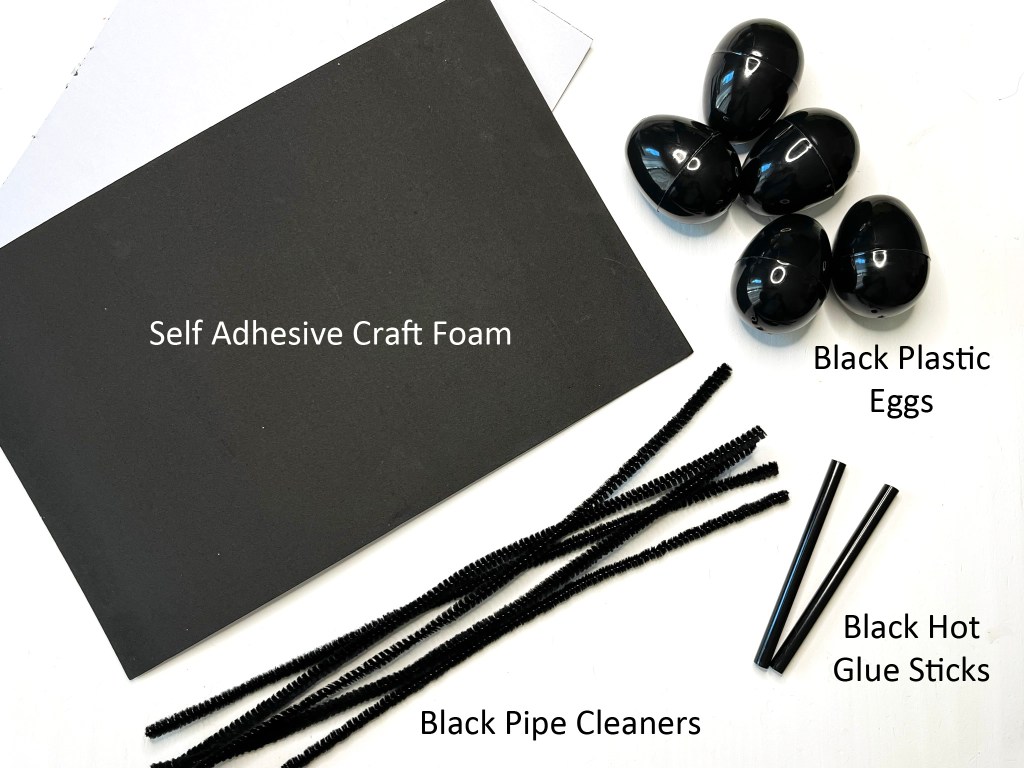
To make your own plastic egg music notes, you will need:

Black self adhesive craft foam sheets, five black plastic eggs, a bunch of black pipe cleaners, and two stick of black hot glue sit on a white table.

Whatever plastic eggs you decide to use (I think colorfully ones would be so adorable, too!), remember to look for plastic eggs that have two holes in the bottom (the wider half of the egg).

Hands hold the halves of a black plastic egg

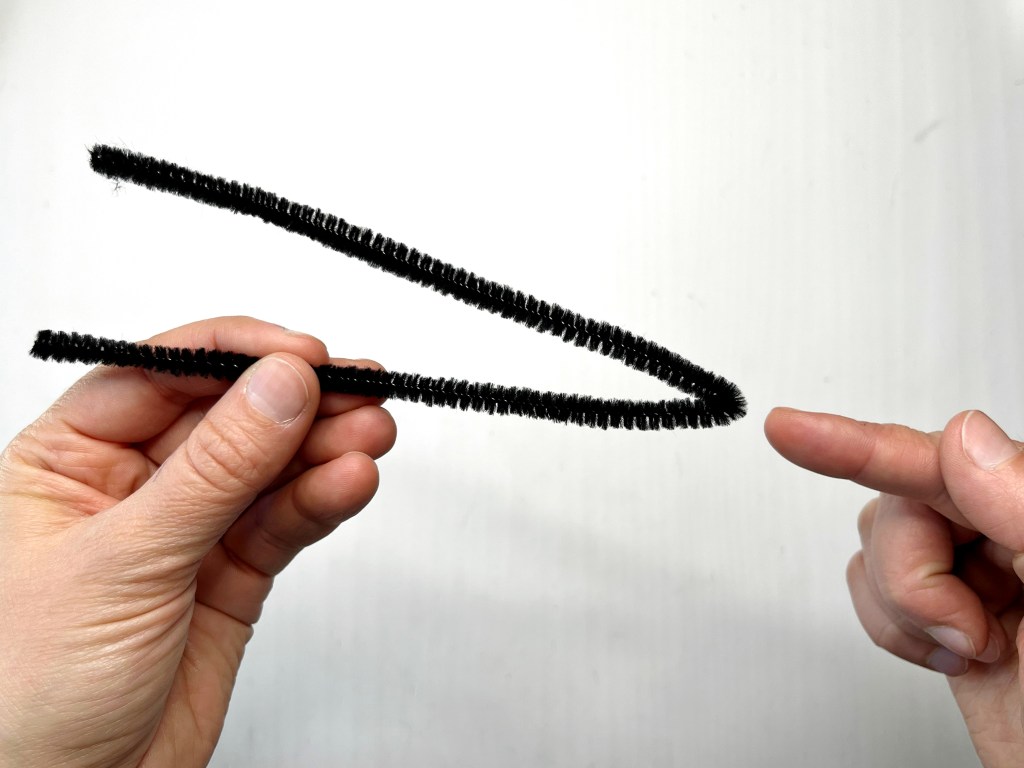
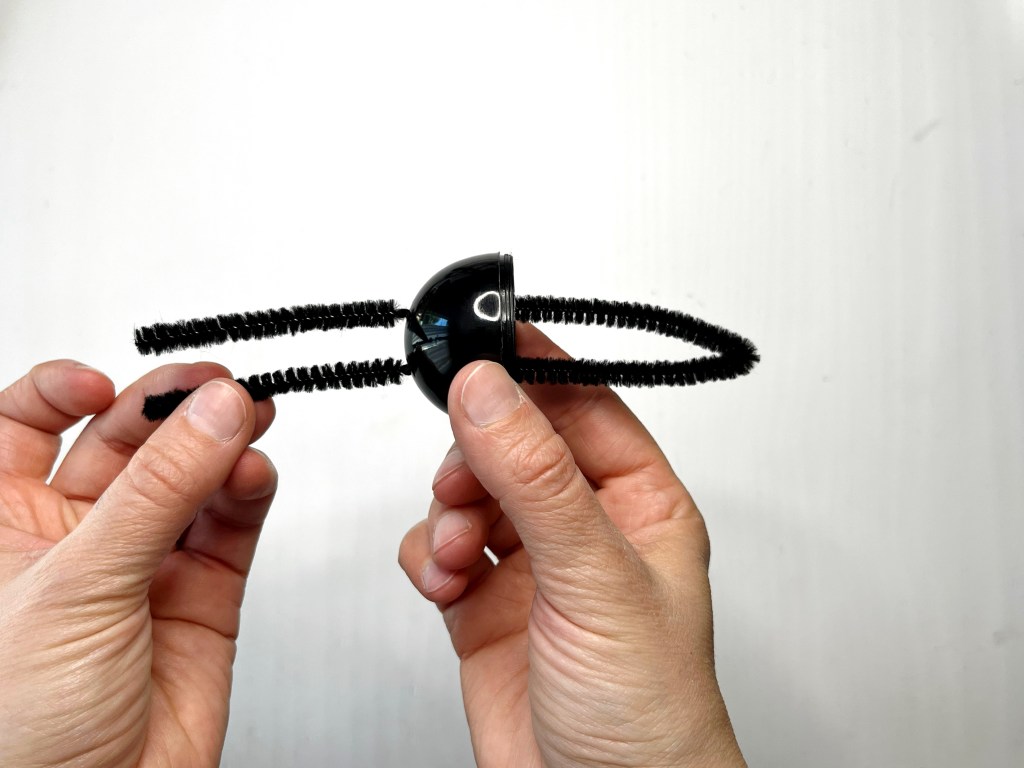
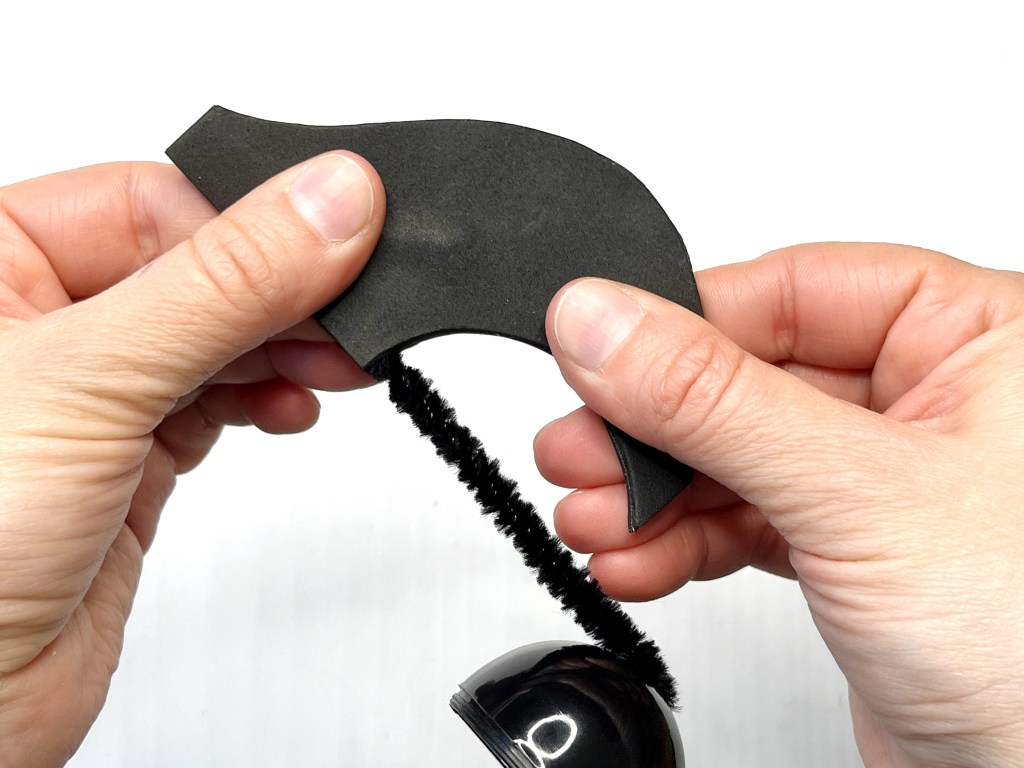
Fold one of the pipe cleaners in half and thread the two ends of the pipe cleaner through the holes in the bottom half of the plastic egg. Make sure to start on the inside of the egg so the ends of the pipe cleaner are on the outside of the egg.

A black pipe cleaner has been bent in half and a hand points to the bend.
A black pipe cleaner is threaded through the holes in the bottom of a black plastic egg

Pull the ends of the pipe cleaner through and twist them tightly against the egg. You may want to push the pipe cleaner on the inside of the egg so that it is flush on the inner wall of the egg.

Then twist the two ends of the pipe cleaner together from the base of the egg all the way up to the ends of the pipe cleaner.

A black pipe cleaner is twisted to the bottom of a black plastic egg
Half of black plastic egg is held up to show how a black pipe cleaner was attached to the end of the egg

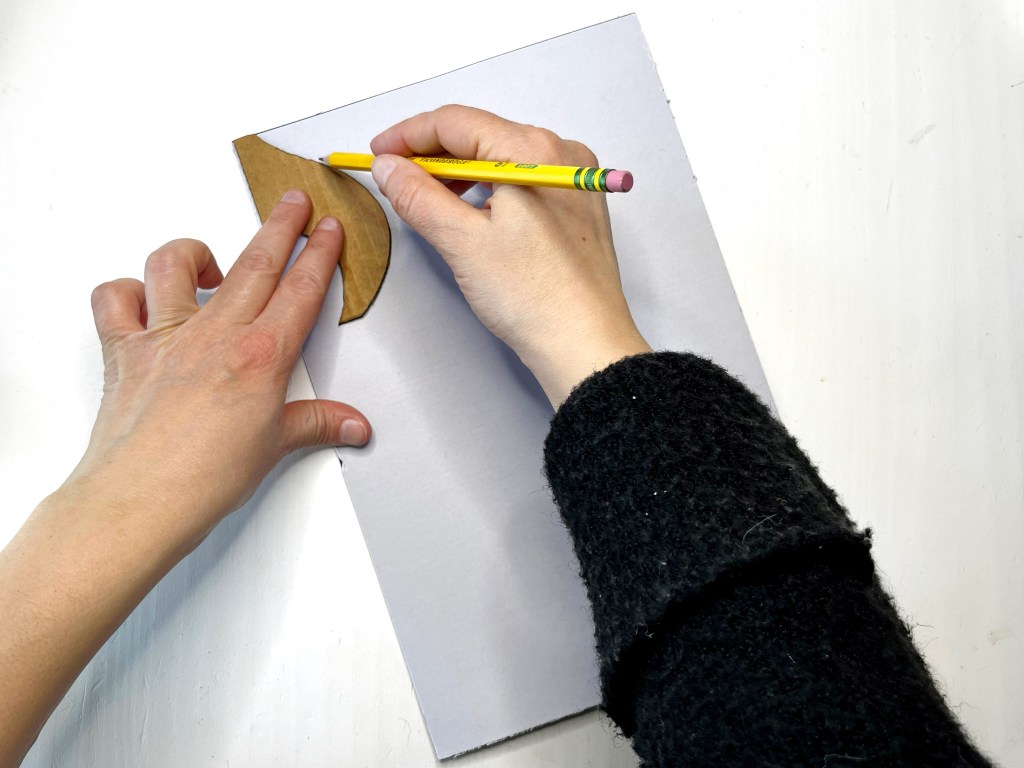
Since I was making a bunch of music notes, I made an eighth note flag stencil out of cardboard. I traced the flag onto the back of self-adhesive craft foam. Then I flipped the stencil over to get a mirrored image of the flag and traced the flag again. I was able to stencil 12 flags onto a single sheet of self-adhesive craft foam.

Hands trace an eighth note flag cardboard stencil onto the backing of a sheet of self-adhesive craft foam
Hands trace a second eighth note flag cardboard stencil onto the backing of a sheet of self-adhesive craft foam

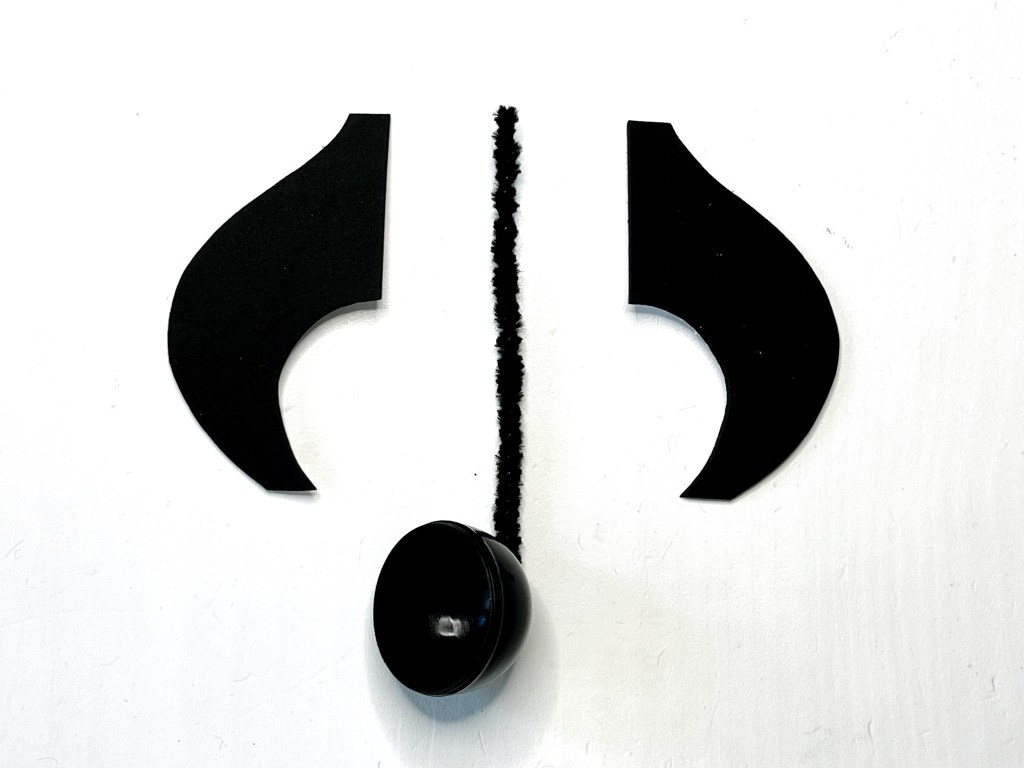
Cut out the flags. It is now time to assemble the three parts of the music note!

Half of a black plastic egg with a black pipe cleaner attached to it sit between two black eighth note flags made of self-adhesive craft foam

Bend the pipe cleaner about an inch from the top. This will provide a secure connection point for the craft foam.

Hands bend a black pipe cleaner

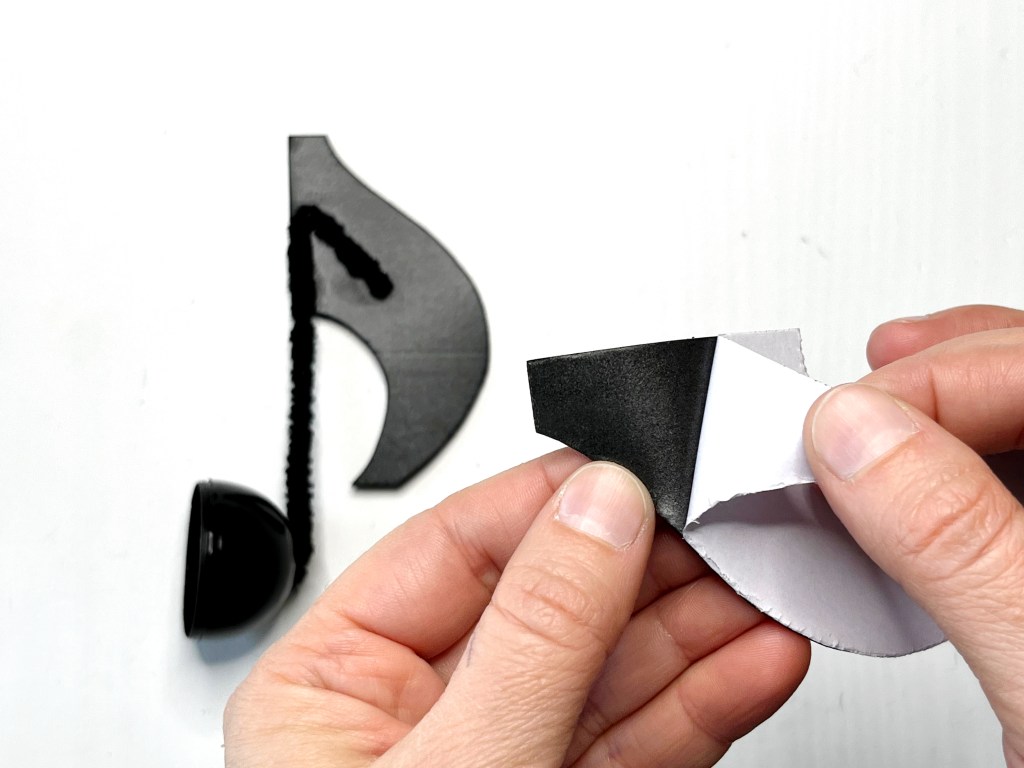
Peel back the paper backing from one of the craft foam flags. Press the bended end of the pipe cleaner against the sticky side of the craft foam. Make sure that the stem of the note is along the edge of the flag but still sticking to the flag.

Hand peels the white paper backing off of black self adhesive craft foam
A pipe cleaner is placed on the sticky side of black self adhesive craft foam

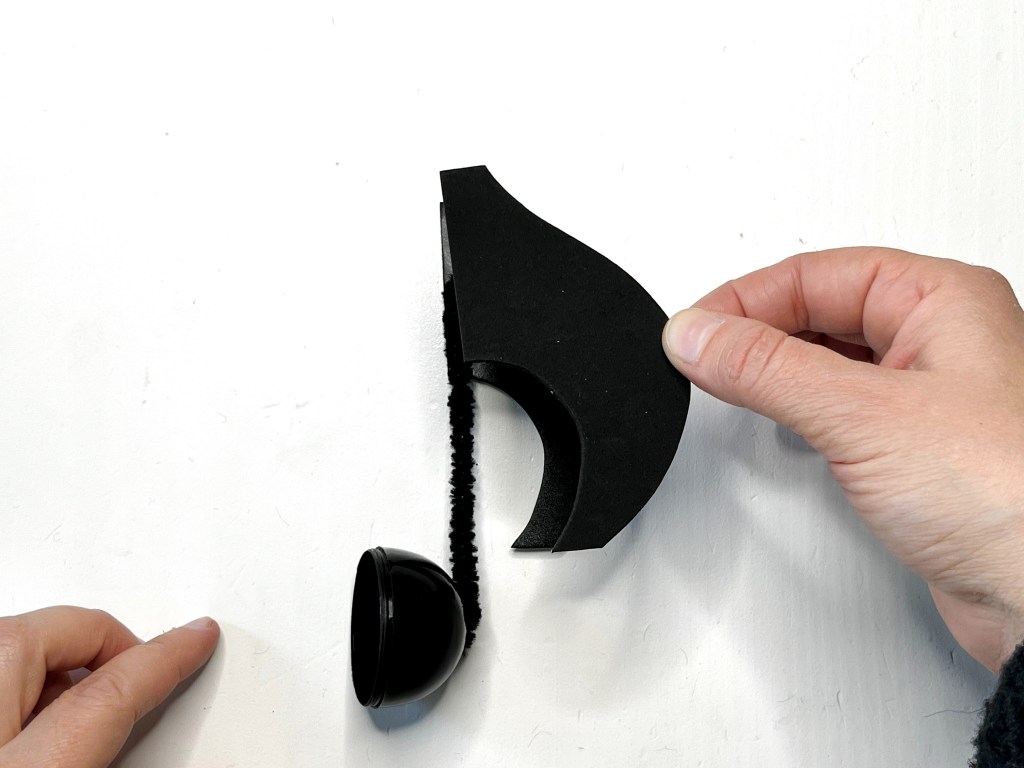
Remove the backing of the second craft foam flag and carefully lay the sticky side of the flag carefully onto the sticky side of the first flag. The pipe cleaner should be sandwiched between the two craft foam flags. Be careful when sticking the flags together… the adhesive is very sticky and once they touch, you cannot pull them apart without ripping the craft foam.

Hand peels the white paper backing off of a second black self adhesive craft foam
Two black self adhesive craft foam eighth note flags are glued together.

Press the flags together to secure everything together.

Hands press together two pieces of black self adhesive craft foam

This part is optional but if you plan to use the plastic egg music notes for games or as decorations, I would strongly suggest adding this step. My experience is that the craft foam tends to separate over time. It will hold together in the short term, but over time the craft foam flags will have to be pressed together again on occasion.

In order to make everything hold together in the long term, I suggest running some hot glue along the seams of the craft foam flags (at the edges where the two flags meet).

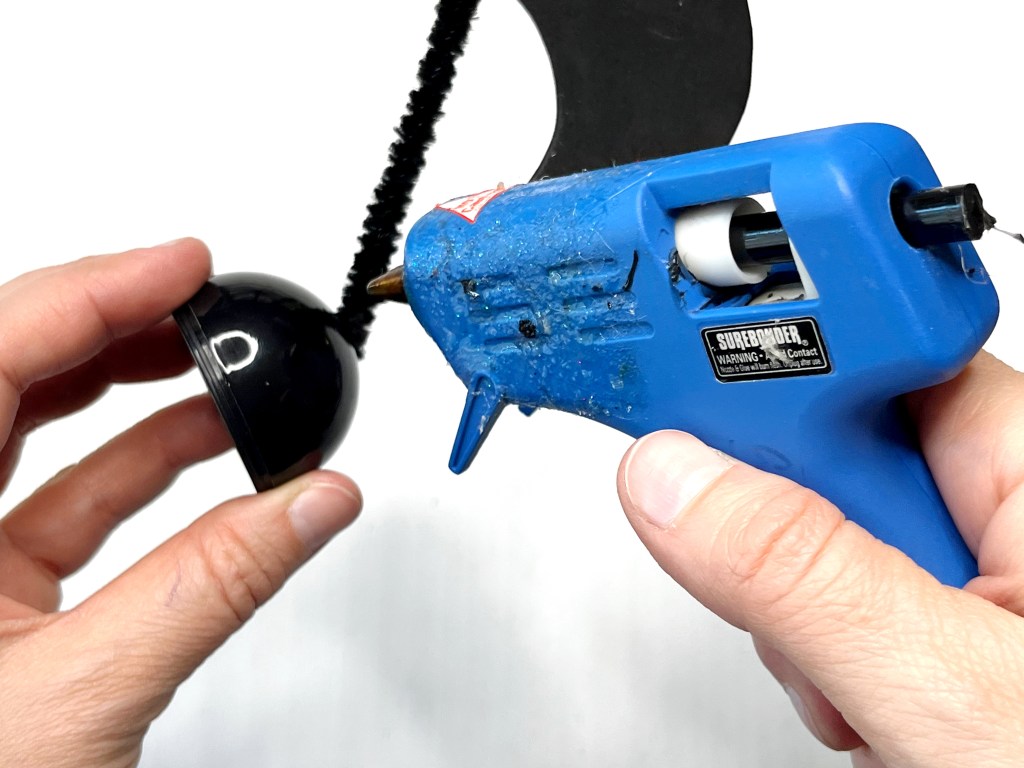
I also like to add a dot of hot glue at the base of the stem, where the pipe cleaner exits the holes of the egg, to help the stem stand up straight. The stem will usually stand up straight with a little adjusting, but the glue gives it a little extra support.

A hot glue gun loaded with a black hot glue stick applies glue to the edges of the plastic egg music note
A hot glue gun loaded with a black hot glue stick applies glue to the base of the plastic egg music note

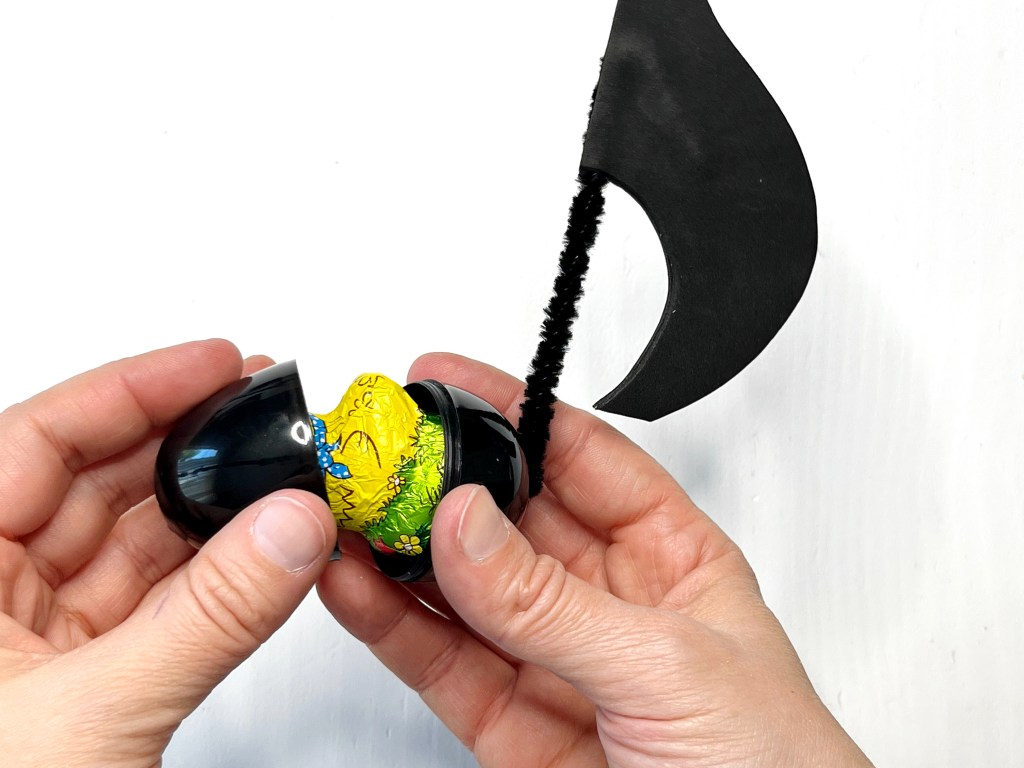
The plastic egg music note is all done and ready to be filled with some treats!!!

A plastic egg music note is loaded up with a piece of chocolate

Explore more creative teaching ideas
  • The Die of Destiny
    Sometimes  a student will walk into my studio without their usual bounce in their step. I’ve found that a little silliness and a dash of chance gets them in the mood to pull out their piano books and play music. The Die of Destiny is a fun and quick lesson starter to get students playing.
  • Compose a Ringtone
    Ringtones are helpful but what if we could make them special too?! This is a fun and quick project that even the most reluctant students can get behind.
  • Two Sides of the Same Coin
    A game about enharmonics that can be played in several different ways! Students will try to collect the most enharmonic pairs and hope that their coins don’t get stolen by another player.

Let’s stay in touch, join the list!

As a “toucan” of our appreciation download a free set of note flashcards (link in our Welcome email)!

Processing…
Success! You're on the list.

We are a participant in the Amazon Services LLC Associates Program, an affiliate advertising program designed to provide a means for sites to earn advertising fees by advertising and linking to Amazon.com. As an Amazon Associate we earn from qualifying purchases.
How to Make your Own Music Theory Dice

Music Theory dice are a great tool to have in your piano teacher arsenal! They can be used for a variety of activities within a lesson, including:

  • Review music theory concepts
  • Play music theory games
  • Test your student’s knowledge on a specific concept
  • Propose challenges for a student
  • Compose

There are many pre-made options available on the market but I love the flexibility of a DIY set of music theory dice. I can cater them to a specific game and I can cover WAY more concepts (there may not always be pre-made dice available for what I would like to work on with my students).

I’m going to share two different dice you could try out: one is a reusable option and the other is a semi-permanent solution which can be used over over again (but can always be changed up if you’d like).

Reusable Music Theory Dice

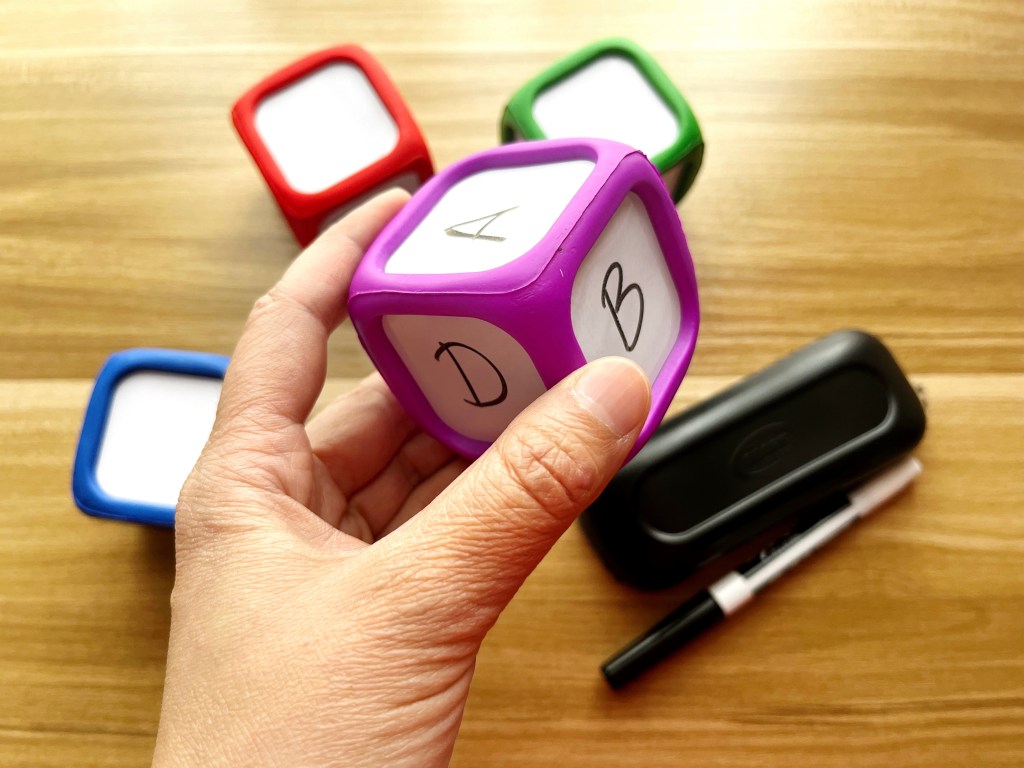
The reusable option is a dry-erase die which can be easily used over and over again for whatever concept you with to work on with your students.

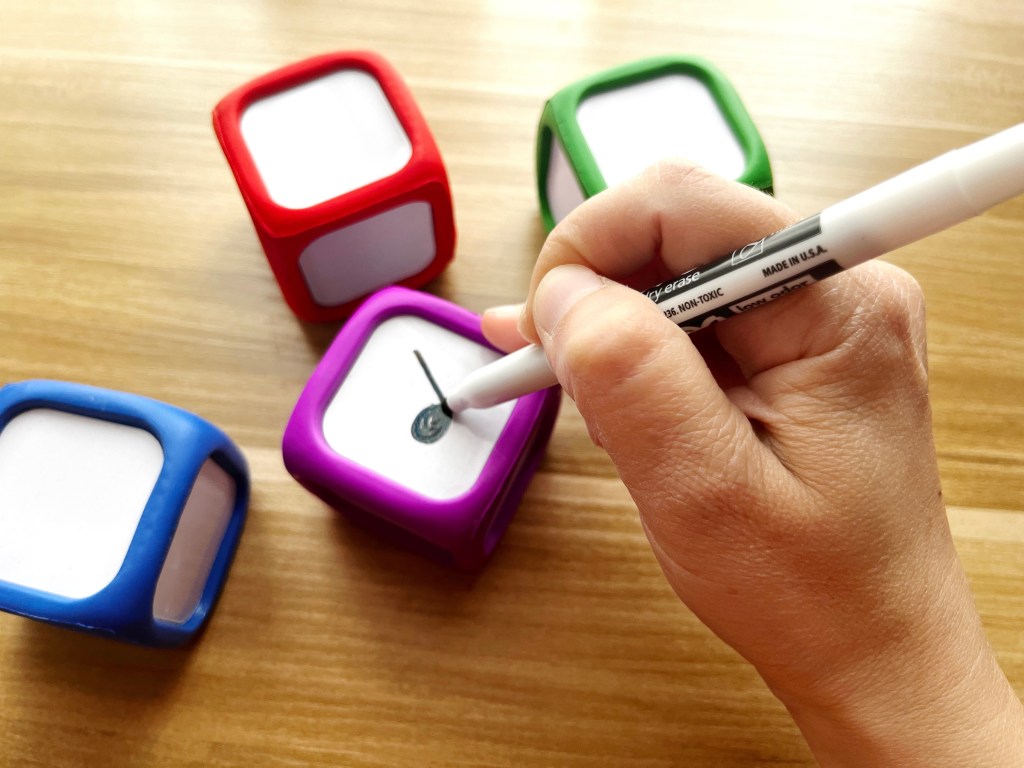
Hand holding a purple dry erase die with the letters A, B and D written on its sides in black marker. In the background are three other dice (a red one, a blue one and a green one) along with a dry-erase marker and eraser.

I especially like this particular dry-erase dice set because the whiteboard of the dice is lower and therefore protected by the colored elevated borders. This keeps what is written on the whiteboard from being rubbed off when the dice are rolled and also gives kids a good place to hold the dice so their fingers don’t erase the text.

A hand holds a black dry-erase marker. It is drawing a quarter note on a purple dry-erase die. Three other dice sit in the background, a blue one, a red one, and a green one.

They are also great for younger kids since they are bigger and easy for them to handle.

Semi-Permanent Music Theory Dice

This is an excellent option for things you would like to use over and over again. I use these blank dice and labels.

15 blank white dice sit on a lighten wood table along with a page of 2 inch by 4 inch white labels.

I just write (or print out) the concept I want to drill on the label, cut it down to size, and stick it to the blank die. You can use a single label to cover all the sides of a die… and still have a lot leftover to use later.

Three pictures show the process of creating a music theory die. The first step shows a hand drawing a quarter note in black pen on a white label. The second step shows scissors cutting out the quarter note. The third step is to stick the label with the quarter note onto the blank die.

If I plan to use the die a lot, I also apply a layer of Mod Podge to protect the labels.

A hand holding a paint brush is applying a layer of Mod Podge sealant to the surface of a die.

If I ever need to change out the concept, it’s just a matter of peeling the label off the die.

With the dice all ready to go, it’s game time!!

Explore more creative teaching ideas
  • The Die of Destiny
    Speaking of dice, the Die of Destiny is a fun lesson starter when a student walks into my studio without their usual bounce in their step. I’ve found that a little silliness and a dash of chance gets them in the mood to pull out their piano books and play music!
  • Sky High Love
    Whose tower will remain standing in the end?!
    This adrenaline-inducing rhythm game is a great game to play with a homemade set of rhythm dice (just replace the rhythm sticks with dice!). AND it’s a great way to kick-off a lesson and get the energy up.

Let’s stay in touch, join the list!

As a “toucan” of our appreciation download a free set of note flashcards (link in our Welcome email)!

Processing…
Success! You're on the list.

We are a participant in the Amazon Services LLC Associates Program, an affiliate advertising program designed to provide a means for sites to earn advertising fees by advertising and linking to Amazon.com. As an Amazon Associate we earn from qualifying purchases.
How to Bow at a Piano Recital

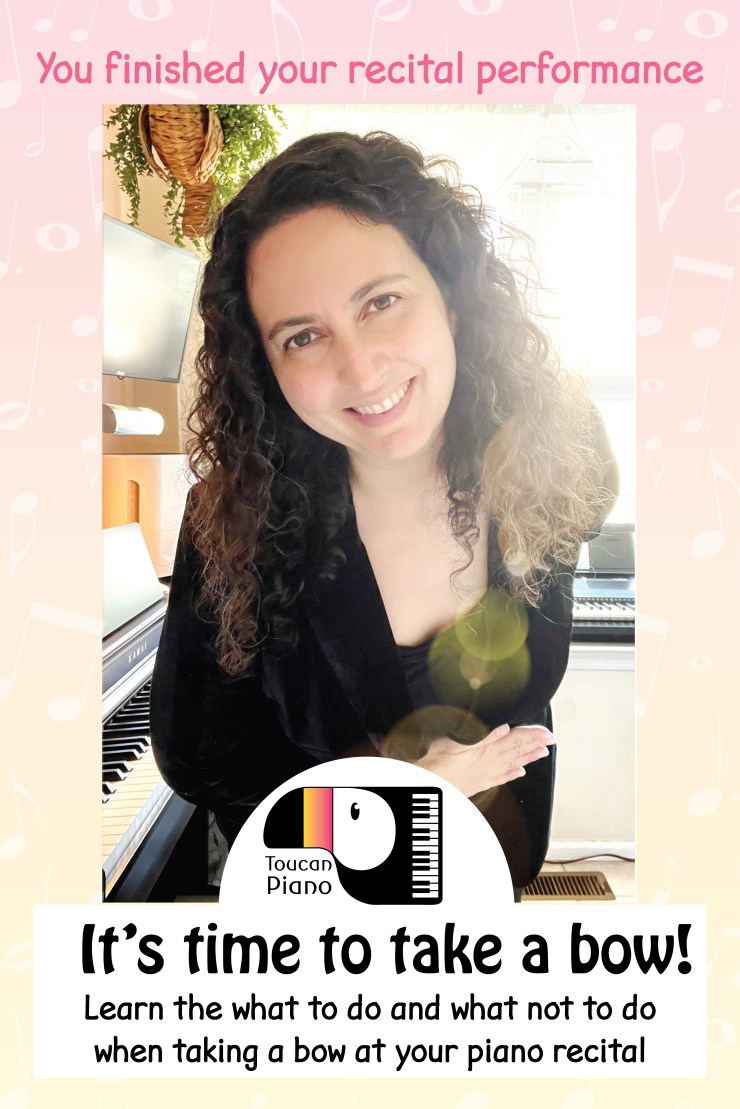
You’ve just finished playing your piano recital pieces and now the audience is clapping, what do you do now??! It’s time to take a bow and enjoy the adulation for all the hard work you put into learning your pieces.

Bowing isn’t hard but it can be a little nerve-racking for a self-conscious or shy student. It’s important to practice bowing in the weeks leading up to the recital so that you feel totally comfortable and at ease with the process.

You can find a free printable summarizing how to bow at the Toucan Piano shop. It’s a great way to remind your students how to bow and to encourage them to practice bowing before a recital.

Why all the fuss about bowing?

There are many reasons to care about how you bow. A bow is a silent exchange between a performer and the audience. It’s a moment for each to recognize the other. It is a special moment and it should be savored and enjoyed.

A bow shows appreciation and respect for the audience. Nobody is obligated to clap for a performer.

Applause is a gift the audience is giving to the performer to show how much they enjoyed their performance.

A proper bow also shows self-respect. You have dedicated countless hours to your instrument and spent weeks or even months preparing your recital piece(s).

A nice bow is a way to give the music and your hard work the dignity they deserve.

I will go over a few different options for bowing, but first the basics!

The Basics

I teach my students five rules that all bows must have no matter which one they end up choosing:

1. Feet should always be together

A solid foundation for your bow is key. Your feet should be facing forward and the insides of your feet should be gently touching. It is not necessary for the heels to touch because this can cause tension in the knees and glute muscles. Your body should be relaxed when bowing, too much tension can throw off your balance.

Feet toghether in black ballet flats facing forward. Standing on a black and white rug.

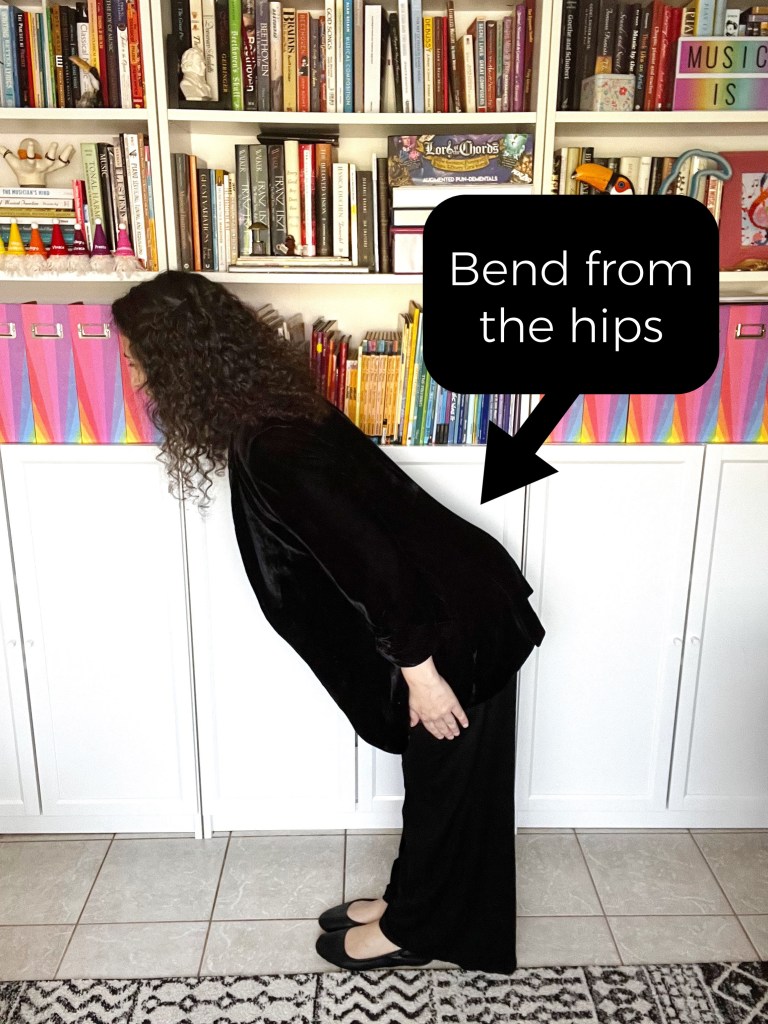
2. Bend from the Hips

Your body should bend at the hip joints, not from the back, the neck, or the knees. The bow from the hips should be deep enough that your gaze will fall upon your feet without having to look down.

Woman with curly brown hair, dressed in black pants and blazer, bending at the hips to show the proper body position for bowing.

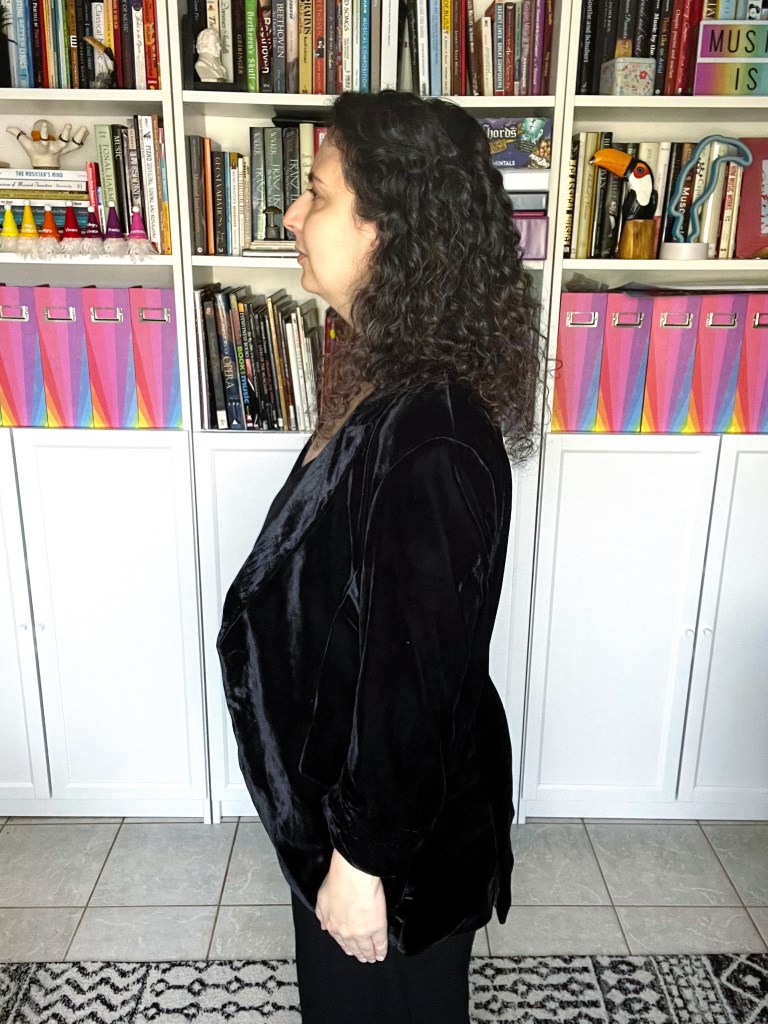
3. Knees and Back should be Straight

Both your knees and back should be straight throughout the process of bowing. A curled back and bent knees gives the impression of a stomachache and bad posture.

Woman with curly brown hair, dressed in black pants and blazer, bending with a straight back and straight knees to show the proper body position for bowing.

4. Count Slowly to 3

The bow should look intentional and not rushed. As you are bending forward, slowly count to 3. Since your back is straight, your eyes will be facing forward and by the count of 3 you should see your feet. Then slowly count to 3 again as you return to an upright position.

5. Always Smile at the End of the Bow

This is your big moment!! Enjoy it! When you are finished bowing, smile to your audience.

Woman with curly brown hair, dressed in a black jumpsuit and blazer smiling at the the camera.

The Bow

I teach my students three different bows and let them pick which one they like best. The three options follow all the basic rules above and differ only in what the performer decides to do with their hands. Try them all out and see which one feels the most natural to you!

Bow no. 1

Place your hands at your sides. Your arms should be relaxed and your hands in an open position (no fists) with your palms in contact with your outer thighs. As you bow, your elbows will bend slightly so your hands do not move much from where you placed them on your legs.

Woman with curly brown hair, dressed in a black jumpsuit and blazer with her hands at her sides to show proper hand placement when bowing. Front view.
Woman with curly brown hair, dressed in a black jumpsuit and blazer with her hands at her sides to show proper hand placement when bowing. Side view.

Bow no. 2

Place your hands on the front of your thighs. Your arms should be relaxed and your hands in an open position (no fists) with your palms in contact with your legs. As you bow, your elbows will bend slightly so your hands do not move much from where you placed them on your thighs.

Woman with curly brown hair, dressed in a black jumpsuit and blazer with her hands at on her legs to show proper hand placement when bowing. Front view.
Woman with curly brown hair, dressed in a black jumpsuit and blazer with her hands at on her legs to show proper hand placement when bowing. Side view.

Bow no. 3

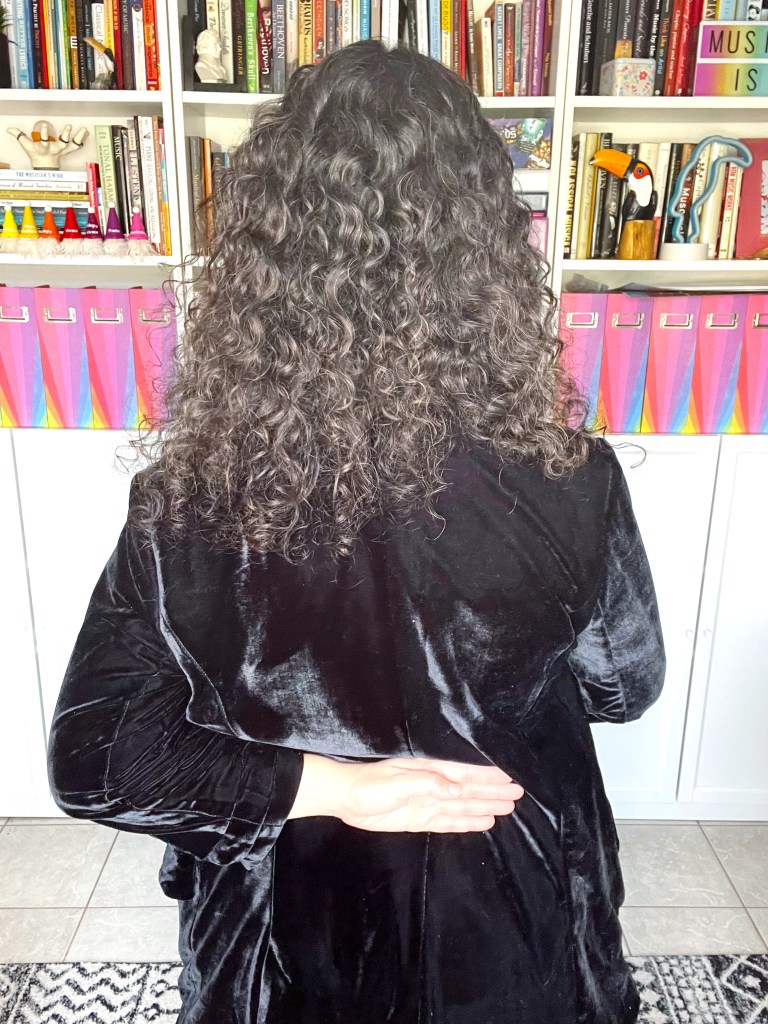
This is the bow most of my students end up picking! Place one open hand on your stomach. Your palm should be in contact with your body. Your other hand will be placed behind you so the back of your hand is touching the middle of your back (open hand, palm facing away from your body). Your arms and shoulders should remain relaxed as you bow.

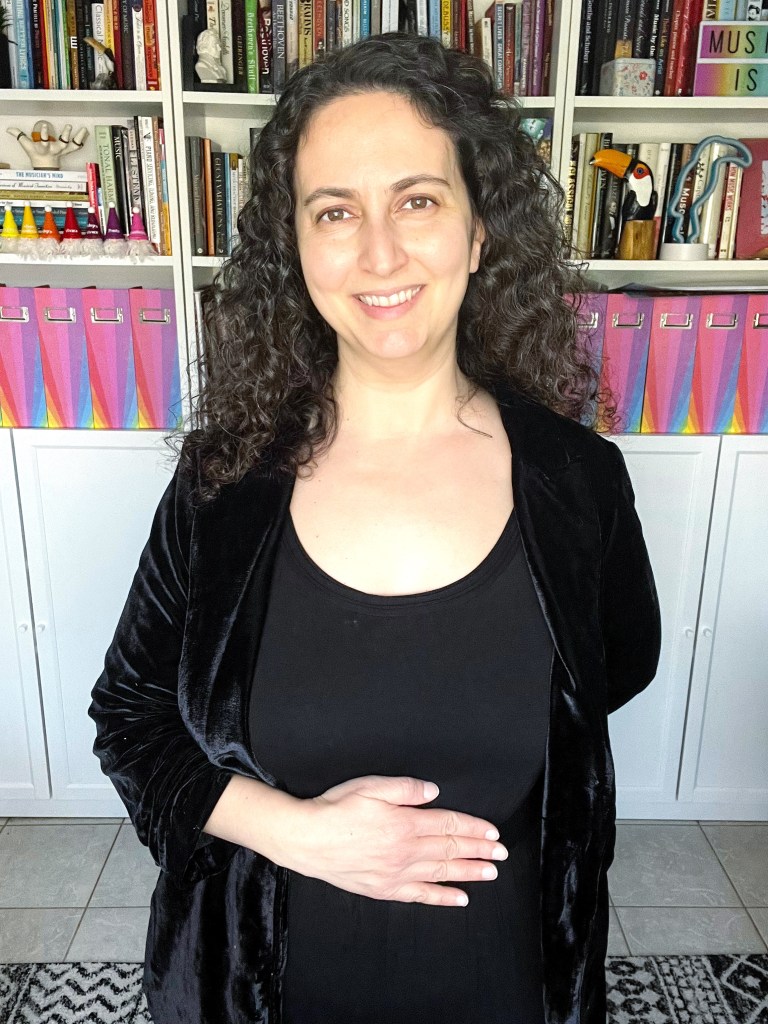
Woman with curly brown hair, dressed in a black jumpsuit and blazer with her hand on her stomach to show proper hand placement when bowing. Front view.
Woman with curly brown hair, dressed in a black jumpsuit and blazer with her hand on her back to show proper hand placement when bowing. Back view.

Practicing your bow is of fundamental importance!

In a situation like a recital, where our nerves can sometimes get the best of us, it’s important to have routines that we can rely on to help us. There is nothing more intimidating than getting up from the bench and having hundreds of eyes looking straight at you. If you practice bowing, your body will remember what to do and it will be easier to just follow through on the big day.

After every practice session in the weeks leading up to the recital, take a bow as you leave the piano. Make it a habit to practice your bow and you will see how natural and comfortable you will feel bowing at the recital!

Even though we rehearse our bows before our recitals, some interesting bows tend to sneak in during our rehearsals! Here are some of my favorite ways NOT to bow.

You can download a summary of this blog post for your students at the Toucan Piano Shop.

Explore more creative teaching ideas
  • Rainbow Manuscript Paper
    This colorful manuscript paper is available in the Toucan Piano shop as a free printable! They are available in three sizes, so they can be used for a variety of ages and activities, like writing out original compositions, explaining music theory concepts, music dictation, games, and so much more!
  • Compose a Ringtone
    Ringtones are helpful but what if we could make them special too?! This is a fun and quick project that even the most reluctant students can get behind.
  • Chord Snowblast
    Build chords and collect points while trying to avoid the snow blast! Kids will test their knowledge of building chords AND they will actually be hoping to get all chords with sharps and flats!!

Let’s stay in touch, join the list!

As a “toucan” of our appreciation download a free set of note flashcards (link in our Welcome email)!

Processing…
Success! You're on the list.

We are a participant in the Amazon Services LLC Associates Program, an affiliate advertising program designed to provide a means for sites to earn advertising fees by advertising and linking to Amazon.com. As an Amazon Associate we earn from qualifying purchases.
Piano Birthday Crown

Birthdays are really important to kids, they care A LOT about how old they are and get really excited counting down the days until their next birthday.

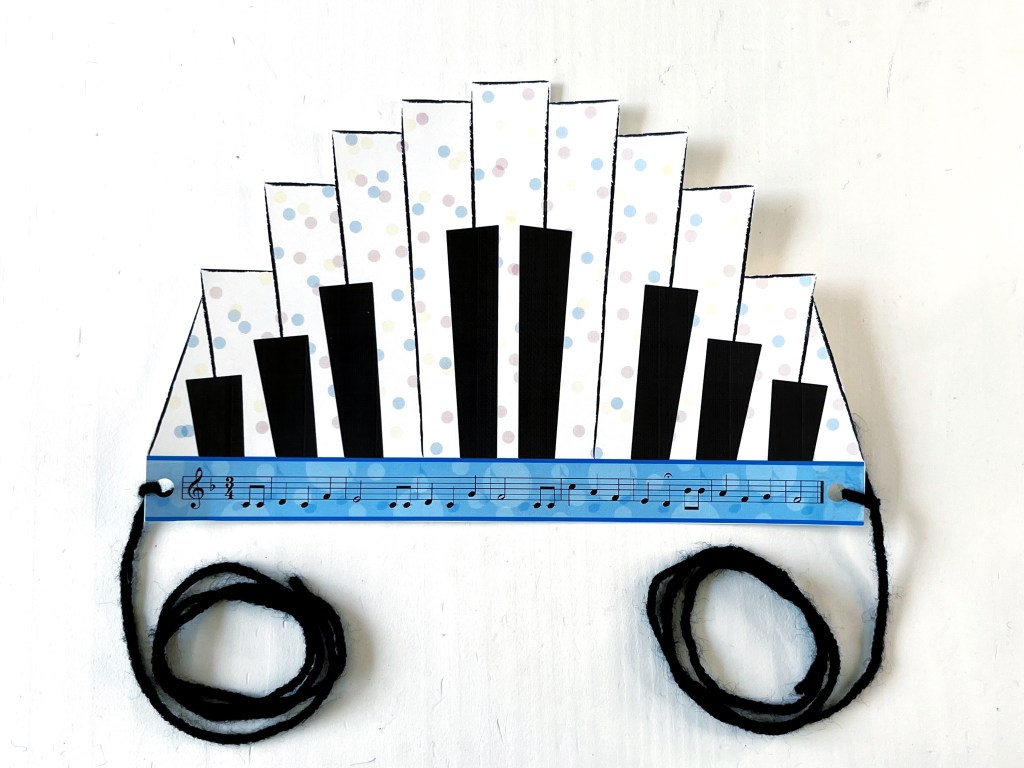
One way I like to celebrate my younger piano students’ birthdays is by giving them a special Piano Birthday Crown! It’s quick to make (less than 5 minutes!) and it makes them feel so special!

The bottom band of the crown comes in three colors (blue, pink, and purple) and it includes the melody of “Happy Birthday” in the key of F major. Not only is it a special way to celebrate your student’s birthday but you can use it to teach them how to play “Happy Birthday” on the piano during their lesson! 

Preparing the Piano Birthday Crown:

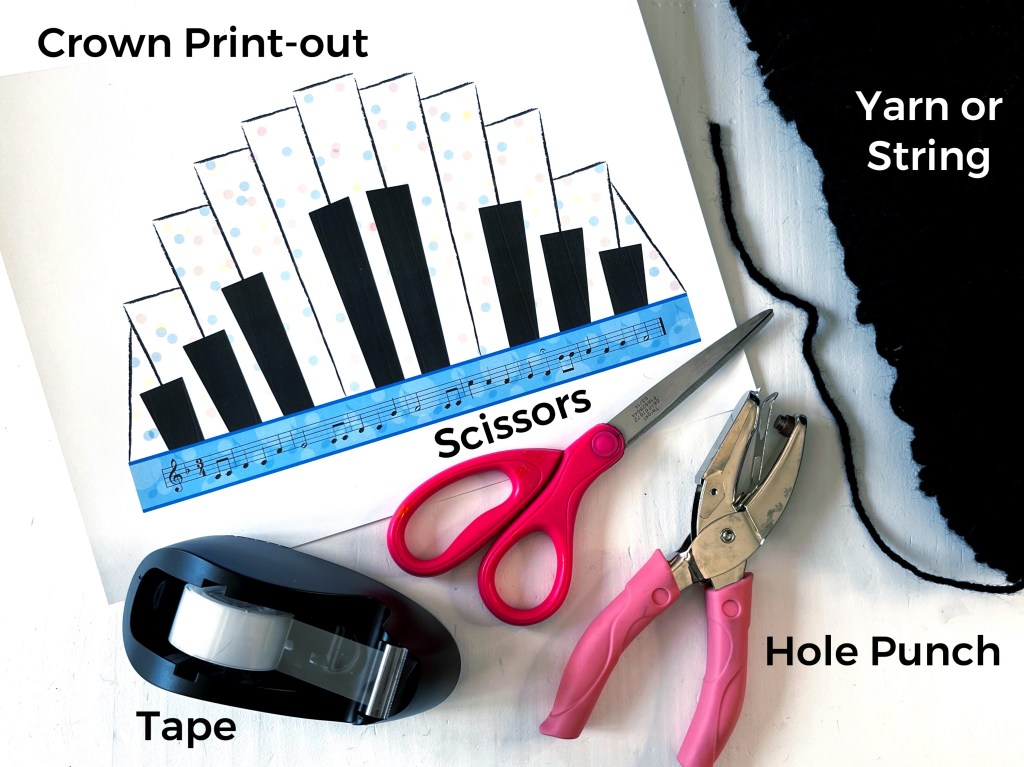
All you need to make a piano birthday crown is:

  • Print out the piano birthday crown on a sheet of cardstock (it will sit more firmly on your student’s head than regular copier paper)
  • Scissors (I like the Westcott brand a lot. My pair is still going strong after more than 10 years!)
  • Hole punch (I do a lot of crafting so I like the soft grip handles on my hole punch)
  • Yarn or string
  • Optional: Transparent tape (I use this for everything)
Piano birthday crown printout laying on a white table surrounded by supplies needed to put the crown together: black yarn, transparent tape, a pair of scissors and and holes punch.

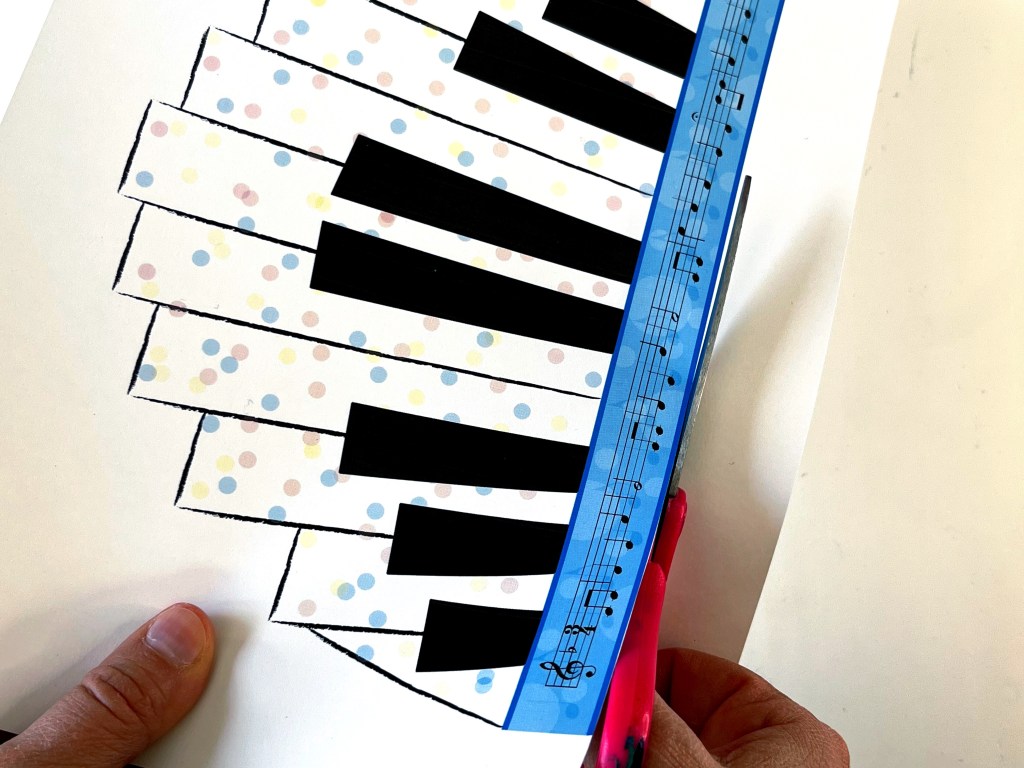
Print out the piano birthday crown on a sheet of cardstock and cut it out.

The piano birthday crown printout is being is cut out using the scissors.

This part is optional, but I like to reinforce the edges of the colored “Happy Birthday” band with a little bit of tape. This is the spot where we will be punching a hole through the crown, so the tape provides the paper with a little extra strength to support the tension of the yarn once it is tied around your student’s head.

The edges of the piano birthday crown printout are being reinforced by a small amount of transparent tape.

Punch a hole on each ends of the colored “Happy Birthday” band through the paper and the tape.

The hole punch is punching a hole through the piano birthday crown where the transparent tape was placed.

Cut two pieces of yarn or string to size. Thread the yarn/string through the holes.

Black yarn is being threaded through the holes in the piano birthday crown.

Tie a knot to secure the yarn/string to the crown.

Tie a knot in the black yarn to secure it the piano birthday crown.

And there you go! An adorable piano birthday crown for your piano student.

Completed piano birthday crown lays on top of a white table.

Just place the crown on your student’s forehead and tie a bow at the back of his/her head with the yarn. Time to play some “Happy Birthday” on the piano!!!

You can purchase and download the piano birthday crown at the Toucan Piano shop. You can print as many crowns as you’d like, so you can use it for any student you teach directly for years to come! I hope your students enjoy this cute crown as much as mine do!

Explore more creative teaching ideas
  • Rainbow Manuscript Paper
    This colorful manuscript paper is available in the Toucan Piano shop as a free printable! They are available in three sizes, so they can be used for a variety of ages and activities, like writing out original compositions, explaining music theory concepts, music dictation, games, and so much more!
  • Musical M.A.S.H.
    This free printable game tests your student’s knowledge of the spaces on the grand staff. It’s a fast, easy game to play, and will predict your student’s musical future with hilarious results!

Let’s stay in touch, join the list!

As a “toucan” of our appreciation download a free set of note flashcards (link in our Welcome email)!

Processing…
Success! You're on the list.

We are a participant in the Amazon Services LLC Associates Program, an affiliate advertising program designed to provide a means for sites to earn advertising fees by advertising and linking to Amazon.com. As an Amazon Associate we earn from qualifying purchases.
Best in Pass: A Fast-Paced Note-Reading Game

We just enjoyed a week of group piano lessons. I love to come up with games that the kids can play together, sometimes in teams and sometimes every-man-for-himself! Note-reading is a basic skill that all students can practice, no matter their skill level, so I always try to include a note-reading game among our activities.

Best in Pass involves not only note-reading but also fine motor skills which makes it fun for students of all ages (including very young students). Although I played it during a group lesson, it is also adaptable to private lessons or buddy lessons.

To play, you will need:

  • Ping-pong balls with the letters of the musical alphabet written on them (you should have a ping pong ball for every note you are drilling in the game)
  • Plastic spoons with notes on them
  • A bowl to hold the ping pong balls (they are an unwieldy bunch!)
  • A container to place all the plastic spoons
  • 1 scooper spoon (a spoon without a note on it) per player
Seven mutli-colored ping pong balls lined up in a row. Each ball has a letter of the musical alphabet written on it in black. The letters are A, B, C, D, E, F and G. The balls sit above a row of five white plastic spoons. On the head of each spoon is a music note written in either the treble or bass clef.

If you’d like to see how to prep the materials for the game, jump down here.

Game Set-up:

Place all the ping-pong balls in a large bowl.

Place all the spoons that have notes on them in a container. Each player draws 5 spoons and names the notes that are written on them. Each player places the spoons in a row in front of them.

Each player gets their own scooper spoon (a spoon without a note on it). They will use this spoon to scoop the ping-pong balls out of the bowl and transfer them to their row of spoons.

How to Play:

The objective of the game is to be the first to fill up all your note spoons with their corresponding ping-pong balls (for example, a spoon with Middle C written on it should be paired with a ping-pong ball with the letter C). But… there’s a catch! Each ping-pong ball must be passed from spoon to spoon before being placed on its matching spoon.

Let’s say when a student laid out his/her spoons in a row, the spoon that ended up all the way at the end of the row on the right was a Middle C.

When the game starts, the student would search for a ping-pong ball with the letter C on it and scoop it out of the bowl with his/her scooper spoon. The student CANNOT place the ball directly on the spoon with the middle C. Instead, the ping-pong ball must be placed on the spoon at the beginning of the row all the way to the left.

The student then picks up this first spoon of the row and moves the ball to the next spoon. Then the student will pick up the second spoon and pass the ball to the third spoon. Then the ball is passed from the third spoon to the fourth spoon. And finally the ball is passed from the fourth spoon to the final spoon, the one with Middle C written on it. That spoon is now completed and out of play.

The student then moves on to filling the fourth spoon in the row using the same procedure.

The only rule is that you cannot touch the ping-pong balls with your hands! Only spoons can touch the balls. A student can use two spoons to try to catch a runaway ball.

Whoever fills up all their spoons first is the Best in Pass and the winner of the game!

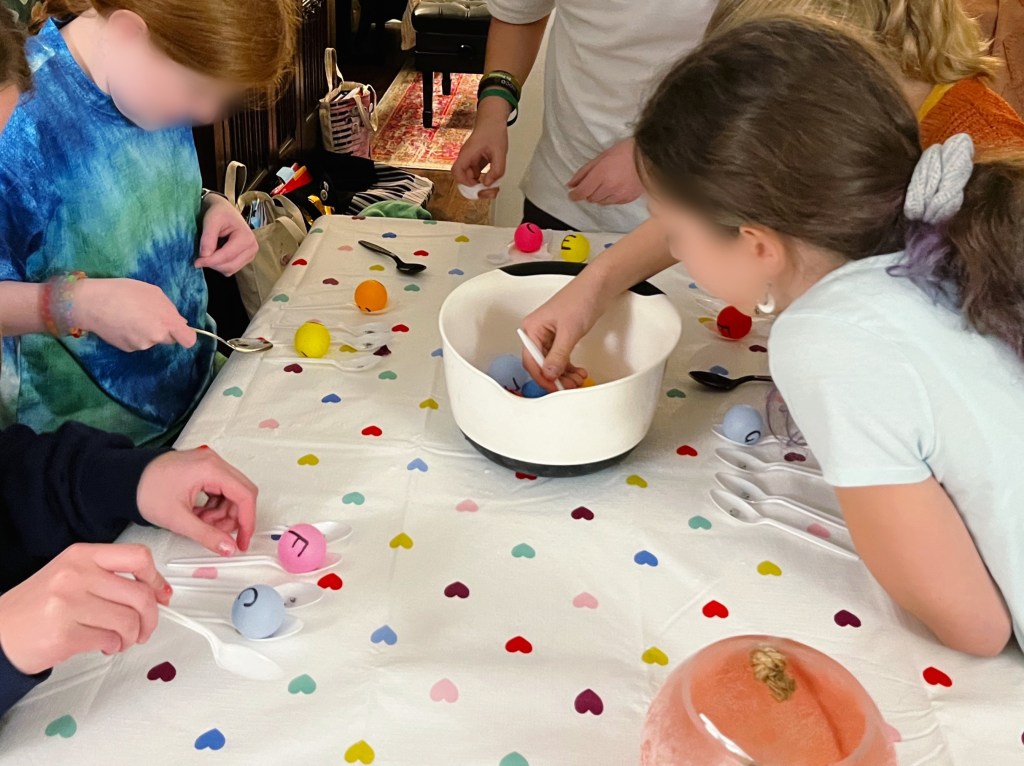
Children gathered around a ball filled with ping pong balls. They are playing Best in Pass a note-reading race game. One child is attempting to scoop a ping pong ball out of the bowl with a white plastic spoon. Two other children are trying to move a ping pong ball from one spoon to another.

We had so much fun playing this at our group lessons! It was a great game to get the energy up and our brains and bodies engaged.

Let me know if you try it with your students!

Explore more creative teaching ideas

For other games that can be used in both private and group lessons, check out:

  • Snowball Rhythm Game
    Who will be able to make the longest rhythm train before the dreaded “Busted!” stick is revealed?! Kids will practice their rhythms while also practicing their aim in this fun toss game.
  • Chord Snowblast
    Build chords and collect points while trying to avoid the snow blast! Kids will test their knowledge of building chords AND they will actually be hoping to get all the sharps and flats chords!!
  • Two Sides of the Same Coin
    A game about enharmonics that can be played in several different ways! Students will try to collect the most enharmonic pairs and hope that their coins don’t get stolen by another player.

Preparing the Materials:

To prepare the game materials for Best in Pass you will need:

Using the permanent marker, write one letter of the musical alphabet (A, B, C, D, E, F, G) on each ping-pong ball. Once all the ping-pong balls are labeled, place them in a bowl.

Colorful ping pong balls sit on a white table next to a black permanent marker. The ping pong balls have letters of the alphabet written on them in black.

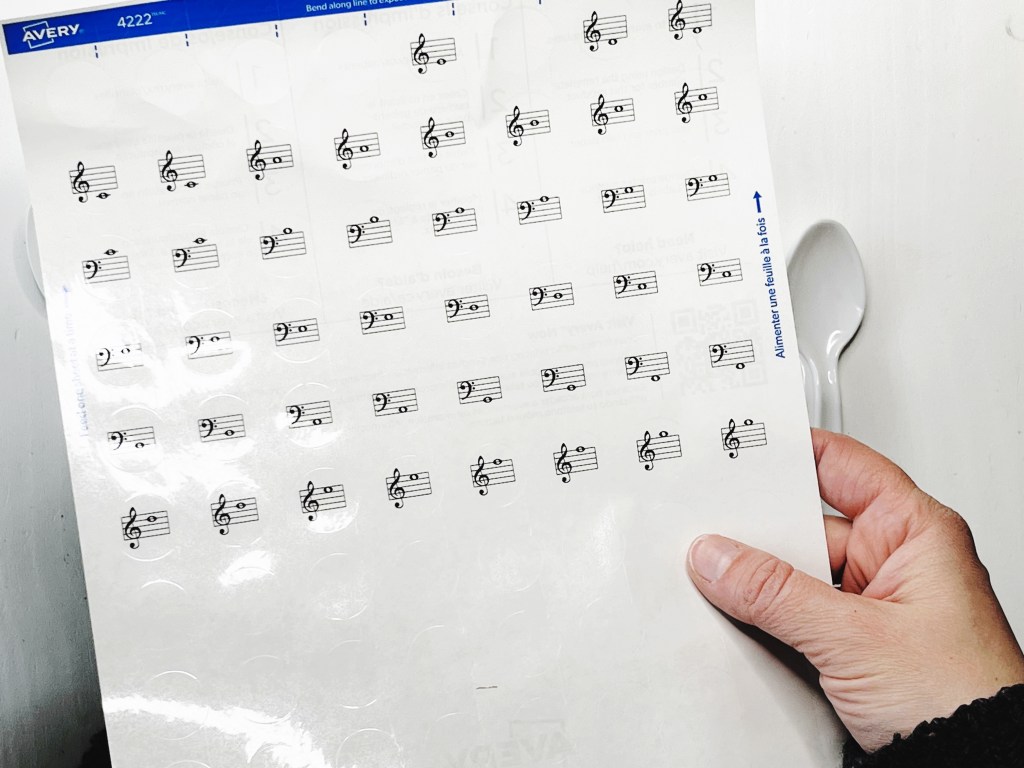
If you are using the suggested Avery labels, Avery provides a template at their website here. Configure the printable labels on the computer so that each circle label has one note in it. Then print the labels.

A hand holds a printed glossy white label sheet with musical notes on it.

Gather all the plastic spoons you will need. There should be one plastic spoon for each label you printed.

Nine white plastic spoons sit on top of a printed glossy white label sheet with musical notes on it.

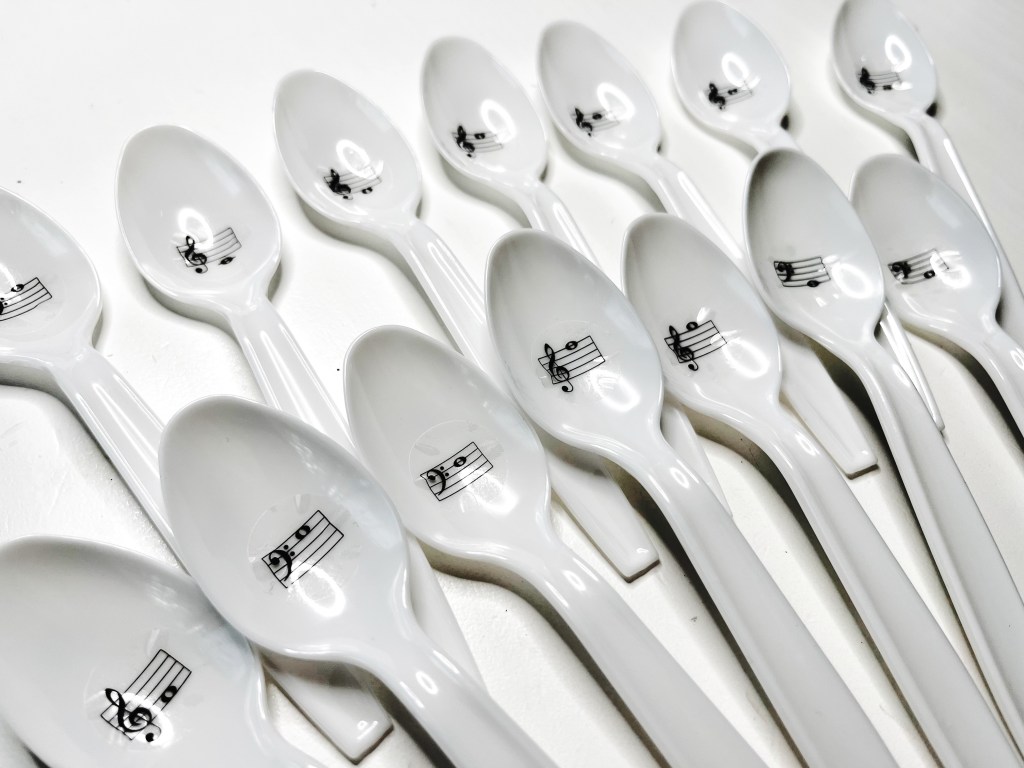
Stick each label to the concave side of a spoon’s bowl.

A hand sticks a circular label with a music note written on it to the concave portion of a spoon's bowl. Below on a white table sit white plastic spoons with and without notes on them.

Once all the spoons are labeled, place them in a container.

White plastic spoons with with music notes written on them sit neatly arranged in two overlapping rows.

Let’s stay in touch, join the list!

As a “toucan” of our appreciation download a free set of note flashcards (link in our Welcome email)!

Processing…
Success! You're on the list.

We are a participant in the Amazon Services LLC Associates Program, an affiliate advertising program designed to provide a means for sites to earn advertising fees by advertising and linking to Amazon.com. As an Amazon Associate we earn from qualifying purchases.
Valentine’s Day “Would You Rather…” Rhythm Game

Would you rather play parallel thirds or parallel sixths?

Would you rather play Chopin or Debussy?

Kids LOVE “would you rather” questions! I use them all the time as ice-breakers at piano parties and group lessons. They always get everyone laughing and trying to pick between two oftentimes awful options… like, would you rather play piano with a bucket on your head or pedal with a cement block on your foot? SO hard to choose!!!

When faced with the choice of playing a rhythm game or answering a “would you rather” question, I say why not do both?!

The Path to Your Heart combines both the fun of “would you rather” questions with rhythm exercises. It is a great game for in-person lessons, online lessons, group lessons, and even classrooms!

Instead of just answering the question, the student must clap the rhythm path that leads to the answer they prefer. It is a fun way to drill rhythms and learn a little more about your student.

Each level of The Path to Your Heart comes with three “would you rather” questions. You can use it as a:

  • lesson warm-up! Ask one question at the beginning of each lesson in the weeks leading up to Valentine’s day.
  • Valentine’s day game. Go through all three questions.
  • ice-breaker game at a group lesson or piano party. Take turns asking each student a question. The others have to figure out which answer they picked but listening to the rhythms that he/she tapped.
  • team activity! Ask a question and the students divide themselves into 2 groups according to which option they’d prefer. Then they have to tap the rhythm together as a group.
Piano student holding a bright red drumstick taps out the rhythms on a worksheet. The student is answering a would your rather question by tapping out a rhythm sequence of quarter notes, quarter rests, half notes and whole notes.

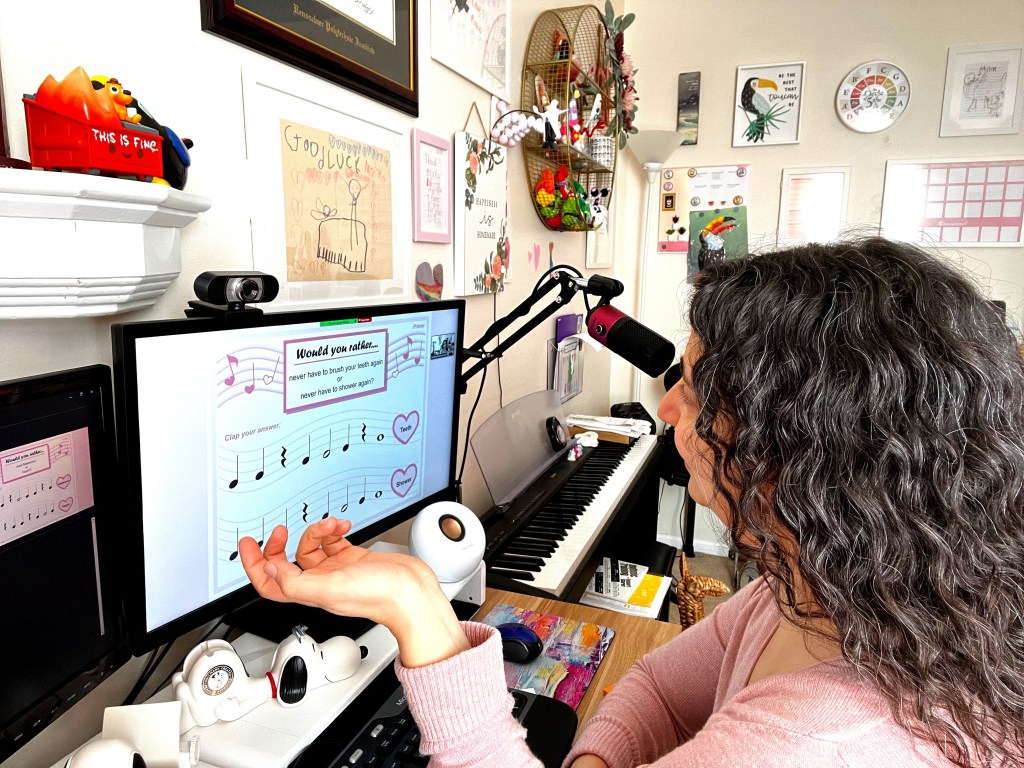
It is also the perfect game for online lessons since it requires no set-up or additional materials. Just share your screen with your student and start playing!

Piano teacher in a pink sweater teaching a student during an online lesson. They are playing a Valentine's day rhythm game that show quarter notes, quarter rests, half notes, and whole notes.

The Path to Your Heart covers the following rhythms (and corresponding rests): whole note, half note, quarter note, eighth note pairs, dotted quarter note, and single eighth note.

Explore more creative teaching ideas

For more Valentine’s Day games, check out:

  • I Can Heart-ly Wait for the Punchline
    A heart themed laugh-out-loud note reading game.
    I love this game because not only do students have to think about keyboard geography, they also have to be able to associate the notes with their exact location on the piano. 
  • Sky High Love
    The rhythms get longer as the heart towers get higher! Whose tower will remain standing in the end?!
    This adrenaline-inducing rhythm game is a great way to kick-off a lesson and get the energy up.
  • Sweet Words
    Students will have fun reading the notes on the staff (or naming the white keys on the piano) to try to fill in the missing letters of their sweet word(s) first. 
  • Musical M.A.S.H
    This free printable game tests your student’s knowledge of the spaces on the grand staff. It’s a fast, easy game to play, and will predict your student’s musical future with hilarious results!

Let’s stay in touch, join the list!

As a “toucan” of our appreciation download a free set of note flashcards (link in our Welcome email)!

Processing…
Success! You're on the list.

We are a participant in the Amazon Services LLC Associates Program, an affiliate advertising program designed to provide a means for sites to earn advertising fees by advertising and linking to Amazon.com. As an Amazon Associate we earn from qualifying purchases.
Sky High Love: A Valentine’s Day Rhythm Game

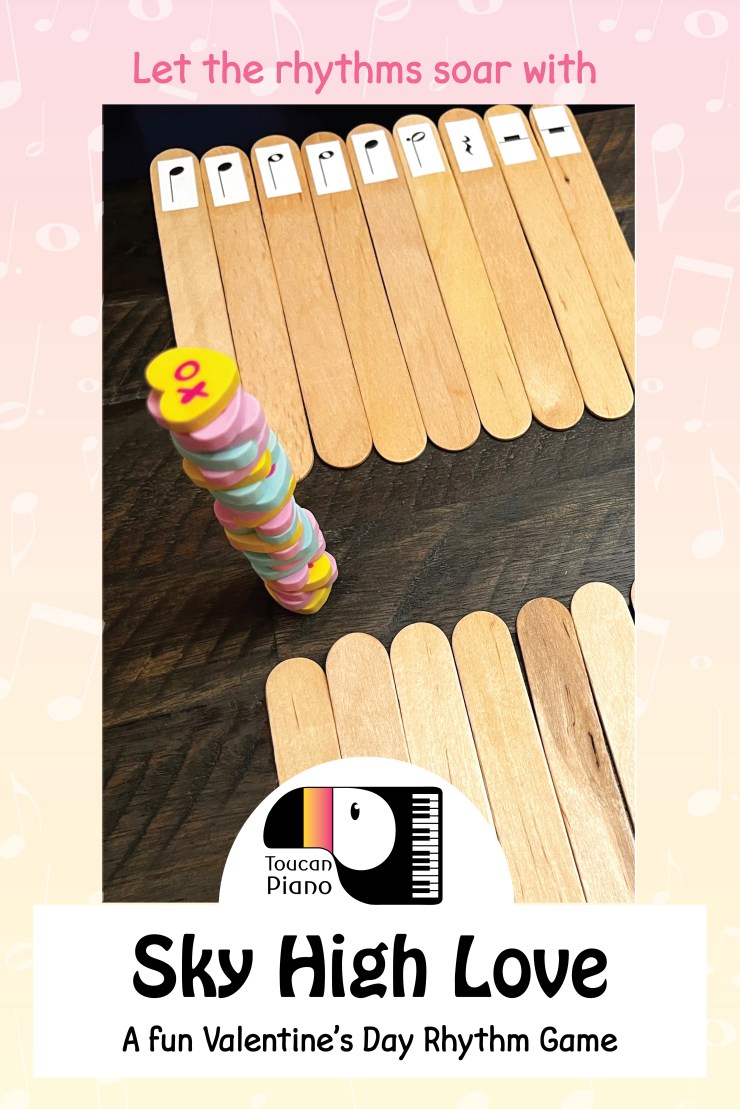
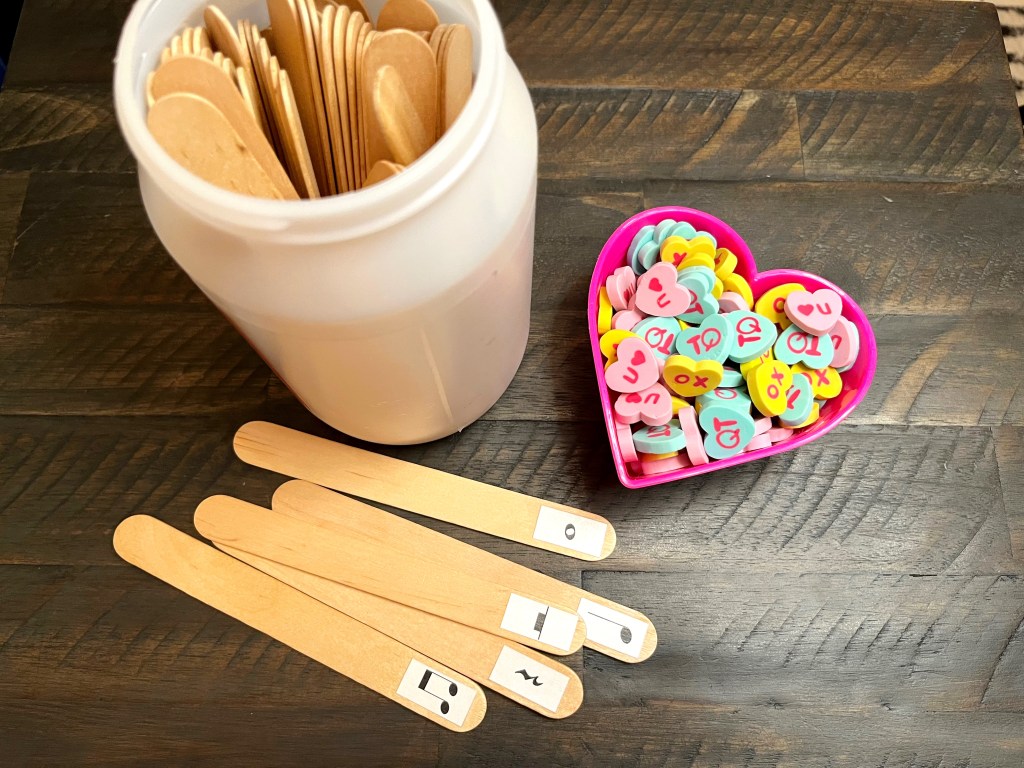
I love fun and easy games that use things I already have around my studio! For this Valentine’s Day game, I used my rhythm popsicle sticks and mini heart-shaped erasers.
Place all the rhythm popsicle sticks in a container so that the student cannot see the rhythms that are written on the popsicle sticks. The mini heart-shaped erasers are placed in the center of the table.
The student pulls a popsicle stick out of the container and claps and counts the rhythm written on the stick. The student will then take the number of mini erasers from the pile that corresponds to the total number of beats that are on the stick. The student stacks the mini erasers to form a tower. For example, if the stick had a half note written on it, the student would take 2 mini erasers and stack them one on top of the other.

When a new popsicle stick is pulled from the container, the player must place the new rhythm stick next to his/her other sticks and clap and count them all as a sequence. Just as the tower of mini erasers will get taller with each round of play, the rhythm sequence each player must clap and count will also get longer.

Players take turns until one of the towers topples over.

The player whose tower is still standing at the end, wins! This is a great game to get the energy up at the beginning of a lesson! I’ve been playing this all week with my students. It has been so much fun to see how they each have a strategy for stacking their heart erasers. They really get into it!!

I always get excited about teaching aids that I can find multiple uses for… my rhythm popsicle sticks are one of them! Another game I love to play with my rhythm popsicle sticks is this Snowball Rhythm Game. It is a favorite every winter with my students.

Explore more creative teaching ideas
  • I Can Heart-ly Wait for the Punchline
    A heart themed laugh-out-loud note reading game.
    I love this game because not only do students have to think about keyboard geography, they also have to be able to associate the notes with their exact location on the piano. 
  • Sweet Words
    Students will have fun reading the notes on the staff (or naming the white keys on the piano) to try to fill in the missing letters of their sweet word(s) first. 
  • Musical M.A.S.H
    This free printable game tests your student’s knowledge of the spaces on the grand staff. It’s a fast, easy game to play, and will predict your student’s musical future with hilarious results!

Let’s stay in touch, join the list!

As a “toucan” of our appreciation download a free set of note flashcards (link in our Welcome email)!

Processing…
Success! You're on the list.

We are a participant in the Amazon Services LLC Associates Program, an affiliate advertising program designed to provide a means for sites to earn advertising fees by advertising and linking to Amazon.com. As an Amazon Associate we earn from qualifying purchases.