Sweet Words: Valentine’s Note-Reading Game

Who doesn’t love to hear Sweet Words?! The right words can make us feel all warm and fuzzy inside!

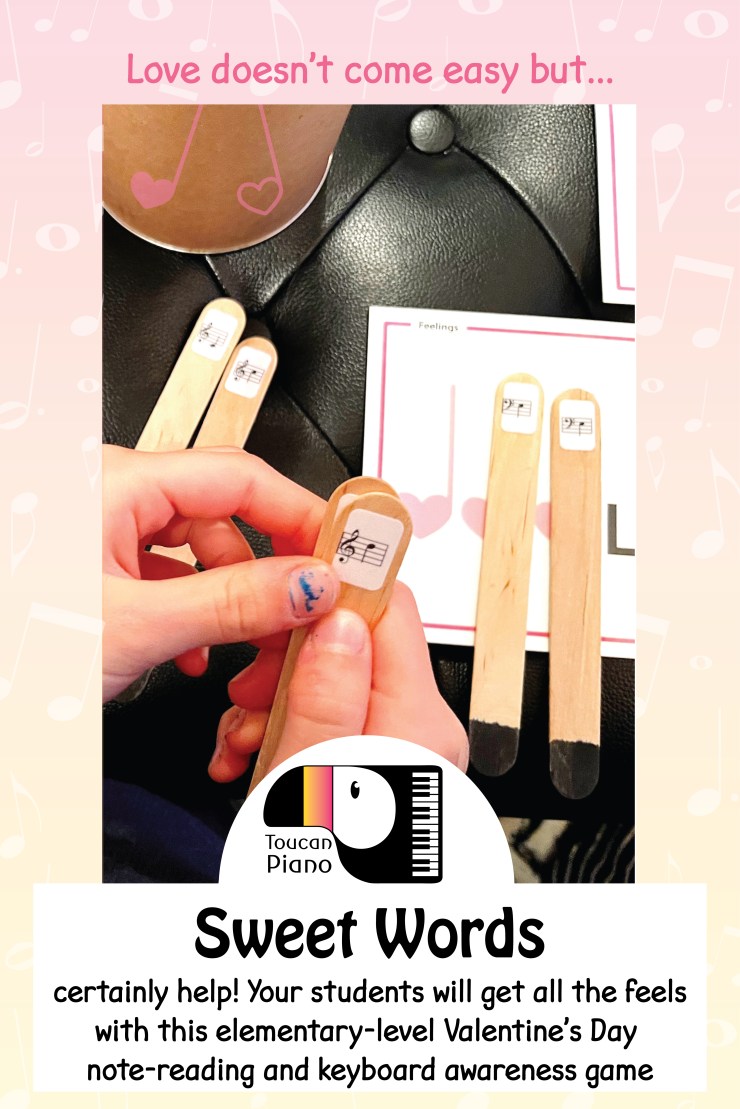
This Valentine’s Day your elementary level students can get all the feels with Sweet Words a note-reading and keyboard awareness game. But love doesn’t come easy… these sweet words are missing letters! Who will be able to find their missing letters and complete their word first? Students will have fun reading the notes on the staff (or naming the white keys on the piano) to try to fill in the missing letters of their sweet word first.

I play this game every year with my students (I use it with my older students as well as a quick review game and to check how fast they are recognizing the notes!). We spent all of last week playing and had a blast!
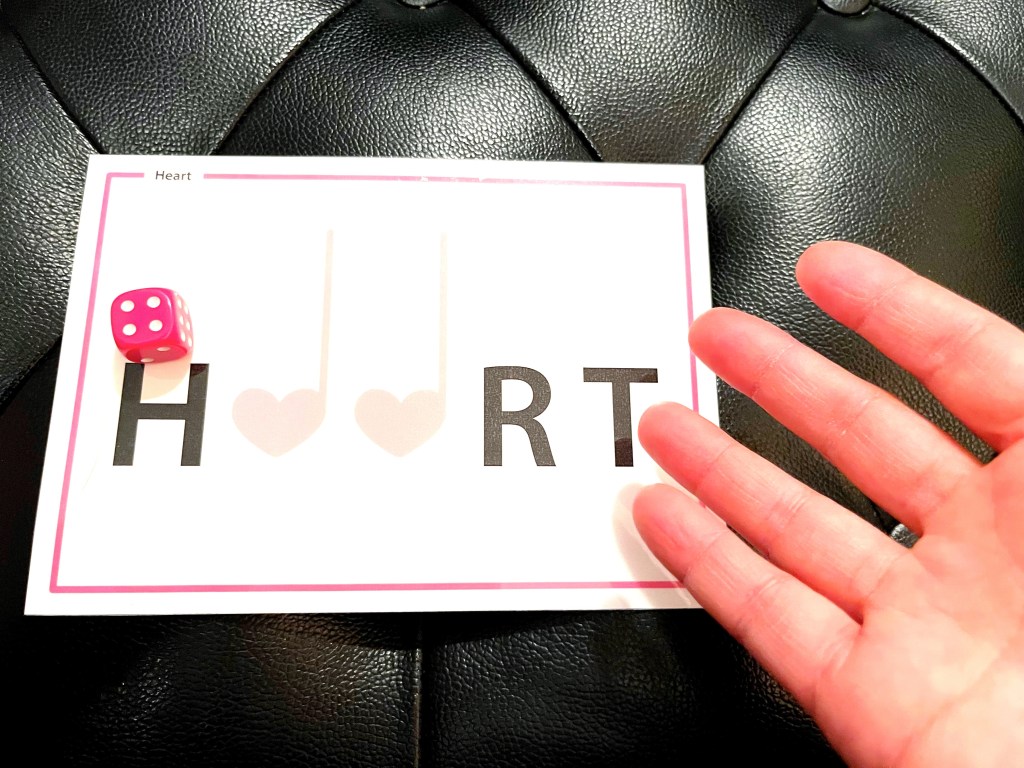
A piano student rolls a pink die on top of a card that reads "Heart" but has letters missing.

For an easy twist on the game, I have each player draw 3 cards. Each player picks one card to start with and can only move onto their next card once they have filled in their first card. It ups the stakes quite a bit and adds an extra layer of excitement to the game!
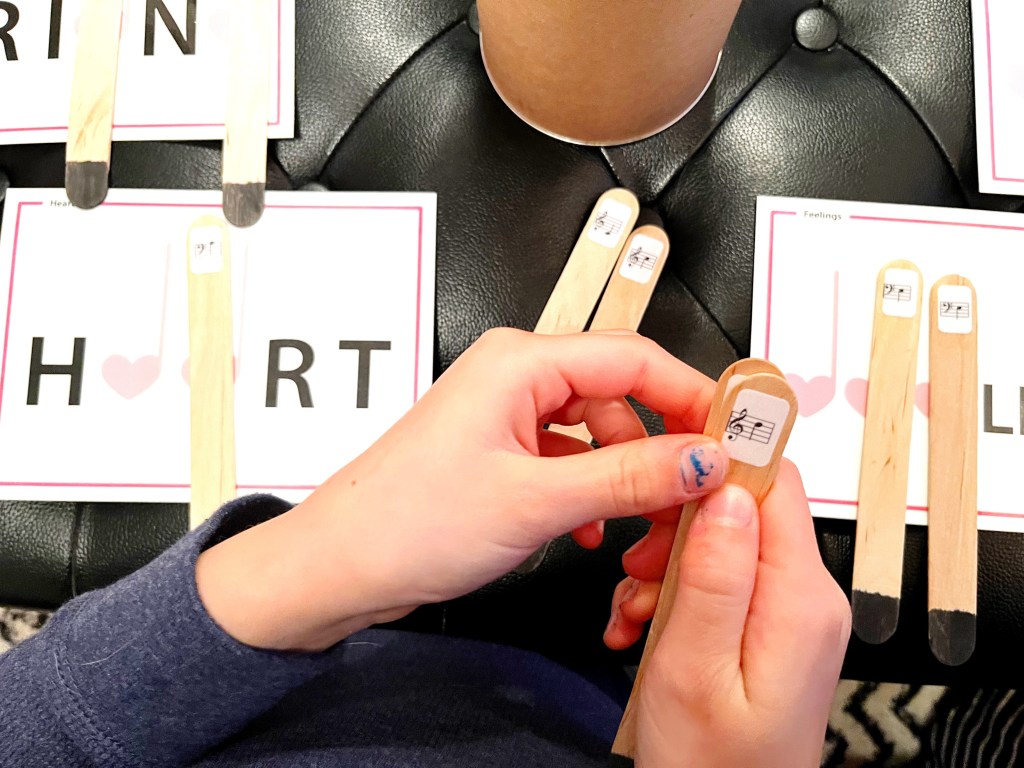
A piano student reads and sorts through popsicle sticks with music notes written on them trying to find a match for one of the Valentine's words.

Another twist I like to use (especially for my high energy students) it to replace the die for a toss game (like the one I use for my Snowball Rhythm Game – the one I use is out of stock but this one on Amazon is a great alternative and can be used throughout the entire year!). Depending on which hole they land the snowball in will determine how many note cards they will get.

I like to use my popsicle stick notes because I have 3 different sets and can drill specific subsets of notes with my students. Sweet Words comes with all the note and keyboard cards needed for playing. Plus they are pink (nothing screams Valentine’s Day more than the color pink!).

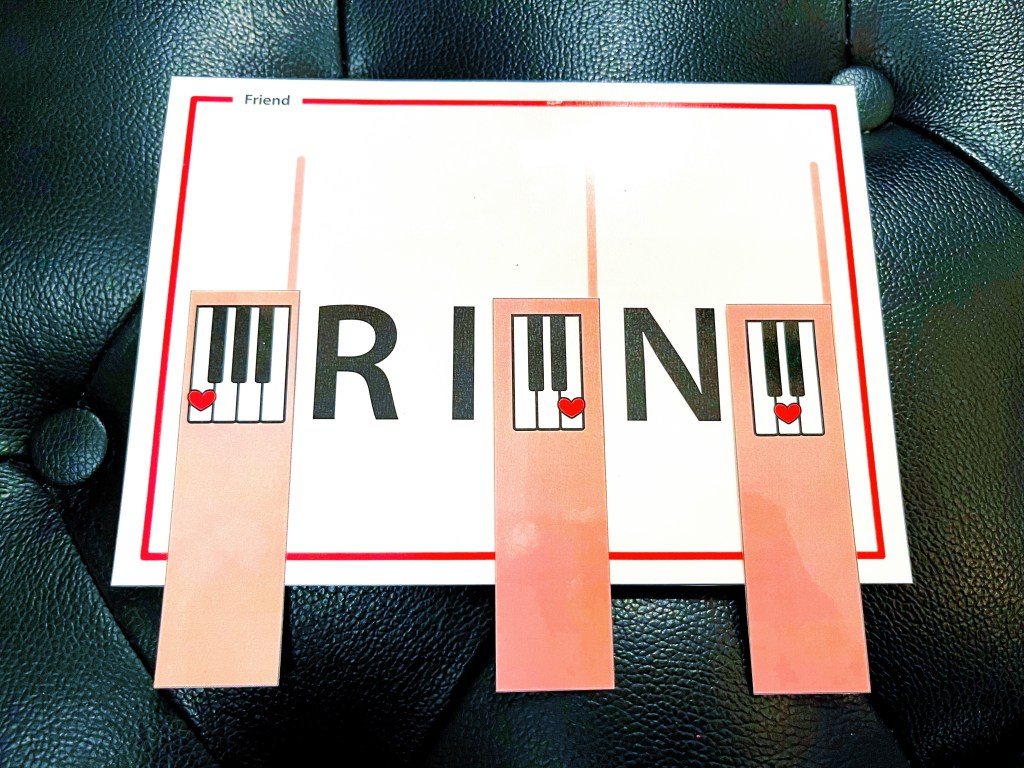
A card with the word "Friend" written in both piano keys and letters sits on a black piano bench.

As I mentioned, I played this game last week with all my students and something funny happened. I always ask my students to draw my cards for me (that way no one can complain about the words we get). I shuffle all the cards then I fan out the deck with the cards face down for the student to select their cards and mine. No joke, three different students on the same day drew “Cupid”, “Date”, and “Baby” for me at random. There are 20 cards in the deck, what are the odds?! I don’t know what the universe is trying to tell me! Lol

Sweet Words is available for purchase in the Toucan Piano store. I hope your students enjoy it as much as mine do!

Happy Valentine’s Day!

Explore more creative teaching ideas
  • Valentine’s Day Round-Up
    Make Valentine’s Day special for your students with free downloadable piano-themed Valentine’s cards and lots of music theory games that will have your students seeing hearts!
  • I Can Heart-ly Wait for the Punchline
    A heart themed laugh-out-loud note reading game. I love this game because not only do students have to think about keyboard geography, they also have to be able to associate the notes with their exact location on the piano. 
  • Sky High Love
    The rhythms get longer as the heart towers get higher! Whose tower will remain standing in the end?! This adrenaline-inducing rhythm game is a great way to kick-off a lesson and get the energy up.
  • Musical M.A.S.H
    This free printable game tests your student’s knowledge of the spaces on the grand staff. It’s a fast, easy game to play, and will predict your student’s musical future with hilarious results!
  • Rainbow Manuscript Paper
    This colorful manuscript paper is available in the Toucan Piano shop as a free printable! They are available in three sizes, so they can be used for a variety of ages and activities, like writing out original compositions, explaining music theory concepts, music dictation, games, and so much more!

Let’s stay in touch, join the list!

As a “toucan” of our appreciation download a free set of note flashcards (link in our Welcome email)!
Processing…
Success! You're on the list.

Piano Valentine’s Day Cards and Games

Whether you love or hate Valentine’s Day, I think we can all agree that celebrating love and showing appreciation for each other is always a good thing! Every Valentine’s Day I like to encourage my students with a little piano-themed Valentine and some games to let them know how much I care about them, their music journey, and helping them grow their love for making music.

Here I’m sharing some of the Valentine’s Day cards I’ve given my students as well as games that I pull out every year to play with my students! I hope you find something that inspires you this Valentine’s Day. Check out the

Here I’m sharing some of the Valentine’s Day cards I’ve given my students as well as games that I pull out every year to play with my students! I hope you find something that inspires you this Valentine’s Day. Check out the Toucan Piano Store for more piano teaching resources and music theory games.

Valentine’s Day Cards

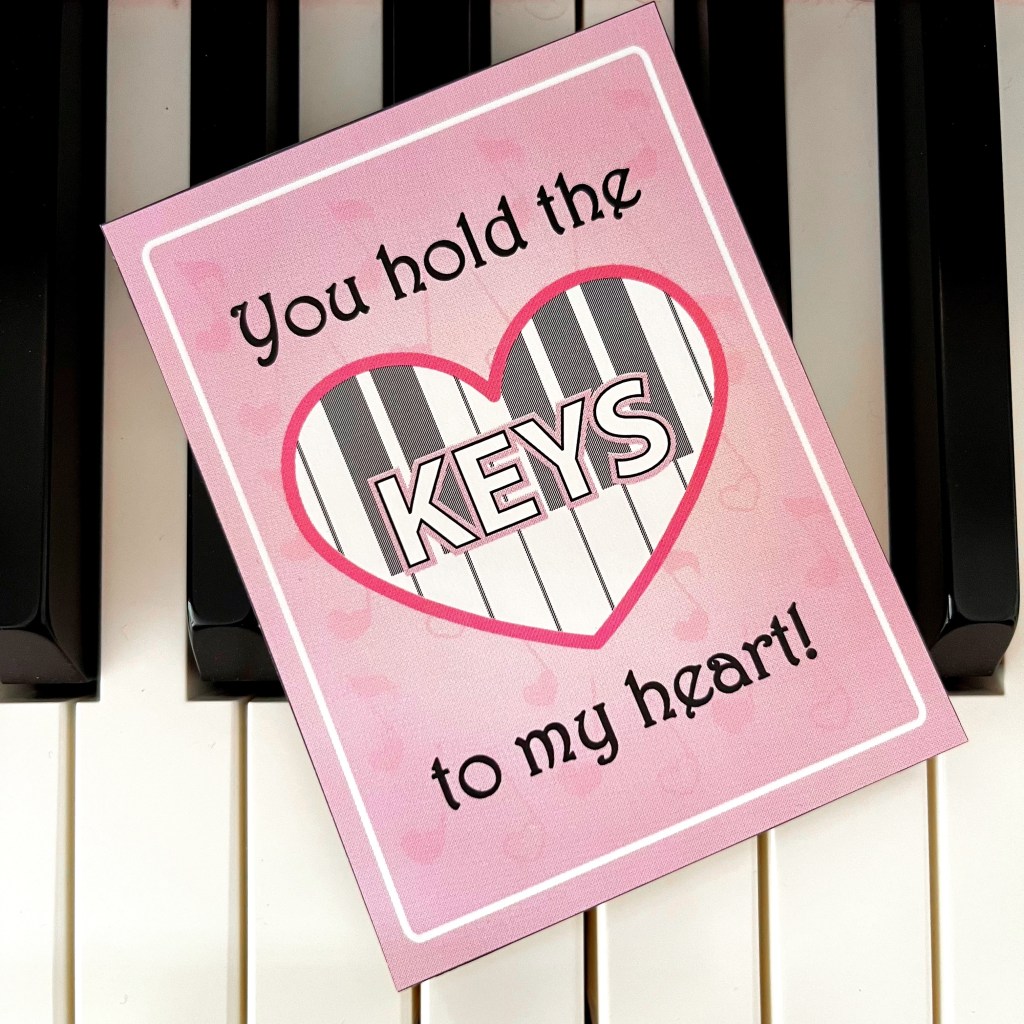
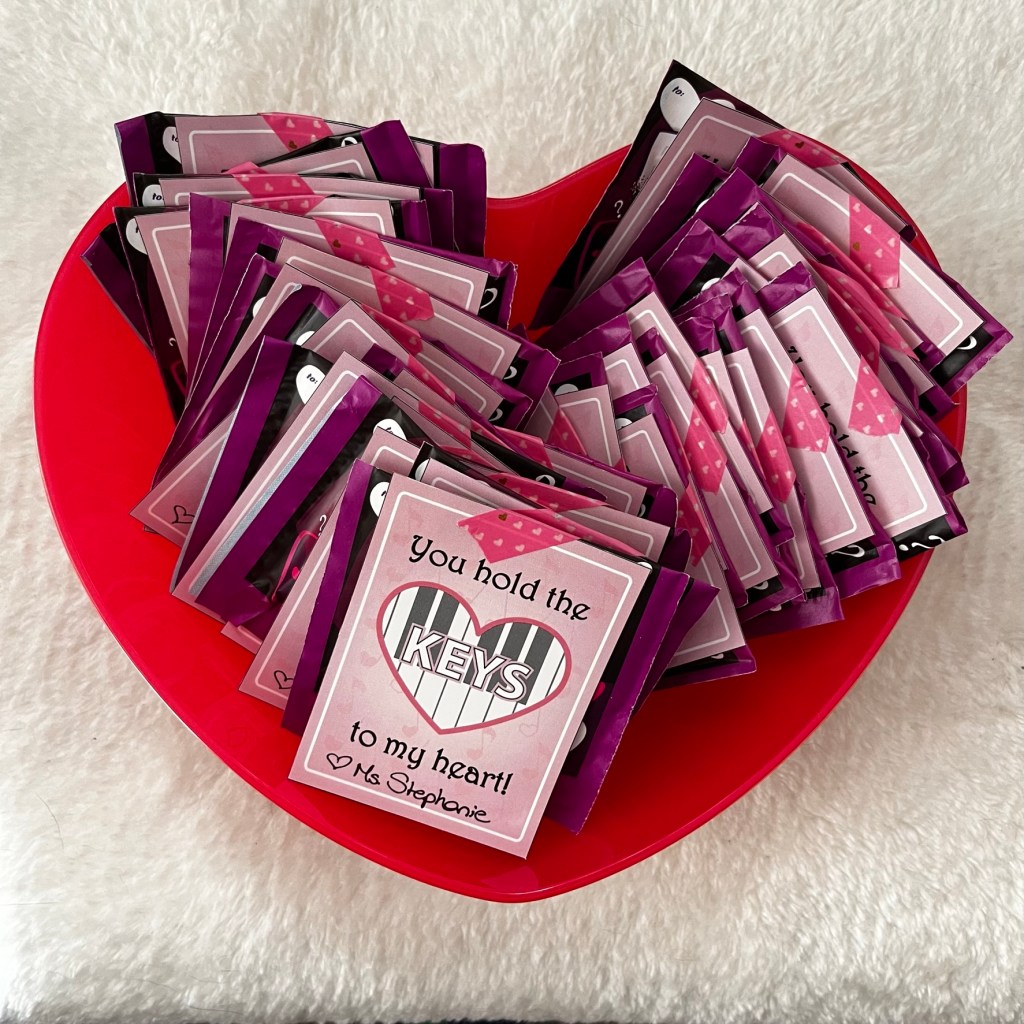
I love coming up with Valentine’s day cards for my students! The first one I ever made was my “You Hold the Keys to My Heart” Valentine (I love a good music pun!). I handed them out with a small piece of candy during Valentine’s Day week. You can download this free printable here.

A pink Valentine's Day Card sits on top of the keys of a piano. They card reads "You hold the keys to my heart".
Piano-themed Valentine's day cards sit inside a heart-shaped bowl.

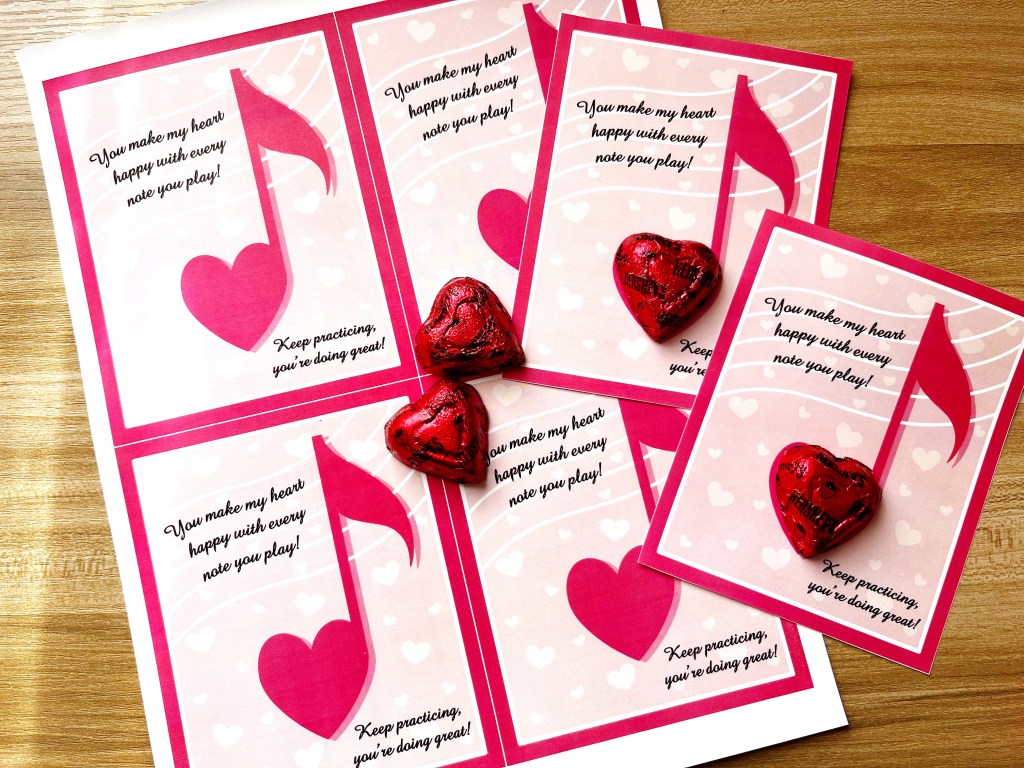
This year I wanted to make a new Valentine that I could attach a heart-shaped chocolate to. The result was my “You Make my Heart Happy with Every Note you Play!” Valentine. I attached a Hershey’s Strawberry Cream Heart to the center of the heart-shaped note with double sided tape. They have been a hit so far! You can download this free printable here.

Music themed Valentines with heart shaped chocolates sitting on a wooden table.

Valentine’s Day Rhythm Games

The Path to Your Heart: A Would-You-Rather Rhythm Game

This one is a favorite with my students and I pull it out every year! The Path to Your Heart combines both the fun of “would you rather” questions with rhythm exercises. It is a great game for in-person lessons, online lessons, group lessons, and even classrooms! Check out the blogpost for more information.

A would you rather question printed on a sheet of paper is laying on a wooden table. The sheet has two possible answers accompanied by rhythm notes. A drumstick held by a piano teacher points to a rhythm on the sheet.

Sky-High Love

I love fun and easy games that use things I already have around my studio! For this Valentine’s Day game, I used my rhythm popsicle sticks and mini heart-shaped erasers. It’s so simple and the kids absolutely love it! The record so far for the most eraser stacked at my studio is 31!! I’m excited to see if anyone will beat the record this year. For more information on how to play check out the video below or the blogpost.

Valentine’s Day Note Reading Games

Sweet Words

Everyone loves hearing sweet words! But these sweet words are missing letters… Who will be able to find their missing letters and complete their word first? Students will have fun reading the notes on the staff (or naming the white keys on the piano) to try to fill in the missing letters of their sweet word(s) first. Check out the blogpost for Sweet Words here.

The word "Friend" is spelled out using keyboard cards and letters.

I Can Heart-ly Wait for the Punchline

What is better than a joke?! Well, a music-themed joke, of course! I love introducing my students to music theory jokes, especially when I can mix in some music theory. I love this game in particular because not only do students have to think about keyboard geography, they have to be able to associate the notes with their exact location on the piano. Check out the full blogpost for more information.

Piano student plays a note-reading game based on music theory jokes.

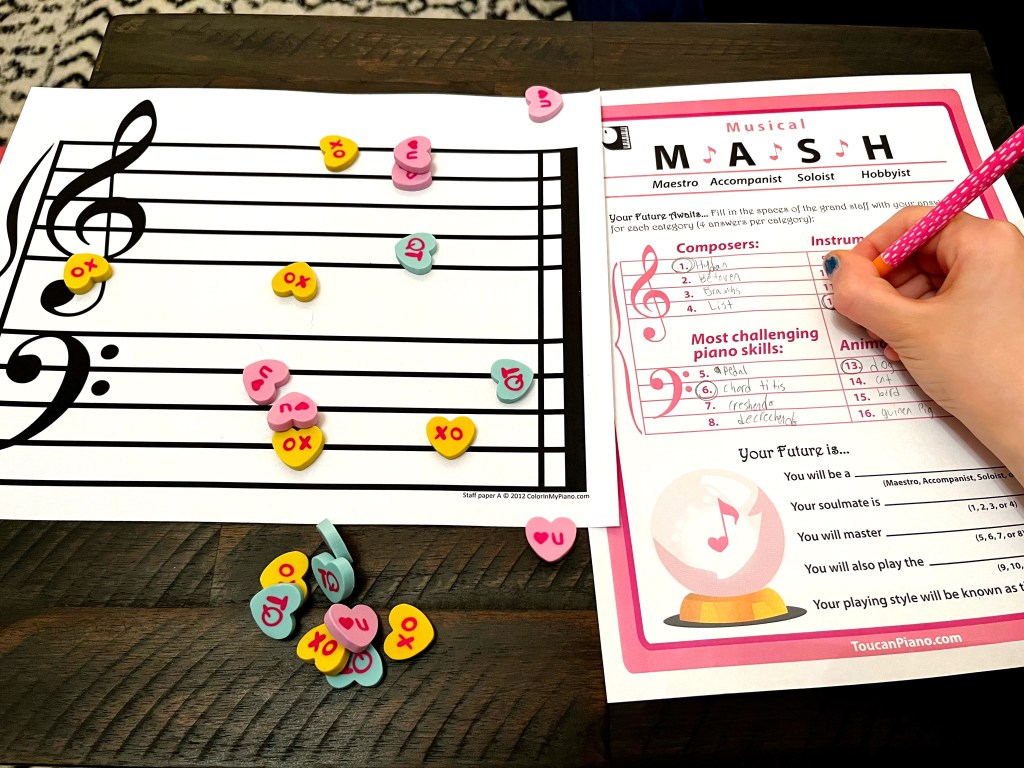
Musical M.A.S.H.

Did you play MASH (Mansion, Apartment, Shack, House) when you were a kid? All it required was a piece of paper and a pencil! My friends and I would spend countless recesses trying to find out if we would marry our crushes, have 20 kids while living in a mansion (we all wanted the mansion, of course) and driving a Ferrari! This Valentine’s Day my students and I are playing the musical version of M.A.S.H. (maestro, accompanist, soloist, hobbyist) that I created. We will be drilling our knowledge of the spaces on the grand staff while figuring out our musical futures!

Musical M.A.S.H. is available as a free download in the Toucan Piano Shop. You can read more about it here.

Other Valentine’s Day Resources

Rainbow Manuscript Paper

We are in the season of hearts and rainbows – Valentine’s Day and St. Patrick’s Day – and what better way to show your love for someone than with an original piece of music! The rainbow manuscript paper is available in the Toucan Piano shop as a free printable! Print as many as you like for your students. You can read more about how I use the rainbow manuscript paper with my students here.

Piano student composes an original song on a piece of rainbow manuscript paper.

The Die of Destiny

Sometimes, when the weather is miserable or after a tiring day at school, a student will walk into my studio without their usual bounce in their step. I’ve found that a little silliness and a dash of chance gets them in the mood to pull out their piano books and play music. This quick lesson starter only takes a minute and gets students in the mood to play! Check out the blogpost here.

Explore more creative teaching ideas
  • Chord Snowblast
    Cast away the winter blues and have fun reviewing chords with Chord Snowblast! Build chords and collect points while trying to avoid the snow blast! Kids will test their knowledge of building chords AND they will actually be hoping to get all the chords with sharps and flats!!
  • Two Sides of the Same Coin
    This St. Patrick’s day see if your students have the luck of the Irish! Two Sides of the Same Coin is a game about enharmonics that can be played in several different ways! Students will try to collect the most enharmonic pairs and hope that their coins don’t get stolen by another player (or the Leprechaun!).
  • Pot of Gold Rhythm Game
    Students love this easy rhythm game for beginner/elementary level students. The value of each rhythm note or rest will determine how many coins go into the pot. Who can fill their pot the fastest?! This game can be adapted for any time of the year or use mini-cauldrons for a fun Halloween or St. Patrick’s Day game.

Let’s stay in touch, join the list!

As a “toucan” of our appreciation download a free set of note flashcards (link in our Welcome email)!
Processing…
Success! You're on the list.

Halloween Note-Reading Challenge

Every fall, when students come back to weekly lessons after summer break, I feel like we spend the first month just reviewing concepts and note-reading. All my students take at least 4 lessons over the summer (July and August) but practice is not as regular as during the school year. The summer slide is a real thing…

Last year I gave each of my students one of my Toucan Piano flashcard decks (you can receive a free printable flashcard deck by signing up for our newsletter! No spam, “tou-can” count on it!).

Processing…
Success! You're on the list.

We spent the first month back drilling flashcards. At the beginning of every lesson, we would do a run-through of their deck and time how long it took them. They were in training mode… because the Zombie Pian-o-pocalypse was upon us!

A zombie hand with bright pink fingers rests on the keys of a piano.

The week before October started, we recorded their flashcard times. Each student was now in competition with themselves. That number represented the number they needed to beat in order to escape the zombies and survive the Zombie Pian-o-pocalypse.

Zombie Beethoven and Zombie Mozart stand in front of a piano gravestone and a rise moon. The banner between them reads "Zombie Pian-o-pocalypse" in red.

When they returned to lessons the following week, our poster was up with everyone’s times and the stage was set for their first showdown with the zombie horde.

Their first weekly challenge was a joke with no punchline. They would have to decipher the punchline at home and then deliver the punchline passcode to me (so I knew they were not a zombie trying to get me!). If they were successful, they placed a sticker on the poster in the passcode column.

But the true challenge was still to come… the weekly game would decide if the zombies would catch them or if they would survive another week of the pian-o-pocalypse. A win guaranteed salvation, but a loss would possibly doom them to the mercy of the zombies.

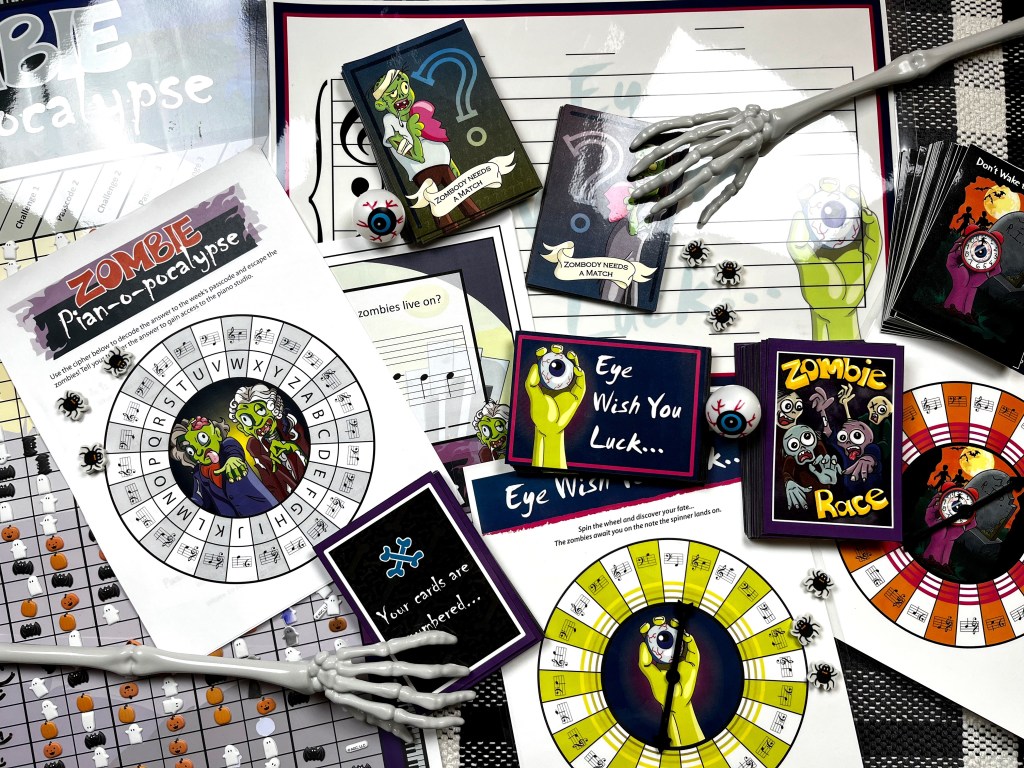
All the games and activities from the zombie piano apocalypse are laying on a table with skeleton hands reaching out to play the games.

I say “possibly” because there was still an inkling of hope! Their flashcard time. If they lost the game, they still had a chance to survive… IF they beat their flashcard time. We would then bust out their deck and time them as they worked their way through their flashcards.

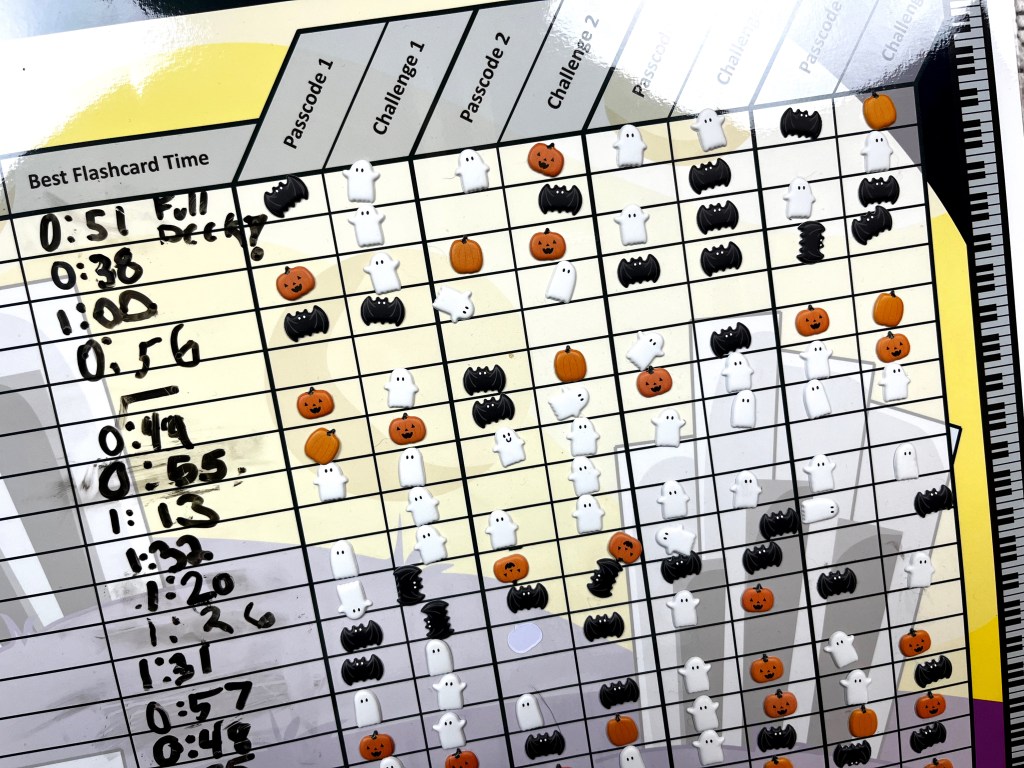
Every student who beat their time had so much pride in their accomplishment. They smiled so wide as they erased their old time off the poster and recorded their new faster time! It was so exciting to watch the seconds get shaved off their times each week. A few were even able to get a full deck (32 cards) in under 1 minute by the time the pian-o-pocalypse was said and done! The record was 51 seconds.

A poster has all the recorded flashcard times of students participating in the zombie pian-o-pocalypse. Bat, ghost and jack-o-lantern stickers were placed on the challenges the students won.

This was one of the most exciting studio-wide challenges I’ve ever done with my students. 4 weeks, 4 joke sets, and 4 zombie-themed games. I saw so much improvement in their note-reading AND we had a blast in the process! All in time to get our Christmas carols ready for our Holiday concert.

This was one of the most exciting studio-wide challenges I’ve ever done with my students: 4 weeks, 4 joke sets, and 4 zombie-themed games.

Another thing I loved about this challenge was that my students weren’t in competition with each other, only themselves (which helped the more non-competitive students I have to stay focused and excited). They didn’t feel like they were losing or getting left behind because even if someone had a better time than themselves, they didn’t all have the same decks (each deck only had the notes that they had already learned), so there was no possibility of comparison. It definitely helped keep everyone motivated.

What’s in the Zombie Pian-o-pocalypse?

The Zombie Pian-o-pocalypse comes with everything you need to keep the fun and learning going for 4 weeks:

The Zombie Pian-o-pocalypse Bundle is available as a download here. The games, poster, and jokes are available as individual downloads as well.

The Zombie Pian-o-pocalypse Poster!

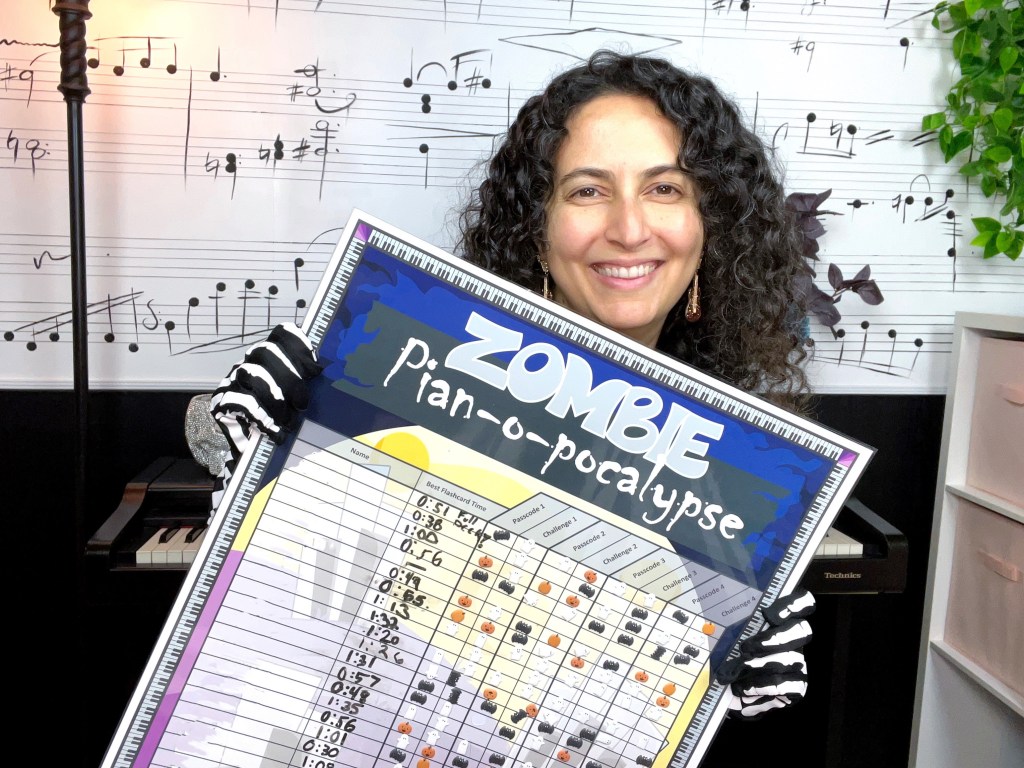
The poster allows students to see how their friends are doing and to keep track of everyone’s progress. So many students were motivated to try to beat the times of friends (even though they knew they didn’t have the same flashcard decks).

Piano teacher holds up the completed Zombie Piano apocalypse poster.

Zombie Passcode Jokes

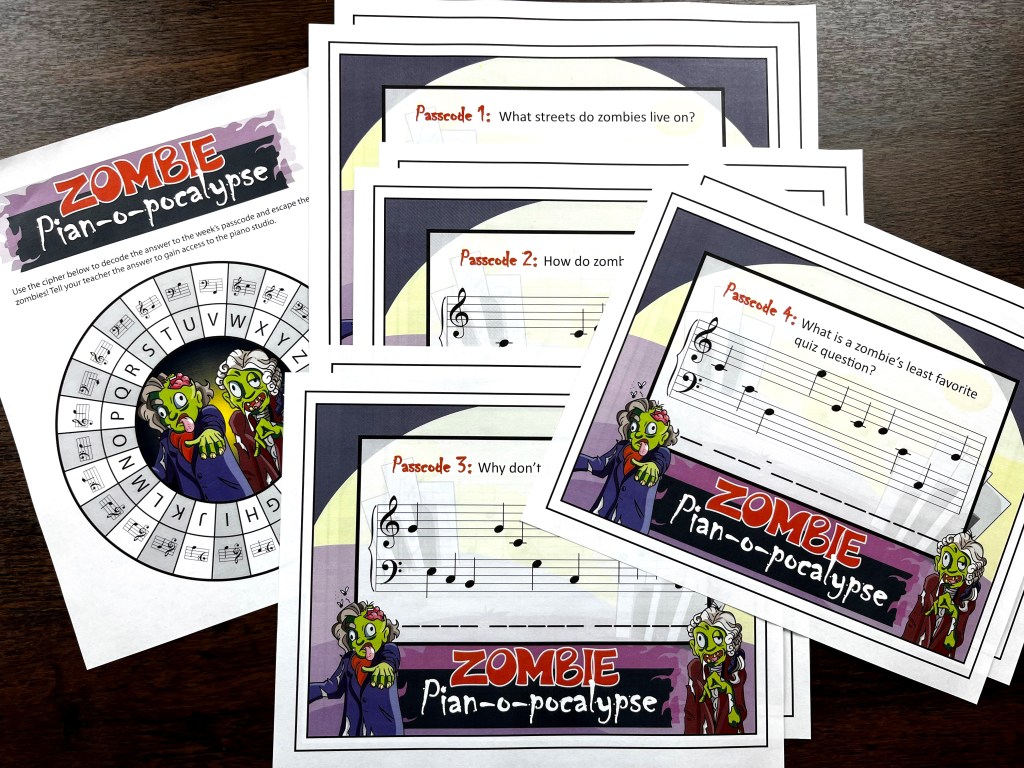
The Zombie Pian-o-pocalypse Passcode Jokes are a great way to keep the fun and learning of the pian-o-pocalypse going at home! There are 2 jokes per week, so siblings can have different jokes to work out on their own. At the beginning of the pian-o-pocalype, every student should receive a cipher. The cipher is used each week to decode the passcode. Every week, students receive a new joke to take home to figure out. They have to tell their teacher the joke when they arrive for their lessons. Even though I heard the same jokes over and over, they were still funny at the end!

The Zombie piano apocalypse passcode  which are a series of zombie jokes are spread out on a wood table along with the cipher wheel.

Games! Games! Games!

Zombie Race

Prepare for a race against the undead in this heart-pounding flashcard game! The zombies are closing in and your survival depends on your quick (and precise!) note-reading skills. Set the timer for one minute and see how many cards you can answer correctly before the zombies catch up.

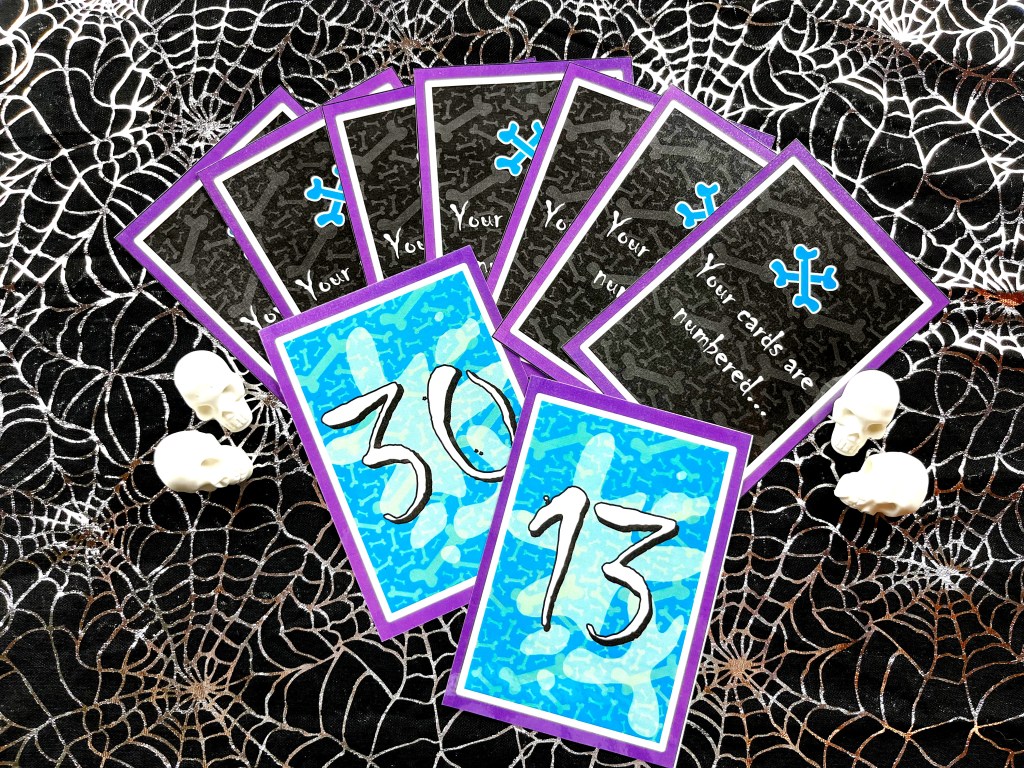
Zombie Race flashcard game is spread out on a spiderweb tablecloth.

It’s a precision test like no other because any wrong answer will count against you at the end… not to mention that the zombies have one final card up their sleeve after your minute is up. Remember, in this game, you’re not just using your brain, you are trying to safeguard it from becoming zombie lunch!

The second deck of the Zombie Race flashcard game is spread out on a spiderweb tablecloth.

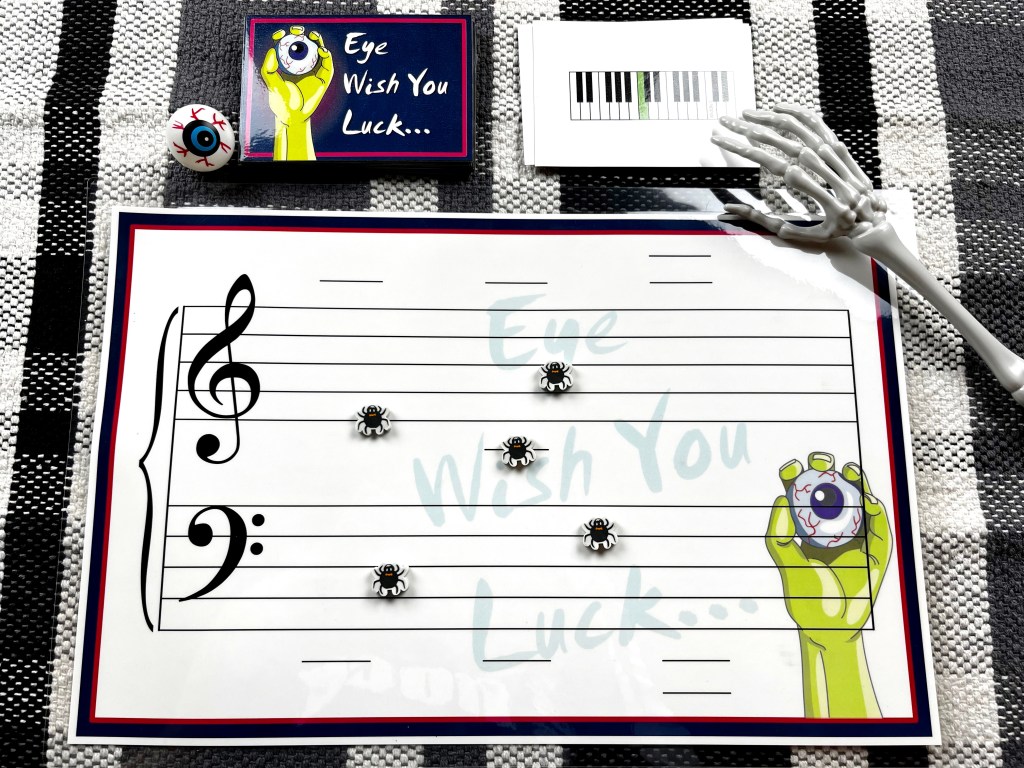
Eye Wish you Luck…

They’ve got their eyes on you. And their eyes are telling them they want you… for dinner (and not as musical entertainment)! You have a mere minute to correctly place as many notes on the grand staff as you can.

Eye Wish you Luck, the note-reading game, is set up on a black white and gray checked tablecloth. Spider erasers are used to mark note placement while a skeleton hand reaches for the next card.

As the seconds tick away, the wheel of misfortune stands poised in the wings, waiting to seal your fate with a single spin… Will it align with one of your notes or will it condemn you to the role of this evening’s featured dish?

A skeleton hand spins Eye WIsh you Luck's wheel of misfortune.

Don’t Wake the Undead

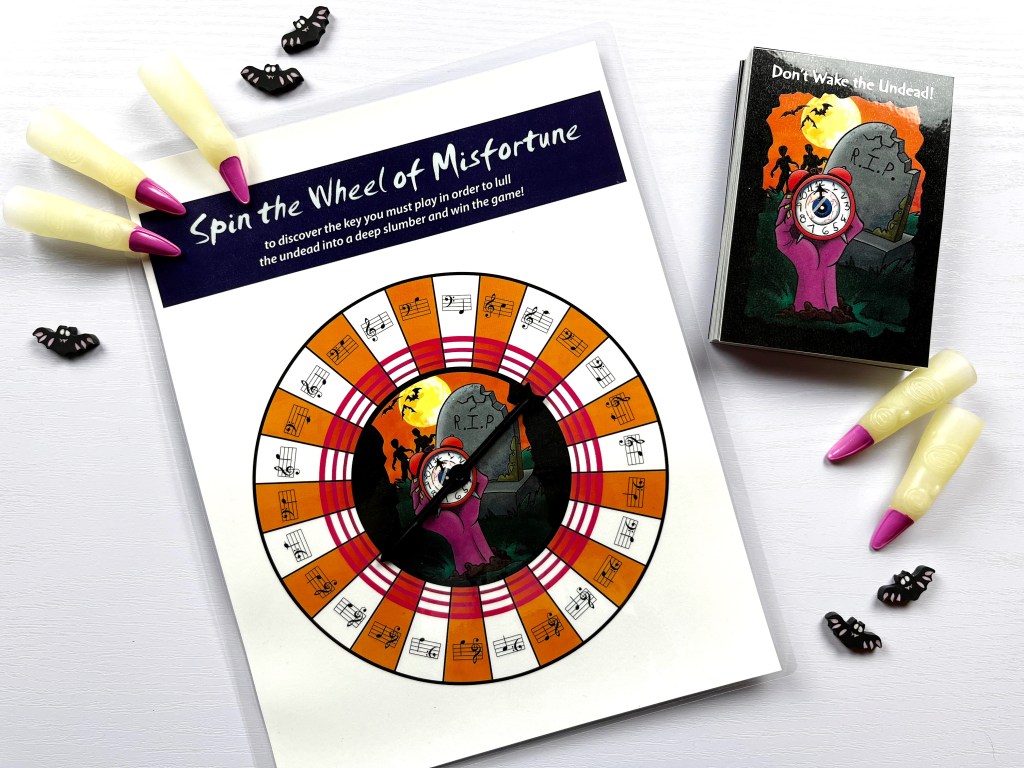
The undead are restless… and the fate of all rests solely in your hand! Students spin the Wheel of Misfortune to discover the mystical note that they must play on the piano to lull the undead back into a peaceful slumber.

A zombie finger with a pink nail spins a game spinner.

The tension mounts as students draw card after card (and play the corresponding keys on the piano), desperately seeking that magical note that will ensure their safety. But beware, the alarm clock card looms somewhere in the deck, and one flip of a card could awaken the undead for eternity!

Don't wake the undead, a note-reading flashcard game, sits on a white table surrounded by zombie fingers and bats.

Zombody needs a Match

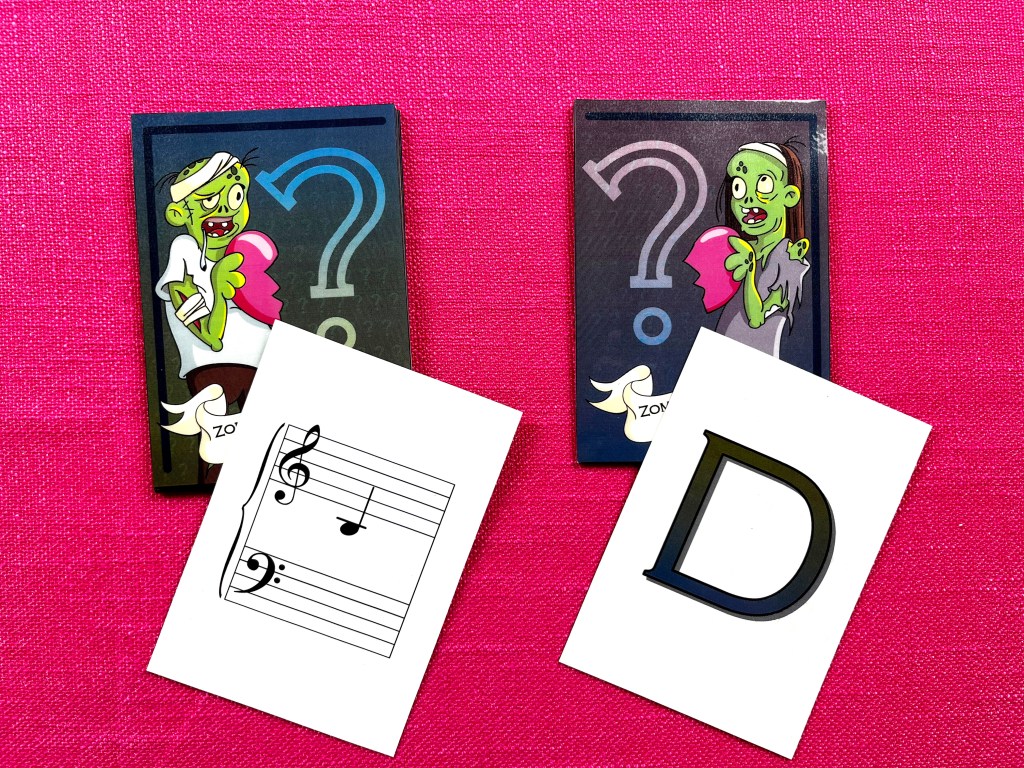
Everybody needs somebody sometime… even zombies! This note-reading matching game will have your students playing matchmaker and seeing hearts fly (literally… because, well, zombies!).

Zombody needs a match, a note-reading flashcard game sits on a pink tablecloth surrounded by little white ghosts.

Students will try to match the notes of the Boy Zombie to the letters of the Girl Zombie. Who will make the most love connections and watch the zombies limp off together into the sunrise?

A match is shown for the note-reading flashcard game, Zombody needs a match.

Explore more creative teaching ideas
  • I Can Heart-ly Wait for the Punchline
    A heart themed laugh-out-loud note reading game. I love this game because not only do students have to think about keyboard geography, they also have to be able to associate the notes with their exact location on the piano. 
  • Musical M.A.S.H
    This free printable game tests your student’s knowledge of the spaces on the grand staff. It’s a fast, easy game to play, and will predict your student’s musical future with hilarious results!
  • Chord Snowblast
    A real howler in July! Are you longing for cooler temperatures this summer? Bust out Chord Snowblast (and the mini-erasers) for a cool piano game that covers all the major and minor chords!
  • Top Practice Tools Every Piano Student should Have: #7 Mini-Erasers
    Piano students don’t need a lot of accessories to practice, but there are a few tools that make a practice session easier and more effective… and in the case of mini-erasers, so much cuter! Mini-erasers can be used in a wide variety of activities, from warm-ups to practice challenges, improvisation to fixing wrong notes, and so much more!

Let’s stay in touch, join the list!

As a “toucan” of our appreciation download a free set of note flashcards (link in our Welcome email)!
Processing…
Success! You're on the list.

We are a participant in the Amazon Services LLC Associates Program, an affiliate advertising program designed to provide a means for sites to earn advertising fees by advertising and linking to Amazon.com. As an Amazon Associate we earn from qualifying purchases.

Bonus Piano Practice Tool: Curiosity!

We’ve made our way down the list of top 7 practice tools every piano student should have and they are ALL awesome practice helpers! From pencils and mini-erasers to timers and metronomes, all of these tools help make practice time more efficient and engaging while keeping students focused on the work at hand.

But none of these tools holds a candle to this bonus entry on our list… Curiosity!

Curiosity is the catalyst that gets students to start learning the piano in the first place and can be exactly what’s needed to keep them going for the long haul!

Piano teacher sits at a table in front of a piano with her hand on her chin. A thought bubble is coming out of her head and it reads How do I stay curious?

Why is curiosity so important for practicing?


We all have a natural drive to explore, question, and understand the world around us. Curiosity can transform mundane tasks and routines into explorations. When students invite their innate curiosity into the practice room, they have the potential to infuse every note with a sense of discovery and keep practicing interesting in the long run. Curiosity also helps develop:

1. Intrinsic motivation
Curiosity comes from within and acts as a natural source of motivation. When a student is genuinely curious, they are more likely to practice regularly and enthusiastically. This intrinsic motivation fuels a student’s desire to improve and they will seek out the piano on their own.

2. Exploration and experimentation
Students who are curious are likely to try different techniques and explore different musical genres. They are excited to pull back the curtain on their favorite pieces so they can better understand the theory behind them and recreate the magic. This sense of wonder drives them to practice and helps them push past obstacles and plateaus.

3. Problem-solving skills
Curiosity can drive students to explore solutions for problems they encounter in their music (instead of just waiting for their next lesson). When faced with a difficult passage, curious students are more likely to dig deeper into the problem, analyze it and experiment with different approaches to conquer it.

4. Deep Learning
Curiosity fosters a deeper understanding of music. Curious students are more inclined to study music theory as well as history. The study of music theory helps them understand how their pieces are put together, how the different elements work together, and how to properly shape the notes on the page. Understanding history and music history allows students to understand the cultural context of their pieces which helps inform their playing and interpretation.

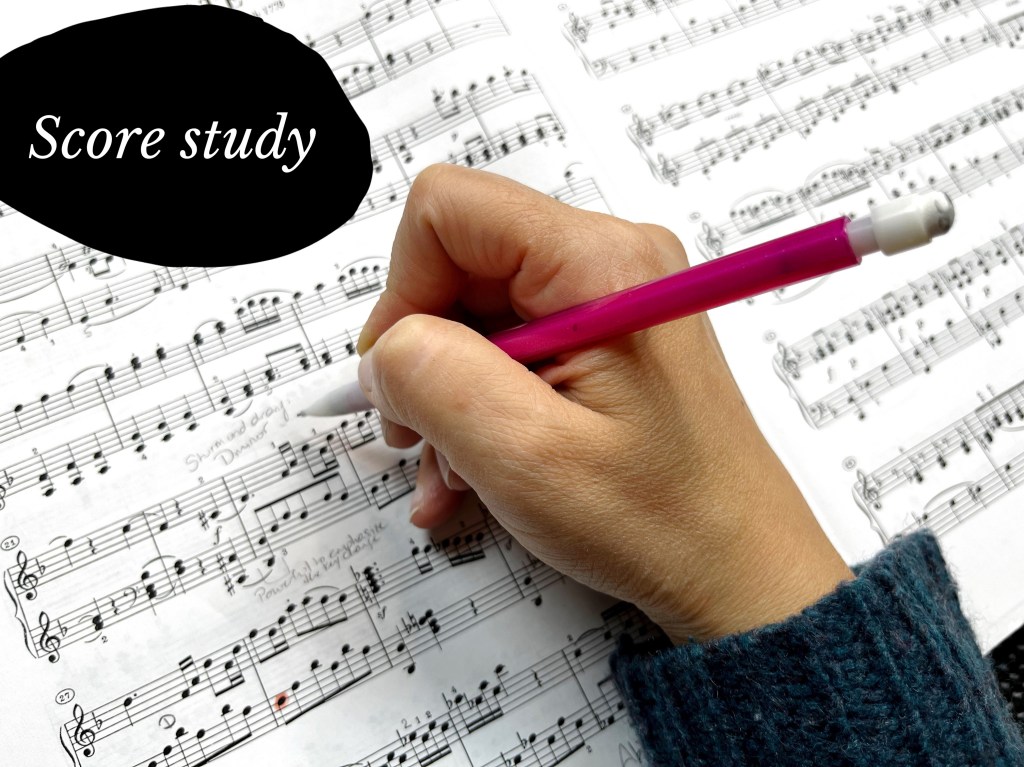
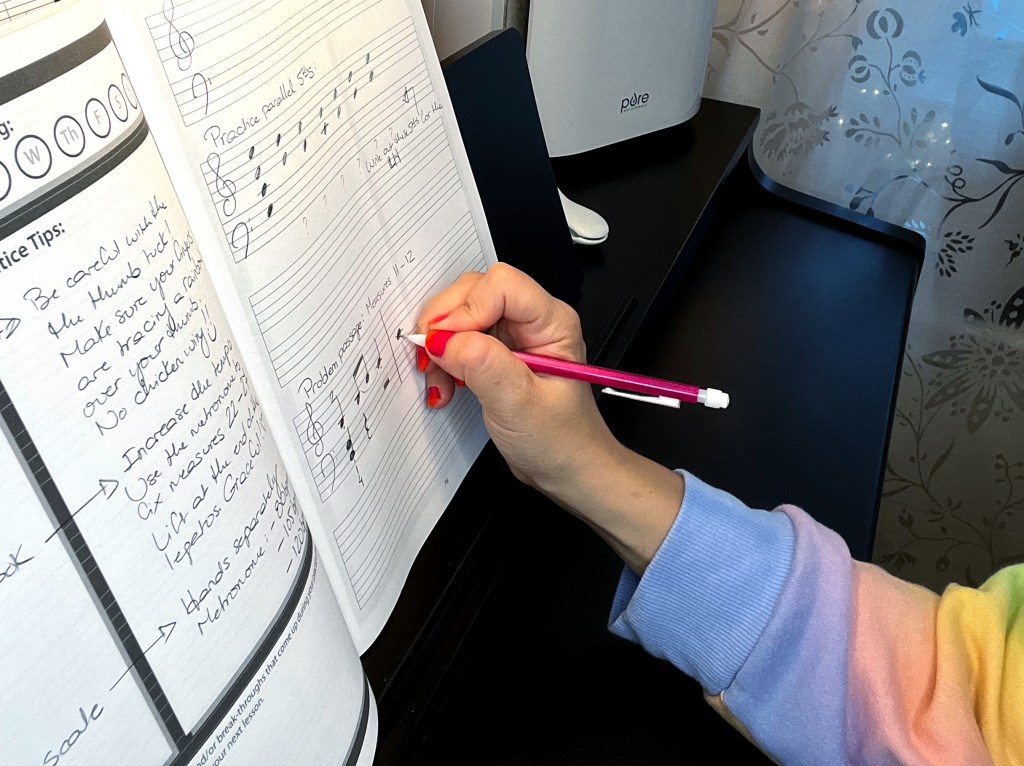
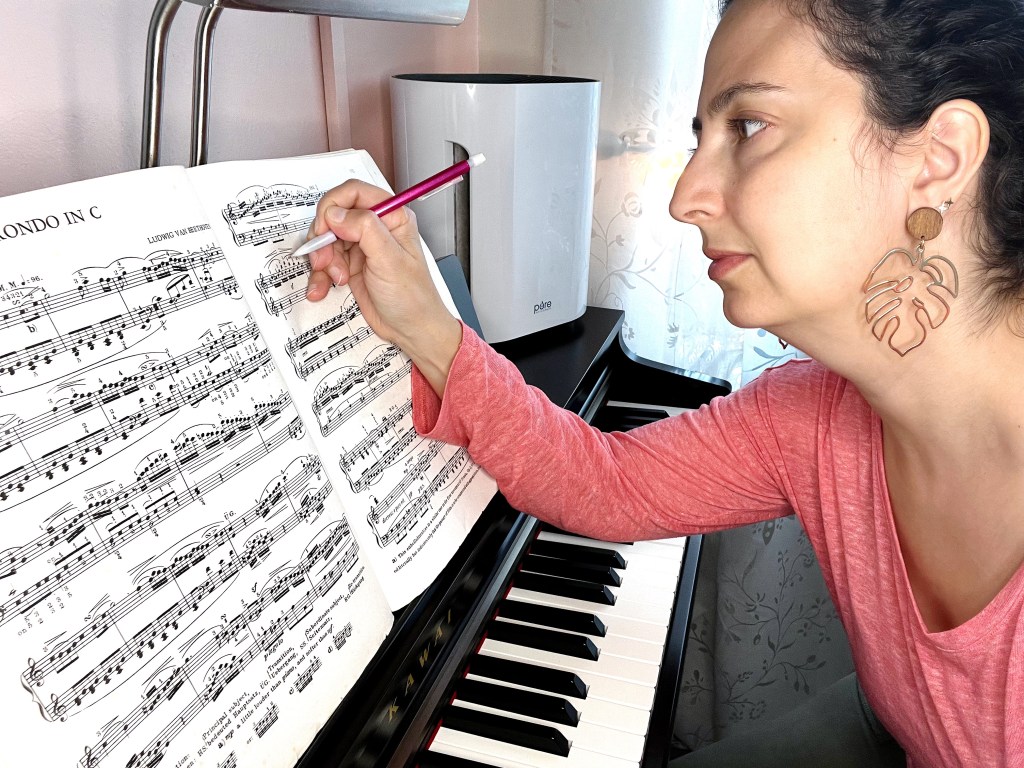
A hand holds a pink pencil as a piano students writes important practice notes on a score.

5. Growth mindset
Curious students view mistakes as opportunities rather than failures. By embracing the challenge of solving a mistake, the student is developing their critical thinking, problem-solving skills, and resilience, all of which build a student’s confidence. These skills will benefit the student in every aspect of life, not just in music.

6. Enjoyment
Curiosity makes the journey of learning an instrument not only productive but deeply fulfilling and enjoyable.

7. Adaptability
Curious musicians are more adaptable. They are more eager to learn new pieces, adapt to different playing styles, and collaborate effectively with other musicians.

Curiosity and practice feed off each other! Curiosity fuels the desire to practice and practicing satisfies the student’s curiosity by revealing new aspects of music and the instrument itself.

How can we keep curiosity alive?

Learning to play the piano is a life-long pursuit and because of this it can be hard to maintain our curiosity along the way (as is true of any long-term pursuit). But there are several things student’s (and all pianists!) can do to keep the mystery alive and continue to feel sparks in the practice room.

1. Diversify your repertoire
Exploring new musical genres can introduce new challenges to a seasoned player and reignite curiosity. These challenges can take the form of new rhythms, harmony, and/or structure which will force a student to think differently and keep the brain curious and engaged.

2. Improvise
Improvisation can be a fun way to experiment with a new technique, rhythmic motive, chord progression, etc. from a piece a student is working on. Exploring new possibilities with elements from current repertoire can lead to a deeper understanding of the intentions of the composer and can promote new discoveries and inspire creativity.

3. Collaborate
Collaboration usually starts as playing duets with a teacher, parent, sibling, or fellow piano student. These initial steps into collaboration encourages students to listen more carefully and to learn about balancing the sounds of the different players. As a student’s playing skills increase, collaboration with other musicians in a band setting or ensemble can be a way to push a student out of their comfort zone by exposing them to different perspectives, sounds, and music genres. Collaboration also provides students with a sense of community and emotional support.

A brother and sister play the piano together.

4. Attend performances
There is nothing quite like live music. Giving students the opportunity to listen to skilled musicians is invaluable. It shows a student what can be achieved if they keep working hard at practicing.

A crowd sits on a lawn watching a performer on a stage. A bubble says Go to Live music events

5. Celebrate achievements (no matter how small!)
Music lessons often do not receive the same sort of recognition as sports, dance, and other activities. Piano lessons are more closely related to school than to other extracurricular activities (although most people lump them in with the latter). In the same manner that we celebrate getting a good grade on a test or a great report card, it is SO important to recognize the progress, accomplishments, and milestones in piano practice. Did the student finish a difficult piece that they worked on for weeks? Celebrate. Did the student master a difficult passage? Celebrate. Did the student finish their book? Celebrate. Recognize progress (no matter how small) and celebrate it.

6. Read up on Music
When a student starts a new piece, take some time to explore the composer’s life, read up on the backstory of the piece, and understand the broader cultural context of the piece. It can help to enrich the student’s performance of the piece.

A parent sits on a sofa and points to Beethoven on the page of a children's story book. The bubble says Read about music.

7. Analyze and Deconstruct Music
Dive deep into the music. Analyze the composition and the elements and ideas the composer used to create the piece. This intellectual exploration can lead to new insights and fuel creative exploration.

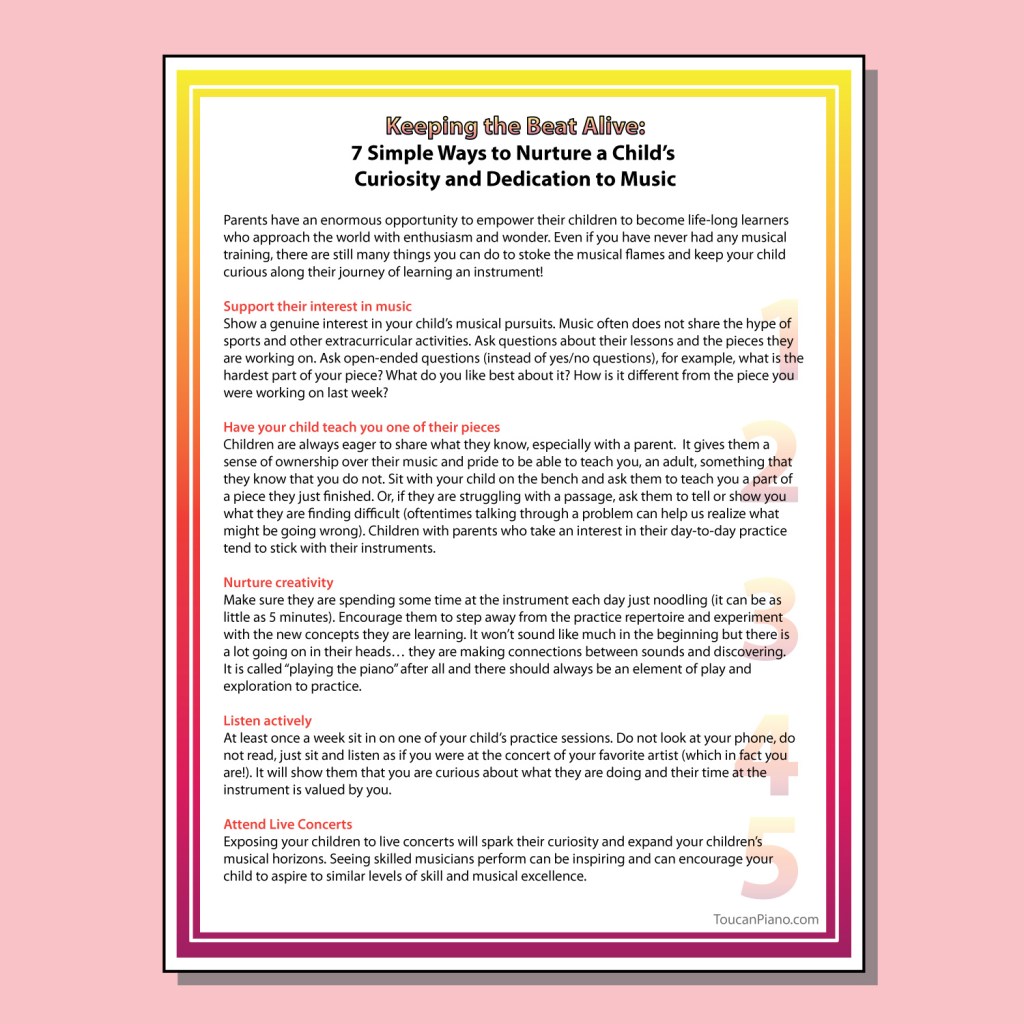
As a parent, how can I engage my child’s curiosity to help them practice?

Parents have an enormous opportunity to empower their children to become life-long learners who approach the world with enthusiasm and wonder. Even if the parent has never had any musical training, there are still many things they can do to stoke the musical flames and keep their child curious along their journey of learning an instrument!

1. Support their interest in music
Show a genuine interest in your child’s musical pursuits. Music often does not share the hype of sports and other extracurricular activities. Ask questions about their lessons and the pieces they are working on. Ask open-ended questions (instead of yes/no questions). What is the hardest part of your piece? What do you like best about it? How is it different from the piece you were working on last week?

2. Have your child teach you one of their pieces
Children are always eager to share what they know, especially with a parent.  It gives them a sense of ownership over their music and pride to be able to teach you, an adult, something that they know that you do not. Sit with your child on the bench and ask them to teach you a part of a piece they just finished. Or, if they are struggling with a passage, ask them to tell or show you what they are finding difficult (oftentimes talking through a problem can help us realize what might be going wrong). Children with parents who take an interest in their day-to-day practice tend to stick with their instruments.

3. Nurture creativity
Make sure they are spending some time at the instrument each day just noodling (it can be as little as 5 minutes). Encourage them to step away from the practice repertoire and experiment with the new concepts they are learning. It won’t sound like much in the beginning but there is a lot going on in their heads… they are making connections between sounds and discovering. It is called “playing the piano” after all and there should always be an element of play and exploration to practice.

4. Listen actively
At least once a week sit in on one of your child’s practice sessions. Do not look at your phone, do not read, just sit and listen as if you were at the concert of your favorite artist (which in fact you are!). It will show them that you are curious about what they are doing and their time at the instrument is valued by you.

A cd of Yo-Yo Ma and Emanuel Ax playing Beethoven is held up inside a car. The bubble read Listen to Music.

5. Attend Live Concerts
Exposing your children to live concerts will spark their curiosity and expand your children’s musical horizons. Seeing skilled musicians perform can be inspiring and can encourage your child to aspire to similar levels of skill and musical excellence.

6. Model curiosity
Demonstrate your own curiosity and love for learning; children often model their behavior after their parents. If the you are not familiar with the artist or the music being performed, take it as an opportunity to model curiosity and learn together with your child. In preparation for a concert, for example, get books from the library about the composer, look up the performer’s bio online, and listen to other pieces by the composer.

A dilapidated piano that once belonged to Jerry Lee Lewis. The bubble reads Learn about Music History.

7. Create activities around music
Music provides so many opportunities to get creative! Here is a short list of activities you can do with your child and the whole family:

  • Dance: Impromptu dance sessions or a planned family dance-a-thon, dancing is instinctive and allows children to physically experience the music.
  • Draw while listening to music: Let the music inspire your color and subject choices. Afterwards, talk about how the music inspired the drawings.
  • Have a sing-along or a karaoke night: This is a great way to help children naturally learn to recognize pitch variations, the contour of melodies, and expressiveness.
  • Musical storytelling: Narrate a story while listening to a piece of music. Ask your child to imagine scenes and characters based on the music.
  • Rhythm games: Use tambourines, maracas, drums to play rhythm games. Create rhythmic patterns for other to play back. Try to mimic rhythms from songs you know or even play along with the songs.
  • Music and nature: Read about the composer Messiaen and his use of bird songs in his music or listen to pieces inspired by nature (like Beethoven’s Pastoral Symphony). Take a nature walk and encourage your child to identify different sounds: birds singing, leaves rustling, water flowing, the wind blowing. Talk about how those sounds could be recreated on the piano.
  • Musical puzzle: Cut up a copy of your child’s current piece and see if they can piece it back together.
  • Add lyrics to a piece your child is learning: Work together to come up with words for your child’s current practice piece. You will be surprised at how much this will help your child learn their piece (and you are creating a special memory together!).

If you would like to receive a printable to share with your piano families on how parents can help their children stay curious in their musical journey, click here!

Check out our top 7 practice tool every piano student should have:

The top 7 practice tools every piano student should have. Be sure to check out the blogposts for the other six practice tools that made my list:

Explore more creative teaching ideas
  • Rainbow Manuscript Paper
    This colorful manuscript paper is available in the Toucan Piano shop as a free printable! They are available in three sizes, so they can be used for a variety of ages and activities, like writing out original compositions, explaining music theory concepts, music dictation, games, and so much more!
  • Compose a Ringtone
    Ringtones are helpful but what if we could make them special too?! This is a fun and quick project that even the most reluctant students can get behind.
  • Chord Snowblast
    Build chords and collect points while trying to avoid the snow blast! Kids will test their knowledge of building chords AND they will actually be hoping to get all the chords with sharps and flats!!

Let’s stay in touch, join the list!

As a “toucan” of our appreciation download a free set of note flashcards (link in our Welcome email)!

Processing…
Success! You're on the list.

We are a participant in the Amazon Services LLC Associates Program, an affiliate advertising program designed to provide a means for sites to earn advertising fees by advertising and linking to Amazon.com. As an Amazon Associate we earn from qualifying purchases.

Top 7 Practice Tools Every Piano Student Should Have: #1 The Pencil

Piano students don’t need a lot of accessories to practice… a quality instrument and sheet music is enough! But there are a few tools that make a practice session easier and more effective.

I’m counting down my Top 7 Piano Practice Tools I think every student should have when they are on the bench (plus a bonus one at the end that you might not expect!).

We’ve reached our number 1 position, the top practice tool every piano student should have! Without further a-do, coming in at number 1 is:

The Pencil

Yes, the humble pencil is the number one, absolutely essential, most important practice tool a piano student can have… and that’s true of all instruments actually! No musician or aspiring musician should be without a pencil when practicing. If I had to pick only one tool to use forever when I practice, it would be the pencil.

No musician or aspiring musician should be without a pencil when practicing.

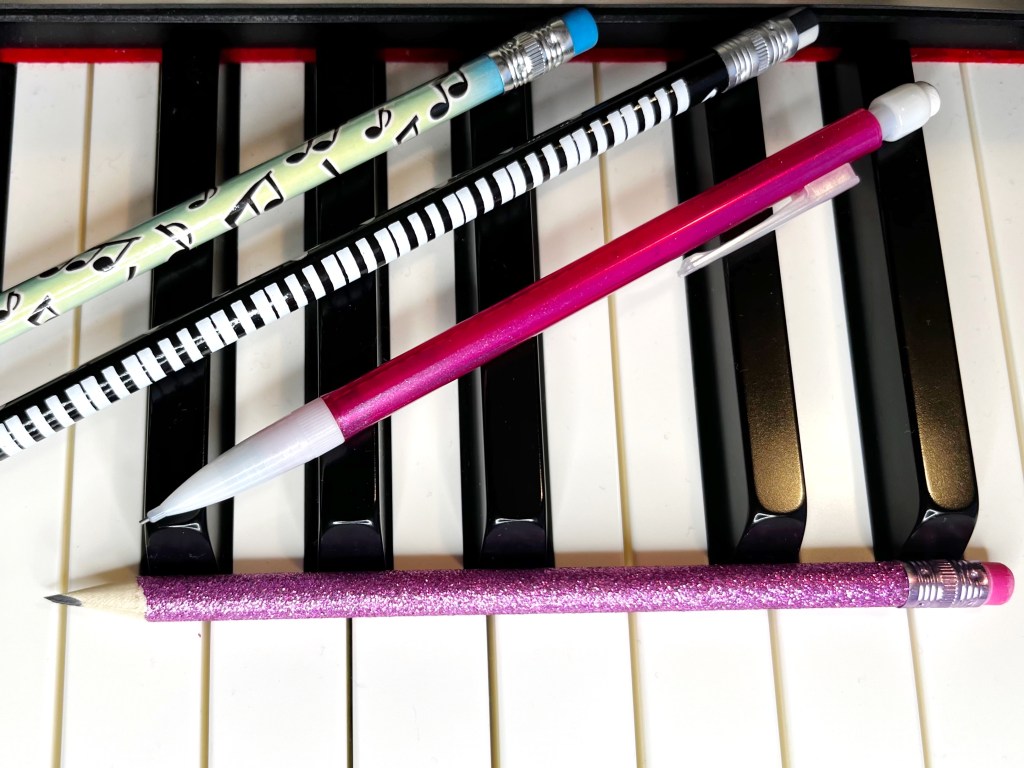
Pencils lay on top of piano keys.

As mundane as it may sound, a pencil should always be available at the piano. It can be used to:

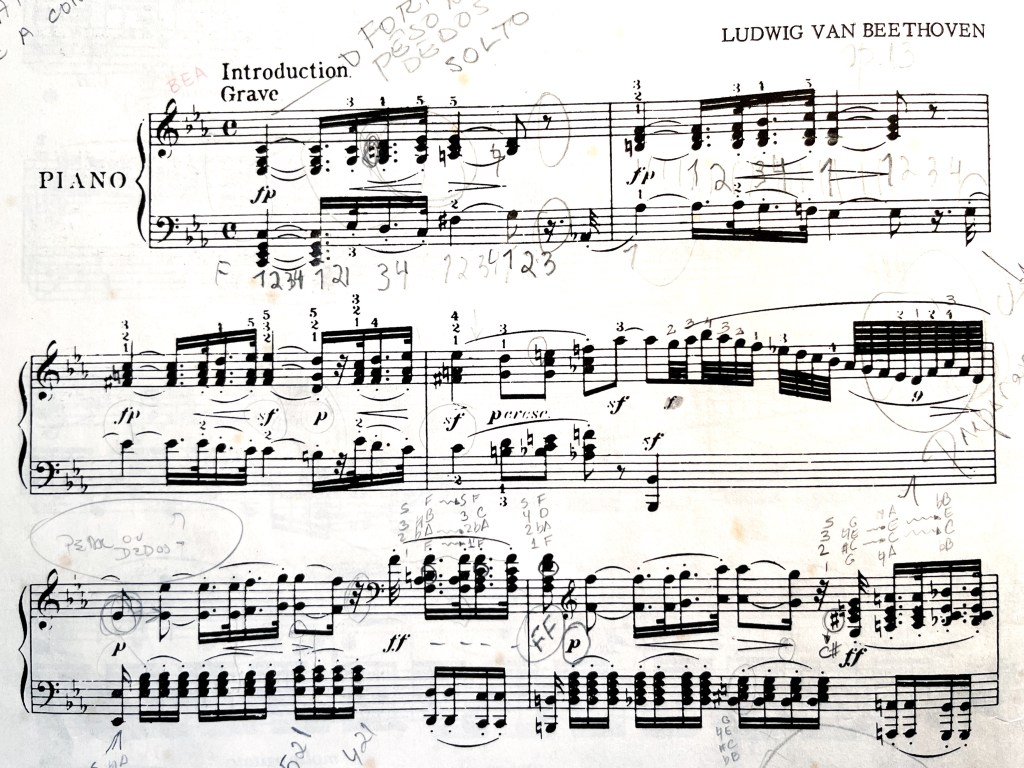
  • Write in or circle notes that need fixing
  • Write in the proper rhythmic counting
  • Section off measures or phrases that need extra practice
  • Circle dynamic markings that need to be incorporated
  • Refine the pedal markings to get the desired sound for a passage
  • Write in performance reminders
  • Write in ornamentation
  • Keep track of repetitions (especially for younger and beginner students)
  • And this list could go on and on!

We like to think that we can keep track of everything… I had a student who HATED seeing any marks on her sheet music. Her music was pristine, but her playing was not. She took a lot longer to learn her pieces because she refused to add in any reminders for herself. She eventually came around and now make her own notations on her score.

Music score with lots of penciled instructions for practicing the piece by Ludwig van Beethoven .

Our brains just don’t work that way when we play… We need visual cues to remember to fix things. The brain tends to cling to what it learned first ALWAYS. I once read a famous piano pedagogue comment that the most important time you play a piece is the first time. It sets the sound image and the mechanics for the piece in your brain and can be a hard thing to change. He would spend a considerable amount of time with the score, studying it thoroughly, before playing a single note on the piano. It’s an extreme case but not without its merits.

The visual cues we give ourselves with our pencil notations in the score help override that initial impression of the music our brain clings to. The pencil notations wake up our brain and remind it that it needs to fix and work on things in the music.

Pencil Exercise for Piano Posture!

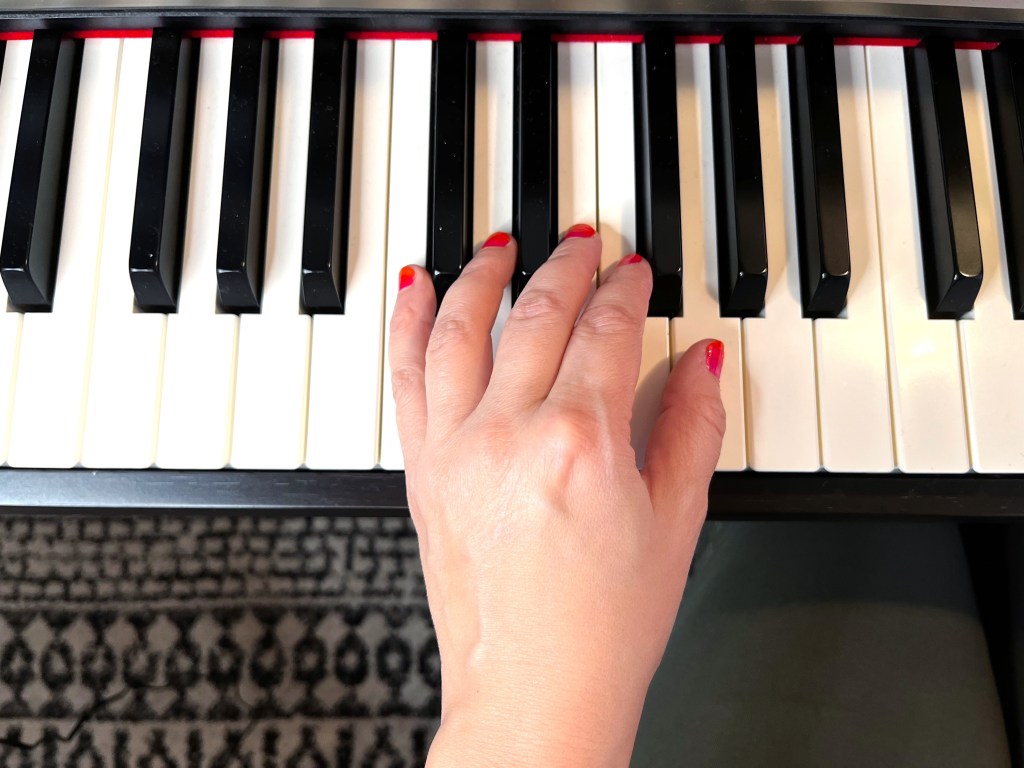
An additional use for the pencil for beginner and younger students is when working on proper hand posture. Students starting out playing the piano oftentimes have difficulty keeping the palms of their hands parallel to the keys. When this happens, the hand ends up tilting towards the pinky which makes the pinky play on its side (I call it “Sleeping Pinky Position”) instead of on its tip.

A hand sits on the piano with a bad hand posture which is forcing the pinky to sit on its side.

But what’s wrong with a “Sleeping Pinky”?! We all get tired now and again… Good question! A student may not run into much trouble with the Sleeping Pinky Position at the beginner level when the hands stay in one position and the music is pretty slow. As the tempo and complexity of the music increases and the hands are required to move around the piano (thumb tucking, leaps, stretches, etc.) the hand will not be as nimble as it needs to be. It’s like a runner only running with one foot while dragging the other foot. The student will also not have the control required over the hand for more nuanced playing and incorporating the forearm, upper-arm, shoulders, and wrist properly when playing.

Sleeping Pinky Position also brings along its boisterous cousin, Pinky Karate Chop. Students who play in a Sleeping Pinky Position will tend to play the 5th finger as a Karate Chop, especially when playing forte. It makes every piano teacher squirm when they see a Pinky Karate Chop on their piano.

A hand karate chops the piano because of poor hand posture.

But don’t worry, our main practice squeeze, the pencil is here to save the day!

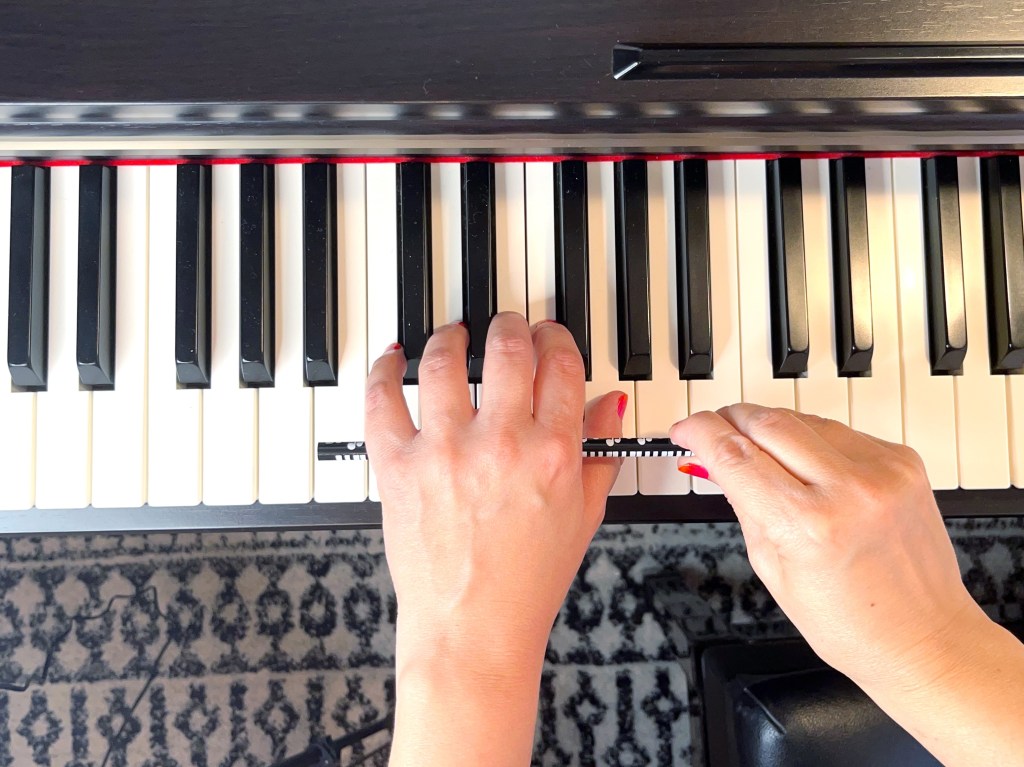
A great exercise when working on hands separately is to place and hold the pencil under the knuckle bridge of the hand. By doing this, the hand will not be able to tilt towards the pinky and the pinky will play on its tip. A student should do a few repetitions of their piece or sections each day with the pencil and then a few repetitions without the pencil to see if they can keep their hand in the proper position. Over time, the hands will learn the proper posture when playing and the pencil can go back to its main job of writing!

The right hand holds a pencil under the left hand to support the left hand so it can keep a proper posture at the piano.

Pencil Exercise for Rhythm!

If the student gives themselves the small luxury of having more than one pencil at the piano when practicing, then they can also work on rhythm!

The pencils make great drumsticks and a student can tap out the rhythms of the right hand, the rhythms of the left hand, and the rhythms of both hands with the eraser side of the pencil on the fall board of the piano. It’s a fantastic exercise to work out tricky rhythms in the music, to work on coordination problems between the hands, and fix any rhythms that are being played incorrectly..

Each hand holds a pencil and taps on the fallboard of the piano like drumsticks to work on rhythm exercises.

Tapping out the rhythms with the pencils, allows the students to focus on one single aspect of the music: rhythm! It removes the layers of pitch, individual finger movements, technique, dynamics and phrasing and allows the brain to work out the foundation of the piece or passage.

I often tell my students that learning a piece is like building a house. There are certain aspects of construction that give the house its shape and other things that make it look like a house. The foundation of our musical house is rhythm. If the foundation is not solid, the house will not stand. If the rhythm is off, the piece will not sounds right, no matter if you play all the correct pitches with the proper phrasing, dynamics, pedaling, and all the bells and whistles. Rhythm is key.

Taking time to work out the rhythms of a piece is of fundamental importance and using the pencils and drumsticks makes rhythm practice a little more appealing especially to younger students (who am I kidding?! Everyone gets a kick out playing the drums!).

Pencil Exercise for Expressive Playing!

Most students, when starting out on their piano journey, think that playing the piano is purely an exercise for the fingers. In reality the fingers are the final conduit of a joint effort by the entire body. The shoulders, arms, and wrist are just as important as the fingers in achieving a beautiful sound from the piano.

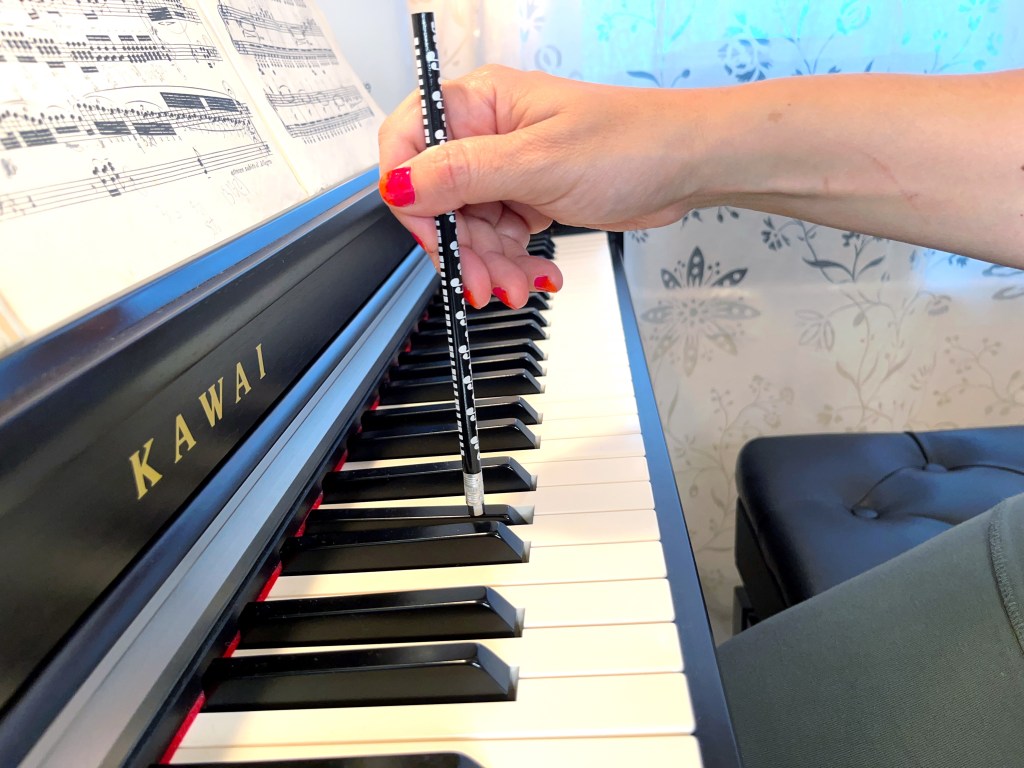
A great way to work on arm and wrist technique is to use a pencil. Instead of using their fingers, a student can practice playing the melody of their piece with the eraser end of the pencil. In order to make the melody sing, the student will quickly realize that they are going to have to do a lot more with their arm and wrist than they expected!

A piano student uses the eraser end of a pencil to play the piano.

By shaping the melody of the piece with the pencil, the student can focus on the movements the arms and wrist need to perform in order to achieve the desired sound. Removing the “distraction” of having to play the melody with the individual fingers, allows the brain to focus on the larger movements the body needs to make to shape the melody.

Once the student is consistently achieving a good sound with the pencil, they can try to reproduce that same sound with their fingers, now equipped with a stronger sense of the roles the arms and wrist will need to play.

And there we have it!

The top 7 practice tools every piano student should have. Be sure to check out the blogposts for the other six practice tools that made my list:

Next up is a bonus tool that is essential for effective practicing!

Explore more creative teaching ideas
  • Don’t Miss a Beat!
    This fun, multi-level game grows with your students as they learn more and more rhythms. Students will have to use their knowledge of rhythm note and rest values as well as time signatures to fill in the missing rhythms on each card. It can be played in private or group lesson settings!
  • Sweet Words
    Students will have fun reading the notes on the staff (or naming the white keys on the piano) to try to fill in the missing letters of their sweet word(s) first. 
  • Two Sides of the Same Coin
    A game about enharmonics that can be played in several different ways! Students will try to collect the most enharmonic pairs and hope that their coins don’t get stolen by another player.

Let’s stay in touch, join the list!

As a “toucan” of our appreciation download a free set of note flashcards (link in our Welcome email)!
Processing…
Success! You're on the list.

We are a participant in the Amazon Services LLC Associates Program, an affiliate advertising program designed to provide a means for sites to earn advertising fees by advertising and linking to Amazon.com. As an Amazon Associate we earn from qualifying purchases.

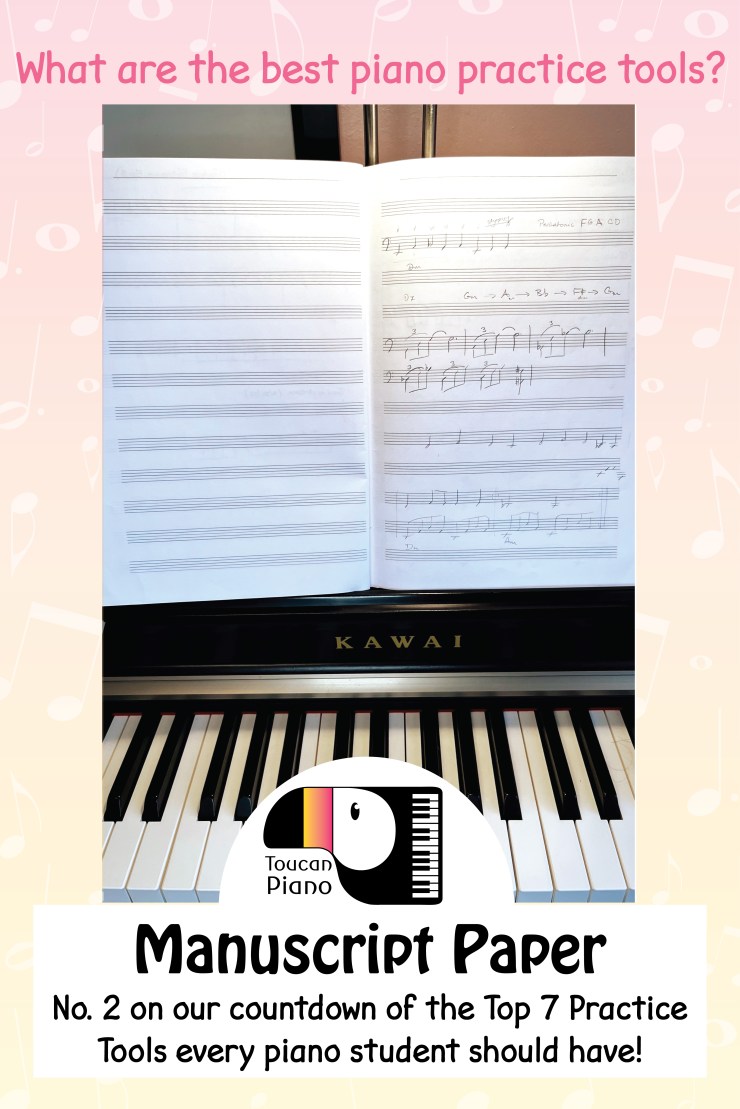
Top 7 Practice Tools Every Piano Student Should Have: #2 Manuscript Notebook

Piano students don’t need a lot of accessories to practice… a quality instrument and sheet music is enough! But there are a few tools that make a practice session easier and more effective.

I’m counting down my Top 7 Piano Practice Tools I think every student should have when they are on the bench (plus a bonus one at the end that you might not expect!).

Coming in at number 2 is:

The Manuscript Notebook

Manuscript notebooks come in all shapes and sizes, with large print staffs or smaller staffs, with plain serious covers or funky color-filled covers. But one thing can be said about all of them: they are essential for effective, goal-oriented practice!

Piano teacher sitting in front of a piano and grand staff whiteboard, holds up different types of manuscript paper notebooks in a variety of colors.

Why not just use a regular notebook?! You most certainly can, but there are many advantages to using staff paper instead of regular lined paper as we will see below.

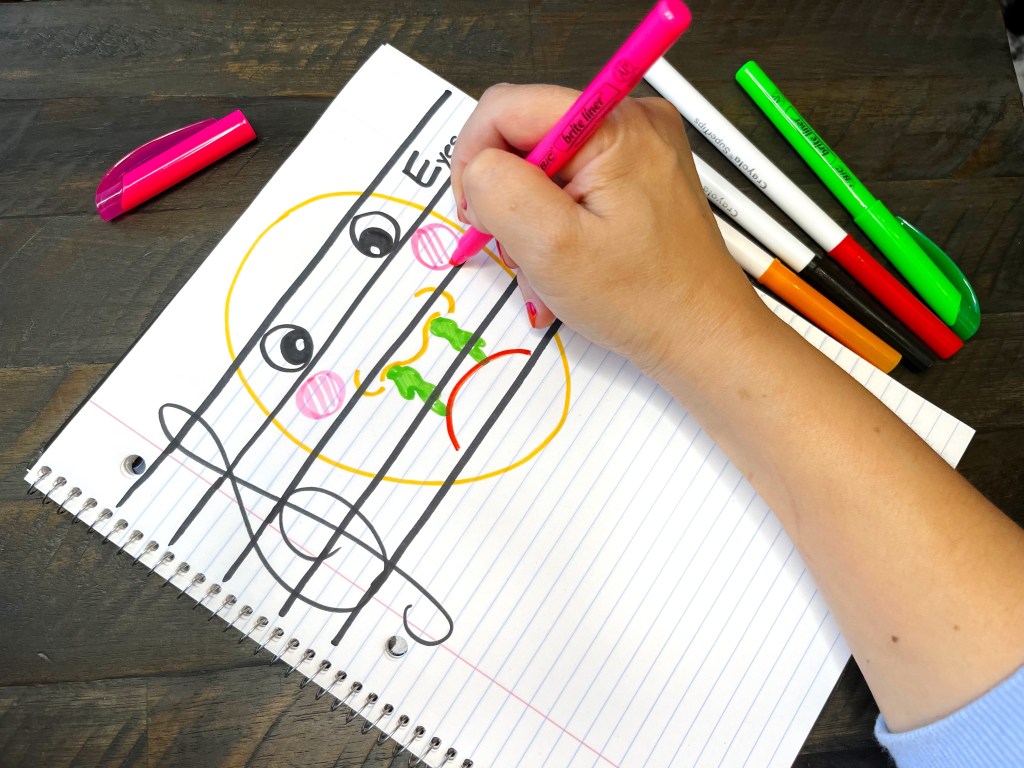
I do have one instance where I prefer to use regular notebooks and that is with younger beginner students. For them I choose a wide-ruled composition notebook. The reason is that it is just plain easier for them to read! I tend to draw a lot of pictures in the earlier stages of learning the piano to help them remember concepts, the names of rhythm notes and rest, rote pieces, and new notes on the grand staff. It gives us a lot more space for creativity and color which helps young minds learn better.

Piano teacher draws a boogery face on the treble staff in a composition notebook.

I do have one instance where I prefer to use regular notebooks and that is with younger beginner students. For them I choose a wide-ruled composition notebook. The reason is that it is just plain easier for them to read!

When I need a sheet of manuscript paper for my younger and beginner students I turn to the Toucan Piano Manuscript Paper and Rainbow Manuscript paper. I print out a few sheets for their binders and we are good to go! The manuscript papers are available in the Toucan Piano shop as free printables.

Piano student using rainbow music manuscript paper to write out a composition.

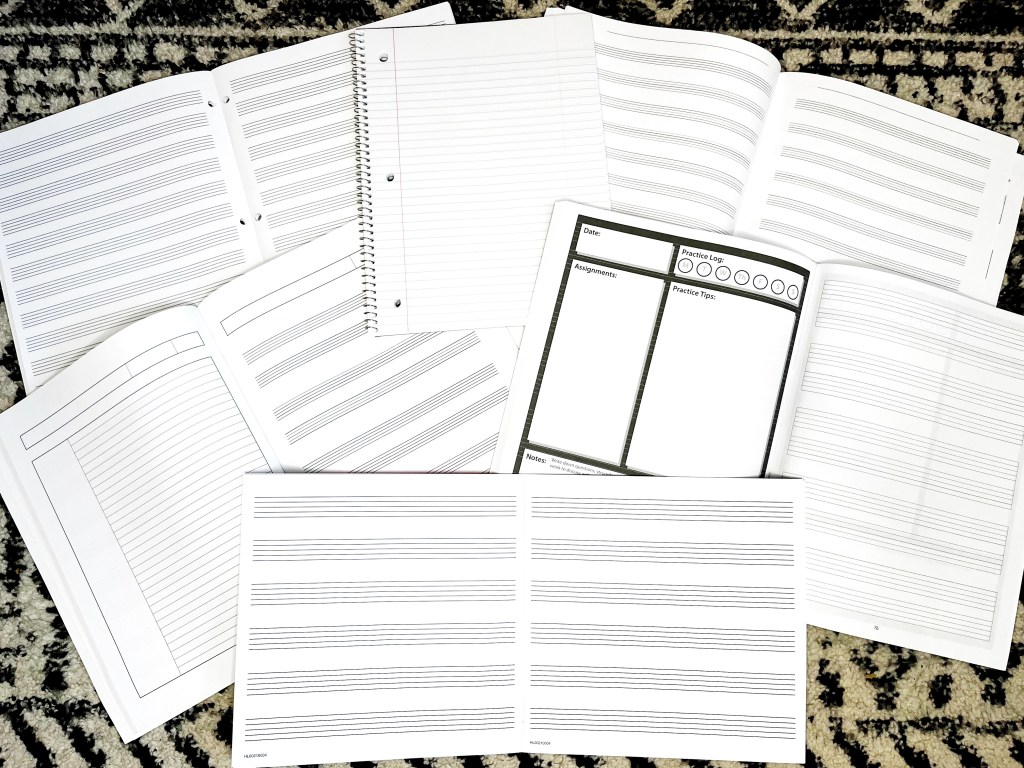
For all other students I prefer to use a manuscript notebook. Here are a few different ones I’ve used in the past with both my students and for my own personal practice:

  • Piano Practice Journal – This is the practice journal I use with all of my students. The weekly spread allows me to write out assignments on one side and the manuscript paper on the other side give me plenty of space to write personalized exercises for each student. It has 52 weeks of spreads so it lasts the full year.
  • Wide Staff Manuscript Paper – This is the notebook I give every single student I teach when they are ready for a manuscript notebook. It gives us more space to work out composition ideas. 8.5″ x 8.5″, 32 pages, 6 staves per page, the paper quality is excellent, and the staff is nice and wide which makes it easer for small hands to write on. The binding is stitched so it lays flat and can be bent over on itself.
  • Blank Sheet Piano Music Notebook for Kids – I’ve had students receive this notebook as a gift and we’ve used it for lessons as well. It is another excellent option for wide staff paper (plus is larger than the previous one I mentioned). 8.5″ x 11″, 100 pages, 6 staves per page (already set up as 3 grand staffs with clefs)
  • Standard Manuscript Paper – This notebook is the next step up from the wide staff option (8.5″ x 11″, 64 pages, 12 staves per page). It’s excellent for intermediate and advanced students. It comes punched so that it can fit inside a three-ring binder. The binding is stitched so it lays flat and can be bent over on itself.
  • A4 Large Print Music Staff Notebook – This is the one I use for writing out my own ideas for compositions. It is 8.3″ x 11.7″, 110 pages, with 12 staves per page.
  • Music Theory Notebook – This is the one I use for my own personal practice. I love how it has one page of regular notebook paper next to a page of music manuscript paper. It gives me an enormous amount of flexibility in working out practice ideas for my music. 8.5″ x 11″, 102 pages. This is a great option for advanced students or pianists working independently.
Manuscript notebooks and practice journals lay open on the a black and white rug.

Although you could choose to use a digital software for music notation and an app for a practice journal, I am a strong believer in putting pencil to paper. I think students think and learn more effectively when writing things out as opposed to typing or clicking the notes on the staff with a mouse. I never recommend digital options for a practice journal until students are playing at an advanced level.

I think students think and learn more effectively when writing things out as opposed to typing or clicking the notes on the staff with a mouse.

Let’s get down to the nitty-gritty of why a manuscript notebook has won my number 2 spot on my list of Top 7 Piano Practice Tools!

Manuscript Notebook as a Communication Tool between Student and Teacher

Creating the habit of using a manuscript notebook or practice journal usually starts as a communication tool between student and teacher. The teacher will use the notebook to write down weekly assignments plus specific instructions for what the student should be practicing each week. This can include warm-ups, technical exercises, and repertoire. The teacher may also add in practice tips and reminders that may have been discussed during the lesson time.

Piano teacher writes practice instructions in a student's practice journal.

The student should make a habit of going over all the instructions in the notebook each day when they sit down to practice to make sure that they are working on all the specifics outlined by the teacher. The student can also use the notebook to write in comments about things that went well or not so well during their practice time to go over with their teacher during their next lesson. The student can also write down questions that came up during their practice time that they need to ask their teacher.

The student should make a habit of going over all the instructions in the notebook each day when they sit down to practice.

When used this way, the notebook can be an invaluable tool to achieve great results at the piano.

Manuscript Notebook as a Practice Journal

As a student grows in their skills and maturity, the notebook will evolve into a practice journal. Keeping a practice journal can help students stay organized, track their progress, and make the most of practice sessions especially if they are working independently.

A piano practice journal lies open showing all the practice instruction the piano teacher wrote out for the student.

At this level a student can choose between a physical notebook and a digital option. It comes down to a matter of personal preference. Whatever the student finds most effective for their own personal style of note-taking and journaling should be used.

How do you set up a practice journal? It’s easier than you’d think and it really comes down to what you are focusing on in your practicing. But here is an outline for setting up your practice journal:

  1. Choose a journal: Whether it be a manuscript notebook or a digital app, it should be something dedicated to your practicing and easy to take notes (so that you will actually do it!).
  2. Create sections: There are as many ways to set up a practice journal as there are people on the planet! Ask yourself a few questions before diving in: how do you want to track your goals (daily, weekly, monthly)? How do you want to log in your practice sessions (a chart to color in the days, a page in the journal dedicated to each day)? Do a quick online search for “Bullet Journaling” and you will find a multitude of ideas to make the journal of your dreams. Although I love scrolling through all the beautiful bullet journal spreads, I know that for me, what works best is simplicity. I map out my week, listing what I would like to work on based on the previous week and anything new that popped up.
  3. Set Goals for your Practicing: Dedicate a spot in your journal to write out your goals. They can be both short-term goals (“I want to work on the first two pages of Beethoven’s first movement of the Tempest sonata this week.”) and long-term goals (“I want to improve my trills.”). Be specific about your goals (“I want the be able to play the first movement at tempo by the end of the month.”) and come up with a plan to achieve them (“I need to learn 3 new measures each day in order to play the whole movement at a comfortable practice tempo by the 15th of the month.”).
  4. Take Notes during your Practice Sessions: Write down important details from each practice session: the date, the duration, specific pieces and exercises you worked on, problem spots you ran into, questions you need to answer, breakthroughs and challenges you overcame. Your notes will serve as discussion points for your next lesson with your teacher.
  5. Reflect and Assess: You should dedicate a little time either after every practice session or weekly to assess your progress and how close you are to achieving your goals. You can take this time to adjust your timeline for your goals and write down additional ideas to explore to help achieve your goals.
Piano student sits at a piano and writes out observations in her practice journal.

The practice journal, very much like a personal journal, can be a wonderful tool of self-reflection and personal growth if used faithfully. It is a safe and non-judgmental place for musicians to explore practice ideas and techniques, set goals for themselves, and have a clear view of their progress (or even lack thereof which may indicate a need for a change in approach or direction).

 Manuscript Notebook as a Troubleshooting Tool

One thing I strongly encourage students to do when they come across a difficult passage in their music is to copy it in their practice journal or manuscript notebook. As I mentioned above, I believe in the power of putting pencil to paper and it is amazing how much students discover when they take the time to copy out a problem passage. They usually notice details that they hadn’t initially noticed, they realize which notes they are playing incorrectly, and they pay more attention to the rhythms.

It is amazing how much students discover when they take the time to copy out a problem passage.

Piano student copies out a problem passage in their practice journal.

Once a passage is completely understood intellectually, the student can then make a list of different strategies to try out in order to fix the problem. This can be done with the aid of their teacher or by themselves if they encounter the problem between lessons. They can then cross out solutions that didn’t work and comment on ones where they saw improvement in their playing. It’s a great way to foster creativity in their practicing and also become more aware of how different practice ideas play out at the piano.

Manuscript Notebook as a Tool for Analysis and Creativity

I encourage students to copy passages from their music that they really enjoyed (much like writing down quotes you like from books!). Then I ask them to do a little bit of analysis on the passage to see if they can discover what exactly made the music pull at their heartstrings.

Piano student analyzes a passaged of music in their practice journal.

The results of their analysis can be a launching board for slew of creative improvisation and composition activities! For example, if they really loved a specific chord progression that the composer used, they can spend some time during the week playing around with the progression and creating melodies on top of it. They can use their notebook to write down anything in particular that they really liked.

And there we have it!

The number 2 practice tool every piano student should have. Be sure to check out the previous blogposts for other practice tools that made my list:

Next up is the Number 1 Practice Tool that is absolutely essential for effective practicing!

Explore more creative teaching ideas
  • Manuscript Paper
    This manuscript paper is available in the Toucan Piano shop as a free printable! They are available in six sizes, so they can be used for a variety of ages and activities, like writing out original compositions, explaining music theory concepts, music dictation, games, and so much more!
  • Rainbow Manuscript Paper
    This colorful manuscript paper is available in the Toucan Piano shop as a free printable! They are available in three sizes.
  • Compose a Ringtone
    Ringtones are helpful but what if we could make them special too?! This is a fun and quick composition project that even the most reluctant students can get behind.

Let’s stay in touch, join the list!

As a “toucan” of our appreciation download a free set of note flashcards (link in our Welcome email)!

Processing…
Success! You're on the list.

We are a participant in the Amazon Services LLC Associates Program, an affiliate advertising program designed to provide a means for sites to earn advertising fees by advertising and linking to Amazon.com. As an Amazon Associate we earn from qualifying purchases.

Top 7 Practice Tools Every Piano Student Should Have: #3 Metronome

Piano students don’t need a lot of accessories to practice… a quality instrument and sheet music is enough! But there are a few tools that make a practice session easier and more effective.

I’m counting down my Top 7 Piano Practice Tools I think every student should have when they are on the bench (plus a bonus one at the end that you might not expect!).

Coming in at number 3 is:

Metronome

I think everyone saw this practice tool coming from a mile away… ticking, ticking, ticking… growing louder and louder as we worked our way down the list of practice tools! It was inevitable. It’s the tool every piano student loves to hate, but can be SO helpful when used correctly!

Students are often reluctant to use the metronome because of its unrelenting ticking. The metronome waits for no one! It exposes our weaknesses and highlights our mistakes… and who enjoys that?!

Piano student facepalms herself as the metronome shouts out, "Wrong!!" because that she made a mistake.

If we give the metronome a strategic purpose in our practicing and start to look at it as more of an ally than a bully, we will discover how helpful it’s actually trying to be. So it’s important then to help students become comfortable with the metronome from the very first lessons, that way they will be more confident in using it on their own during their practicing.

I believe metronome practice should be like surgery. You use it to fix the problem and then get out. Don’t allow yourself to linger too long with the metronome. Overuse of the metronome tends to make our music sound mechanical, with no real flow or expression.

A metronome is wearing a blue surgical mask and a banner below it says, "The Doctor is in!"

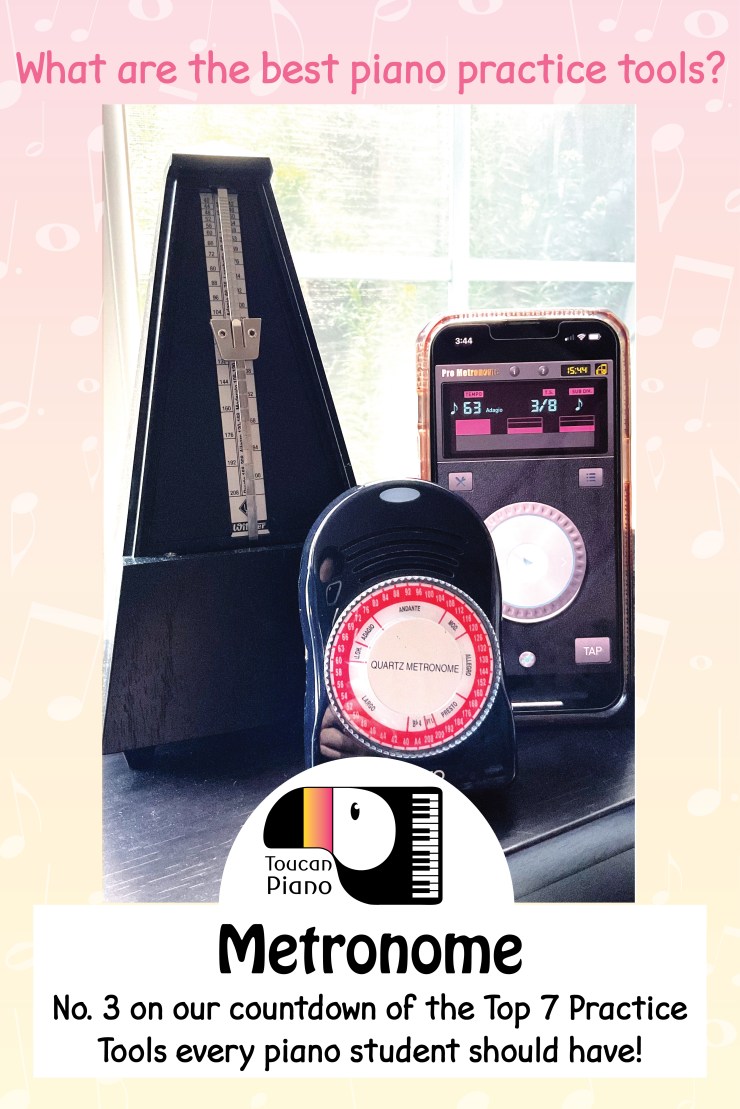
I use metronomes in all forms… analog, digital, app-based! Here are the metronomes I use in my teaching and personal practice:

  • Wittner 903304 Metronome: This one works beautifully and looks nice to boot! It’s the most expensive of the metronomes on this list, but not as pricey as a real wood metronome.
  • Seiko SQ50-V Metronome: I love this metronome!! It’s the one I usually use during lessons, it’s the one I recommend to parents, and it’s the one that I’ve purchased for a children’s music program I run at my church. It’s keeps great time, it’s reliable, and very easy to use.
  • ProMetronome: This is app available for free (in-app purchases) in the Apple Store or Google Play. You can change the sounds of the individual beats and even silence certain beats. You can set the tempo by tapping, turning the dial, or typing in the number you want. You can also change the time signature. The paid version includes beat subdivisions, polyrhythms, rhythm trainer, and more.

Once students are familiar with the metronome and understand how to play along with it, a fun app to try out is SuperMetronome Groovebox Pro (paid app in the Apple Store). This app allows students to create backing tracks to play along with. It can help add a little spice and an element of fun to practicing with the metronome.

So how can we strategically use the metronome in our lessons and practicing? Here are some different ways you can use it to help:

Get Acquainted with the Metronome

I introduce the concept of beat and the metronome usually during my second lesson with a new student. I ask the student to think of things that have a steady pulse or make “tick-tocking” sounds. The student immediately thinks of clocks and will usually say heartbeats, as well. We play around at the piano with the concept of tick-tocking like a clock and oftentimes we’ll do a little improvisation on the black keys.

I then bring out the metronome (usually my analog metronome because it’s more interesting to play around with)! They are usually fascinated by it and I let them move the slider up and down to see how it affects the ticking. We then play a game…

Metronome Madness!

This game is similar to the game Mirror, where players have to copy each other’s movements.

  • Teacher and student stand facing each other.
  • I recommend having the teacher lead the first round of play, so the student understands how it works.
  • The teacher starts the metronome at a comfortable speed.
  • The teacher then does a movement (for example, tapping your head) in synch with the ticking of the metronome.
  • The student, who is the mirror, has to copy whatever movement the teacher does and stay in time with the metronome.
  • After a few repetitions, the teacher changes the movement (for example, hop on one foot) and the student needs to copy it.
  • Do several different movements, then swap roles. The student now leads and the teacher has to be the mirror.
  • Change up the tempo every now and then! We usually end with a prestissimo which has us both laughing and trying to catch our breath!! Metronome Madness is a workout!

Metronome and Rhythm Practice

This can be incorporated into any rhythm work you use with your students.

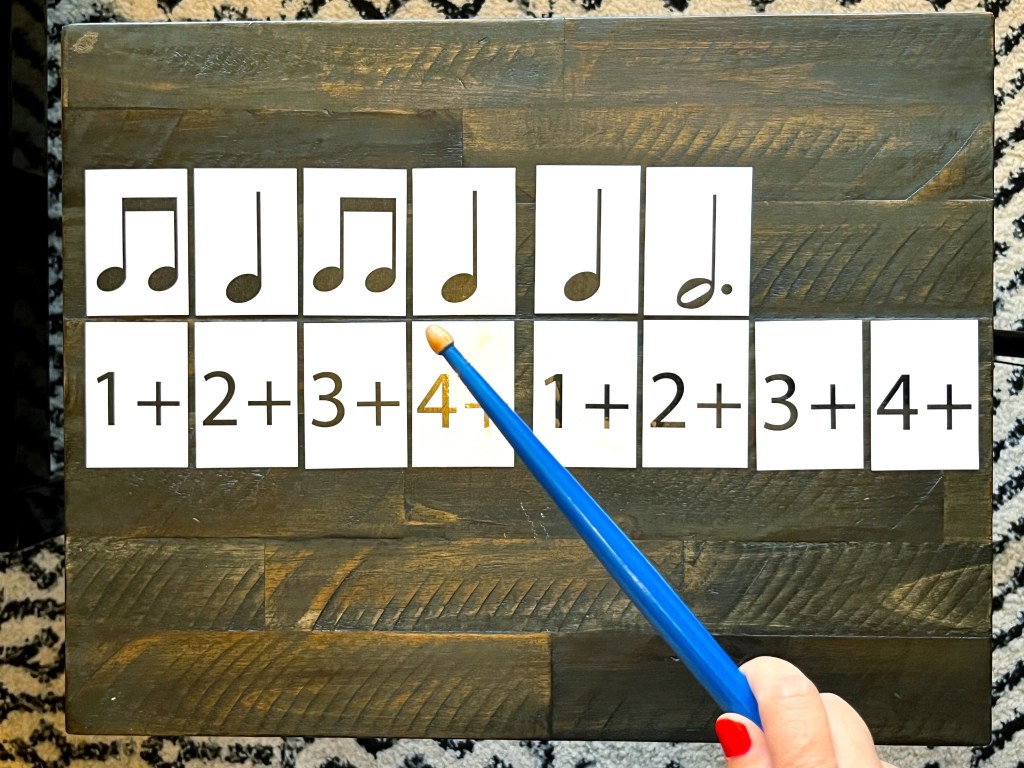
  • Select a rhythm sequence (it can be a rhythmic motive or passage from a piece your student is working on, a rhythm sequence that you drew on a whiteboard, or something that the student came up with using rhythms that they are working on).
  • Go over the rhythmic value of each note and/or rest and the proper counting.
  • Practice tapping/clapping the rhythm sequence until the student is comfortable with it.
  • Now the game can begin!
  • Bring out the metronome and set it to a tempo you know the student will be able to tap the rhythm sequence out with ease (for example, set the metronome to andante).
  • Just like a video game has a “big boss”, the metronome is the big boss and must be defeated!
  • The student will now try to tap out the rhythm sequence in synch with the metronome.
  • The student should be able to pass the first level (remember, start at a speed that you know the student will be successful at).
  • The student has now moved onto the next level! The metronome tempo is increased by at least 20 bpm.
  • The student will now try to tap out the rhythm sequence in synch with the metronome at the new, faster tempo.
  • If the student is successful, the tempo will be increased again. If not, the tempo is decreased by 10 bpm. If the student is successful at that speed, the metronome is set back to the original speed for another try.
  • We usually go through 2-3 rounds of increasing the speed before moving onto something else.
Rhythm cards sit on a dark brown wooden table as a piano student hold a blue drumstick in her hand to tap out the rhythms.

Students really love to try to beat the “big boss” metronome! They can get really determined to nail the faster tempos. Sometimes they will even take the rhythm sequence home to practice during the week to try again at our next lesson!

This game is great for helping student understand how the beats fit in with the different rhythm notes and rests.

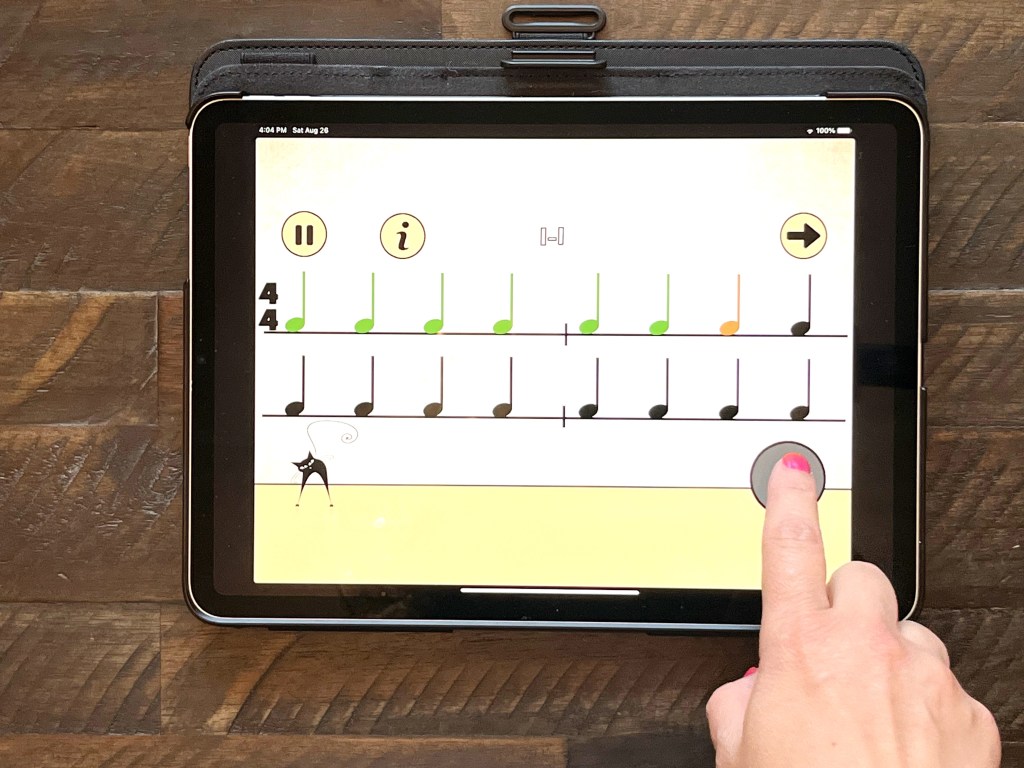
A variation of this game is when I use the app Rhythm Cat (Apple Store link and Google Play link. The Lite version is free if you want to try it out before purchasing). I draw out the rhythm sequence that we will be working on in Rhythm Cat (I need to prep this in advance). The student then works on mastering the rhythm sequence. When they think they are ready, they try it in the app. The app will count the student in and then play an instrumental version of a song (usually traditional songs, like “Twinkle Twinkle”), while the student needs to tap the rhythm sequence correctly on the screen. The cat will judge the student’s performance and award them with either 1, 2 or 3 stars. It’s a fun app that the kids really enjoy!

A piano student plays the app Rhythm cat on a tablet sitting on a brown wooden table

Metronome Markings in the Score

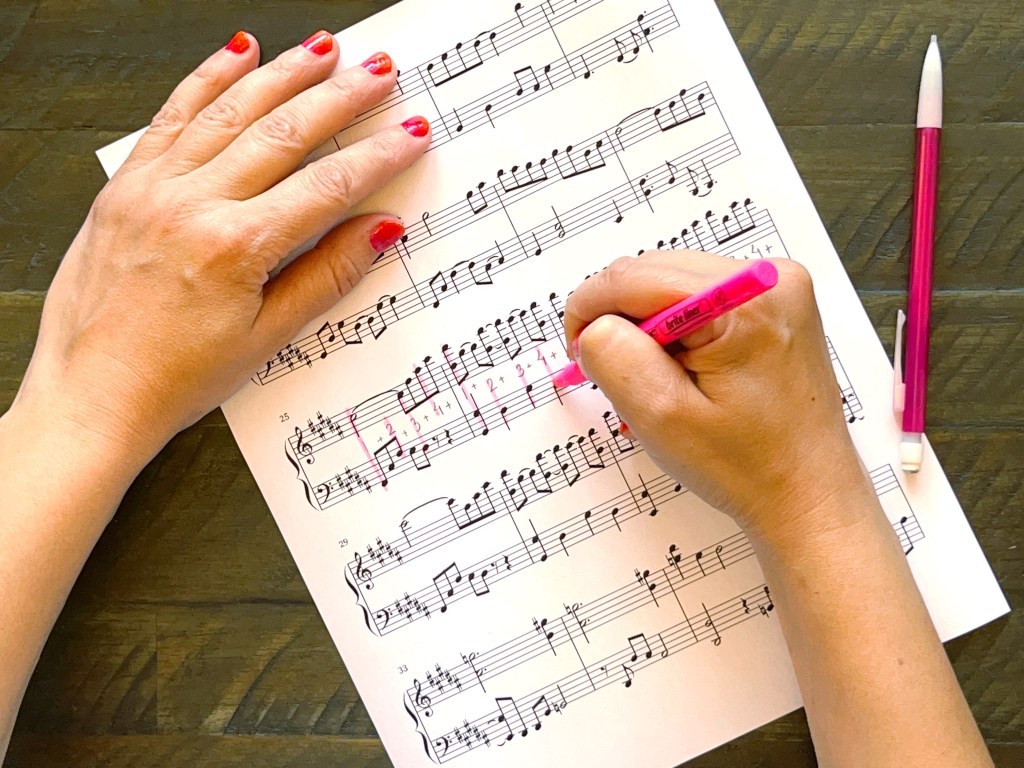
This strategy can be used for fixing passages in the music that are not being played correctly. Work with the student to determine where the beats fall in the passage (it is helpful to also write out the proper counting on the score if it is not already there). Next, mark on the score with a pencil, colored pencil, or marker where the tick of the metronome should be heard. The mark can be as simple as a dot or a vertical dash, but it should stand out enough that the student’s eyes are drawn to it and creates a visual cue to listen for the tick of the metronome. The student would then try to play the passage along with the metronome at a very slow speed.

A piano student uses a pink highlighter to mark the beats on her score.

You can turn this into a game as well:

  • The student has 3 “hearts/lives” to make it to the end of the passage.
  • For every mismatch between the metronome and the student’s playing, the student loses a heart/life.
  • The student must make it to the end of the passage with at least 1 heart/life to spare.
  • If the student loses all their hearts/lives, the teacher slows down the metronome.
  • If the student has 1 or more hearts/lives at the end of the passage, the teacher increases the tempo by 5-10 bpm.
  • Can the student bring the passage up to tempo AND be in synch with the metronome?

Metronome and Counting

I think we can all agree that knowing how to count properly is a basic skill all students need to eventually master. And I think we can also agree that 99.9% of students hate counting, especially if it means counting out loud! Most of the times it stems from just being confused or overwhelmed by the amount of things they need to take care of at the same time (reading the music, playing, counting… it’s a lot!).

That’s what makes rhythm work off the bench so crucial!

But even when they have understood it off the bench, it can still be a struggle to put everything together at the piano. During lessons I will often count out loud for students as they play and then have them try it on their own. A little trick that I have found that works wonders for practice at home is to record either myself (or preferably them) counting along with the metronome on the Voice Memo app of their smartphone. Then, at home, they can play along with the recording to correct their rhythm and eventually count by themselves, without the recording. Check out my video below to see this trick in action:

And there we have it!

The number 3 practice tool every piano student should have. Be sure to check out the previous blogposts for other practice tools that made my list:

Next up is the Number 2 Practice Tool for effective practicing!

Explore more creative teaching ideas
  • Don’t Miss a Beat!
    This fun, multi-level game grows with your students as they learn more and more rhythms. Students will have to use their knowledge of rhythm note and rest values as well as time signatures to fill in the missing rhythms on each card. It can be played in private or group lesson settings!
  • Snowball Rhythm Game
    Who will be able to make the longest rhythm train before the dreaded “Busted!” stick is revealed?! Kids will practice their rhythms while also practicing their aim in this fun toss game.
  • Sky High Love
    The rhythms get longer as the heart towers get higher! Whose tower will remain standing in the end?! This adrenaline-inducing rhythm game is a great way to kick-off a lesson and get the energy up.

Let’s stay in touch, join the list!

As a “toucan” of our appreciation download a free set of note flashcards (link in our Welcome email)!
Processing…
Success! You're on the list.

We are a participant in the Amazon Services LLC Associates Program, an affiliate advertising program designed to provide a means for sites to earn advertising fees by advertising and linking to Amazon.com. As an Amazon Associate we earn from qualifying purchases.

Top 7 Practice Tools Every Piano Student Should Have: #4 Recording Device

Piano students don’t need a lot of accessories to practice… a quality instrument and sheet music is enough! But there are a few tools that make a practice session easier and more effective.

I’m counting down my Top 7 Piano Practice Tools I think every student should have when they are on the bench (plus a bonus one at the end that you might not expect!).

Coming in at number 4 is:

Recording Device

If you caught my No. 5 practice tool blogpost, you know that I said no smartphones and tablets during practice time… the only exception is when you are using them as practice tools! And I DO recommend using a smartphone or tablet because of their ease of use and accessibility.

You might be asking yourself, “I listen to myself when I play, why do I need to record myself too?” The truth is how we listen to ourselves when we play and how we listen to a piece being played are very different.

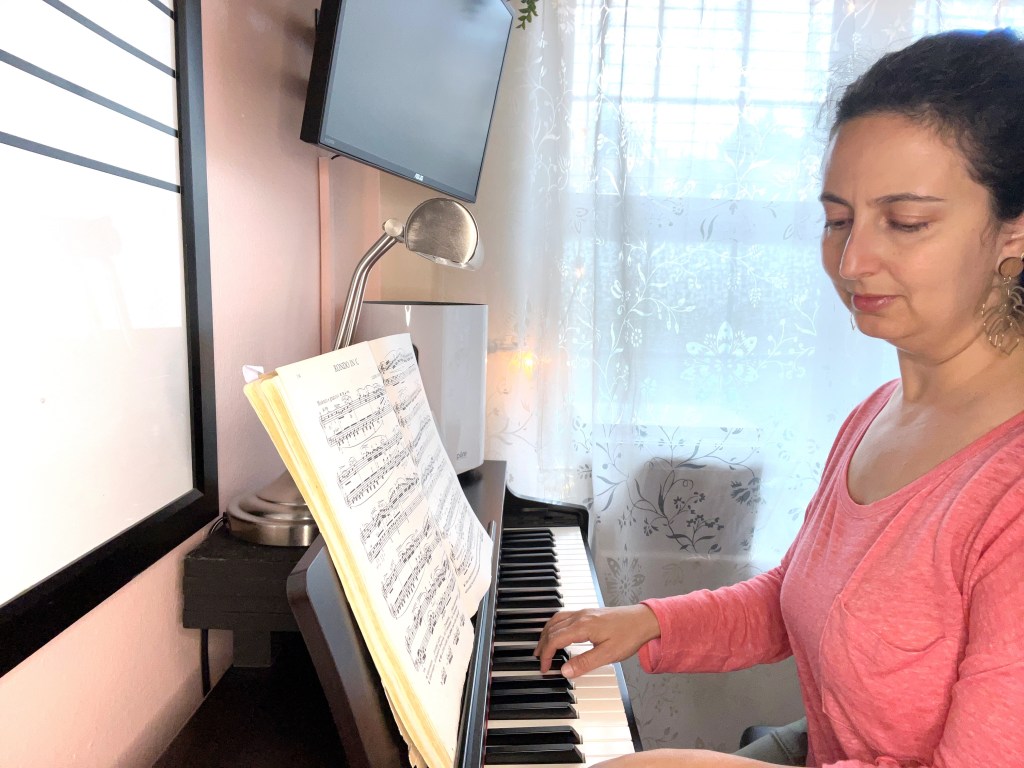
Dark haired woman in a pink sweater plays the piano

When we play, our brains are pulled in many different directions… All at once the brain is focusing on the sound being produced, it is managing our movements to produce the sound, it is reading and interpreting the sheet music, it is trying to block out external distractions, and it is managing our inner critic and mental chatter (which can be deafening!). What we hear is often a warped version of reality shaped by our inner world.

When we play, what we hear is often a warped version of reality shaped by our inner world.

Recording ourselves allows us to distance ourselves from the process of making music and gives us a chance to hear what an audience would hear. It helps us gain a more realistic view of our playing and it helps us zone in on parts of our music that need the most TLC (tender loving care).

When it comes to recording our practicing, we first have to think about what we want to learn from the recording. Are we trying to identify passages that need more work? Are we listening for particular details, such as articulations or dynamics? Are we trying to figure out the proper amount of pedaling for a piece? Are we preparing for a performance? The answers to our questions will determine if we can get by with doing a simple audio recording or if we need to do a video.

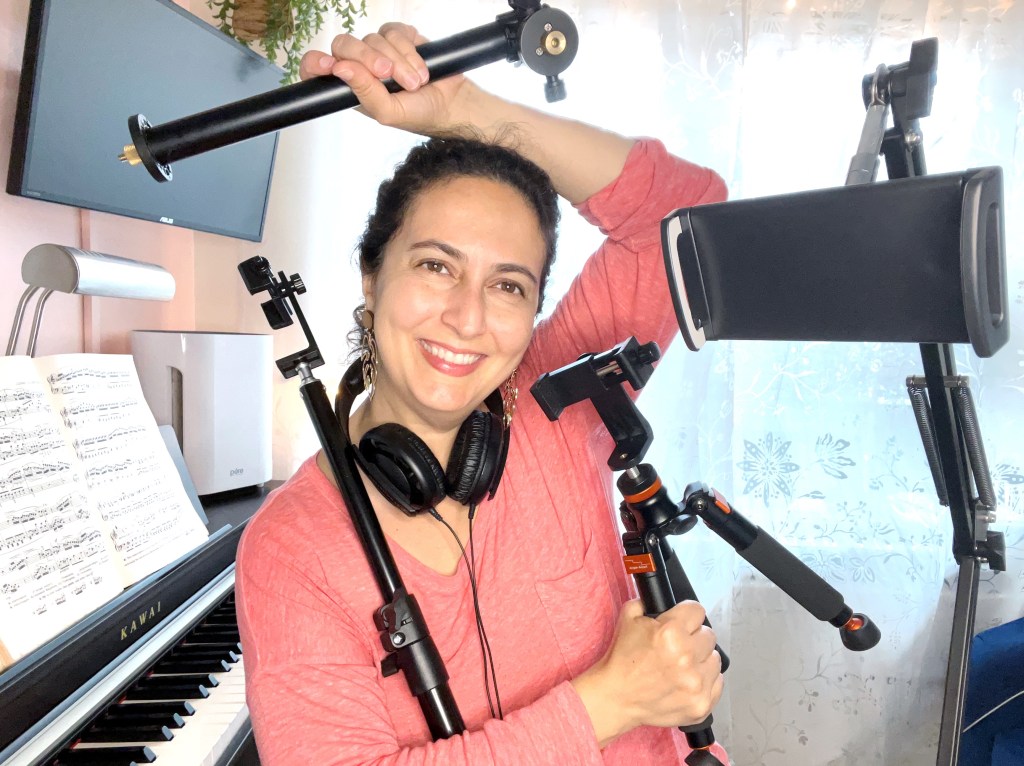
Dark haired woman in a pink sweater holds a variety of videography equipment

Answering these questions will also determine the amount of equipment we will need to set up around the piano. As a rule of thumb, I say the simpler the better. We are using the recording as a tool for our practicing. Practice time is precious. If the goal of the recording is to upload it to social media or YouTube as a polished final product, that is not practicing and a different time should be scheduled to do a nice recording of your work.

Keep your recording set up simple. Practice time is precious. Remember, it’s practice, not a polished final product.

Audio Recording and Set-Up

This is the simplest and most time efficient way to record yourself during practice. As musicians our ultimate concern is the quality and beauty of the sound we are producing from our instruments. The best way to focus our attention on this is through an audio recording.

We live in a time where recording is accessible to pretty much everyone and tremendously easy to accomplish. Most people have some sort of smartphone or tablet (even children). Making an audio recording can be as simple as opening the Voice Memo app or camera on the device, hitting record, and placing the device on the bench next to you.

Dark haired woman in a pink sweater sits in front of a piano while pressing the record button on a tablet

If you own a digital piano, doing an audio recording is even simpler, since digital pianos have a record button built into them. You can also connect them directly to a smartphone or tablet and record yourself using apps such as GarageBand (check out my blogpost on how to set up GarageBand for recording from your digital piano). You may need adapters to connect your device to your piano, so remember to check your connection ports.

Here are a few things to try out when using an audio recording during practice:

1. Use a Recording to Measure your Progress

  • Record yourself at the beginning of your practice week.
  • Save it but don’t listen to it.
  • Continue with your regular practice schedule throughout the week.
  • At the end of your practice week, record yourself again.
  • Listen to both your recordings, starting with the first one from the beginning of the week.
  • Listen for areas where you improved. It’s important to look for the good first to give yourself some encouragement.
  • Look for areas that could benefit from additional practicing. Make notes in your score or practice journal along with ideas on how to fix them.
Dark haired woman in a pink sweater sits in front of piano with black headphones on. She is listening to a piano recording

2. Use a Recording to Solve Problems

  • Find a section in your music that is giving you trouble.
  • Record yourself playing that section.
  • Listen to your recording and ask yourself what needs to be improved (rhythm, phrasing, dynamics, etc.).
  • In your practice journal, list out different solutions you could try to fix the problem passage.
  • Work on the first solution from your list. Once you have played it a few times, record yourself.
  • Compare it to the original recording. What was better or worse this time around? Write your observations down in your practice journal.
  • Try out the next solution from your list and repeat the procedure above.

This is a very methodical way of practicing that can bear tremendous fruit and inspire a lot of creative problem solving.

3. Use a Recording for Deep Listening and Refining a Piece

This type of recording can be used when preparing a piece for performance.

  • Record yourself playing as if you are performing for an audience. Your focus should be on the overall flow and musicality of the piece. Allow your inner critic to take a break and play in the moment.
  • Listen back on your recording and look for spots in the music that could use additional refining. Do you remember what you were thinking during those moments? Did you lose focus? Did your mind wander away from the music? Were you worried about an upcoming difficult passage? Write your thoughts down in your practice journal.
Dark haired woman in a pink sweater and wearing headphones sits in front of a piano and writes in her practice journal

Don’t be overly critical of yourself (we tend to expect a lot from ourselves and as a consequence we can beat ourselves up over the littlest things). Imagine you are listening to a dear friend play and not yourself. Give yourself the type of feedback you would give a friend.

Don’t be overly critical of yourself. Give yourself the type of feedback you would give a friend.

Video Recording and Set-Up

Video recording is also a useful way of gaining insight into our playing. With videos we can focus more on the physical movements we make when we play, technique and posture, and presence at the instrument (if we are preparing for a performance). With a video recording we are looking for feedback that sound alone cannot give us.

A video recording can be as simple as propping a smartphone up against the piano or a pile of books. But depending on what we want to focus on with our video recording, we may need additional equipment in order to get the right angle.

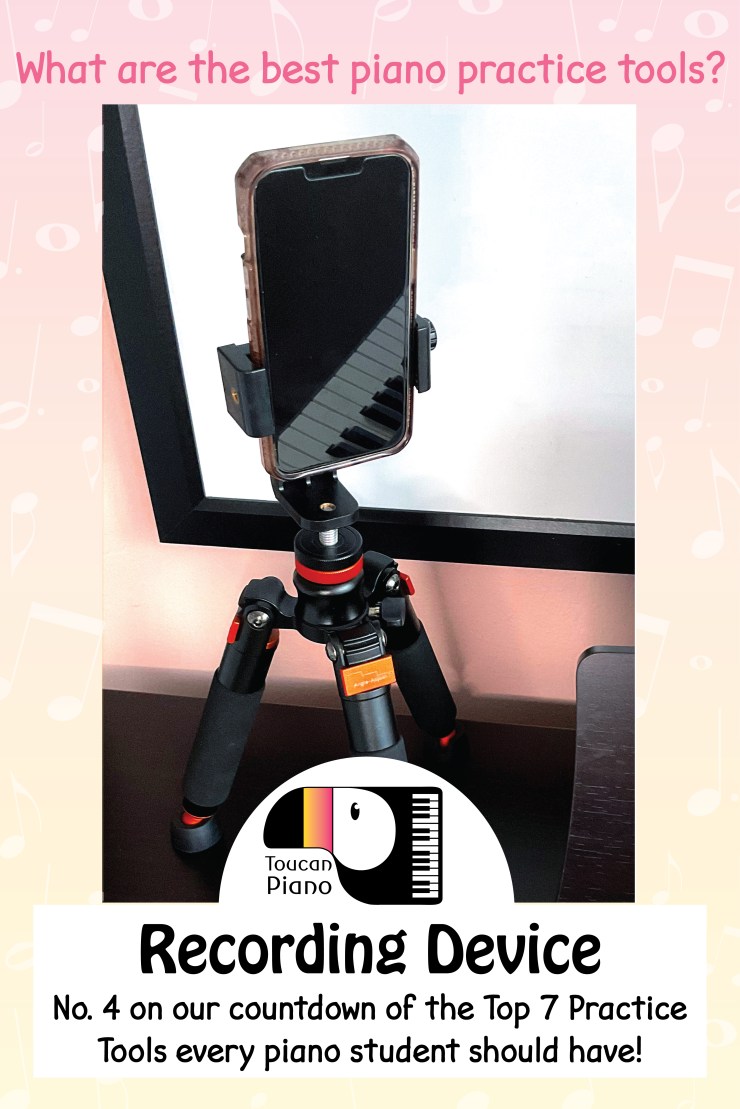
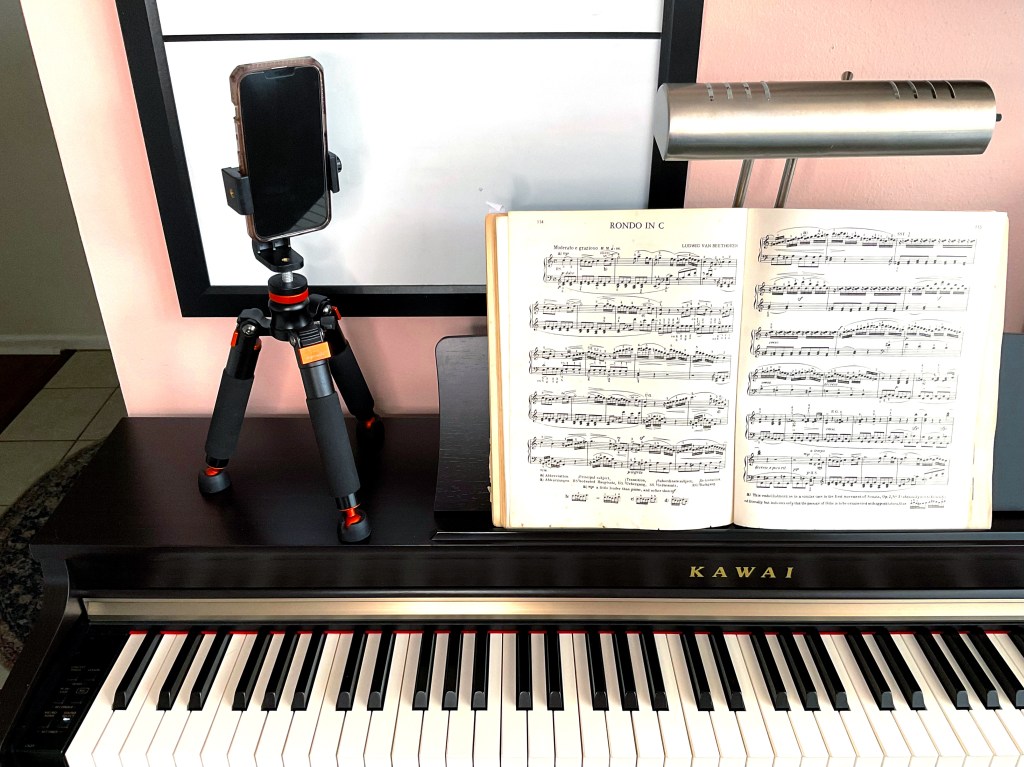
For side or back views, we can use a tabletop tripod:

A tabletop tripod holding a smartphone sits on top of a piano

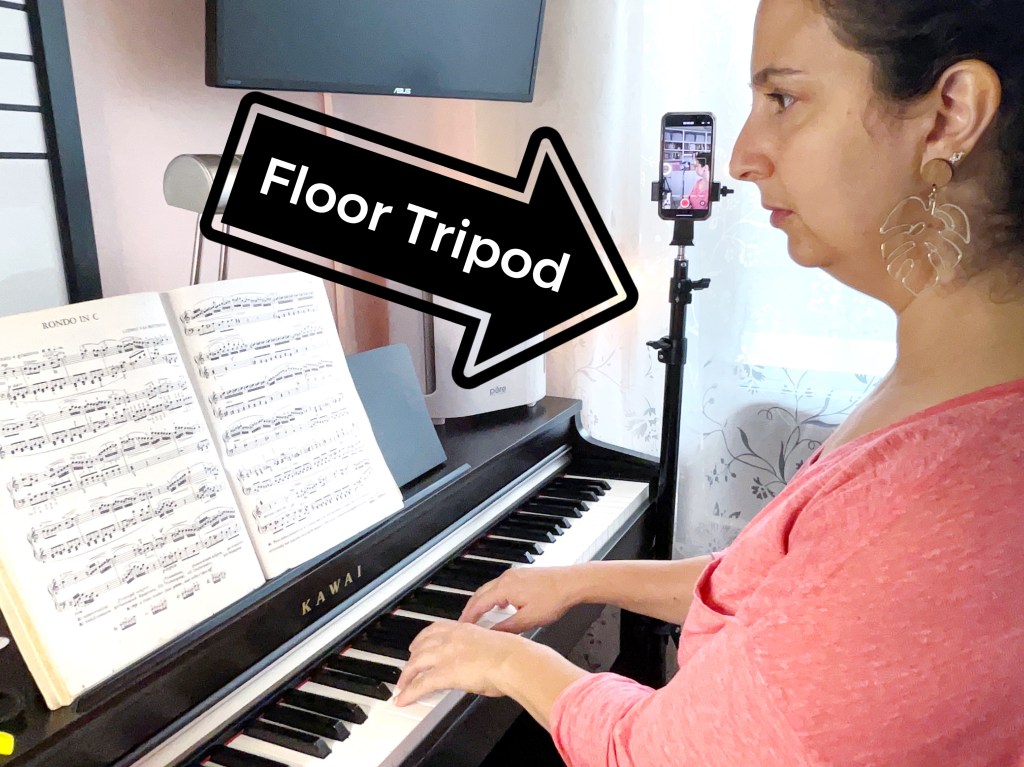
Or a floor tripod (this is the one I use for my smartphone and this is the one I use for my tablet):

Dark haired woman in a pink sweater play the piano next to a floor tripod that is recording her playing
Dark haired woman in a pink sweater play the piano next to a tablet stand that is recording her playing

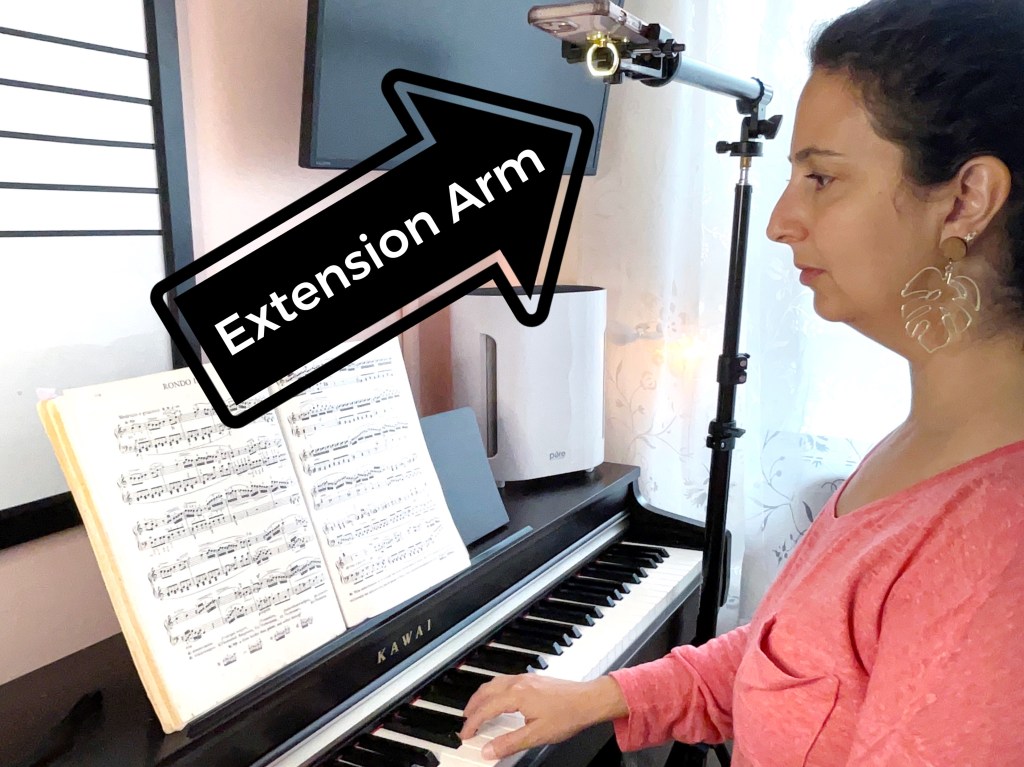
For an aerial view of the hands and keyboard, an extension arm can be attached to the floor tripod:

Dark haired woman in a pink sweater play the piano next to a floor tripod with an extension arm that is recording her playing

You will also need an adjustable smartphone holder for the tabletop tripod. For the set-up with the floor tripod and the extension arm, you will also need screw adapters.

Just a reminder, keep it simple! Only set up what you need to answer your questions. It’s very easy to fall down the rabbit hole when it comes to recording equipment. But remember that this is practice, not content creation. You can certainly use the same equipment for content creation (I do!), but set up just enough to get the job done.

Here are a few things to try out when using a video recording during practice:

1. Use a Video Recording to Check your Posture

Proper posture is SO crucial to avoiding injury and discomfort when playing (especially for extended periods of time). Oftentimes we will feel pain or discomfort in a part of our bodies but not be able to pinpoint what it is we are doing to cause the pain (our minds are so focused on the playing and certain things just go into autopilot because of force of habit).

  • Set up your video recording equipment in a way that focuses on the area of your body that your are concerned about.
  • Play your piece.
  • Watch the recording back and look for misalignments, drooping, leaning, arching, etc. in your posture.
  • Ask yourself if these in posture failures occur throughout the entire piece or only during certain passages?
  • If they occur throughout the entire piece, select several moments in your piece where you can remind yourself to check in with your body. Write these reminders into your score (it can be as simple as a red ‘X’ – you will know what the symbol means).
  • If they occur only during certain passages, ask yourself if this is a posture problem or a technical problem. If you suspect a technical problem, try recording a video to focus on your technique during that passage. If it is a posture problem, correct your alignment as necessary and consciously work on relaxing during the passage.
Dark haired woman in a pink sweater sitting at a piano makes notes in her music score

2. Use a Video Recording to Work on Technique

Video recordings can be an invaluable tool when a student is working on a new technique or trying to investigate why a passage is not working. The video can also be sent to the student’s teacher or taken to their lesson to get suggestions on how to fix their technical problems.

  • Set up your video recording equipment to focus on your hands, wrists and arms (select a vantage point that best suits your needs).
  • Play the passage that is giving you trouble.
  • Watch the recording back.
  • Identify where the problem is happening (it can be in the lead up to the passage or something in the passage itself).
  • Look for technical issues that are making the passage difficult to play.
Aerial view of two hands playing the piano

Some questions to ask yourself as you watch the video:

  • Are your fingers, wrists, and arms working together?
  • Are your motions fluid or stiff?
  • What is causing the tension? For example, your fingers need to stretch too far so you stiffen your wrist and arm; the fingering is awkward, so your elbow juts out and away from your body causing your fingers to become misaligned with the keys; your arpeggios sound stiff because you are losing your wrist rotation as you get further into the passage; your wrist is dipping making the passing of your thumb difficult to manage, etc.

3. Use a Video Recording to Practice for a Performance

  • Set up your video recording equipment from the vantage point of your audience.
  • Hit the record button.
  • Practice approaching the piano from the same direction you will on the day of the performance.
  • Take a bow to greet your audience.
  • Sit on the bench and prepare your mind to begin playing.
  • Play your piece.
  • Get up from the bench and take a deep bow (check out my blog post on how to bow after a performance)
  • Exit the “stage” in the same direction you will go on the day of the performance.
  • Bonus: Up the stakes and send the video to family members and friends.

Having a video camera pointed at us when we play gives us the sensation of being watched. It’s a great way to recreate some of the performance jitters we all feel when playing in front of an audience. AND if we keep in mind that the video we will be shared with friends and family, it will add a whole other layer of butterflies to our stomachs, because then we know that other people will actually see it.

And there we have it!

The number 4 practice tool every piano student should have. Be sure to check out the previous blogposts for other great practice tools that made my list:

Next up is the Number 3 Practice Tool for effective practicing!

Explore more creative teaching ideas
  • Compose a Ringtone
    Ringtones are helpful but what if we could make them special too?! This is a fun and quick project that even the most reluctant students can get behind.
  • I Can Heart-ly Wait for the Punchline
    A heart themed laugh-out-loud note reading game. I love this game because not only do students have to think about keyboard geography, they also have to be able to associate the notes with their exact location on the piano. 
  • Chord Snowblast
    Build chords and collect points while trying to avoid the snow blast! Kids will test their knowledge of building chords AND they will actually be hoping to get all the chords with sharps and flats!!

Let’s stay in touch, join the list!

As a “toucan” of our appreciation download a free set of note flashcards (link in our Welcome email)!
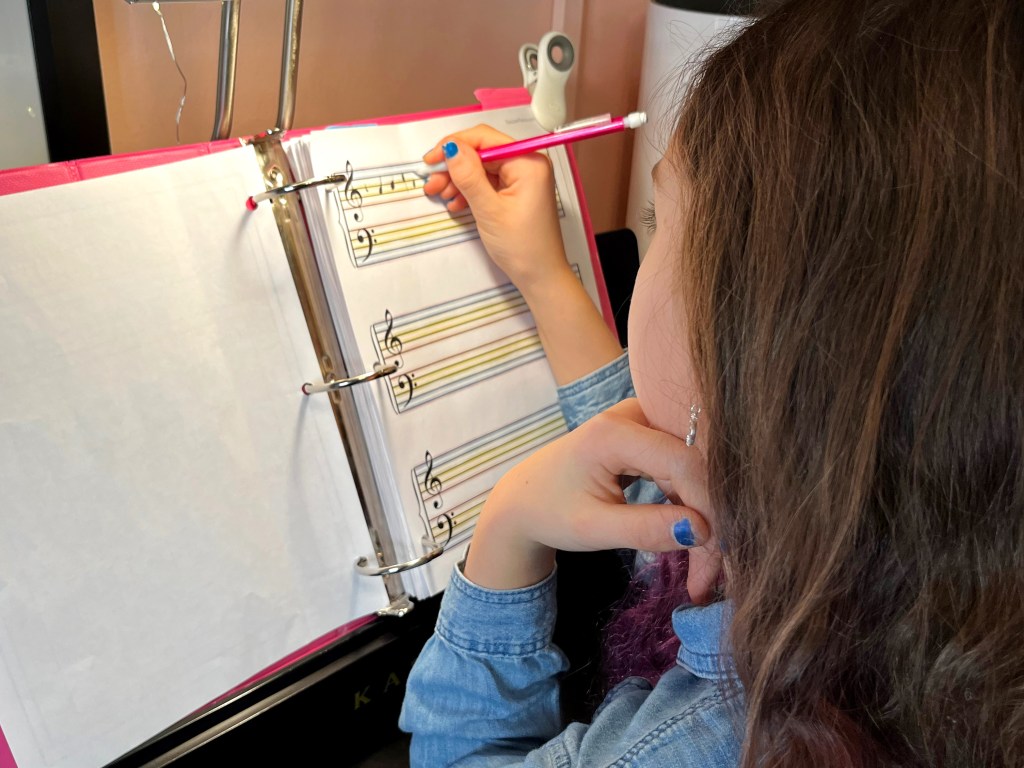
Processing…
Success! You're on the list.

We are a participant in the Amazon Services LLC Associates Program, an affiliate advertising program designed to provide a means for sites to earn advertising fees by advertising and linking to Amazon.com. As an Amazon Associate we earn from qualifying purchases.

Top 7 Practice Tools Every Piano Student Should Have: #5 Cube Timer

Piano students don’t need a lot of accessories to practice… a quality instrument and sheet music is enough! But there are a few tools that make a practice session easier and more effective.

I’m counting down my Top 7 Piano Practice Tools I think every student should have when they are on the bench (plus a bonus one at the end that you might not expect!).

Coming in at number 5 is:

Cube Timer

Time is a hot commodity is our fast-paced world, so the time spent at the piano practicing should be used to its full potential. However, how many times has a student “just wanted to check the time” and then ended up playing around on their device instead of practicing? It happens to the best of us, but our practice time dwindles away quickly when we get side-tracked by our devices.

I generally recommend that devices should be as far away as possible from the piano during practice time. I know, I know, they can be used as alarms but ultimately they are a huge distraction… How do we keep track of our practice time then?

A clock near the piano can be enough but a practice tool that I recommend to my students (and use myself!) is the cube timer.

Why do I prefer the cube timer over a traditional clock? Because students will oftentimes stare at the clock or repeatedly look up at the clock to see how much practice time is left. This constant pull to look at the time destroys focus… Every time the student looks at the clock, their focus is gone and will then need to be redirected back to the music.

The cube timer eliminates the distraction of looking at the clock and “worrying” about how much practice time is left. Once the timer is set for the desired amount of time, it will beep when the time is up and the student can fully focus their attention on their music.

Important Tip!!! The cube timer has a small LCD screen on its bottom that counts down the time left on the timer. I strongly suggest covering it with a small sticker or painting over it. Otherwise, students will run into the same problem as using a regular clock.

A purple cube timer is held up in front of a piano. An arrow points to the LCD screen on the bottom of the timer.
A purple cube timer is held up in front of a piano. An arrow points to a sticker placed over the LCD screen on the bottom of the timer.

The cube timer comes in different time configurations. The one I generally recommend for students is the 5/10/20/30 minute option. A typical 30 minute practice session for an elementary age student using this timer could look like this:

  • 5 minutes: Technical exercises and warm-ups
  • 10 minutes: Practice piece number 1
  • 10 minutes: Practice piece number 2
  • 5 minutes: Cool down/fun time

The student would just lay the timer on the piano, the desired number of minutes facing up, and start practicing. When the timers beeps, the student would then move onto the next practice activity and set the timer again. The timer helps students take ownership of their practicing and keep track of their time without distractions.

A purple cube timer set to 20 minutes sits on top of a piano.

Practicing is just as much of a mental battle as it is a physical challenge. We are surrounded by distractions from the world around us but we are also swamped by distractions from within. Training the mind to focus on a high level task, like playing an instrument, is a long process. So setting ourselves up for success from the beginning is half the battle and worth the investment.

And there we have it!

The number 5 practice tool every piano student should have. Be sure to check out the previous blogposts for other another great practice tool that made my list:

Next up is the Number 4 Practice Tool for effective practicing!

Explore more creative teaching ideas
  • Chord Snowblast
    Are you longing for cooler temperatures this summer? Bust out Chord Snowblast (and the mini-erasers) for a cool piano game that covers all the major and minor chords!
  • Pot of Gold Rhythm Game
    Students love this easy rhythm game for beginner/elementary level students. The value of each rhythm note or rest will determine how many coins go into the pot. Who can fill their pot the fastest?! This game can be adapted for any time of the year or use mini-cauldrons for a fun Halloween or St. Patrick’s Day game.
  • Rainbow Manuscript Paper
    This colorful manuscript paper is available in the Toucan Piano shop as a free printable! They are available in three sizes, so they can be used for a variety of ages and activities, like writing out original compositions, explaining music theory concepts, music dictation, games, and so much more!

Let’s stay in touch, join the list!

As a “toucan” of our appreciation download a free set of note flashcards (link in our Welcome email)!
Processing…
Success! You're on the list.

We are a participant in the Amazon Services LLC Associates Program, an affiliate advertising program designed to provide a means for sites to earn advertising fees by advertising and linking to Amazon.com. As an Amazon Associate we earn from qualifying purchases.

Top 7 Practice Tools Every Piano Student Should Have: #6 Music Clips

Piano students don’t need a lot of accessories to practice… a quality instrument and sheet music is enough! But there are a few tools that make a practice session easier and more effective.

I’m counting down my Top 7 Piano Practice Tools I think every student should have when they are on the bench (plus a bonus one at the end that you might not expect!).

Coming in at number 6 is:

Music Clips

I love simplicity when it comes to a music clip. I’ve been using chip clips since I was a child (and, yes, I have tried all sorts of fancy music clips but none of them worked as well for me as a regular chip clip!). I have two clipped to either side of my book rack on my piano and my students have quickly learned how useful they are!

Piano with music clips clipped to the book rack. A sign with two arrows points to the music clips.

Now this may seem like a superfluous item to add to a list of practice tools, but I would argue that it is essential. There is nothing more anxiety-inducing than watching our music slowly close or fall off the book rack as we are playing. Knowing that our sheet music is securely in place when we are practicing or performing allows us to focus on the music itself.

After hearing a few of my students comment on how they wished they had their own clips at home, I decided to gift every student a music clip at our last recital (albeit, an embellished one!).

These are the clips I gave my students and I recommend them for several reasons:

  • they are easy for small hands to grip because of their rounded design
  • the mouth of the clip has rubber ribbed teeth which keeps the clip firmly in place
  • the wire of the spring is snuggly tucked into the handle (I once had the wire of a hairclip pierce right through my finger, so I always looks for how the design of the clip manages the excess wire from the spring)
  • they come in a variety of colors
  • they are cost effective (as of the time of this writing, each one costs about $1.10)

These clips will help with the common problems we face when wrangling our sheet music:

Hold up sagging pages in a binder:

A pink binder filled with music sits on the book rack of a piano.  The sheet music is sagging and falling out of the binder. A large pink X indicates a problem.
A pink binder filled with music sits on the book rack of a piano.  The sheet music is being held up by music clips clipped to the corners of the music. A large pink heart indicates this set up works for keeping music in place.

Clip a book open to the book rack:

A piano book on the book rack of a piano.  One side of the book is sagging and slowly closing. A large pink X indicates a problem.
A piano book on the book rack of a piano. Music clips hold the book open by holding it against the book rack. A large pink heart indicates this set up works for keeping music in place.

Clip a book open across the upper end of the spine:

A piano book on the book rack of a piano.  One side of the book is sagging and slowly closing. A large pink X indicates a problem.
A piano book on the book rack of a piano. Music clips hold the book open by gripping the spine of the book. A large pink heart indicates this set up works for keeping music in place.

Another clip I love is the dry-erase board clip from Kikkerland. It not only holds sheet music and books in place but also has its own built in dry-erase board that is SO helpful during practice time!

A red dry erase magnetic clip sits on top of the keys of a piano. A dry erase marker with an eraser sits next to the clip.

Students can use the dry erase board to keep track of repetitions and specific parts of their piece that they are working on:

A hand is holding a dry erase marker and writing on a dry erase board clip that is clipped to a book of music by Beethoven.

Then, when they move onto their next practice piece, it’s just a matter of erasing the board and starting fresh!

A hand is holding a dry erase marker and erasing the writing on a dry erase board clip that is clipped to a book of music by Beethoven.

Parents can also use it to write down weekly assignments, little messages of encouragement, and/or practice reminders.

A dry erase clip is clipped to the top of a piano book. It has a message on it that reads, "You are doing great!! Practice after ballet".

And there we have it!

The number 6 practice tool every piano student should have. Be sure to check out the previous blogpost for other another great practice tool that made my list:

Next up is the Number 5 Practice Tool for effective practicing!

Explore more creative teaching ideas
  • Top Practice Tools Every Student should Have: #7 Mini-Erasers
    Piano students don’t need a lot of accessories to practice, but there are a few tools that make a practice session easier and more effective… and in the case of mini-erasers, so much cuter! Mini-erasers can be used in a wide variety of activities, from warm-ups to practice challenges, improvisation to fixing wrong notes, and so much more!
  • The Die of Destiny
    Sometimes a student will walk into my studio without their usual bounce in their step. I’ve found that a little silliness and a dash of chance gets them in the mood to pull out their piano books and play music. The Die of Destiny is a fun and quick lesson starter to get students playing.
  • How to Make your Own Music Theory Dice
    Music theory dice are a great tool to have in your piano teacher arsenal but most of the time what you need isn’t available to buy anywhere. DIY Music Theory Dice are so easy to make and they are completely customizable for any concept you would like to work on with your students.

Let’s stay in touch, join the list!

As a “toucan” of our appreciation download a free set of note flashcards (link in our Welcome email)!
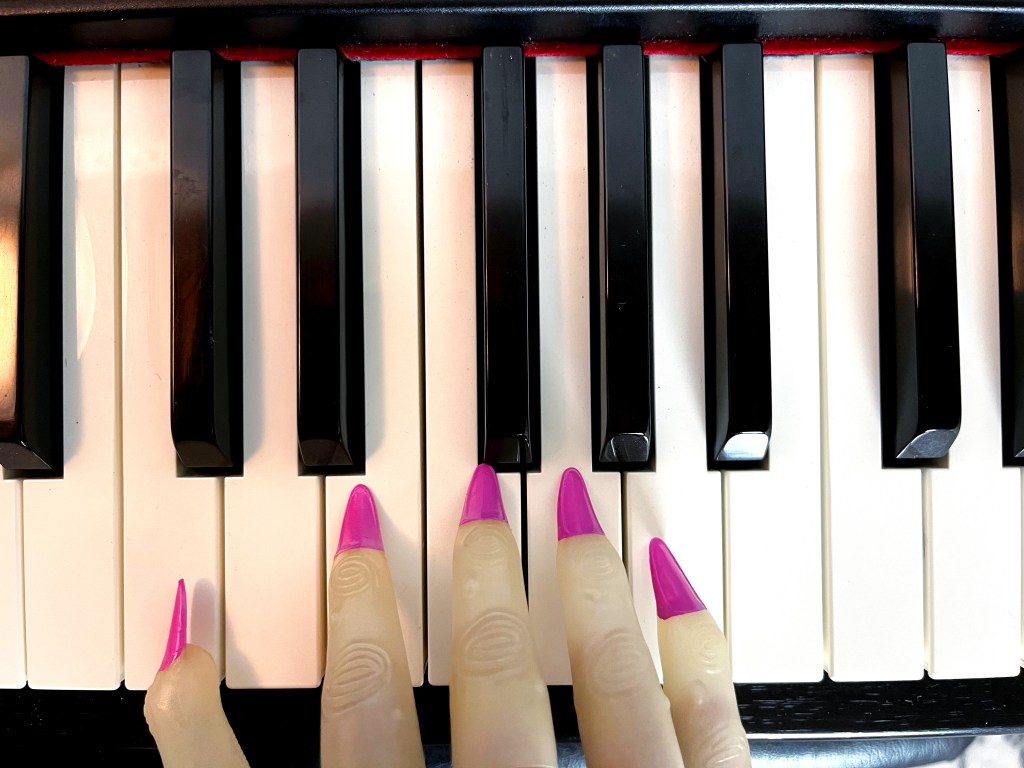
Processing…
Success! You're on the list.

We are a participant in the Amazon Services LLC Associates Program, an affiliate advertising program designed to provide a means for sites to earn advertising fees by advertising and linking to Amazon.com. As an Amazon Associate we earn from qualifying purchases.