Chocolate Eighth Notes: A Sweet Valentine’s Day Treat

Every Valentine’s Day I like to make my students a little music-themed treat. This year I made these cute chocolate eighth note!
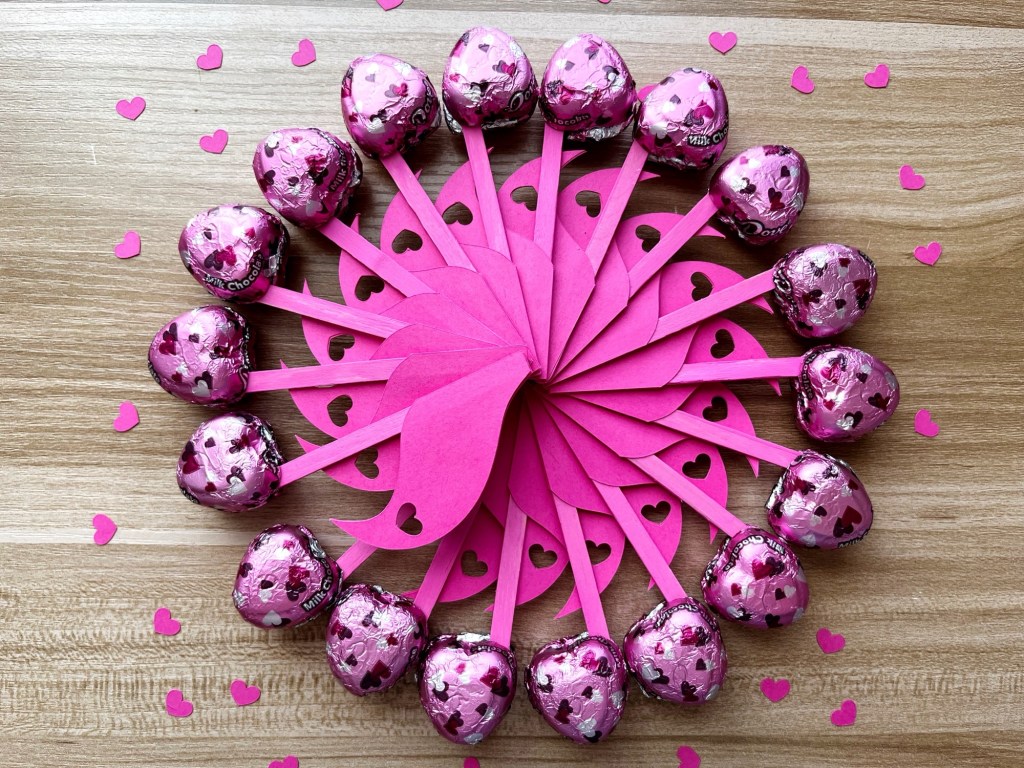
Chocolate eighth notes are arranged in a circle with the flags at the center. The chocolates are surrounded by tiny pink hearts.

Check out my Valentine’s Day round-up post with more Valentines treats, activities and games!

If you’d like to make these sweet treats, here’s what you’ll need:

Depending on the size of the heart-shaped chocolates you are using, you may need to trim your coffee stirrers. I cut mine in half by etching a notch in the coffee stirrer with the X-acto knife. Then I broke the stirrer in half.

An X-acto knife cuts a coffee stirrer

Paint the coffee stirrer pink and cut out the eighth note flags from the cardstock. Glue the flags to the coffee stirrers with stick glue.

A pink eighth note flag and stem are placed next to a bottle of pink paint and a tube of stick glue.

Apply the double-sided tape to the end of the coffee stirrer.

The crafter applies double sided tape to the end of the pink eighth note stem.

Press one of the chocolate hearts onto the double-sided tape.
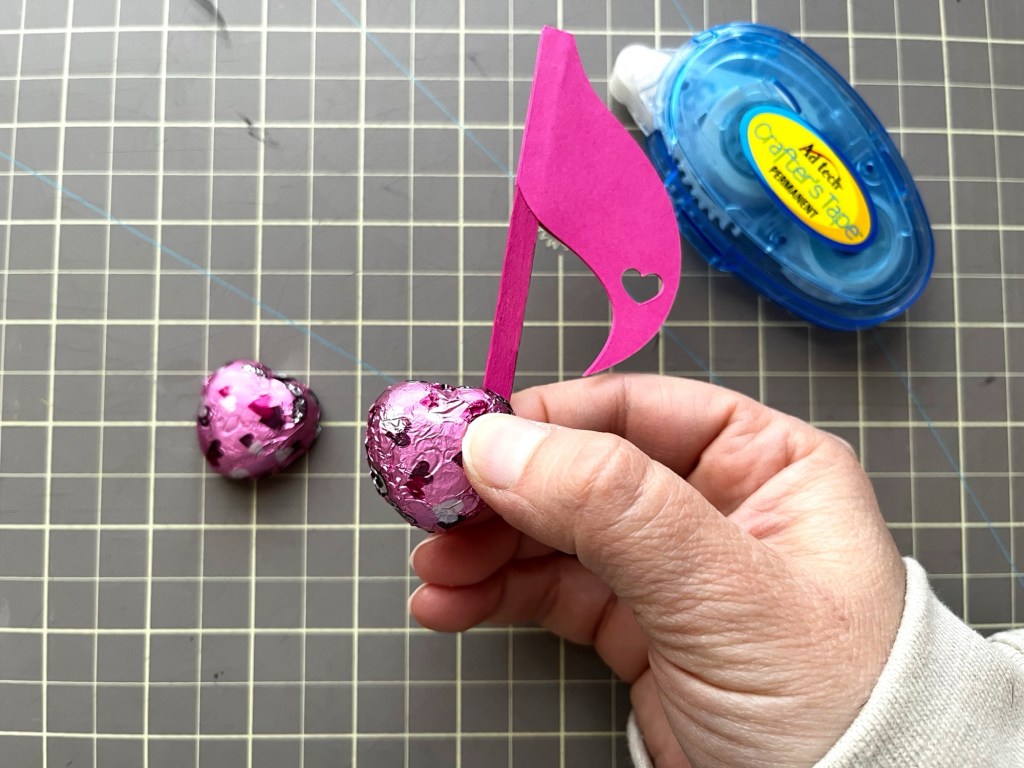
A chocolate is pressed against the tape on the pink eighth note stem

Apply double-sided tape the other side of the coffee stirrer and to the wrapping of the chocolate heart.

The crafter applies double sided tape to the back of the chocolate’s wrapper and the back of the pink eighth note stem

Press the second chocolate heart onto the first heart and stirrer.
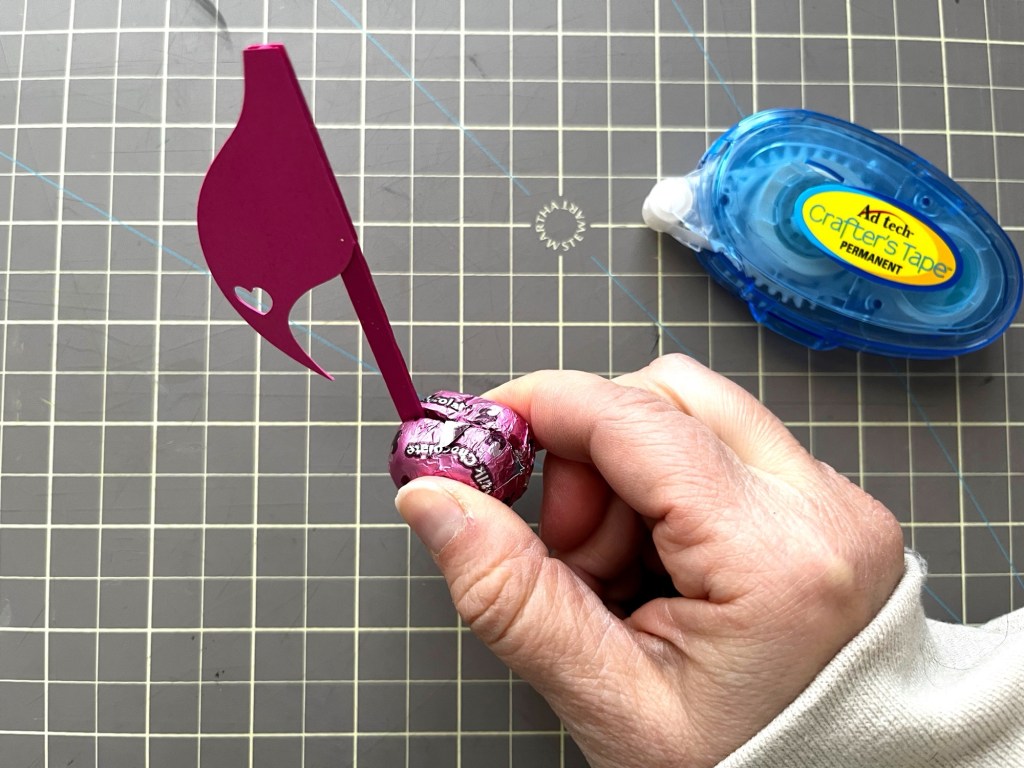
The crafter presses the other chocolate onto the double sided tape

Optional: Write a message on the flag.

The crafter uses a black fountain pen to write a sweet message on the flag of the pink chocolate eighth note

And there you have it! 🙂 My students loved these sweet notes!

The pink chocolate eighth note sits on a piano keyboard

Explore more creative teaching ideas
  • Valentine’s Day Round-Up
    Make Valentine’s Day special for your students with free downloadable piano-themed Valentine’s cards and lots of music theory games that will have your students seeing hearts!
  • Sweet Words
    Love doesn’t come easy but Sweet Words certainly help! Your students will get all the feels with this elementary-level Valentine’s Day note-reading and keyboard awareness game.
  • I Can Heart-ly Wait for the Punchline
    A heart themed laugh-out-loud note reading game. I love this game because not only do students have to think about keyboard geography, they also have to be able to associate the notes with their exact location on the piano. 
  • Sky High Love
    The rhythms get longer as the heart towers get higher! Whose tower will remain standing in the end?! This adrenaline-inducing rhythm game is a great way to kick-off a lesson and get the energy up.

Let’s stay in touch, join the list!

As a “toucan” of our appreciation download a free set of note flashcards (link in our Welcome email)!

Processing…
Success! You're on the list.

We are a participant in the Amazon Services LLC Associates Program, an affiliate advertising program designed to provide a means for sites to earn advertising fees by advertising and linking to Amazon.com. As an Amazon Associate we earn from qualifying purchases.
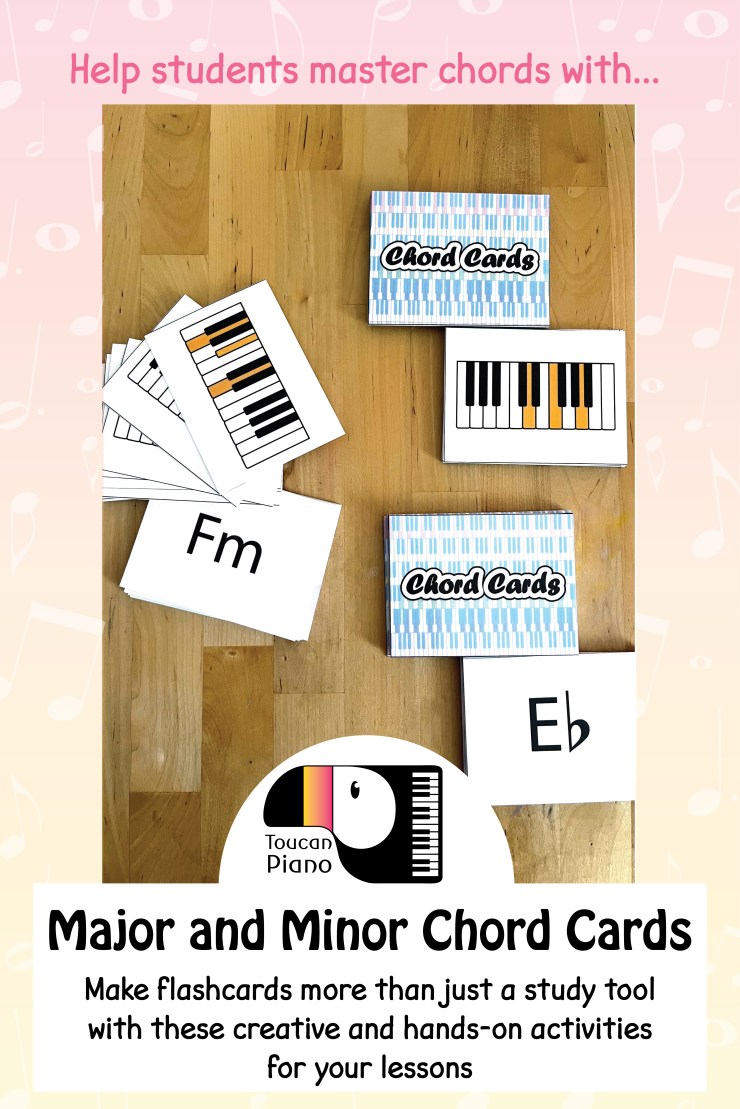
Chord Flashcards – How to Use them with your Students

I’m going to just come out and say it… I love flashcards!

Fingers making the shape of a heart hover over chord flashcards.

Flashcards are often stereotyped as being boring, repetitive, and only useful for basic memorization or geared towards younger kids. Some argue that they don’t suit creative learners or that digital tools have made them outdated. However, flashcards are extremely effective for active recall and the long-term retention of concepts.

And the best part? They have SO many uses! From interactive games and hands-on activities to group challenges, the possibilities are endless!

Sending flashcards home for students to drill (the Toucan Piano double-sided chord cards are a great option for home study!) is a fantastic way to reinforce their learning between lessons. But flashcards aren’t just for independent review — there are countless creative and engaging ways to use them during lesson time, helping students see just how much creative thinking can come from this simple tool!

The Toucan Piano major and minor chord flashcards are available as a free download in the shop here.

  1. Chord Activities
    1. Name that Chord
    2. Build a Chord
    3. Part of the Family
    4. Progressions
    5. Inversions
  2. Chord Games
    1. Chord Match/Memory
    2. Speed Chords
    3. Chord Relay
  3. Let’s stay in touch, join the list!

Chord Activities

Hands-on activities during lessons are a fantastic way to engage students in learning about chords. Taking just a few minutes during a lesson to review chords can reap enormous benefits over time… Students will gain confidence in playing chords, recognizing them in their music, and using them in their own improvisations and compositions.

Name that Chord

Students starting out with chords initially work on feeling the shape of chords, using the correct fingering, and identifying the difference in the sound produced by a major or minor chord.

Using the keyboard chord cards, draw a card from the deck. Have the student find the keys on the piano that match the card (start with either the right hand or the left hand). Have the student play the chord and then try to name it.

Taking it one step further, can the student then transform that chord into its major or minor version?

Chord cards sit on the piano while a piano students play a B minor chord.

Build a Chord

Another beginner activity, this has students trying to build the chord from its symbol.

Using the chord symbol cards, draw a card from the deck and have the student place mini-erasers or gems on the keys that constitute that chord.

Chord cards sit on the piano while a piano students uses gems to mark the keys that make up the chord of E flat major.

Part of the Family

Understanding which chords belong to a particular key family is an essential skill for coming up with chord progressions, improvising, and recognizing the harmonic progression in a piece.

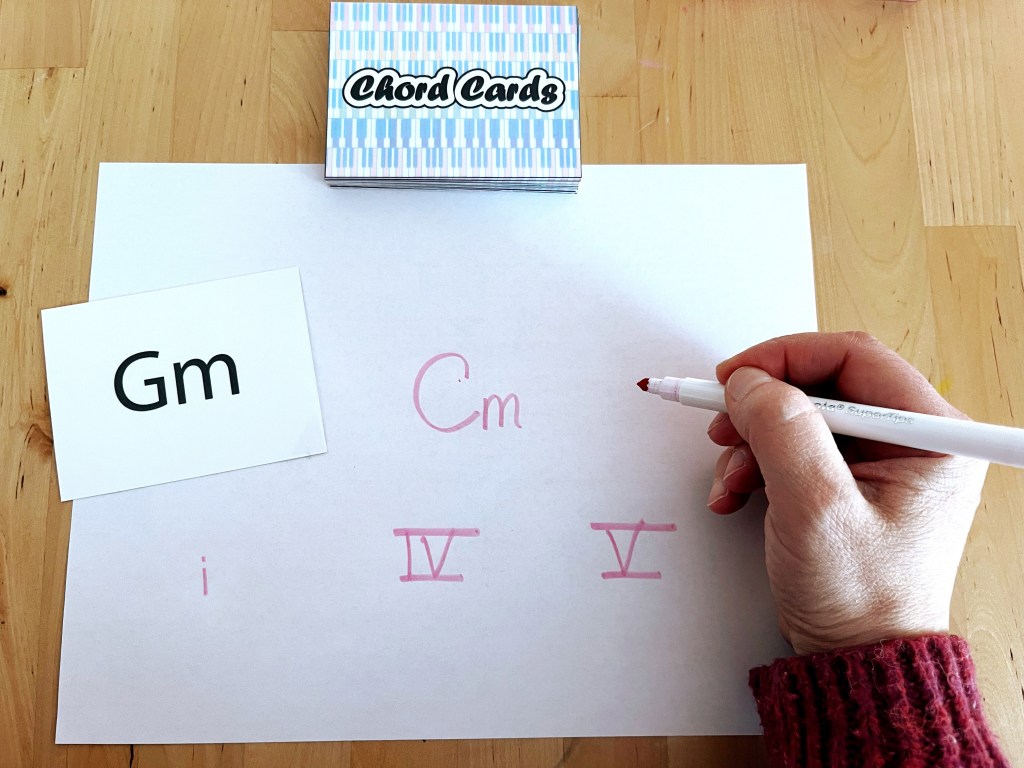
Using the chord symbol cards, draw a card from the deck. The chord on the card is the “One” chord (I or i in Roman Numerals). Have the student write out the IV and V chords of the key.

A piano student writes out the four and five chords in the key of G minor. A deck of chord cards sits on the table above the paper.

Progressions

Once students have a solid understanding of key families, they can experiment with building different chord progressions.

For added fun, have them also experiment with chords outside the key. Ask the student how that chord affects the progression? What sort of emotion or mood does it introduce? If you were to continue the chord progression from the new chord, which chord would make sense to use next?

Chord cards are placed on the piano. They outline a chord progression. The piano student is playing the progression, starting with the D major chord.

Inversions

Moving between chords is another essential skill for playing chords smoothly and with ease. Jumping from a root position chord to another can result in a large leap on the piano, which can be technically challenging for a student to manage. Additionally, these large jumps can create abrupt shifts in the sounds which, depending on the music, can negatively affect the overall mood.

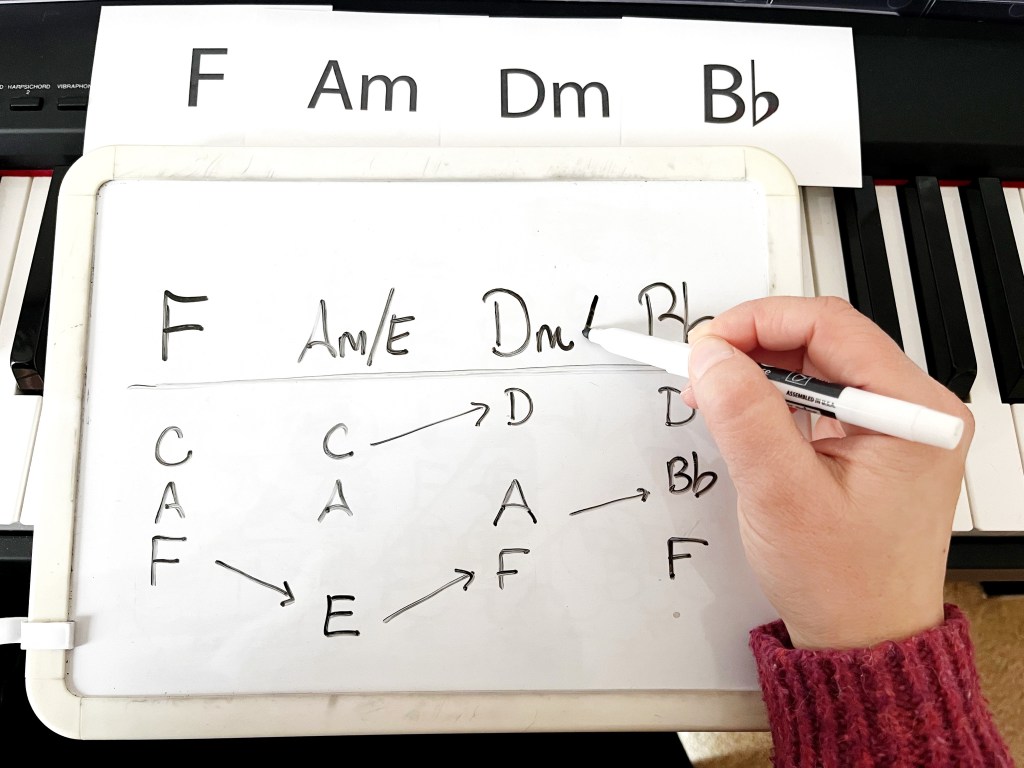
Pick a chord progression. Have the student write out the chords. The student should then analyze the chords (what pitches do they have in common? Are any of the pitches neighbors?, etc.). From their observations, rewrite the chords in different inversions and play the chord progression. Experiment with different inversions. Which was easier to play? How did the inversions sound with the melody (if using a chord progression from a lead sheet)?

Thinking about inversions in this sense, turns the activity into a puzzle with multiple solutions!

A chord progression is laid out on the piano. A piano student uses a whiteboard and dry erase marker to write out the chords and identify the best inversions to use for the chords.

Chord Games

Kids love games and they are a great way to test their knowledge! Here a few games that can be played with things you probably already have in your studion!

Chord Match/Memory

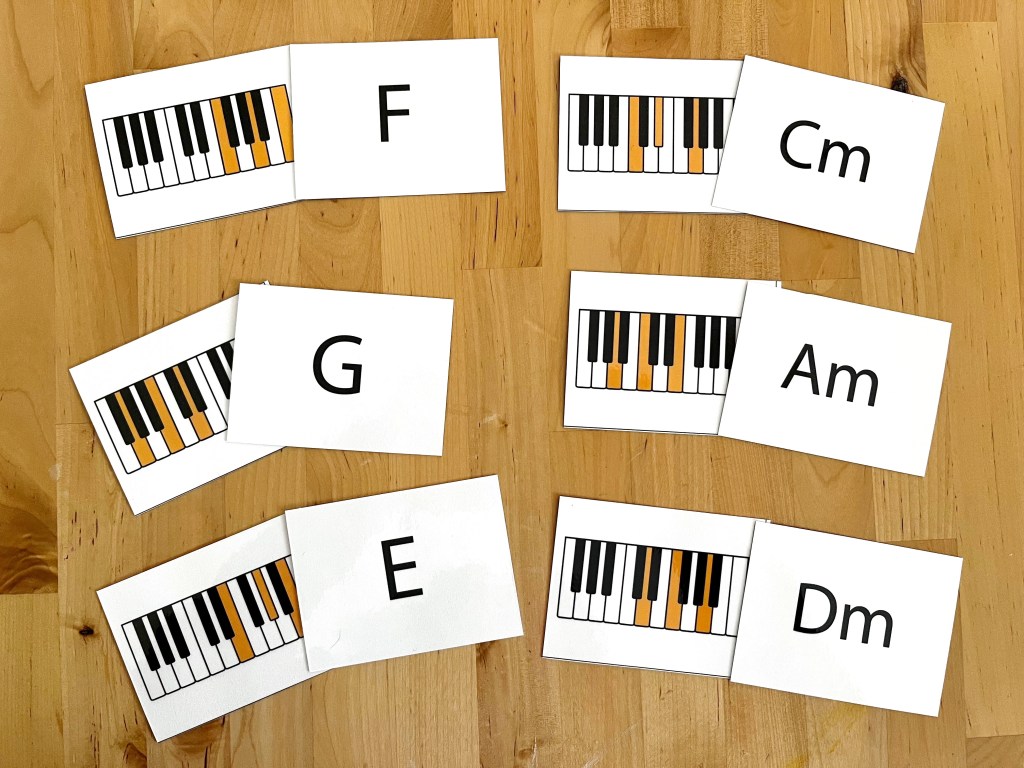
Using the keyboard chord cards and the chord symbols cards, select matching chords from each deck that the student is working on (for example, the C minor keyboard card and the C minor symbol card).

Chord flashcards are paired up on a table. The chord symbol matching the highlighted keys on the keyboard cards.

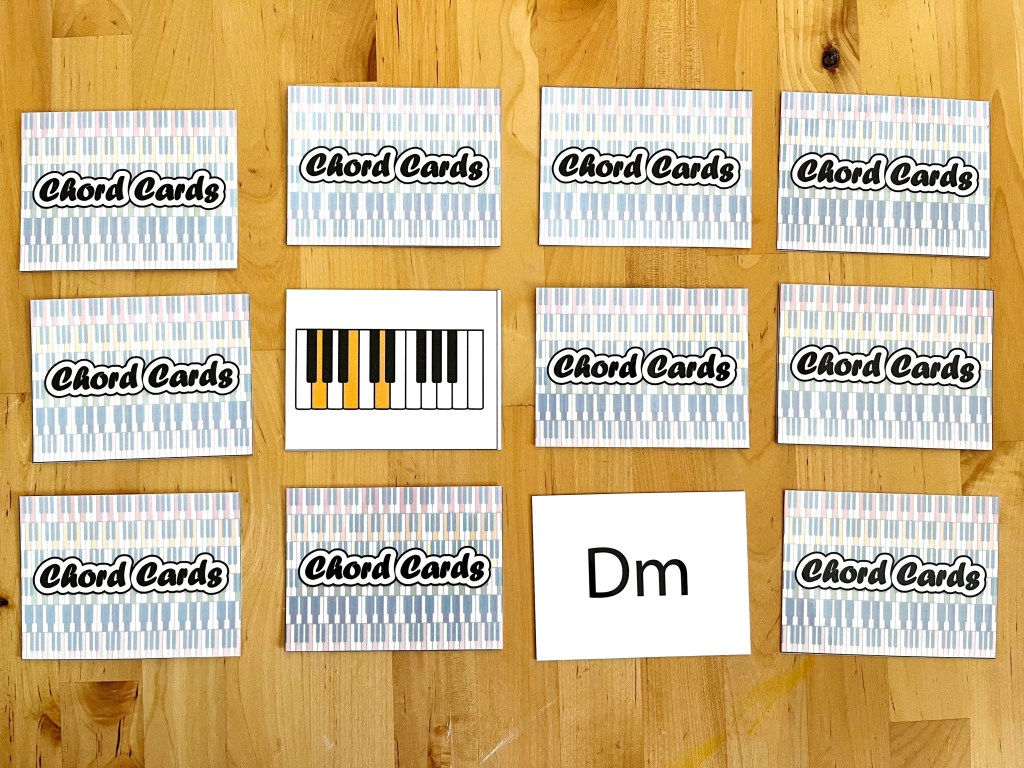
Lay them face down on a table. Play a game of Memory, where players take turns flipping over two cards, trying to make a match.

Two cards in a game of Memory are flipped over but do not match.

Whoever has the most matches at the end of the game, wins!

Speed Chords

This game uses the chord cards, a stopwatch, dry erase board and marker, and mini-erasers.

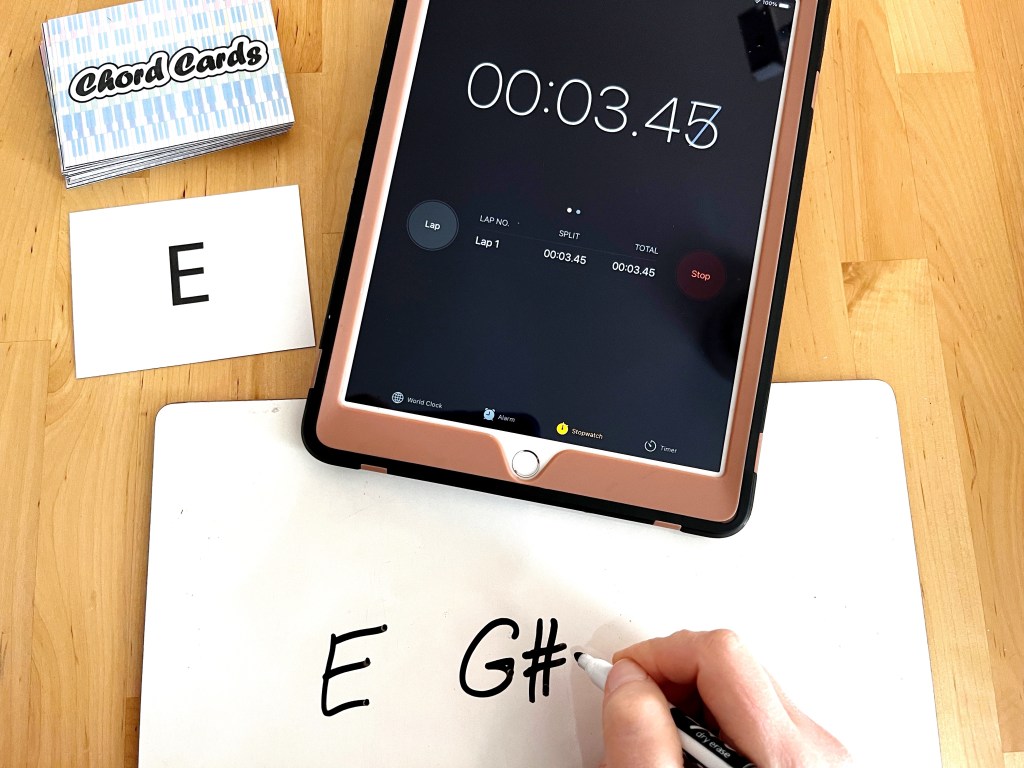
Player 1 draws a chord card while Player 2 controls the stopwatch. As soon as the Player 1 flips over the card, Player 2 should start the stopwatch.

A piano student quickly writes down the notes of an E major chord as a stopwatch times them to see how long it takes.

Player 1 must write out the chord on the dry erase board as quickly as possible. When Player 1 says, “Done!” Player 2 should stop the stopwatch. Player 2 checks Player 1’s work. If the chord is correct, Player 2 tells Player 1 how long it took for them to write the chord. The number of seconds is how many mini-erasers Player 1 must stack. For example, if it took Player 1 five seconds to write out the chord, they should stack 5 mini-erasers.

A piano student stacks mini-erasers after completing an E major chord in 6 seconds.

If the chord is incorrect, Player 2 unpauses the stopwatch and Player 1 must try again!

When Player 1 has stacked their mini-erasers it is then Player 2’s turn and the above procedure is repeated for Player 2 (with Player 1 now being in charge of the stopwatch). Play continues back and forth, with players adding more mini-erasers to their towers each round.

Players should work fast because whoever’s tower falls over first loses!

Chord Relay

This is a fun group game! All you need are the chord cards, two dry erase boards, and two dry-erase markers.

Divide the group into two teams and have them sit in two lines. Give each team their own set of dry-erase board and marker.

The first player of each line should have the board and marker. The teacher hands a chord card to the first player of each team and says, “Go!” The two players must write down the pitches that make up their chord as quickly as possible.

When they have finished, they should pass the dry erase board and marker to the next player in line. The teacher should then give the second player a new chord card.

Play continues down the line until all the players from one team have had a turn. The teacher then checks their work. If all their chords are correct, they win the round. If not, the other team has a chance to finish up. When they are done, the teacher will check their work. If all of their chords are correct, they win. If not, the team with the fewest mistakes is the winner.

Explore more creative teaching ideas
  • Three-Chord Dash
    Boost your students’ chord skills with this fun, fast-paced game! In Three Chord Dash, students race to build their chords quickly and accurately. Who will be the fastest?! On your mark, get set, go!
  • Chord Snowblast
    Build chords and collect points while trying to avoid the snow blast! Kids will test their knowledge of building chords AND they will actually be hoping to get all the chords with sharps and flats!!

Let’s stay in touch, join the list!

As a “toucan” of our appreciation download a free set of note flashcards (link in our Welcome email)!

Processing…
Success! You're on the list.

We are a participant in the Amazon Services LLC Associates Program, an affiliate advertising program designed to provide a means for sites to earn advertising fees by advertising and linking to Amazon.com. As an Amazon Associate we earn from qualifying purchases.

Three Chord Dash – A Chord Building Game

At our last group lesson, we worked on our chord building skills! Some students were learning chords for the first time while others already had experience playing chords in their music. Three Chord Dash offered an even playing field for everyone and it was a blast to see them try to be the first to collect all of the pitches.

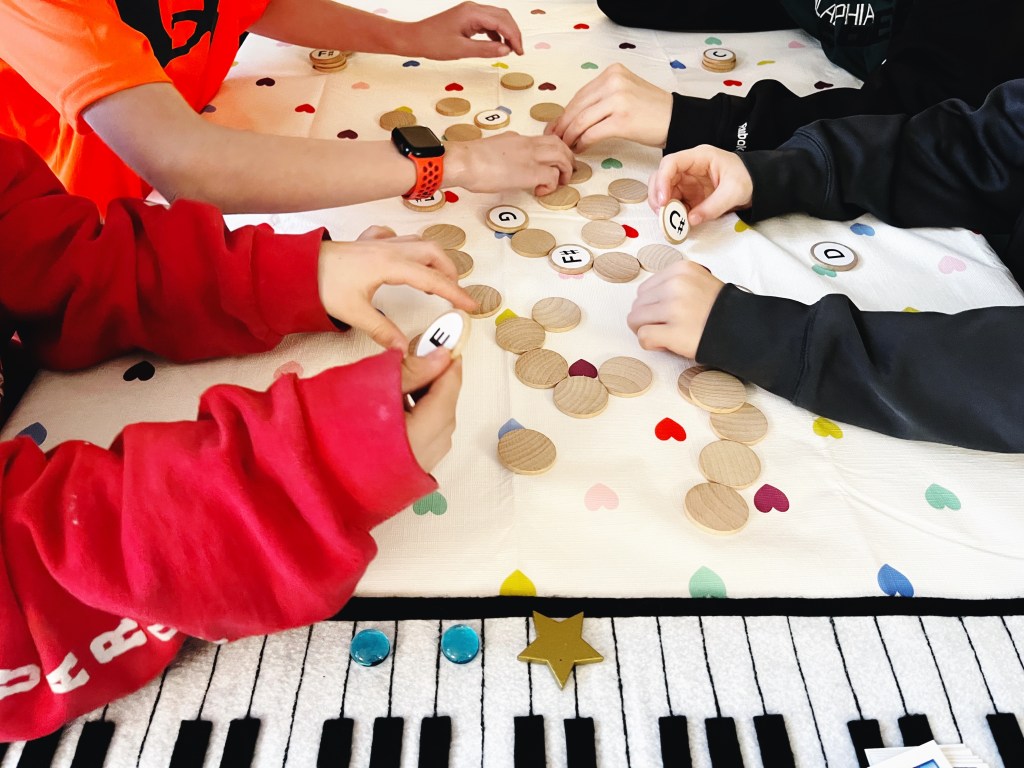
Piano students race to complete their chord by flipping over wooden circles with pitch names on them.
  1. To play, you will need
  2. Game Set-up
  3. How to Play
  4. Make it harder!
  5. How to Make the Wooden Circles with Pitch Names
  6. Let’s stay in touch, join the list!

Three Chord Dash is a versatile, fast-paced chord building game to help your students memorize the pitches that make up a given chord. It can be used in both private lessons or group lessons by students of all skill-levels (because it’s always a good idea to drill chords!). Students can be tested on any type of chord and/or inversion.

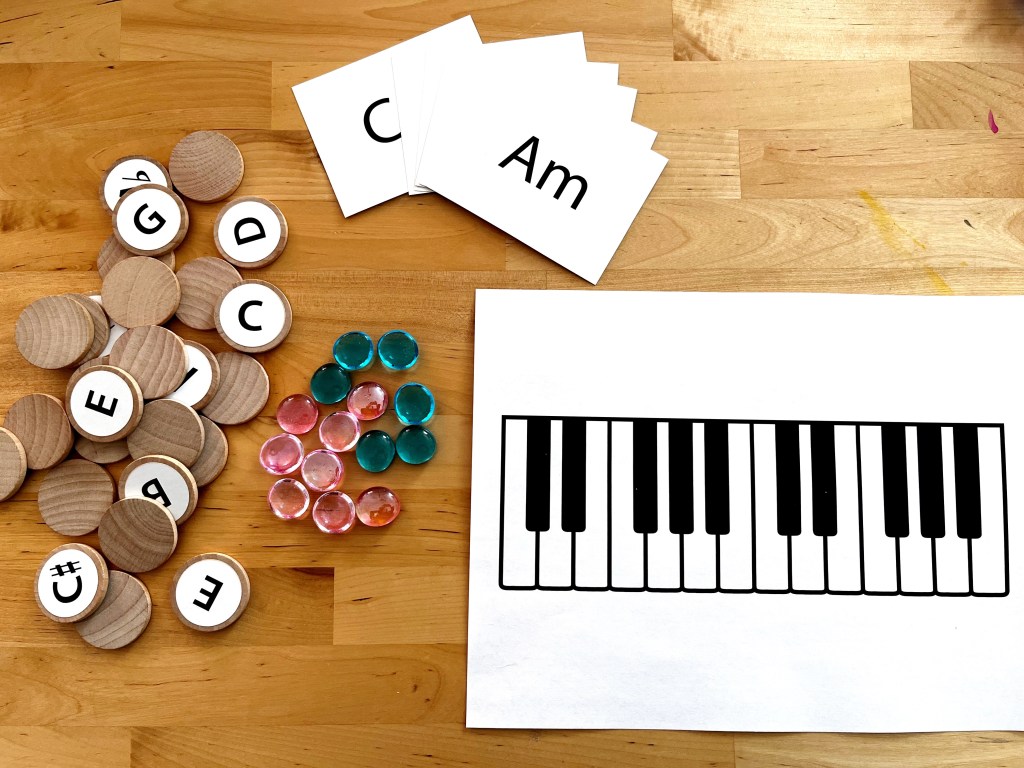
To play, you will need

  • Chord flashcards (I used mine, available in the Toucan Piano Shop for download). Alternatively, you can simply call out the chords you would like to drill or use an app like Decide Now! (Check out my blogpost on how to use the Decide Now! app)
  • Pitches on wooden circles
  • Keyboard print out (one for each player or team) – A great option are these dry erase keyboard/staff sheets (they are made from a cardstock-like material. They are double-sided, which make them great for a wide variety of tabletop games).
  • Mini-erasers, gems, or any other gamemarker (3 per player or 3 per team)
Supplies for a chord games are laid out on a table. The supplies include chord cards, a keyboard printout, wooden circles with pitches printed on them, and blue and pink gems.

If you’d like to see how I prepared the materials for the game, jump down here.

Game Set-up

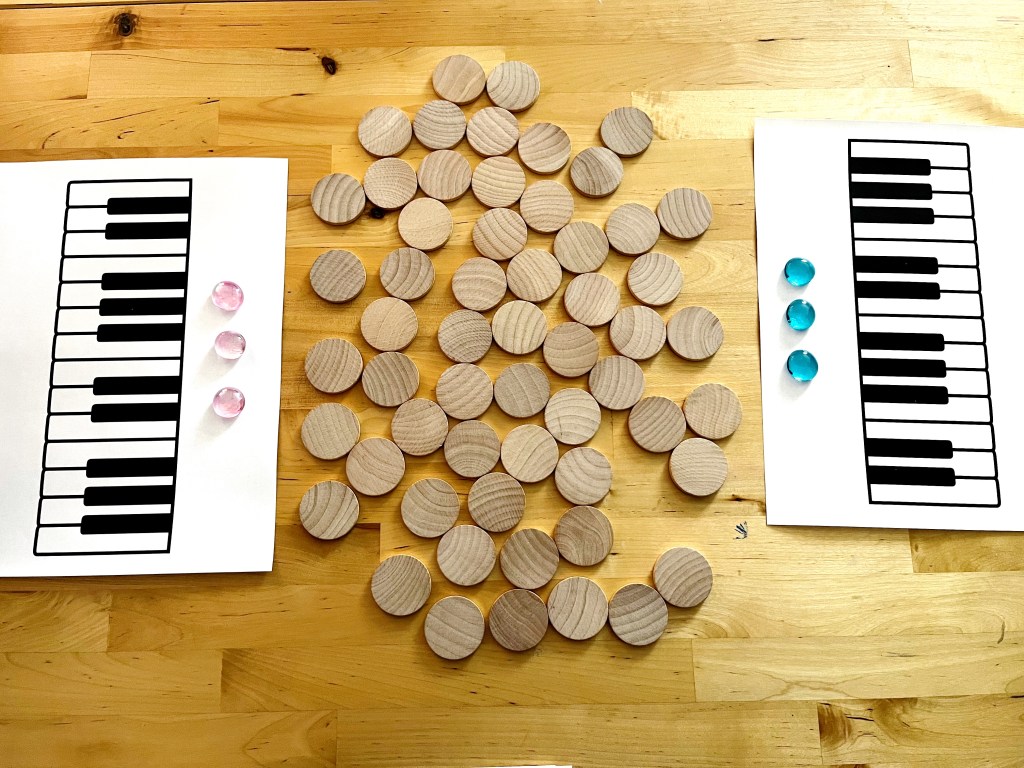
Give each player or team a keyboard print out and 3 gamemarkers (mini-erasers, gems, etc.).

The wooden circles should be placed in the center of the table, pitch side down. Scramble the wooden circles.

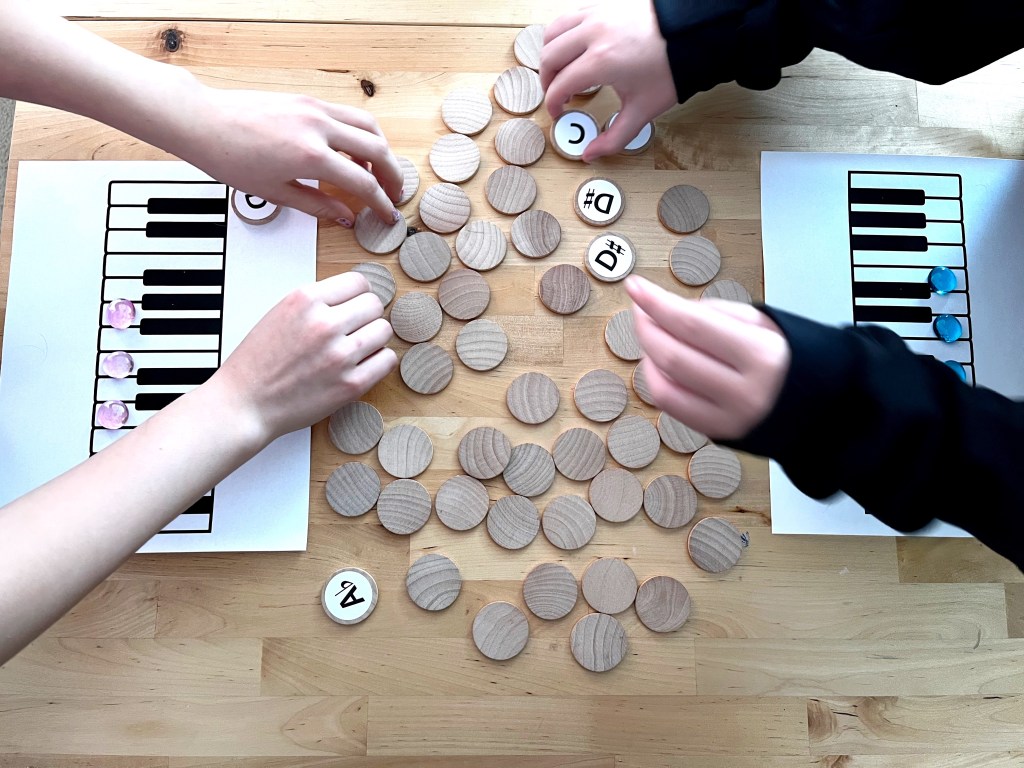
Three Chord Dash, a chord game, is set up on a table. Each team has a keyboard printout with 3 gems lined up along the top of the printout. Wooden circles are arranged at the center of the table between the two printables.

Shuffle the chord flashcards and place them to the side.

How to Play

The game will be explained for two players. To play with a group, each action explained below should be performed by the group working together.

The teacher flips over the top card of the chord flashcard pile.

Players analyze the chord. Using the keyboard printable, players place a gamemarker on the each keys that makes up the chord. The teacher verifies their work and makes any corrections necessary.

Piano students place their gamemarkers on their keyboards to create an A minor chord.

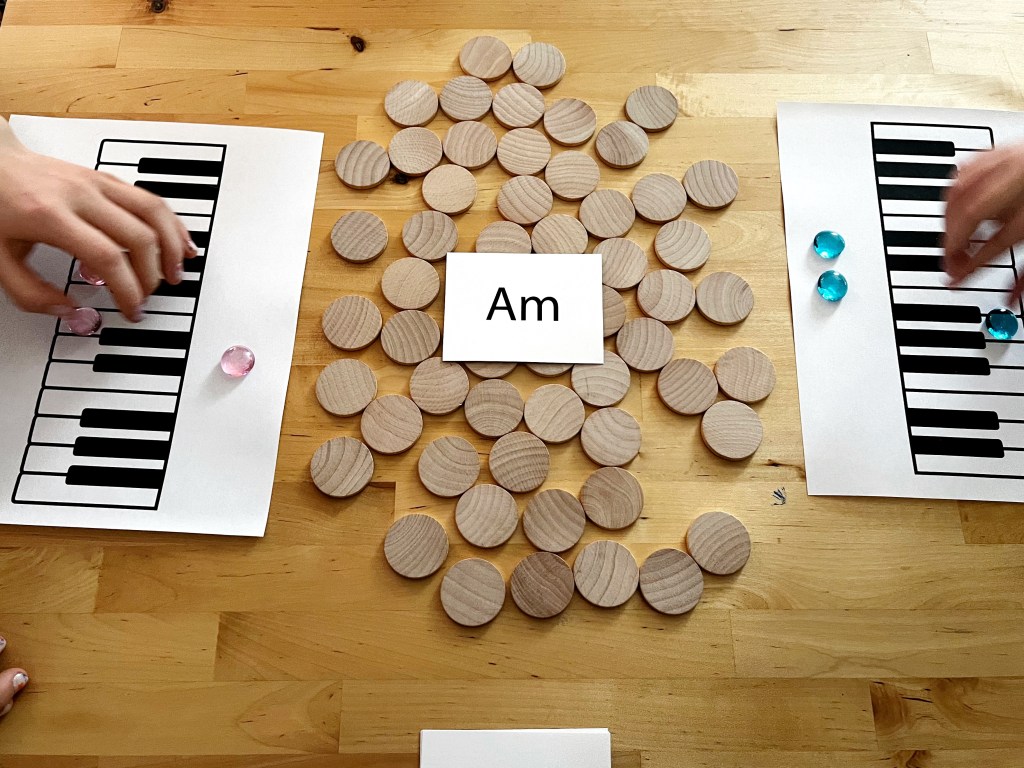
It is now a race! Players simultaneously flip over the wooden circles to try to find the pitches they need to complete the chord. When a pitch is found, they place the circle in front of them and continue searching for the remaining pitches.

Players quickly turn over the wooden circles at the center of the table to reveal the pitches and attempt to find an A, a C, and an E.

The first player to complete the chord wins the round. The player who completes three chords first is the winner of the game!

The player on the left has completed their chord first.

Make it harder!

If your students are very familiar with chords, you can play Three Chord Dash without the keyboard printable and gamemarkers.

Simply flip over a chord card and start the race! Whoever successfully finds the correct pitches and lines them up properly wins the round.

Take it a step further and have students build the chords in a different inversion each round!

How to Make the Wooden Circles with Pitch Names

Kids love manipulatives and I use the wooden circles over and over again for a variety of games and activities at my studio. And they are very durable! Which is important in fast-paced games like Three Chord Dash since kids are frantically grabbing at them and flipping them over.

I purchased these 1.5″ wood coins in bulk (since I needed to create more than one of each pitch).

There are many different ways to the make the pitch circles. The simplest and quickest way is to use a permament marker and write the names of the pitches directly on the wood coins.

If you would prefer to have the pitches be printed, I used 2″x4″ Avery Shipping Labels. Three pitch names fit on each label (I used Adobe Illustrator to make the circles and align everything, but Avery has a template you can download from their website which would work just as well, minus the circles).

Cut out the individual labels.

Music pitches printed on label paper.

I then used a 1.25″ circle punch (I’ve used this brand in a different size) to cut out the individual pitches.

A 1.25 inch circle punch cuts out the pitches on the labels.

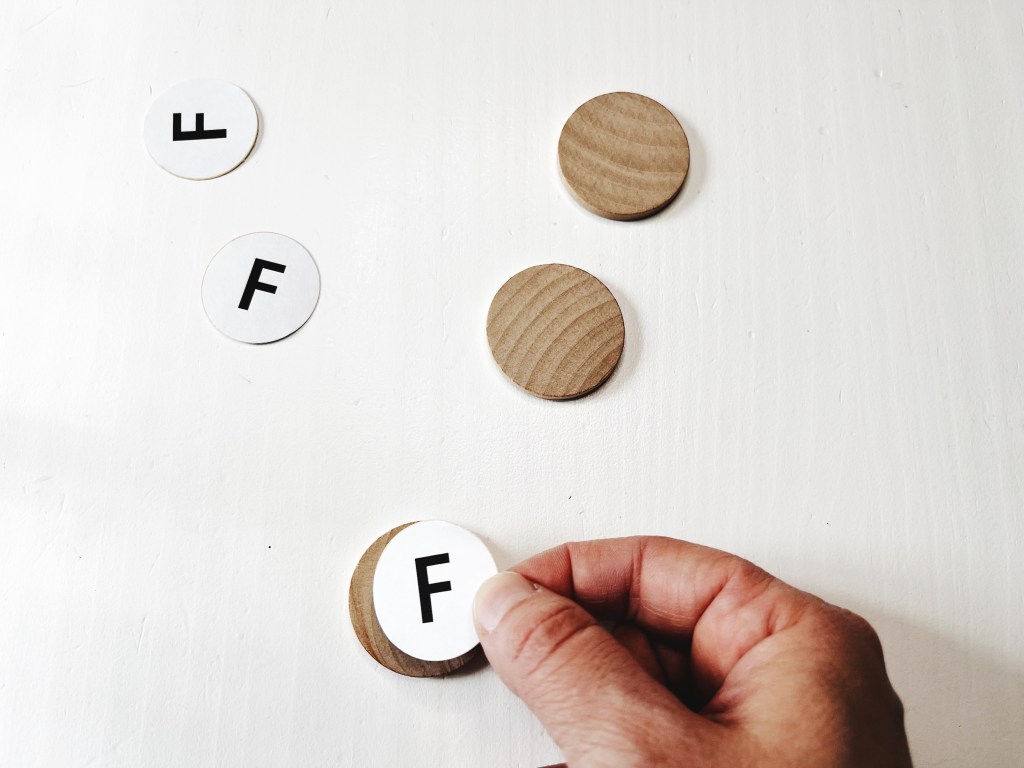
Since the labels are stickers, you can then remove the backing and stick them onto the wood coins.

The label with the pitch name is glued to a wood coin.

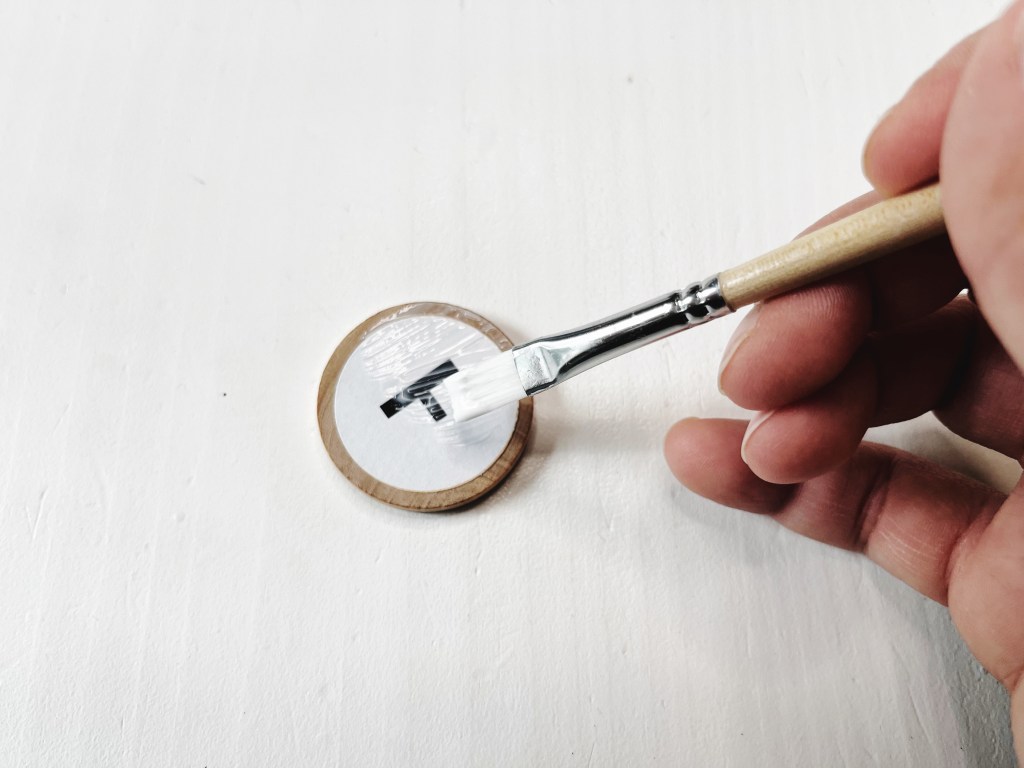
For added protection, I applied a layer of sealant (Mod Podge) over the sticker.

The top of the wood coin and label is sealed with Mod Podge.

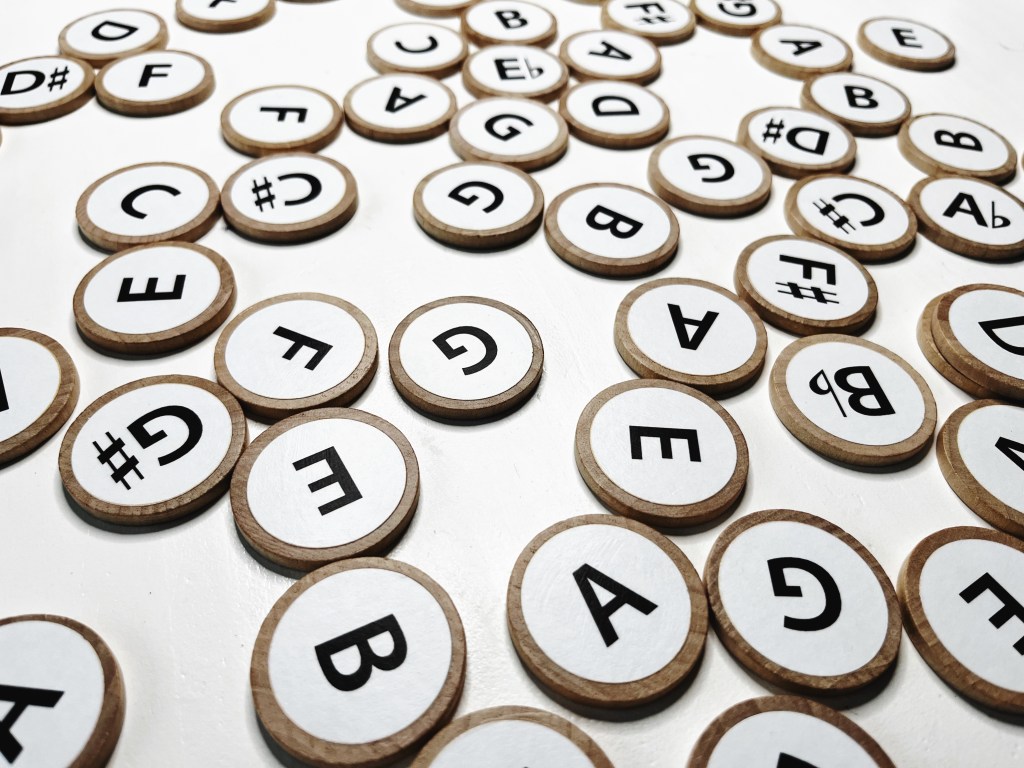
Make as many as you need!!

Wood coins with music pitches printed on them are arranged on a white table.

Explore more creative teaching ideas
  • Chords Cards – How to Use them with your Students
    I love flashcards!  They are extremely effective for active recall and the long-term retention of concepts. And the best part? They have SO many uses! From interactive games and hands-on activities to group challenges, the possibilities are endless!
  • Best in Pass
    Note-reading and fine motor skills combined! Students will race to be the first to match the letter ping-pong balls to the notes on their spoons. But there’s a twist! They cannot touch the balls with their hands.
  • Snowball Rhythm Game
    Who will be able to make the longest rhythm train before the dreaded “Busted!” stick is revealed?! Kids will practice their rhythms while also practicing their aim in this fun toss game.
  • Chord Snowblast
    Build chords and collect points while trying to avoid the snow blast! Kids will test their knowledge of building chords AND they will actually be hoping to get all the sharps and flats chords!!
  • Two Sides of the Same Coin
    A game about enharmonics that can be played in several different ways! Students will try to collect the most enharmonic pairs and hope that their coins don’t get stolen by another player.

Let’s stay in touch, join the list!

As a “toucan” of our appreciation download a free set of note flashcards (link in our Welcome email)!

Processing…
Success! You're on the list.

We are a participant in the Amazon Services LLC Associates Program, an affiliate advertising program designed to provide a means for sites to earn advertising fees by advertising and linking to Amazon.com. As an Amazon Associate we earn from qualifying purchases.

Eyes on the Music! Fun and Effective Strategies to Stop Students from Looking at Their Hands

Do your students constantly look down at their hands when their playing?

Beginner students will often look down at their hands because they don’t trust their fingers to navigate the keys soley by touch. In order to avoid mistakes, they look down from their music to visually find the next note they need to play. Their eyes become a crutch which delays the development of the spatial awareness and muscle memory they need to play the piano.

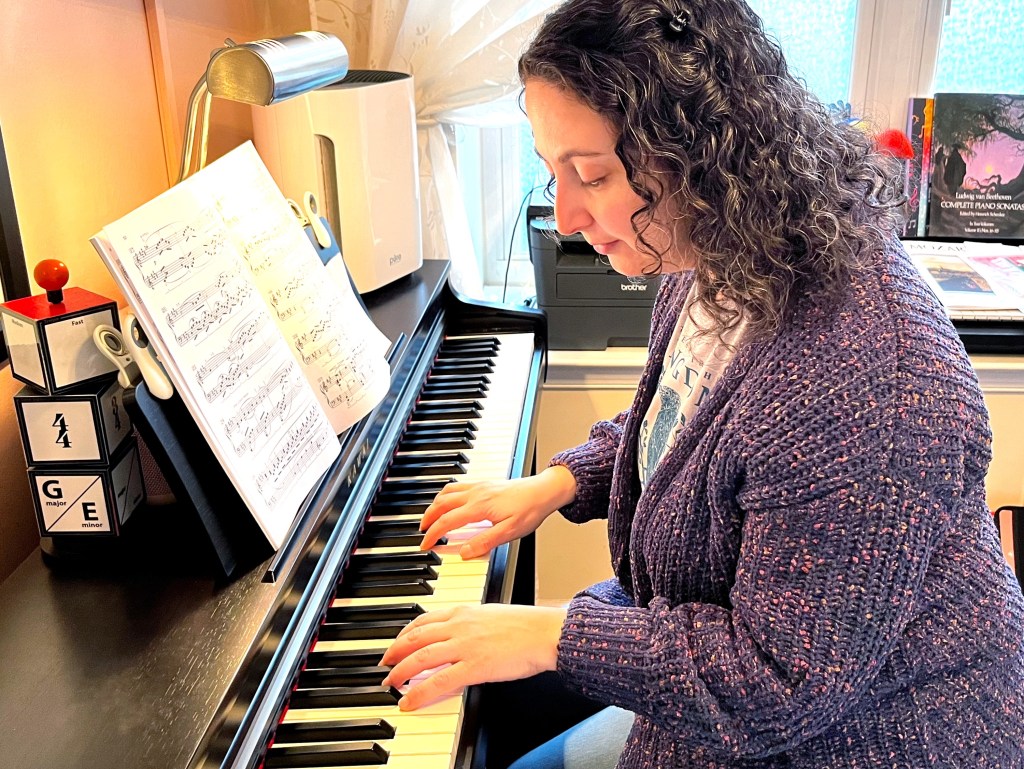
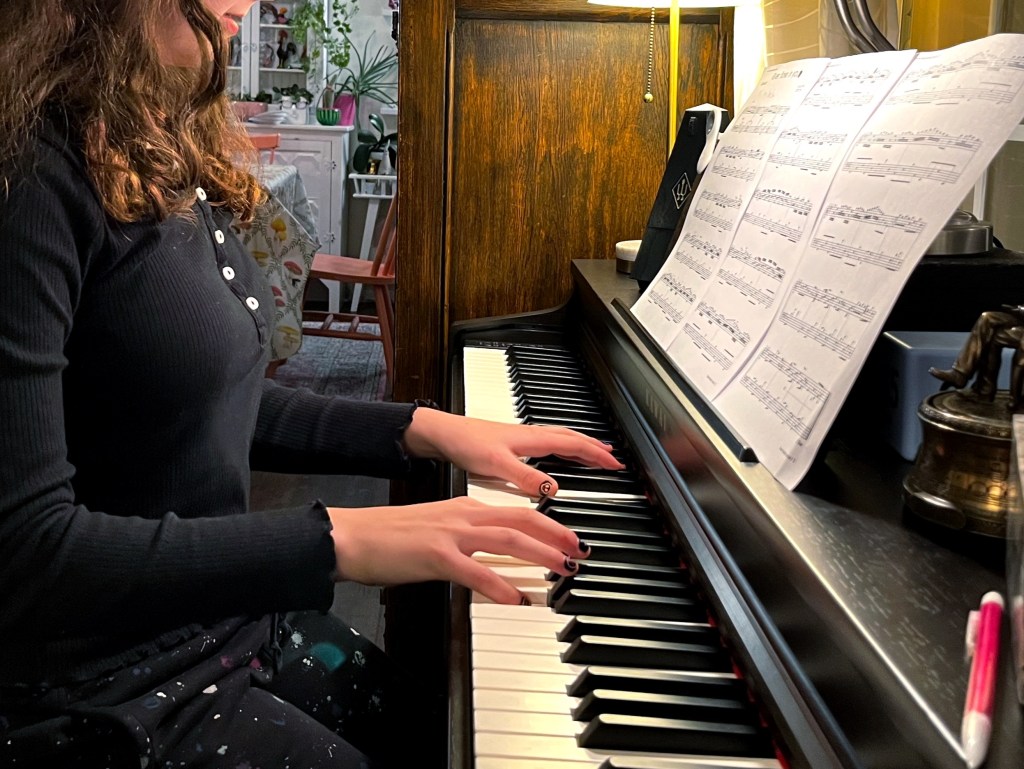
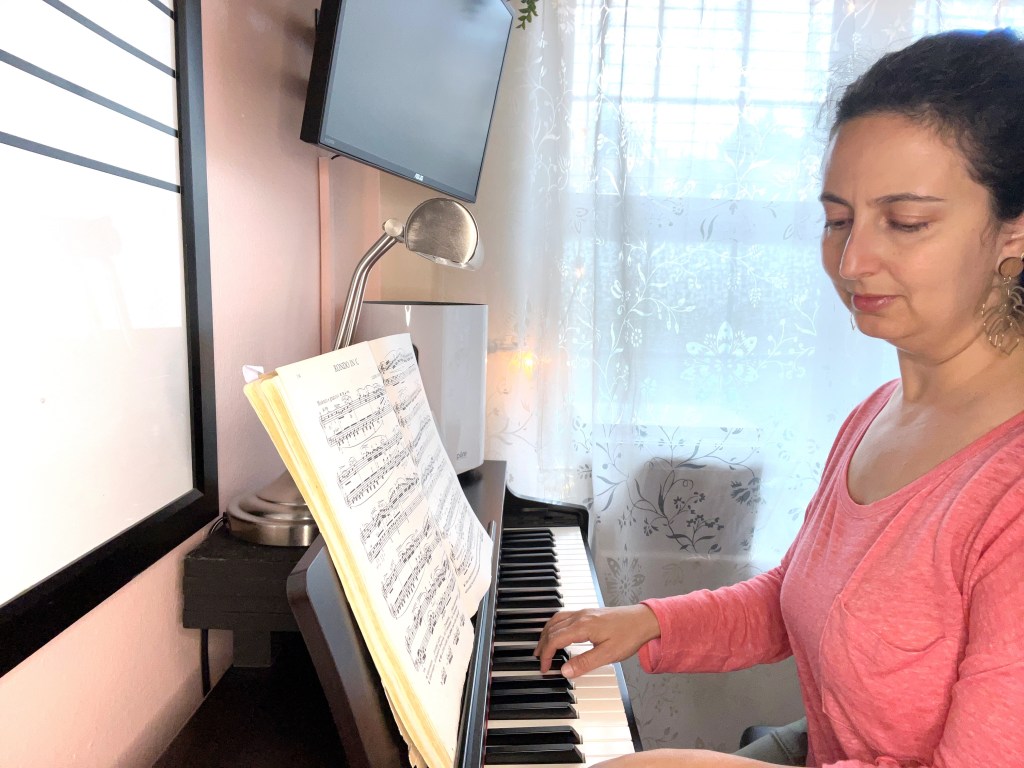
Piano student looks down at her hands while playing the piano.

  1. Why is it important for students to keep their eyes on the music?
  2. Exercises for Keyboard Awareness
  3. Practice Strategies to Keep Eyes on the Music
  4. Can Students EVER look down when playing?
  5. Let’s stay in touch, join the list!

As teachers, we want our students to trust their fingers, develop a deeper connection with the piano, and, ultimately, become confident pianists. To do so, we can use exercises during our lessons to help students build confidence in finding their way around the piano by touch, as well as suggest practice strategies that encourage them to stay focused on the music by blocking their view of the keys (because let’s face it, habits are very hard to break and sometimes we need a little helping hand… or beard! Or even a hoodie!!).

As teachers, we want our students to trust their fingers, develop a deeper connection with the piano, and, ultimately, become confident pianists.

A piano student confidently plays the piano while keeping their eyes on the music.

Why is it important for students to keep their eyes on the music?

In the beginning stages of learning a piece, we are teaching our fingers the movements and distances they need to navigate in order to play that particular piece. By constantly looking and placing our hands and fingers on the right keys we are not allowing our fingers to feel their way around the keyboard and learn how far they need to go to play. Just like a basketball player has to be able to dribble a ball without staring down at it, a pianist must be able to navigate the piano without looking down all the time.

Just like a basketball player has to be able to dribble a ball without staring down at it, a pianist must be able to navigate the piano without looking down all the time.

Another reason we don’t want to look down is because it cuts the flow of the music. The small amount of time it takes to look down at the hands and then look up again to find our place in the music is enough to miss a beat or two… or even more. Looking down becomes a crutch for students and introduces pauses in the music, which can become ingrained and end up compromising the overall flow and structure of the piece.

Exercises for Keyboard Awareness

1) What Key is that?

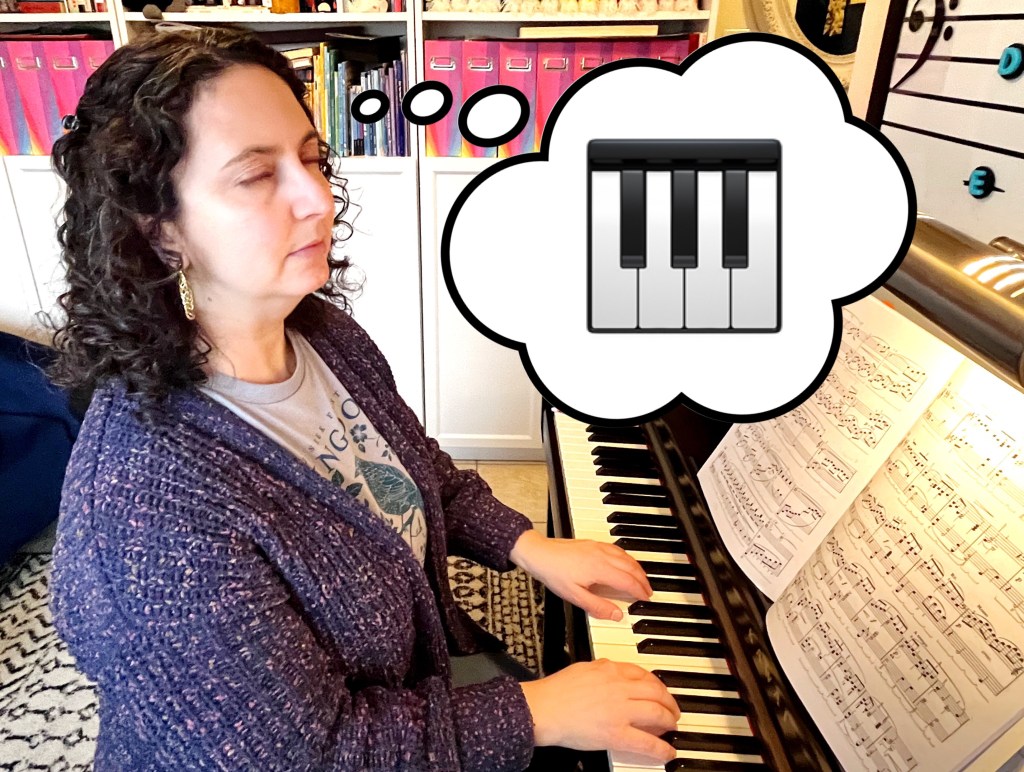
This is a great exercise for students to really think about what key each individual finger is resting on. Have the student find the starting position of their piece. Close their book and have the student close their eyes. Then ask them, “What key is finger 2 of your right hand sitting on?” When the student has answered, ask about a different finger, “What key is finger 4 of your left hand sitting on?” And so forth, alternating hands and scrambling the finger numbers you call on.

I encourage students to visualize the piano in their mind’s eye and tap the finger I’m asking about on the key (without actually playing it).

Piano student keeps eyes closed while visualizing the keys of the piano in her head.

As students become more confident, you can move their hands to random positions on the piano or increase the speed of your questions.

2) Find your Spot

This is a great exercise for students to feel how their arms are also an integral part of placing their hands on the piano (students often become hyperfixated on the fingers and hands and don’t realize how important everything from the wrist up is!). It also helps them to really feel the key patterns on the piano with their fingers.

Cover the piano keys. Open their book to the piece they are working on. Ask the student to place their hands on their head. Have them analyze the starting position of their piece. When they feel they are ready and have a mental image of where their hands should be placed on the piano, have them close their eyes.

Piano student closes her eyes and places her hands on her head while sitting at the piano.

Uncover the piano keys and tell them to find their starting position by just feeling their way around the piano. With their eyes still closed, the student will lower their hands and attempt to place their hands on the correct keys. When they think they have it, they can open their eyes and see if they are right.

3) One Small Leap…

A lot of beginner music has students playing in one position throughout the entire piece. This exercise helps students make small moves around the playing position to build awareness of the keys that are close by.

Have the student place their hands in the starting position of their piece, then ask them to close their eyes.

Give instructions such as:

  • Move your left hand thumb up a step. What key is it on now?
  • Move your right hand pinky up a step. What key is it on now?
  • Move your entire right hand down a step. Play and name all the keys your fingers are touching.
  • Move your entire left hand up a skip. Play and name all the keys your fingers are touching.
  • Cross the second finger of your right hand over your thumb. Play the key and name it. Then return your hand to the starting position.
  • Move finger 3 of your right hand onto the black key a half step below it. Play the key and name it.
  • Any other movement that is in their practice piece or variation you can think of.
A right hand on the piano crosses finger 2 over the thumb to play a B

Practice Strategies to Keep Eyes on the Music

Habits can be hard to break in general and if a student has become reliant on looking at their hands while playing, they may need some extra help to not peek… especially because sometimes they don’t even realize they are doing it!

So, how can we encourage students to keep their eyes on their music?

1) Cover the Student’s Hands with a Book

If a student is constantly looking down at their hands during a lesson, a quick fix is to hold a book over their hands, obstructing their view. Students are usually amazed with themselves that they can in fact play the piece withouth looking down!

Piano teacher holds a book over a piano students hands to obstruct their view of the keyboard.

This practice strategy can be used at home as well if a parent is available to help.

2) Use a “Beard”

The second strategy is both fun and effective. I saw a similar trick years ago online and when I saw this Santa beard at the store over the holidays I knew I had to have it for my studio. I extended the beard with some fleece.

A package containing a Santa beard and glasses disguise sits on a piano bench

The student puts on the glasses. Then the student tucks the end of the beard under their book on the book rack. The beard hides the student’s hands from view.

Piano student wears a beard connected to toy disguise glasses to obstruct her view of her hands while playing the piano.

It’s hilarious and it works! If you’d like to have a one of your own, you can use a pair of toy glasses and connect a piece of cloth to them.

3) Use a Hoodie worn Backwards

But what about home practice? You can’t always lend out your beard and a parent may not be available to sit with a student while they practice. In this case, the student can use something that is ubiquitous with kids nowadays… the hoodie!

A student plays the piano wearing a hoodie that is on backwards. The hood is lifted so the student cannot see their hands.

This trick works like a charm! Have the student turn their hoodie around, so that the hood is in front of them. The student then adjusts the hood so it is propped up. And there you go! They will not be able to see their hands when they play.

Can Students EVER look down when playing?

Yes! There is a time and place for everything. The real question becomes, “Is what I’m doing benefitting the music? Am I achieving the sound I want from the piano when I look down?”

In general, large leaps and difficult passages require more from us and we do look down at our hands to navigate these passages. BUT at this point, the music is usually memorized and/or looking down has become part of the how the pianist plays the piece. Looking down in this case is not a crutch but adds to the accuracy and flow of the music.

Pianist plays a piece by Beethoven while looking down at the keyboard.

Explore more creative teaching ideas
  • Slurs & Ladders: The Recital Prep Game
    If there is one game my students beg to play year after year (and sometimes when we don’t even have a recital anytime soon!) is this recital prep game. It’s a great de-stressor and it shows students how prepared they are to perform while also injecting some fun and joy back into those recital pieces that may be sounding a little tired.
  • Top Practice Tools Every Piano Student should Have: #4 Recording Device
    When used strategically, a recording device can help students gain valuable insight into their playing and progress faster! I’m sharing my favorite recording equipment and different ways students can use recording themselves as a practice tool to improve their playing.
  • Top Practice Tools Every Piano Student should Have: Curiosity
    Curiosity is the catalyst that gets students to start learning the piano in the first place and can be exactly what’s needed to keep them going for the long haul. Why is it so important and how do we keep it going? What if I don’t play an instrument, but want to encourage my child in their practicing? Check out all the answers plus download a free printable for parents!

Let’s stay in touch, join the list!

As a “toucan” of our appreciation download a free set of note flashcards (link in our Welcome email)!

Processing…
Success! You're on the list.

We are a participant in the Amazon Services LLC Associates Program, an affiliate advertising program designed to provide a means for sites to earn advertising fees by advertising and linking to Amazon.com. As an Amazon Associate we earn from qualifying purchases.
Summer Piano Listening List

This summer I’m sending my piano students home with the Summer 60: 60 Days of Piano Music! The goal is for them to listen to a piece most days over summer vacation and complete the entire list by the end of August.

It is SO immensely important for students to listen to music and it’s often one of the things that get lost in the shuffle of life. But the summer, the time of long car rides and barbeques, basically demands music! So why not add a little piano music into the mix?!

The Summer 60 is divided into six categories:

  • Top 20 Sizzlers: 20 pieces for solo piano that most people would recognize even if they don’t listen to classical music
  • Baroque Beach Bonanza: A selection of eight pieces from the Baroque period with pieces by J.S. Bach, Arcangelo Corelli, George Frideric Handel, Georg Philipp Telemann, Jean-Philippe Rameau, Dietrich Buxtehude, and Domenico Scarlatti
  • Classical Campfire Concert: A selection of eight pieces from the Classical period with pieces by C.P.E. Bach, J.C. Bach, Muzio Clementi, Luigi Boccherini, Christoph Willibald Gluck, Joseph Haydn, and Carl Czerny
  • Red-Hot Romantic Remix: A selection of eight pieces from the Romantic period with pieces by John Field, Felix Mendelssohn, Clara Schumann, Edvard Grieg, Modest Mussorgsky, Antonin Dvorak, Sergei Rachmaninoff, and Amy Beach
  • Modern Midsummer Melodies: A selection of eight pieces from the Modern period with pieces by Igor Stravinsky, Sergei Prokofiev, Alexander Scriabin, Maurice Ravel, Arnold Schoenberg, Heitor Villa-Lobos, Bela Bartok, and Dmitri Shostakovich
  • Contemporary Summer Coda: A selection of eight pieces from the Contemporary period with pieces by Philip Glass, Gyorgy Ligeti, Unsuk Chin, Luciano Berio, Lera Auerbach, Errolyn Wallen, Ludovico Eunadi, and Takeshi Kokayashi.

You might be asking, where’s Beethoven, Mozart, Chopin, Brahms, and all the other heavy-hitters?! They are in the Top 20 Sizzlers!! I decided, in order to have a wide variety of composers and music, anyone who was in the Top 20 Sizzlers wouldn’t be added to the period selections (with the sole exception of J.S. Bach because we ALWAYS make an exception for Bach!).

A list of piano music lays on the grass in the sun next to a pair of toucan sunglasses and a colorful beach ball.

Each piece on the list is around 5 minutes (or less! Only a few are longer) so it should be easy to squeeze a quick listen in among all the fun summer activities! Some great times to listen are while driving around town, while winding down before bed, while setting the table, and before practicing (wink! wink! Summer is a fantastic time for practicing!!).

Students can listen to the pieces in any order (but listening to them in order does give them an idea of how piano music has changed over the centuries, which is really neat!). When they’ve listened to a piece, they can check the box next to the piece and rate the piece on the emoji scale on the right:

  • Frowny face: Ugh… I never want to hear that again
  • Straight face: That was good, but not my favorite
  • Smiley face: That was fantastic! Why did it have to end?!

The emoji scale can help students to figure out their musical taste!

Summer 60: 60 Days of Piano Music is available as a printable download in the Toucan Piano Store. Happy listening!!

Explore more creative teaching ideas
  • Rhythm Olympics
    Students will go for gold in the Rhythm Olympics, a multi-level multi-week rhythm game! Students compete in 5 rhythm sporting events in the hopes of collecting all 5 gold medals and being crowned a Rhythm Olympics champion!!!
  • Slurs & Ladders: The Recital Prep Game
    If there is one game my students beg to play year after year (and sometimes when we don’t even have a recital anytime soon!) is this recital prep game. It’s a great de-stressor and it shows students how prepared they are to perform while also injecting some fun and joy back into those recital pieces that may be sounding a little tired.
  • Music Friendship Bracelets
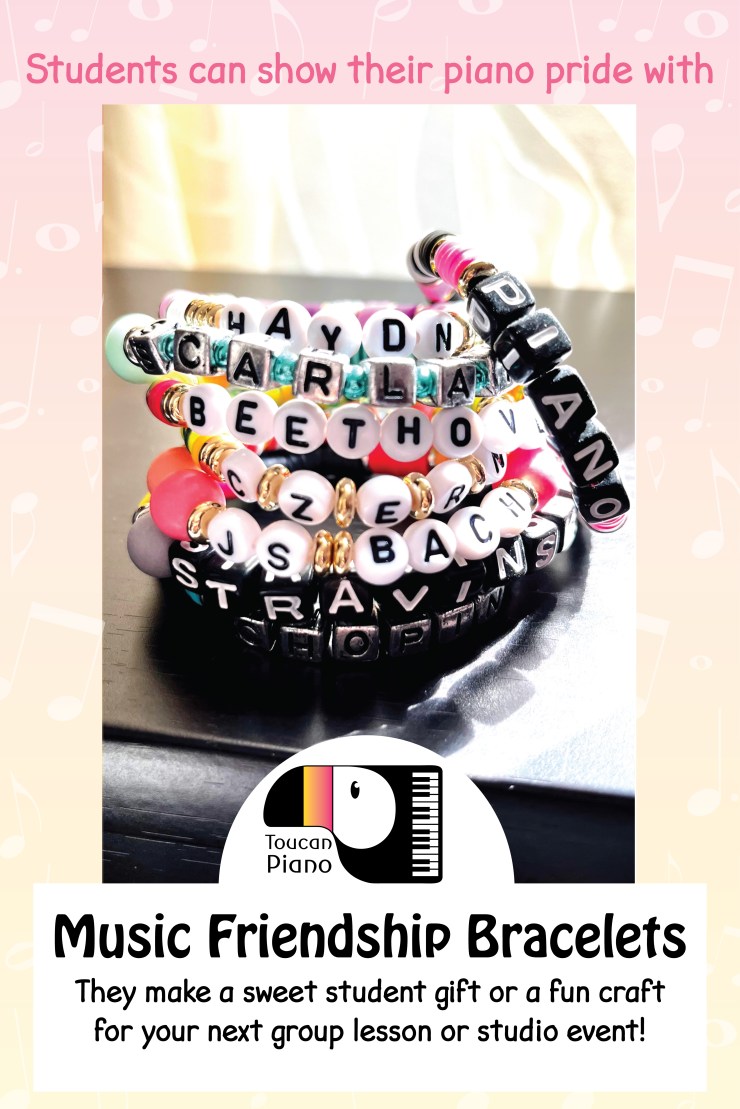
    Colorful friendship bracelets make great student gifts for your next recital or they could be a craft for your students to make at a group lesson or studio event! They are colorful, easy to make, and show off our piano pride!

Let’s stay in touch, join the list!

As a “toucan” of our appreciation download a free set of note flashcards (link in our Welcome email)!

Processing…
Success! You're on the list.

We are a participant in the Amazon Services LLC Associates Program, an affiliate advertising program designed to provide a means for sites to earn advertising fees by advertising and linking to Amazon.com. As an Amazon Associate we earn from qualifying purchases.

Rhythm Olympics

I’m so excited for the Paris 2024 Summer Olympic Games! The amazing breadth of sports, the stories of the athletes, the pure perseverance and triumph over adversity… the Olympics are always epic!

My students are going for gold this summer as well as they compete in the Rhythm Olympics!

Rhythm Olympics cover sits on top of a page from the Metric Medley sporting event. Gold medals lay around the rhythm game.

I’m busting out this studio-wide multi-week game that I made for the 2020 Olympic games again this summer. And since it’s multi-level, the students who played it back in 2021 (both virtually and in-person) will be able to do it again (we’ll just level up)!

I love studio-wide activities because it provides a sense of community for the students (lots of the kids know each other and I LOVE it when I hear that they are talking about our piano lessons outside of the studio!). The studio-wide activies can serve to introduce concepts to younger students, solidify concepts more deeply with older students, and serve as a refresher for more experienced students.

And the summer is an excellent time for a themed activity… especially when the Olympic games are happening!

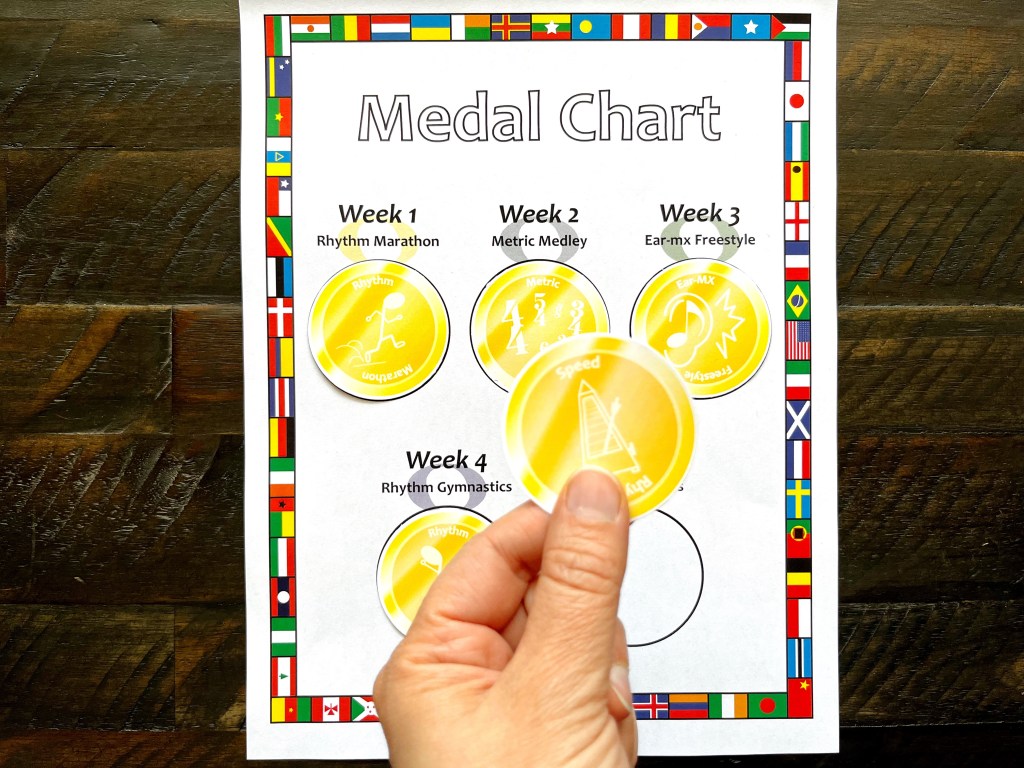
Each student receives their own medal chart. Each week as they try out a new rhythm sport they have a chance to earn a gold medal to add to their chart.

A hand hold a gold medal in the Rhythm Olympics over a medal chart filled with other gold medals.

There are five different rhythm sporting events that students compete in:

  • Rhythm Marathon: Will students be able to make it to the end as more and more rhythms are added on each round?!
  • Metric Medley: Students will put their time signature knowledge to the test!
  • Ear-mx Freestyle: Remind students to clean out their ears because they are going to need them in this x-treme listening challenge!
  • Rhythm Gymnastics: Rhythm and coordination must come together in order to take home the gold!
  • Speed Rhythms: How fast can students play the rhythm sequence?! Will it be enough to earn the gold?

The Rhythm Olympics download also comes with Microsoft PowerPoint versions of all the rhythm sporting events, which is perfect for online/virtual lessons.

A piano student draws a bar line on a rhythm sheet with a black dry erase marker.

Rhythm Olympics also comes with a practice log. In order to qualify for the next Rhythm Olympics sporting event, students have to practice a certain number of days during the week.

Rhythm Olympics can be an individual challenge for each student or you can use the silver and bronze medals that come in the download to turn it into a competition among all your students! Each Rhythm Olympics sporting event comes with suggestions on how to incorporate the silver and bronze medals. Keep track of how many gold, silver and bronze medals each student wins and see who can earn the most gold medals!

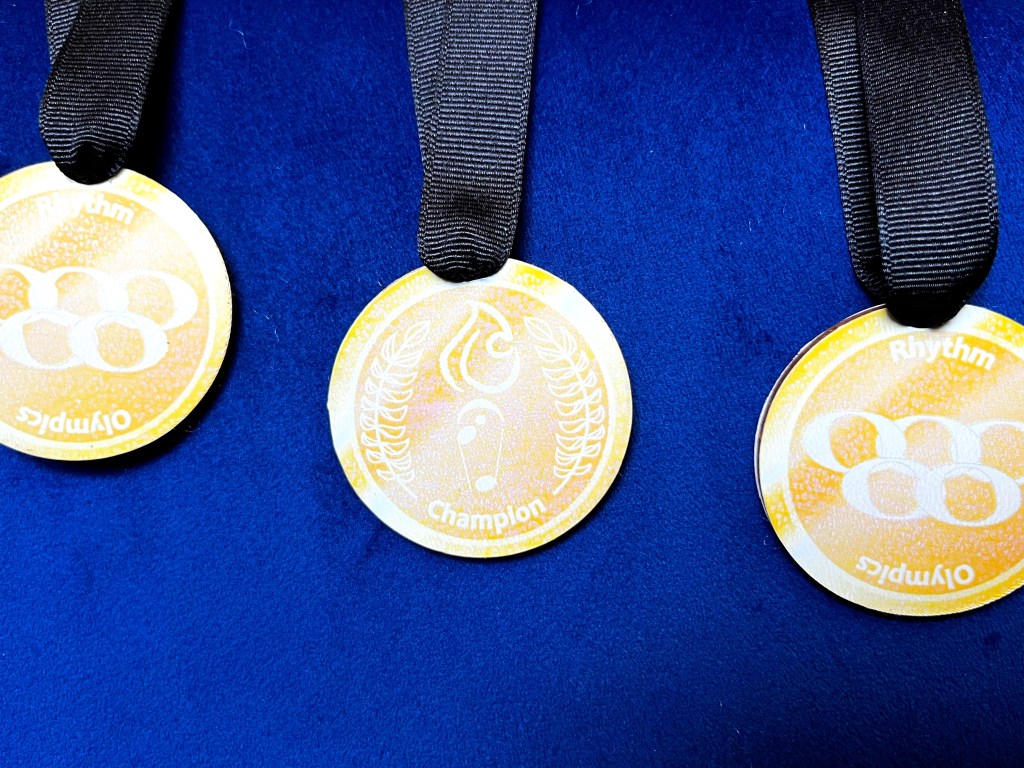
Included in the download is a gold Champion medal printable. At the end of Rhythm Olympics, each student can receive a Champion medal for having completed all of the rhythm sporting events!

The gold champion medal sit on a velvety blue background

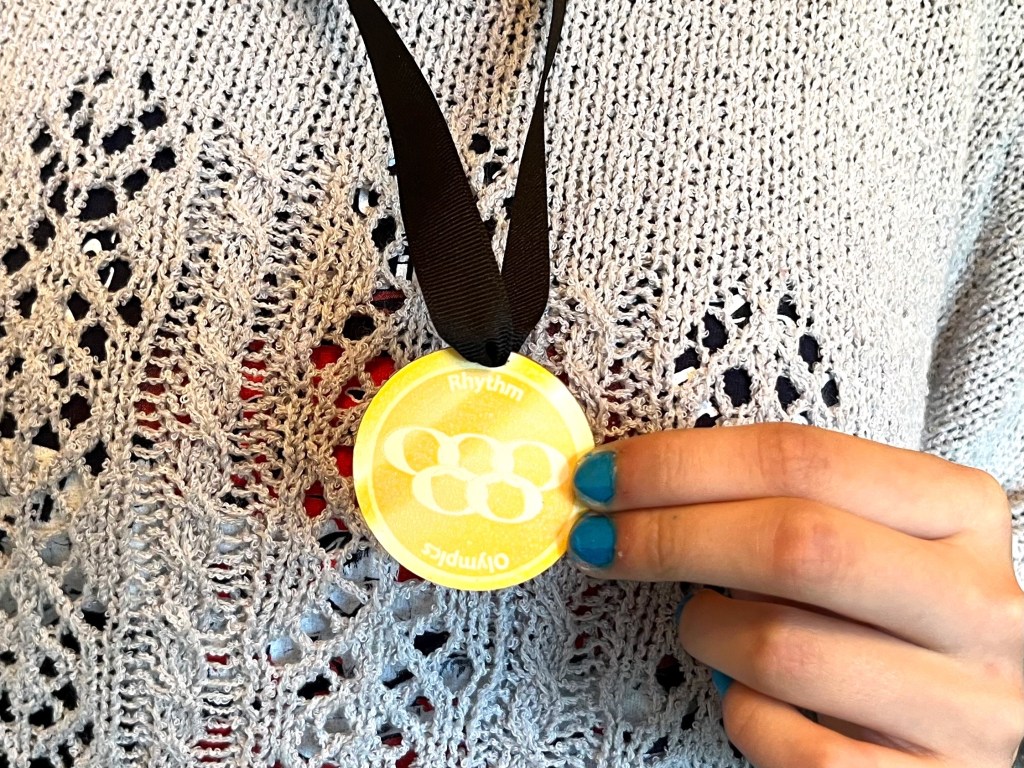
I took the medals a step further and glued them to these wooden circles with holes and ran a strand of ribbon through the holes, turning them into actual medals my students could wear! They loved them!

A piano student holds up a gold Rhythm Olympics medal.

Rhythm Olympics is available for purchase in the Toucan Piano store.

Explore more creative teaching ideas
  • Halloween Note-Reading Challenge
    Every fall, when students return to lessons after summer break, I feel like we spend the first month just reviewing concepts and note-reading. The summer slide is a real thing… This studio-wide Halloween note-reading challenge gets things back on track. Only the best note-readers will survive the Zombie Pian-o-pocalypse!
  • Slurs & Ladders: The Recital Prep Game
    If there is one game my students beg to play year after year (and sometimes when we don’t even have a recital anytime soon!) is this recital prep game. It’s a great de-stressor and it shows students how prepared they are to perform while also injecting some fun and joy back into those recital pieces that may be sounding a little tired.
  • Top Practice Tools Every Piano Student should Have: Curiosity
    Curiosity is the catalyst that gets students to start learning the piano in the first place and can be exactly what’s needed to keep them going for the long haul. Why is it so important and how do we keep it going? What if I don’t play an instrument, but want to encourage my child in their practicing? Check out all the answers plus download a free printable for parents!

Let’s stay in touch, join the list!

As a “toucan” of our appreciation download a free set of note flashcards (link in our Welcome email)!

Processing…
Success! You're on the list.

We are a participant in the Amazon Services LLC Associates Program, an affiliate advertising program designed to provide a means for sites to earn advertising fees by advertising and linking to Amazon.com. As an Amazon Associate we earn from qualifying purchases.
The Ultimate Piano Recital Prep Game

If there is one game that my students ask for and can’t wait to play each and every year, it is our recital prep game! I bust out this game at our last lesson before the recital and we have a great time putting their recital pieces through the wringer (with a lot of laughter along the way!).

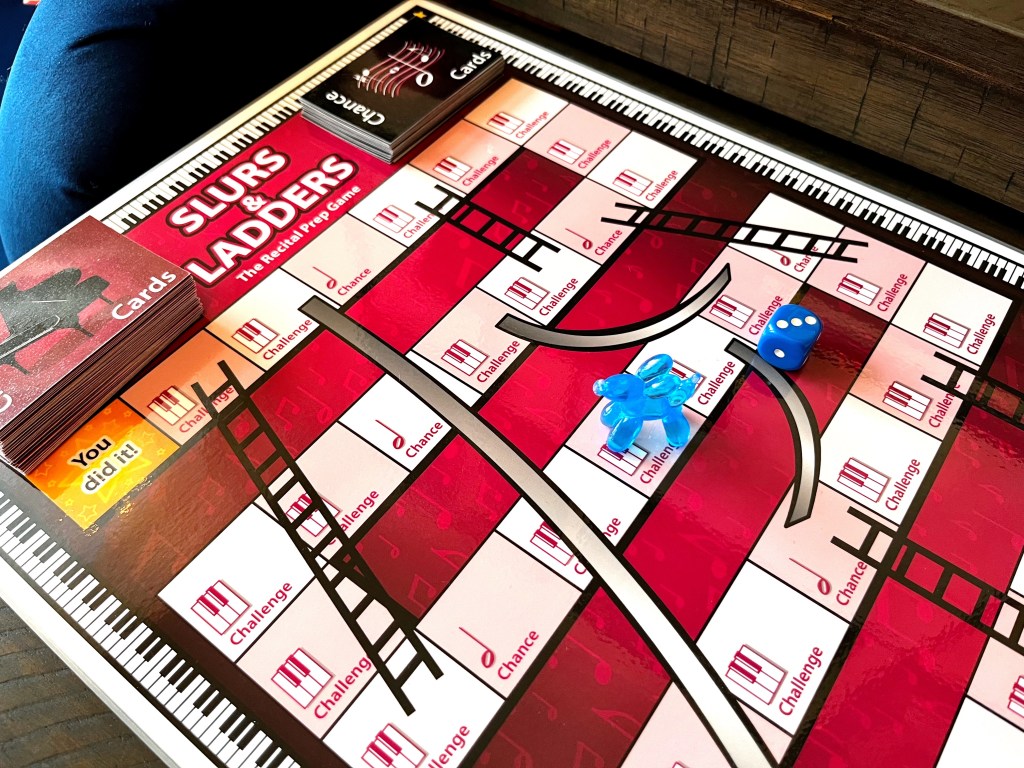
Slurs and Ladders, the piano recital prep game, sits on a wood table along with a blue balloon dog game marker and a blue die.

I’ve found this game to be a great de-stressor for my students. It shows them that they are prepared for the recital and adds some fun back into their pieces after having spent so much time preparing them.

I use it as a studio-wide game to see which student can score the most points (I usually announce the results at the recital and the winner gets a little prize). And since it is a game of chance and completely independent of skill level, a kindergartener and a high school student have the same odds of winning!

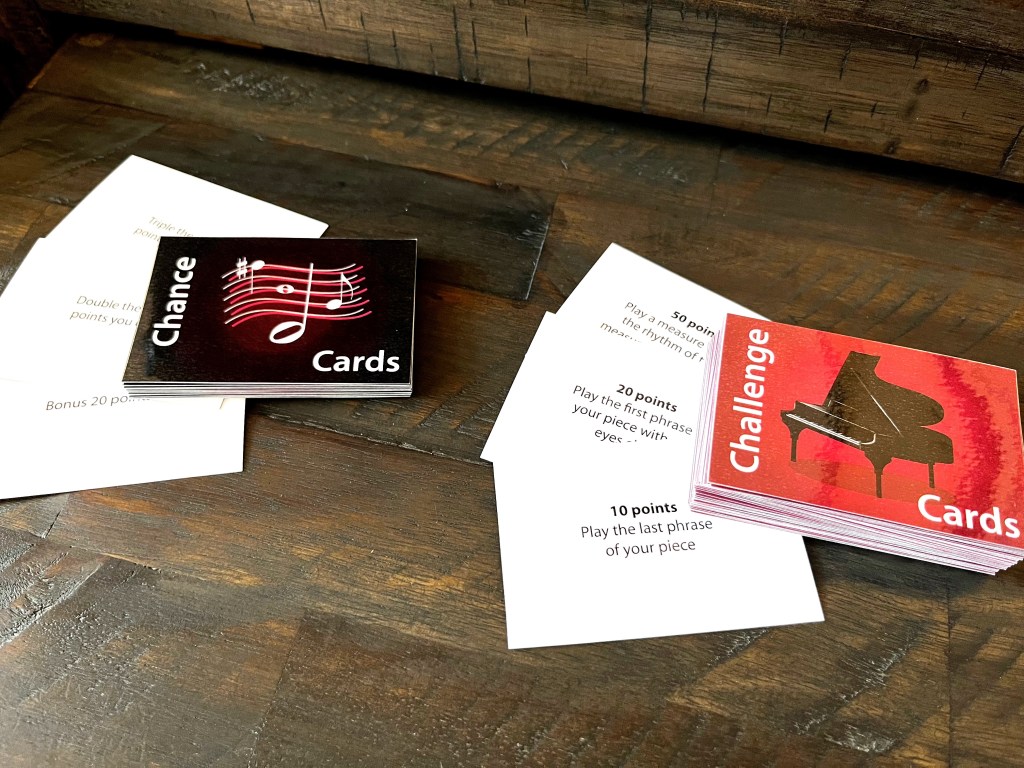
The game is called Slurs and Ladders – The Recital Prep Game and works a lot like the game “Chutes and Ladders”. It comes with a gameboard (2 sizes), 40 Challenge cards, 20 Chance cards, and instructions as well as a document explaining each Challenge card. Slurs and Ladders is available for purchase in the Toucan Piano Store.

Challenge and chance cards sit on a dark wood table

How to Play

To play you will need:

  • The Slurs and Ladders gameboard
  • Deck of Challenge cards
  • Deck of Chance cards
  • 1 Die
  • 1 Gamemarker

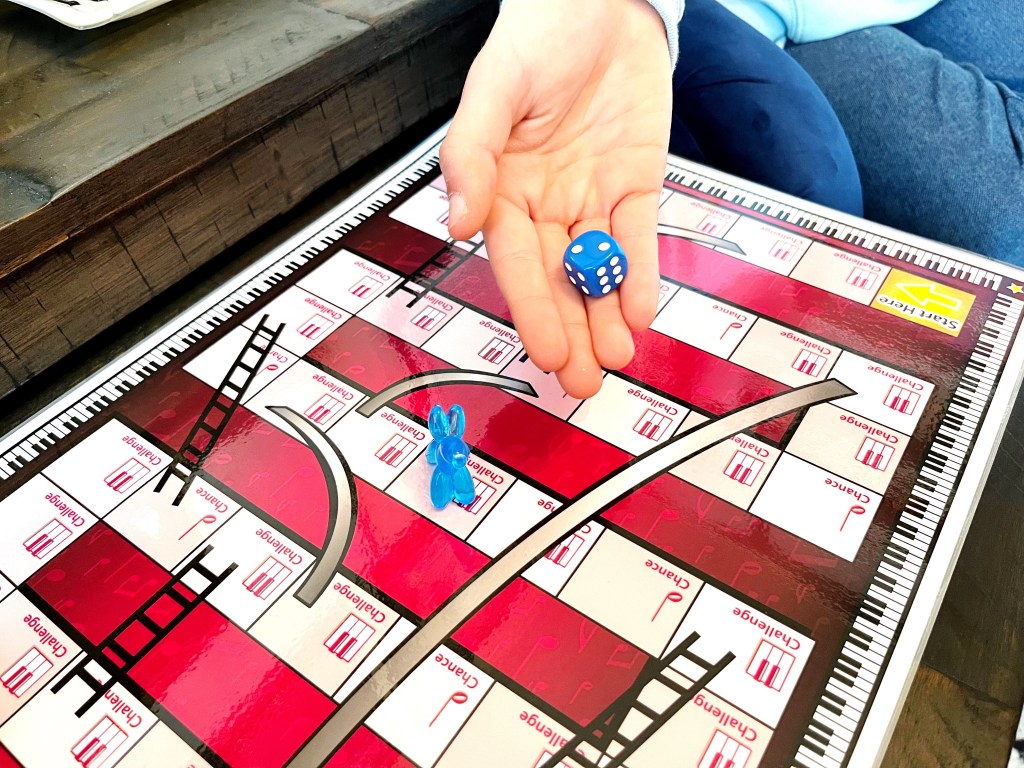
This is a single player game. The student will work their way up the board and collect as many points as they can before reaching the last space on the board. The teacher will keep track of the points the student earns and add them up at the end of the game.

Piano student rolls a blue die while playing the recital prep game, Slurs and Ladders.

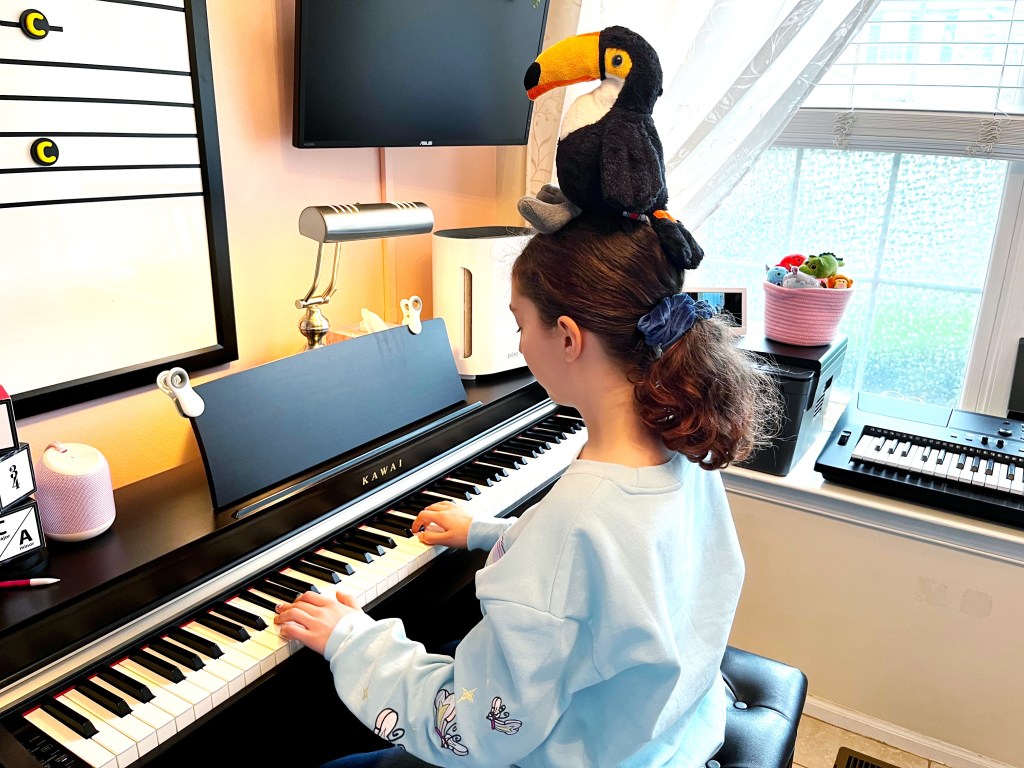
The student rolls the die and moves their gamemarker the corresponding number of spaces on the gameboard. If the student lands on a Challenge card space, the student takes the top card from the deck, reads the challenge, then executes the challenge on their recital piece (for example, “Play your piece while doing squats”). Once the student has completed the challenge, the teacher writes down the number of points from the card and play continues.

Piano student plays the piano while balancing a stuffed toucan on her head.

Some challenges are musical, some are meant to get your student’s adrenaline pumping, some are meant to throw them off track and have them try to recover, and some are to remind them of recital etiquette. In the Slurs and Ladders download there is a document explaining each challenge.

If the student lands on a Chance card space, the student takes the top card from the deck, and reads the chance card. Chance cards can give students free points or move them on the board.

If a student lands at the base of a ladder, the student must first do the Challenge/Chance card before climbing the ladder. Once the student has climbed the ladder, they will then do the Challenge/Chance card at the top of the ladder before rolling the die again.

If a student lands at the top of a slur, the student must first do the Challenge/Chance card before sliding down the slur. Once the student has reached the bottom of the slur, they will then do the Challenge/Chance card at the base of the slur before rolling the die again.

A student plays the piano with their arms crossed.

This game has been a hit year after year with my students (we have been playing it for 6 years now!!!) and their eyes light up each time they see it waiting for them when they walk in for their lesson.

Slurs and Ladders is available for purchase in the Toucan Piano Store. I hope your students get a kick out of it as much as mine have!

Explore more creative teaching ideas
  • Positive Notes: Recital Encouragement
    Spread some positivity and encouragement to your students this recital season with these adorable Positive Notes! They will help remind them of how hard they work and how much you believe in them.
  • How to Bow at a Piano Recital
    You’ve just finished playing your piano recital pieces and now the audience is clapping, what do you do now??! It’s time to take a bow and enjoy the adulation for all the hard work you put into learning your pieces. Here’s the step-by-step on nailing the perfect piano recital bow!
  • Music Friendship Bracelets
    Colorful friendship bracelets make great student gifts for your next recital or they could be a craft for your students to make at a group lesson or studio event! They are colorful, easy to make, and show off our piano pride!

Let’s stay in touch, join the list!

As a “toucan” of our appreciation download a free set of note flashcards (link in our Welcome email)!

Processing…
Success! You're on the list.

We are a participant in the Amazon Services LLC Associates Program, an affiliate advertising program designed to provide a means for sites to earn advertising fees by advertising and linking to Amazon.com. As an Amazon Associate we earn from qualifying purchases.
Music Friendship Bracelets

Probably like me, you teach a lot of Swifties! My students have been showing up for lessons regularly with cute Taylor Swift-inspired friendship bracelets (they were huge during the Eras tour! Concert-goers would trade them with other Swifties).

I decided to jump on the bandwagon and make my own music and composer-inspired friendship bracelets! They are super easy and inexpensive to make and a great way for students to show off their piano pride!

These colorful friendship bracelets would make great student gifts for your next recital or be a craft for your students to make at a group lesson or studio event. The “message” on the bracelet can be anything from a simple “Piano” to a favorite composer’s name or (for ultimate personalization) the title of their recital piece!

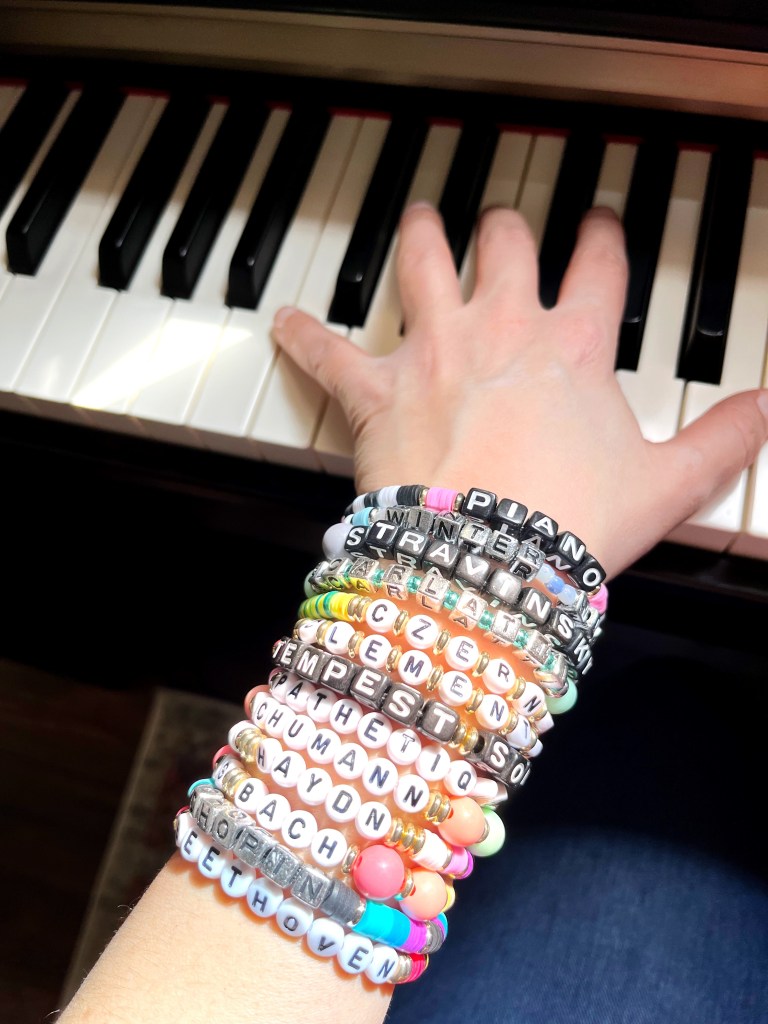
A hand sits on the keys of a piano. The arm is covered with a stack of colorful friendship bracelets with the names of composers and compositions on them.

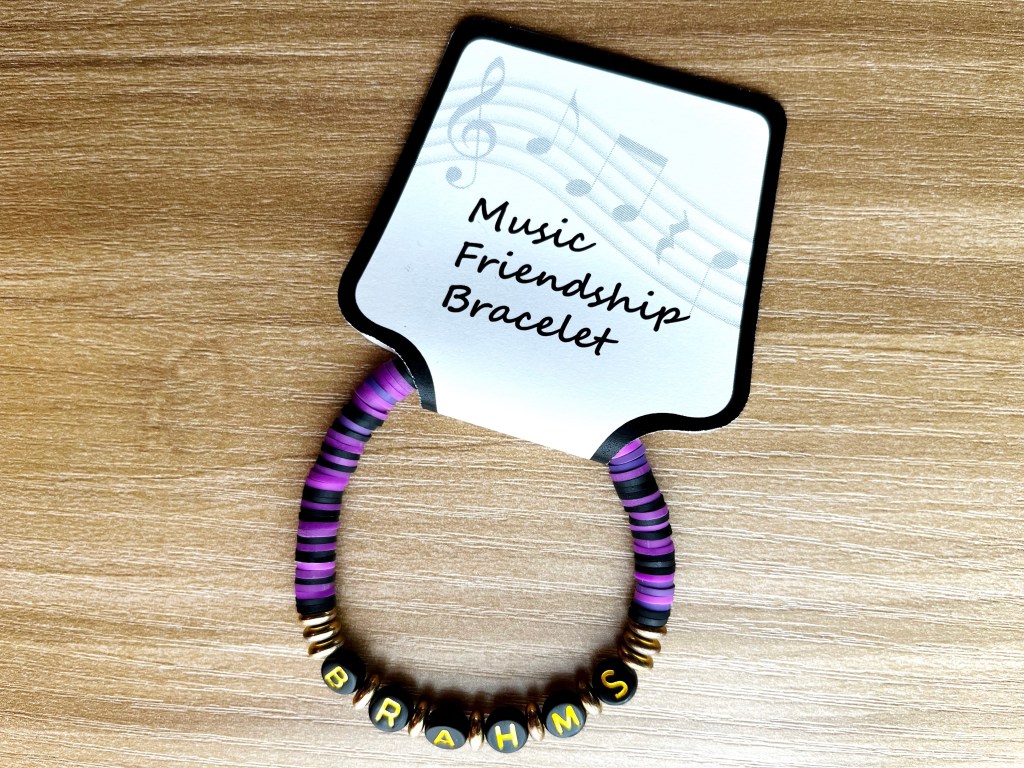
If giving the bracelets as gifts you can add this cute bracelet display card to make it extra special (available as a free download in the Toucan Piano Store!). All you need to do is print it on cardstock, cut it out and add your bracelet!

Music friendship bracelet on a display card.

For this craft you will need:

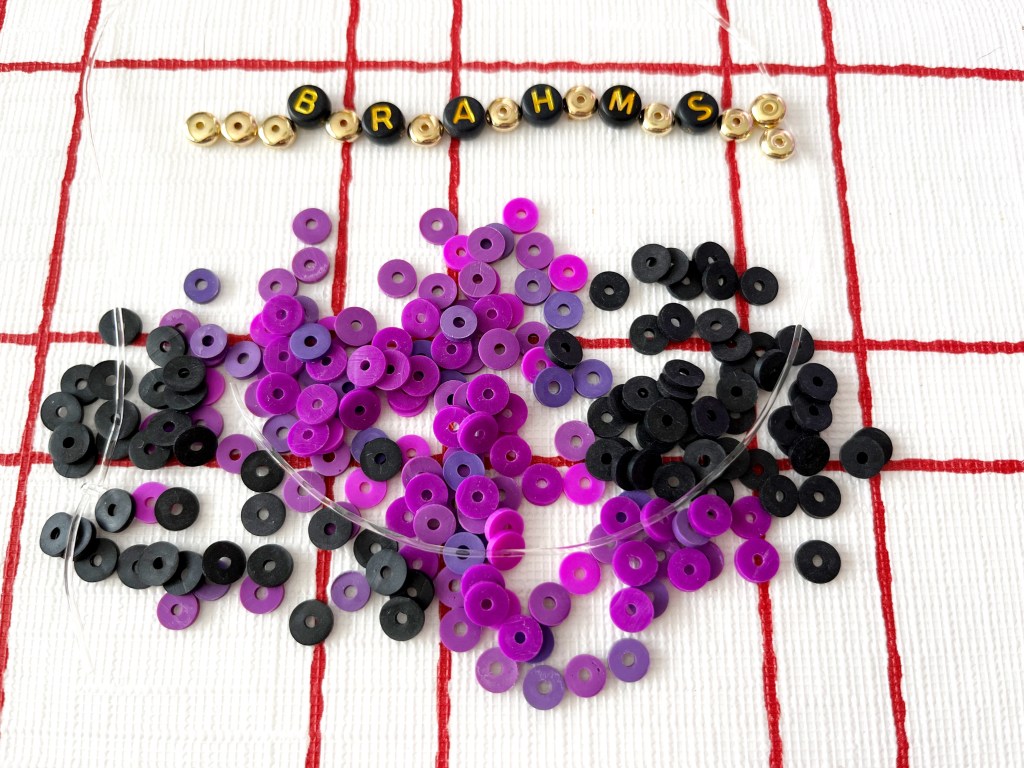
Start by choosing your color palette, spacer beads, and spell out the message or name you want on your bracelet.

Purple, gold and black beads lay on a table. Letter beads spell out the name Brahms.

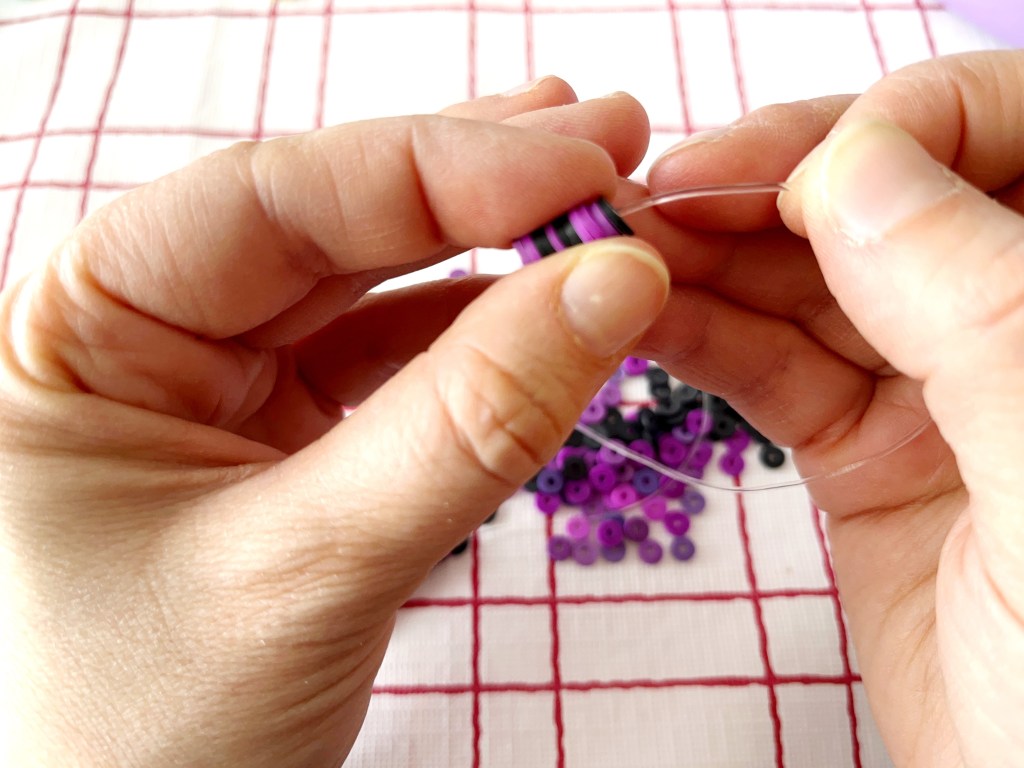
Thread all the beads onto the elastic cord. I like to make a small tower of clay beads and string them all at once to save time.

Purple and black polymer clay beads are strung onto an elastic stretch cord.

When you have finished stringing all the beads, tie a knot in the elastic cord.

The ends of an elastic stretch bracelet are tied together to secure the beads on the bracelet.

Optional step: Add a tiny dab of E6000 glue to the knot to secure it.

E6000 glue is applied to a knot in an elastic stretch cord to secure it in place.

Wear your music friendship bracelets with pride!!!

A girl holds up her arm that is stacked with colorful music and composer themed beaded friendship bracelets.

If you would like to give the bracelets to your students as a gift, one way to fancy them up is to place them on a bracelet display card (you can download the free printable here).

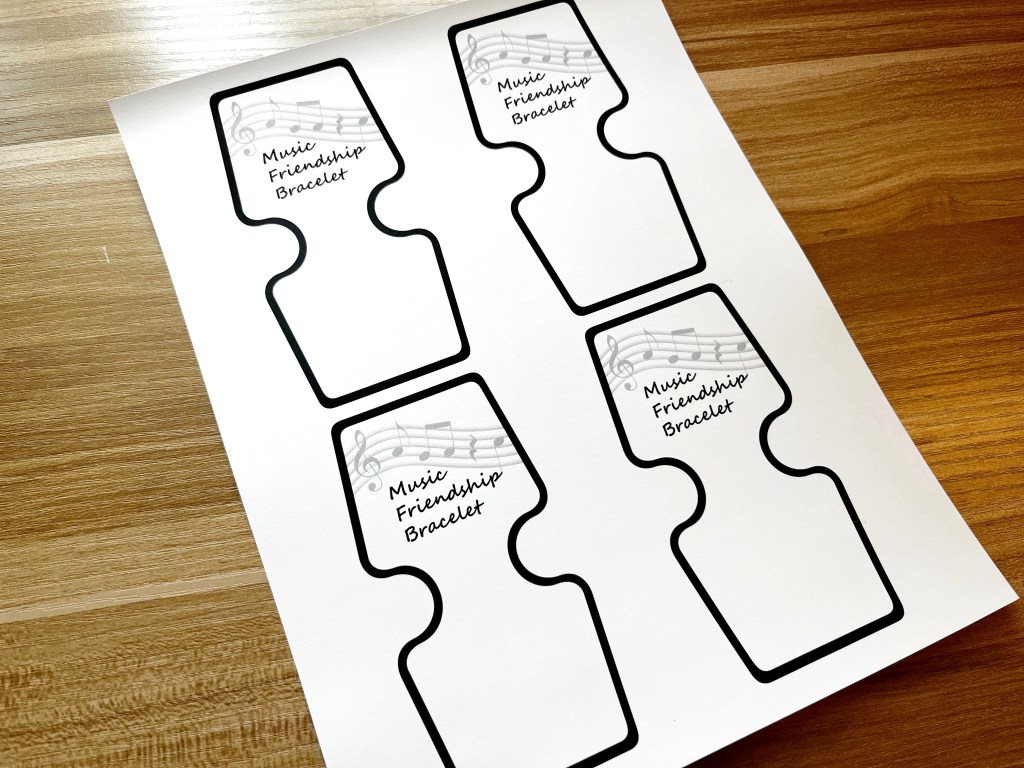
Start by printing the card onto cardstock.

Four music bracelet display cards printed on a sheet of white cardstock.

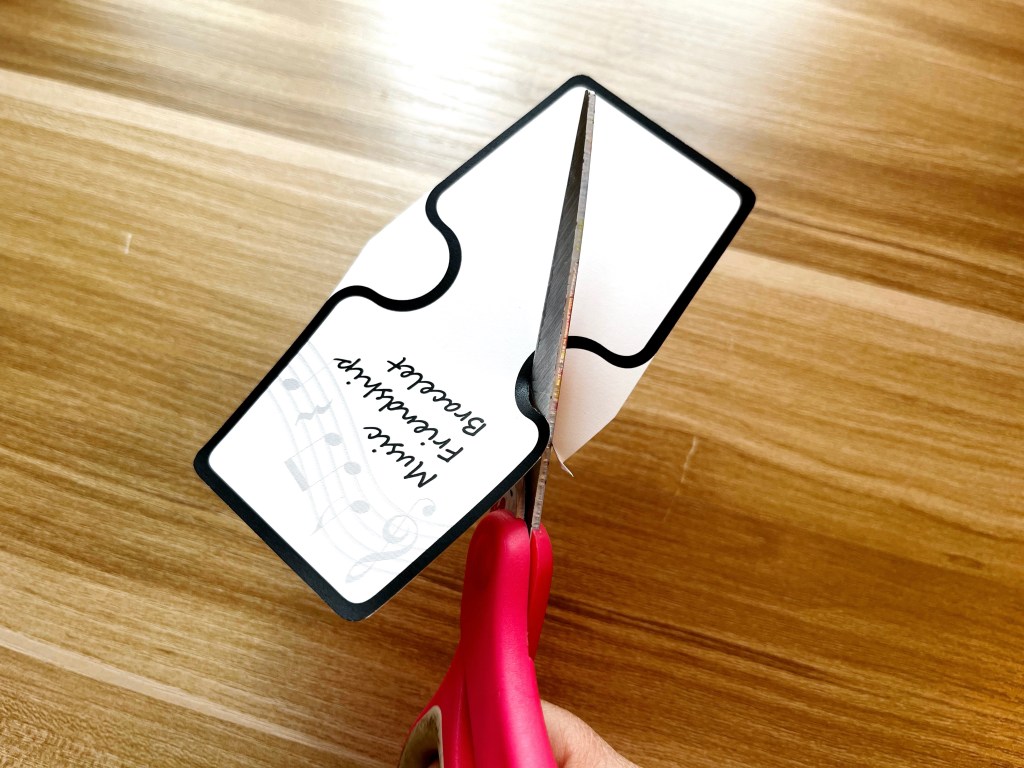
Then cut the card out.

A pair of pink scissors are being used to cut out a bracelet display card.

If you’d like, you can write a short message to your student.

A black fountain pen is used to write an encouraging message to a student on a bracelet display card.

Slide the bracelet onto the card.

A music friendship bracelet is placed on a bracelet display card.

Place double sided tape (or regular tape) along the inside at the top.

Double sided tape is run along the top of a bracelet display card.

Fold the card onto itself and your gift is ready!

Three music friendship bracelet sit on a table with their display card.

Explore more creative teaching ideas
  • Positive Notes: Recital Encouragement
    Spread some positivity and encouragement to your students this recital season with these adorable Positive Notes! They will help remind them of how hard they work and how much you believe in them.
  • Two Sides of the Same Coin
    A game about enharmonics that can be played in several different ways! Students will try to collect the most enharmonic pairs and hope that their coins don’t get stolen by another player.
  • Rainbow Manuscript Paper
    This colorful manuscript paper is available in the Toucan Piano shop as a free printable! They are available in three sizes, so they can be used for a variety of ages and activities, like writing out original compositions, explaining music theory concepts, music dictation, games, and so much more!

Let’s stay in touch, join the list!

As a “toucan” of our appreciation download a free set of note flashcards (link in our Welcome email)!

Processing…
Success! You're on the list.

We are a participant in the Amazon Services LLC Associates Program, an affiliate advertising program designed to provide a means for sites to earn advertising fees by advertising and linking to Amazon.com. As an Amazon Associate we earn from qualifying purchases.
Positive Notes: Recital Encouragement

Spring is officially here in the northern hemisphere and nature is coming back to life after a long winter’s rest. Flowers are blossoming, the birds are back and busy building nests, and the bugs are back, too (for better or worse!). But the butterflies fluttering about are not the only butterflies I’m noticing…

That’s because it’s recital season! Students are busy working on preparing their pieces for performance soon and some butterflies are starting to creep into their bellies when they start to think about the day of the recital.

We spend a lot of time in the weeks leading up to the recital talking about performance anxiety and stress testing our performance pieces. It helps my students to put things in perspective and deal with the anxiety that we all feel about performing in front of an audience.

I introduced something new at our recital this year: Positive Notes! Positive Notes are cute little eighth notes that each student received on the day of the recital. The Positive Notes had a short encouraging message to help focus my students’ minds before playing. They were a hit (the rainbows ones were the first to run out!!).

The message on the back of the Positive Note reads:

“Hi! I’m a Positive Note! I believe in you. When it’s your turn to face the music, remember you’ve worked very hard and are prepared. Go do your thing! You’ve got this!”

The Positive Notes are available as a free download in the Toucan Piano Store under Recital Resources. I hope that your students will enjoy them as much as mine did! Be sure to tag me on social media if you use them (I love seeing my creations out in the world!).

There are two versions of the Positive Notes: a printable and a paper squishy craft.

Positive Notes: Printable

This version of the Positive Notes is the easiest of the two versions and a quick way to get an encouraging message into the hands of your students.

A rainbow of smiling kawaii eighth notes with sit on a black background.

All you have to do is print them (double-sided printing) and cut them out. They looked so welcoming and joyful on our recital table!

A recital table is set up with programs, a poster of the classical composer Joseph Haydn, colorful positive eighth notes and compliment cards.

You can download the basic printable version of the Positive Notes here.

Positive Notes: Paper Squishy Craft

If you enjoy crafting (like I do!) nothing beats the paper squishy version of the Positive Notes!

Not only are they adorable and spreading positivity but they also double as a fidget and “finger warmer-upper” for your students as they sit waiting for their turn to play!

They do require more time to make but they are definitely worth it if you have kids who need that extra outlet for their nerves. And if you do a group lesson before your recital, this can be a fun craft for the kids to do themselves!

To make the Squishy Positive Notes, start by printing out the color of your choice on regular copier paper.

Printing out a rainbow colored paper eighth note squishy

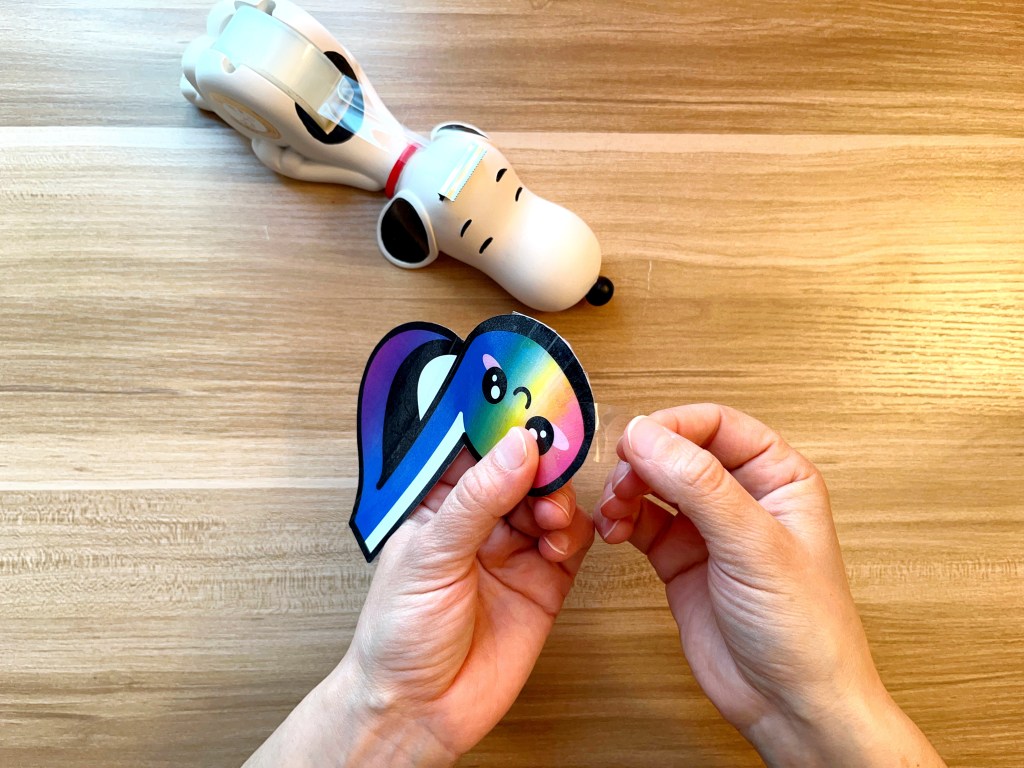
Cover both sides of the print out with clear tape (I used packing tape because it’s wider and covers a larger area at once, but any clear tape will do).

Covering the print out of a rainbow colored paper eighth note squishy with transparent packing tape

Next, fold the paper along the “Fold here” line.

Folding the tape covered print out of a rainbow colored paper eighth note squishy

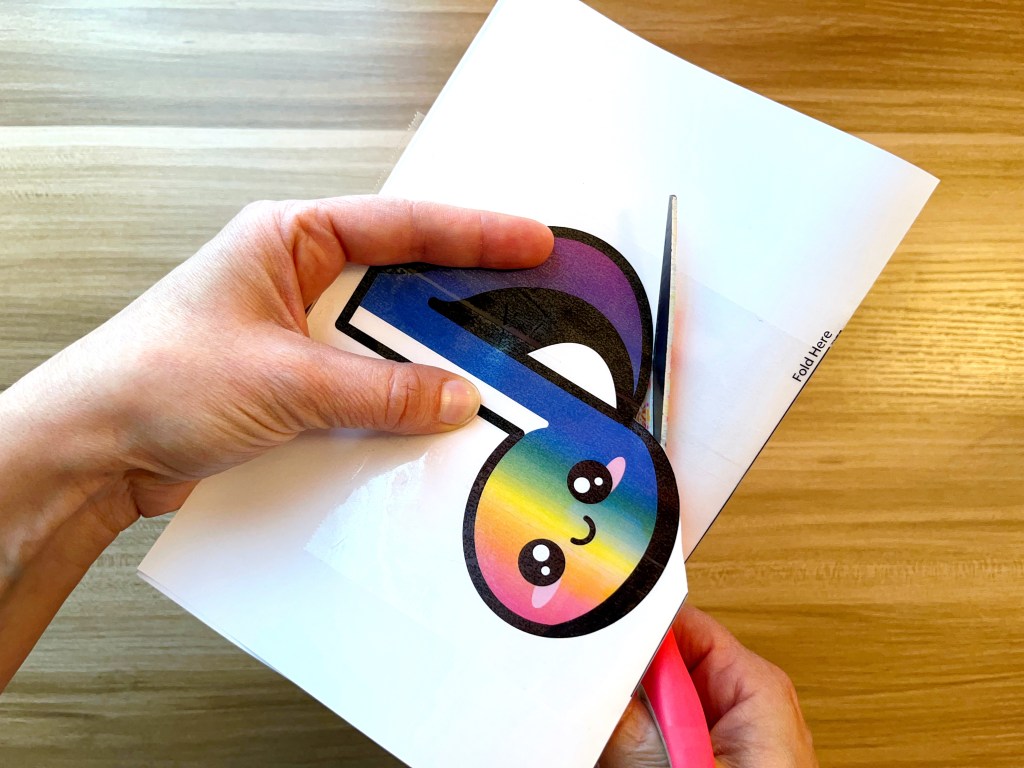
While holding the paper in a folded position, cut out the note (you will be cutting the front and the back out at the same time).

Cutting out a rainbow colored paper eighth note squishy
Two hands hold up the two halves of a rainbow colored paper eighth note squishy

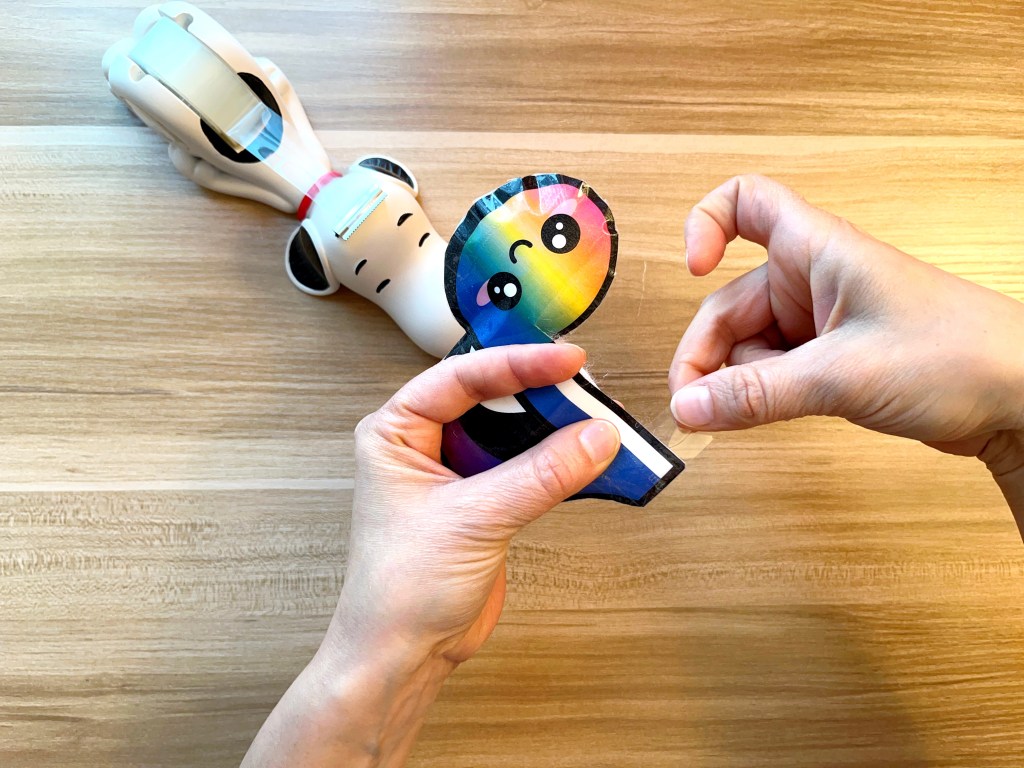
Tape the edges of the two halves together, leaving an opening (I found it easier to leave an opening along the straight edge of the note).

Sealing a rainbow colored paper eighth note squishy with transparent tape

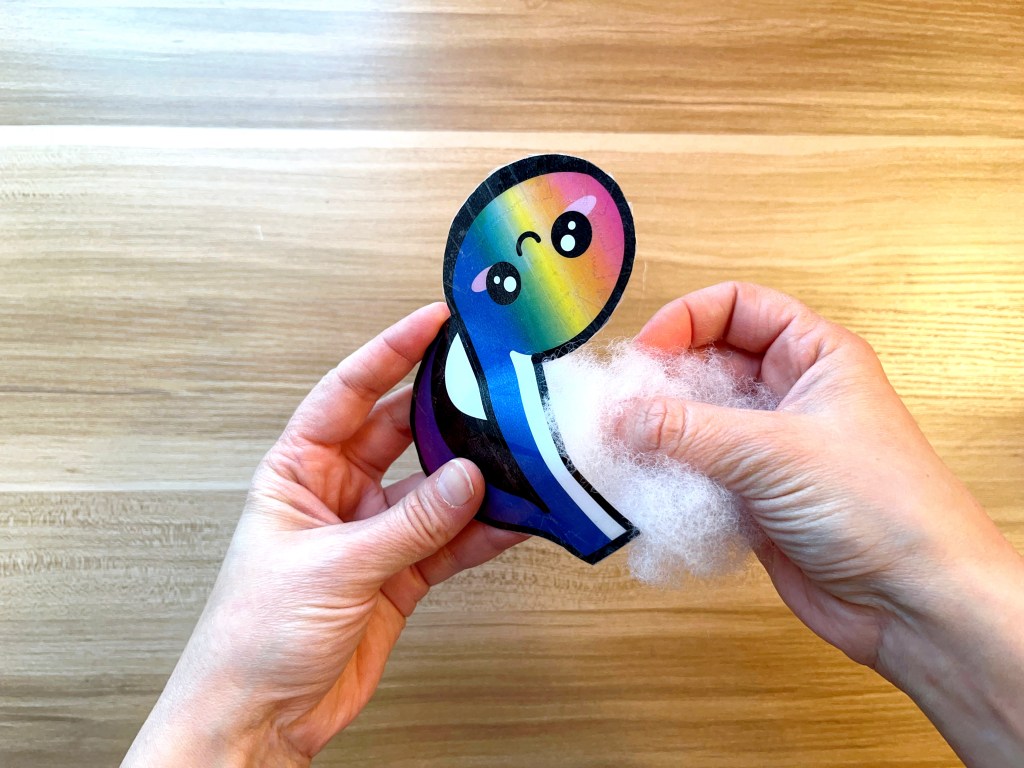
Stuff the note with fiber fill (stuffed animal filling). Don’t overstuff!

Stuffing a rainbow colored paper eighth note squishy with stuffed animal poly fill

Seal the open edge with some tape.

Sealing the open edge of a paper eighth note squishy with transparent tape

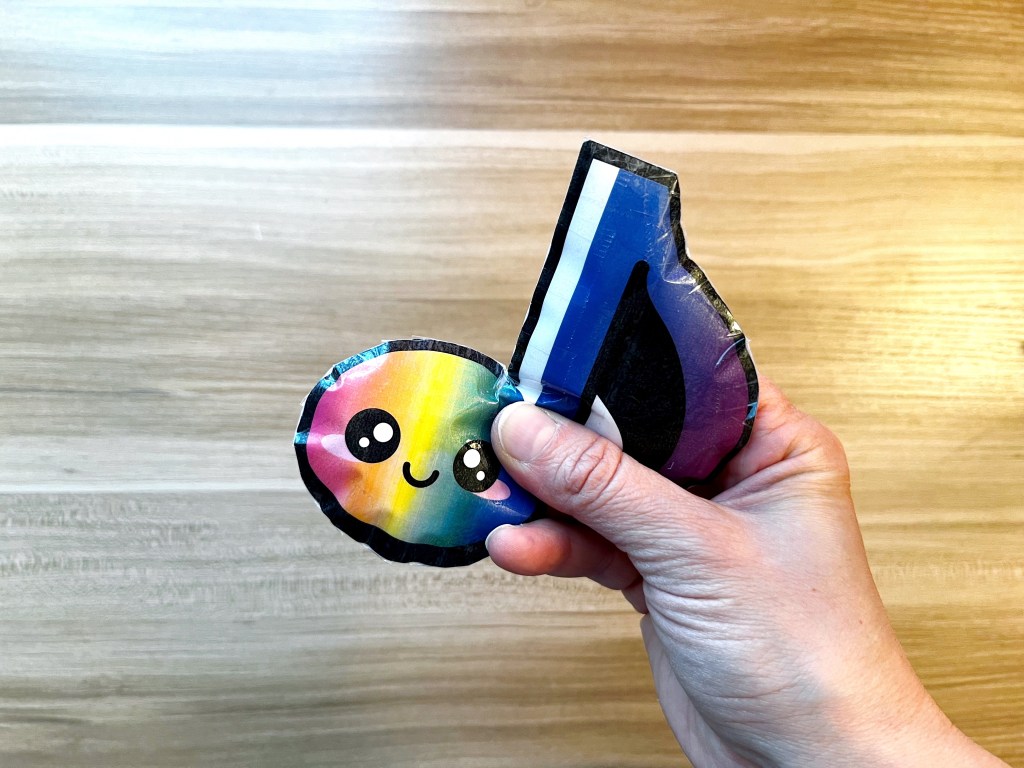
Your squishy is ready for the recital!!

Rainbow colored eighth note paper squishy being squeezed by a hand

You can download the paper squishy Positive Notes craft here.

Explore more creative teaching ideas
  • Compose a Ringtone
    Ringtones are helpful but what if we could make them special too?! This is a fun and quick project that even the most reluctant students can get behind.
  • Top Practice Tools Every Piano Student should Have: Curiosity
    Curiosity is the catalyst that gets students to start learning the piano in the first place and can be exactly what’s needed to keep them going for the long haul. Why is it so important and how do we keep it going? What if I don’t play an instrument, but want to encourage my child in their practicing? Check out all the answers plus download a free printable for parents!
  • How to Make your Own Music Theory Dice
    Music theory dice are a great tool to have in your piano teacher arsenal but most of the time what you need isn’t available to buy anywhere. DIY Music Theory Dice are so easy to make and they are completely customizable for any concept you would like to work on with your students.

Let’s stay in touch, join the list!

As a “toucan” of our appreciation download a free set of note flashcards (link in our Welcome email)!

Processing…
Success! You're on the list.

We are a participant in the Amazon Services LLC Associates Program, an affiliate advertising program designed to provide a means for sites to earn advertising fees by advertising and linking to Amazon.com. As an Amazon Associate we earn from qualifying purchases.
Classical Music Easter Eggs

I LOVE a good classical music pun and I feel it’s my responsibility as a piano teacher to share all of the awesome classical music puns with my students! Fortunately they humor me and get a kick out of it too (I mean who doesn’t love a good dad joke?!).

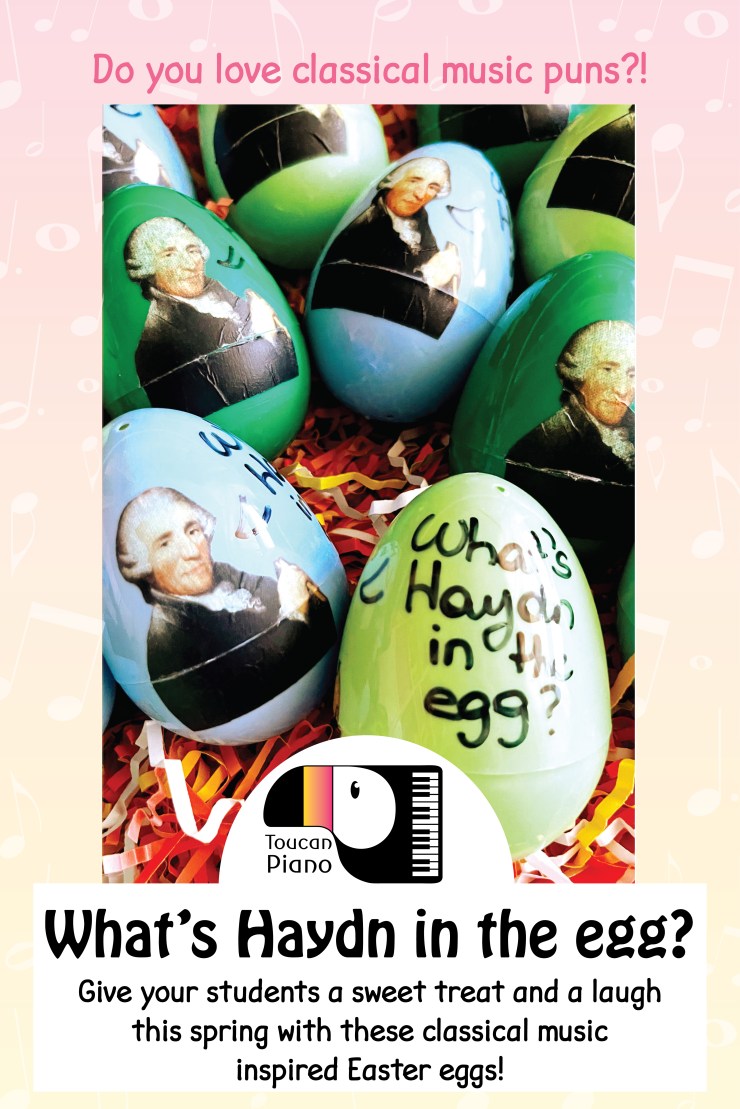
Each year I’ve been challenging myself to come up with different Easter egg crafts to hand out to my students before our Spring break. Last year I made music note eggs which were a big hit! This year our recital theme is Joseph Haydn so I decided to make a classical music pun egg for my students to 1) help them remember how to properly pronounce Haydn’s name and 2) get a chuckle out of them.

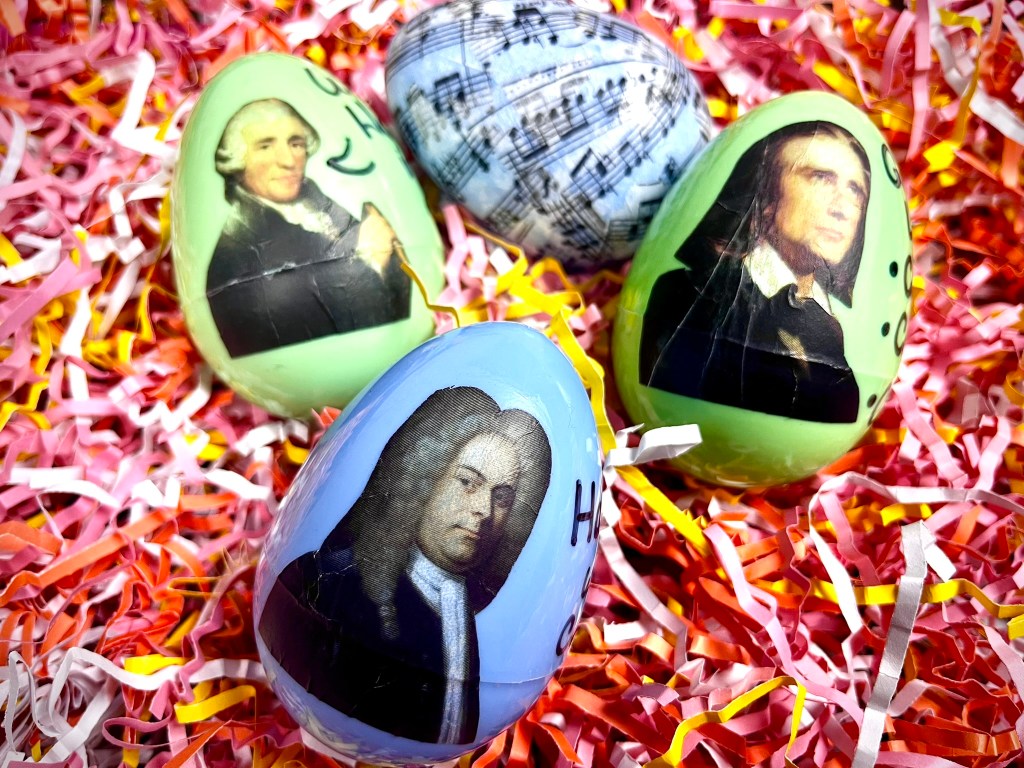
Four composer easter eggs with Haydn, Liszt and Handel sit in a pile of pink fake grass.

They are easy and cheap to make which is always a winning combo in my book! I even took it a step farther and made a couple of other designs just for fun. The possibilities are truly endless with this craft!

For this craft you will need:

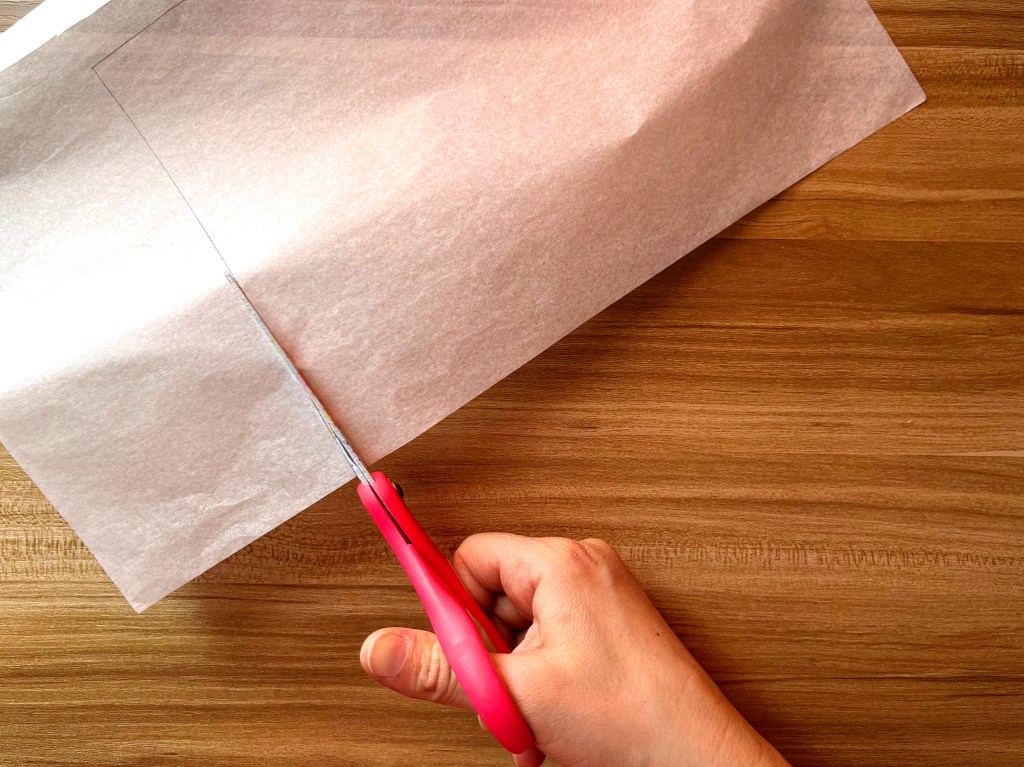
Take a piece of copier paper and place it on top of a sheet of tissue paper. Using a pencil, gently trace the outline of the copier paper onto the tissue paper. Cut the tissue paper along the lines you traced. The tissue paper should now be the same size as the copier paper.

A person traces a the outline of a sheet of copier paper onto a sheet of white tissue paper using a green mechanical pencil.
A person cuts a sheet of white tissue paper using a pair of pink scissors.

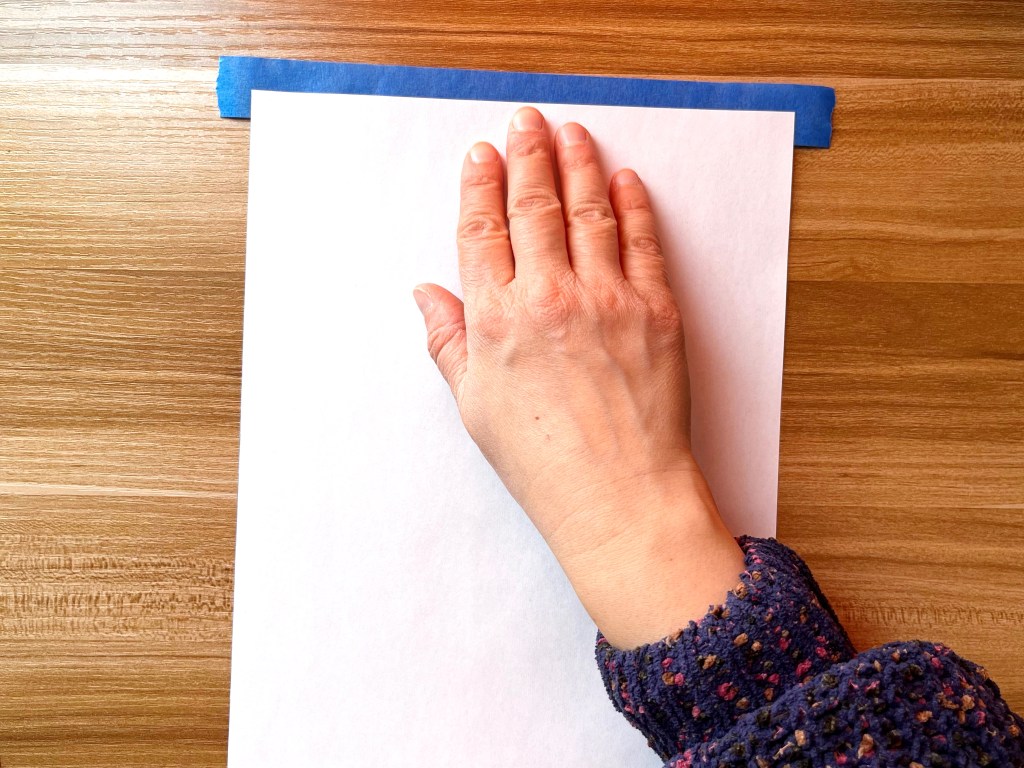
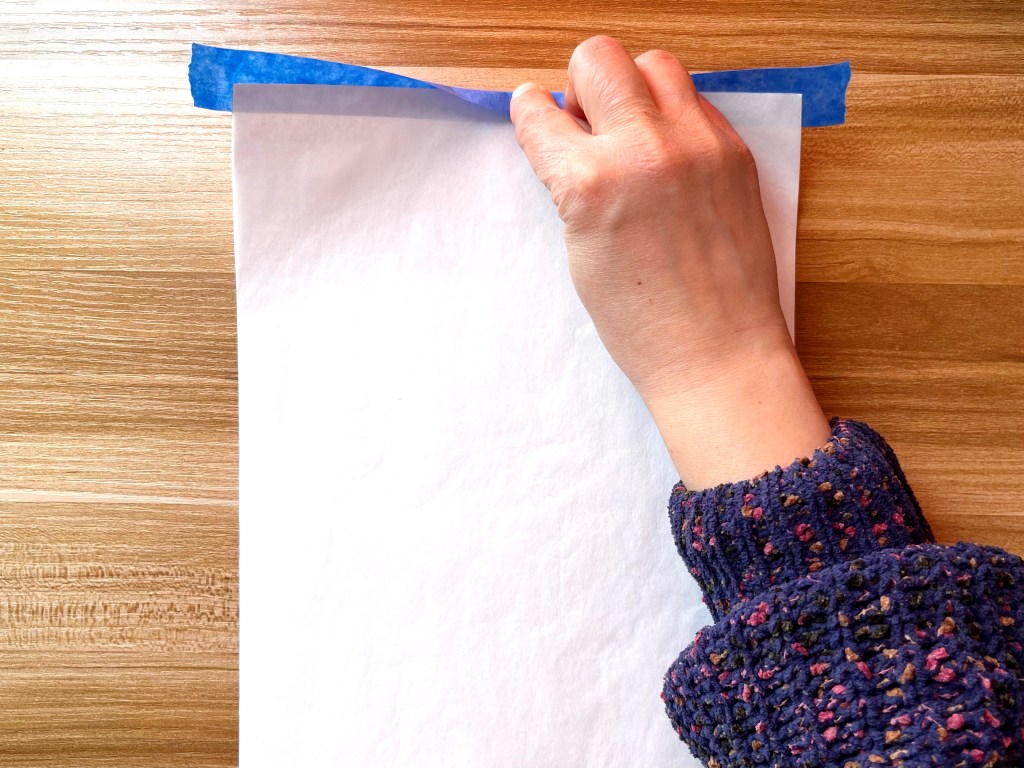
Place the tissue paper on top of the copier paper and tape the top edge of the papers together (this will give the tissue paper stability when it runs through the printer). I used painter’s tape but any tape will do. Trim any excess tape off the edges of the papers.

A person tapes together a sheet of copier paper and a sheet of white tissue paper using blue painter's tape.
A person folds over a strip of blue painters tape to secure two sheets of paper together.

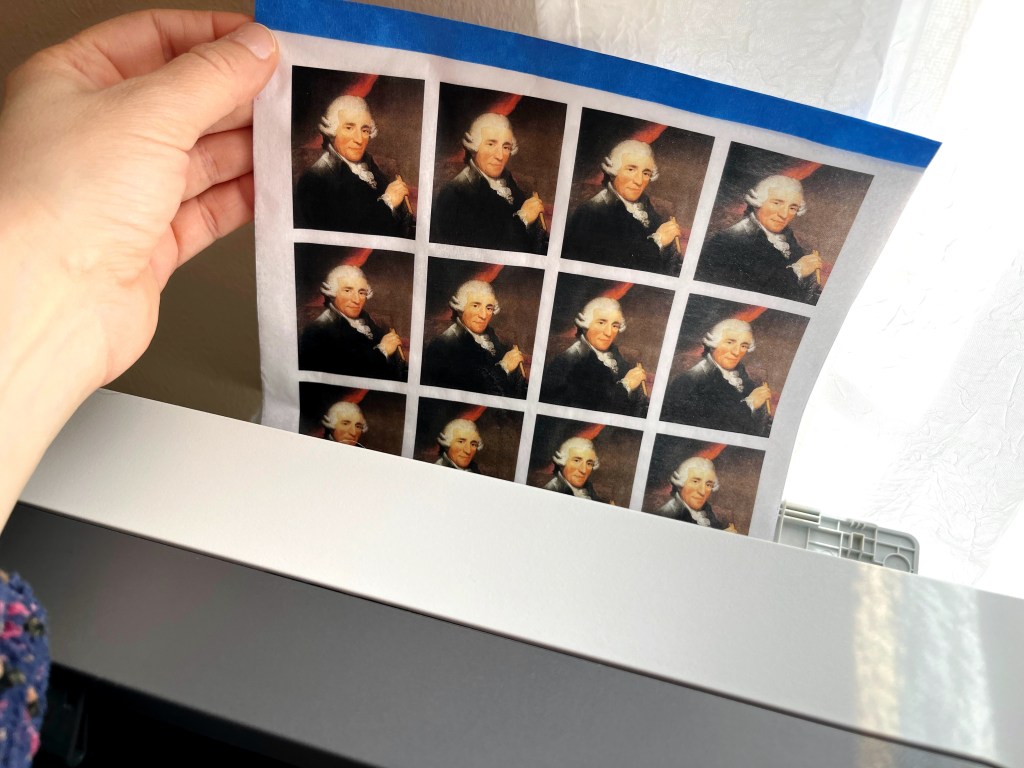
Feed the taped edge of the papers into your printer and print out your design onto the tissue paper.

Paper is feed into a laser printer.
A sheet with mutliple images of the classsical music composer Joseph Haydn exits a printer.

Cut out the designs carefully.

Multiple images of classical music composer Joseph Haydn lay on a wood desk.

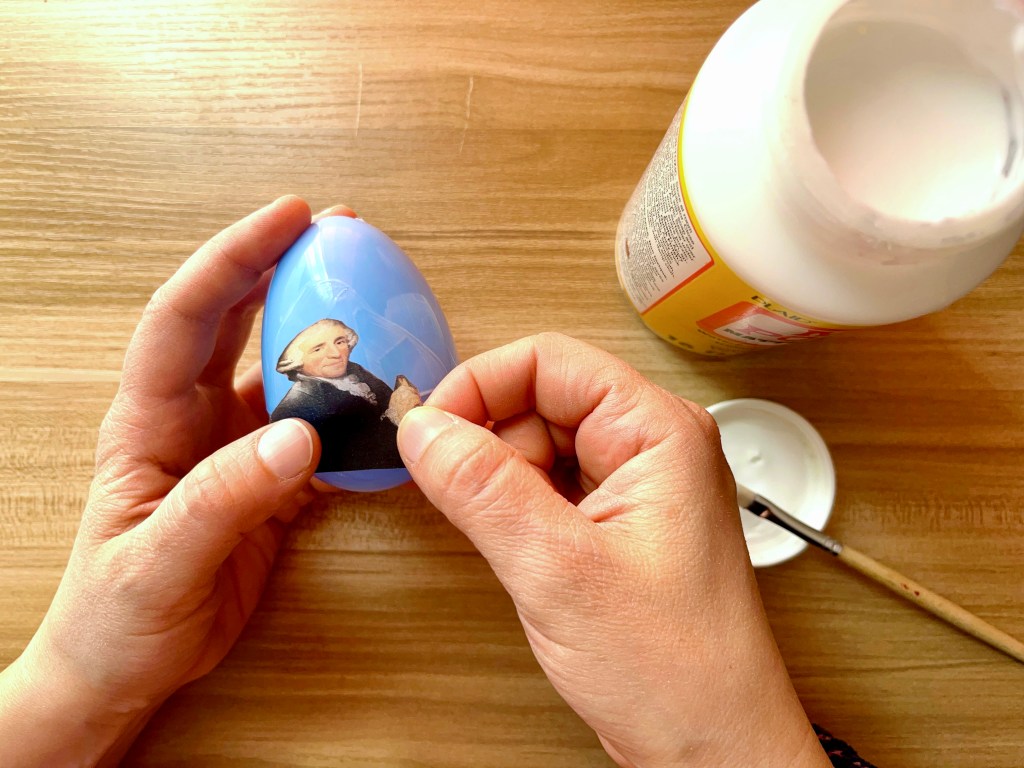
Apply a coat of Mod Podge to the area of the plastic egg where you will be placing the design. Place the design onto the egg.

A person applies a layer of Mod Podge to a light blue plastic easter egg.
A person glues an image of Joseph Haydn to a blue plastic easter egg.

Gently tap the design into place and apply a layer of Mod Podge on top of it to seal it. Set the egg aside to dry.

A person taps the image of Joseph Haydn onto a blue plastic easter egg.
A person seals the image of Joseph Haydn onto a blue plastic easter egg using Mod Podge and a paintbrush.

Once the egg is dry, take a Sharpie and write your message on the egg. In my case I wrote: “What’s Haydn in the egg?”

A person writes a on a blue plasitc easter egg using a black Sharpie permanent marker.

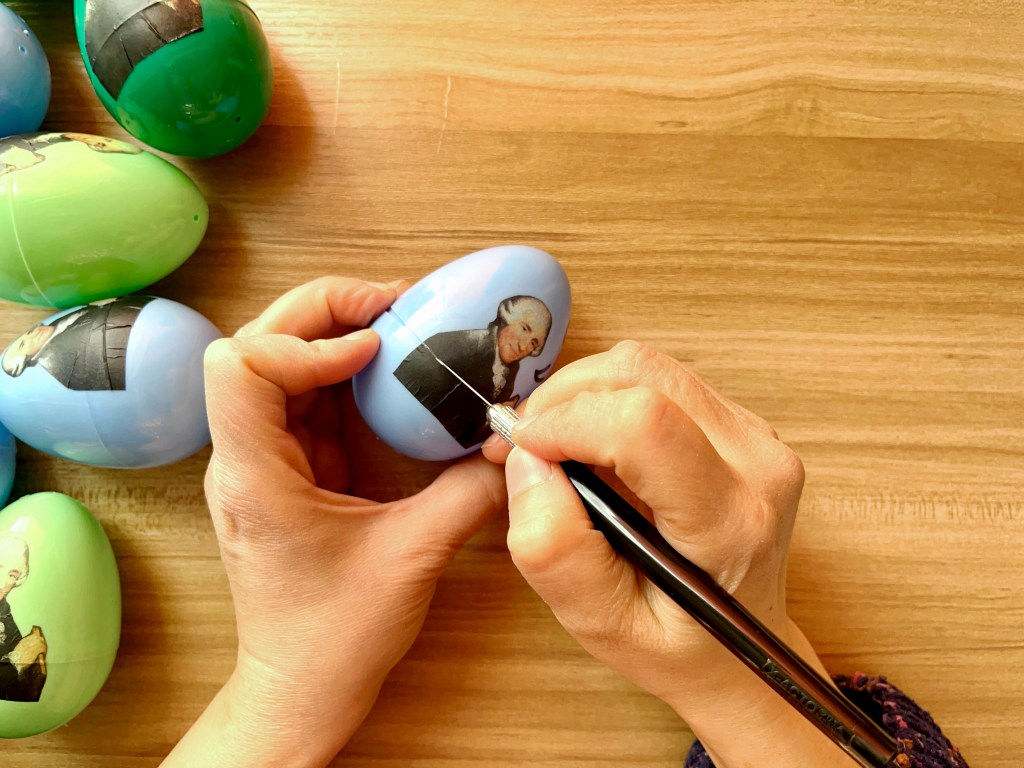
Gently pop the egg and carefully cut the design where the seam of the egg has been glued shut using the X-acto knife (utility knife). Then fill the egg with goodies!!

A person cuts the image of Joseph Haydn along the seam of a blue plastic easter egg using an xacto utility knife.
A person fills a blue plastic easter egg with candy.

I loved my Haydn egg so much I decided to experiment with a few other designs for fun! One with sheet music and two with composer puns: “Grocery Liszt: Candy, Candy, Candy!” and “Handel with care!

Classical music pun on plastic easter eggs sit in a pile of pink grass.

Explore more creative teaching ideas
  • Top Practice Tools Every Piano Student should Have: Curiosity
    Curiosity is the catalyst that gets students to start learning the piano in the first place and can be exactly what’s needed to keep them going for the long haul. Why is it so important and how do we keep it going? What if I don’t play an instrument, but want to encourage my child in their practicing? Check out all the answers plus download a free printable for parents!
  • Compose a Ringtone
    Ringtones are helpful but what if we could make them special too?! This is a fun and quick project that even the most reluctant students can get behind. Plus it makes a sweet Mother’s or Father’s Day gift!

Let’s stay in touch, join the list!

As a “toucan” of our appreciation download a free set of note flashcards (link in our Welcome email)!

Processing…
Success! You're on the list.

We are a participant in the Amazon Services LLC Associates Program, an affiliate advertising program designed to provide a means for sites to earn advertising fees by advertising and linking to Amazon.com. As an Amazon Associate we earn from qualifying purchases.