

If you mention fingernails to any piano teacher, you will be greeted by exasperated sighs, rolling eyes, and a myriad of strong emotions. This is because piano teachers across the board share a very complicated relationship with this seemingly innocent part of the hand…

You may hear stories about teachers keeping fingernail clippers on their piano to clip their students’ fingernails if they are too long. Or of a piano teacher who sends students home because of their nails.
It’s a pet peeve… and it’s not unfounded! Long fingernails are a real problem for learning to play the piano.
My hope is that this post will help guide conversations between teachers and parents about this important topic. Any conversation of this nature, in my opinion, should be approached with compassion and understanding.
On the one side, fingernails can represent more than mere vanity; they can serve as a form of cultural expression, personal identity, or even a reflection of one’s creative or professional journey.
For the piano teacher, on the other hand, long fingernails can be an impediment to their job of teaching a student to play the piano with proper technique. Teachers are professionals who know the challenges of the instrument and the path to achieve mastery; their opinions and advice on the subject have weight and value.
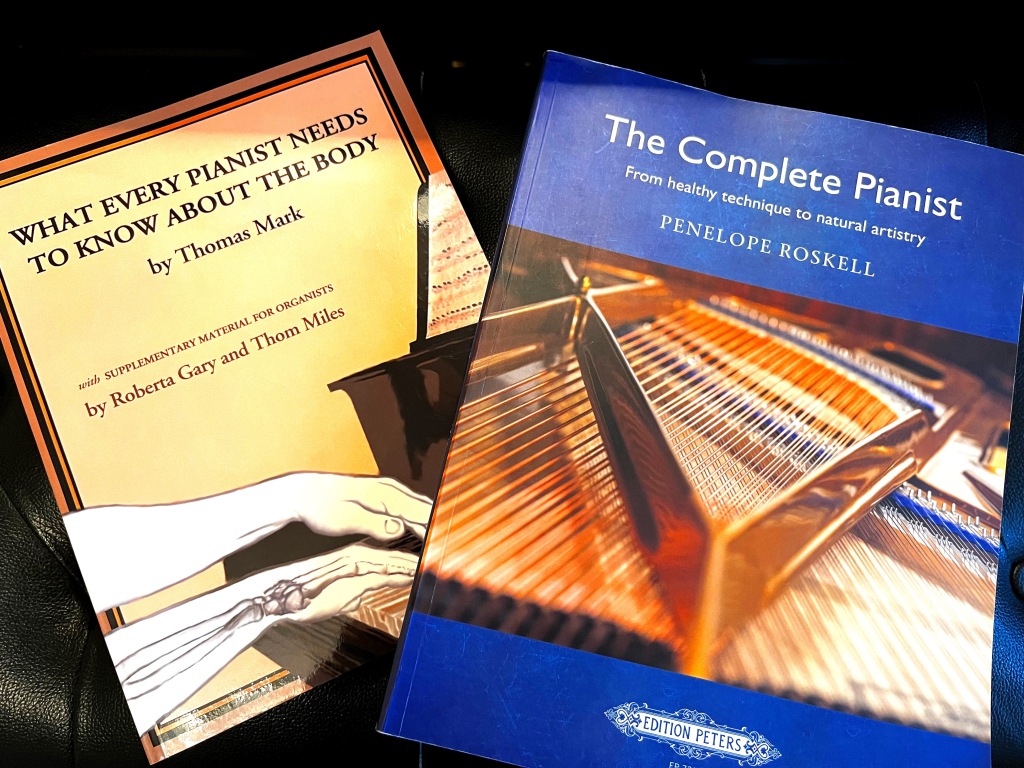
All the discussions in this post provide a high-level overview. For a deeper dive into body mechanics and proper technique I recommend the following books:
- What Every Pianist Needs to Know about the Body by Thomas Carson Mark, Roberta Gary, and Thom Miles
- The Complete Pianist – From Healthy Technique to Natural Artistry by Penelope Ruskell
- Why are Long Fingernails so Bad?!
- How Long should Fingernails Be?
- What if a Student wants to Keep their Long Nails?
Why are Long Fingernails so Bad?!
Long fingernails are not inherently bad. On the contrary, as I mentioned, they can be a powerful and beautiful form of self-expression and can even boost self-confidence. However, for piano students, this beauty and artistry come with a hidden cost.
The truth is that long fingernails inhibit the development of proper piano technique, which limits what a student is capable of playing and could eventually lead to injury.
But let’s break it down:
Nail Clicking
When fingernails are long enough they will make a tapping or clicking sound on the keys as the fingers strike the keys. And they don’t have to be very long for this to happen; in the video above I measured my nails to be about 1 mm long, which is very, very short by most people’s standards.
In a world where fingernail tapping is all over social media, it really has no place in creating music at the piano. A student should be developing their ear and listening intentionally and deeply to their playing. The constant clicking gets in the way of that and is just a big distraction.
Hand Posture
Proper hand posture at the piano resembles a hand at rest: fingers gently curled inwards towards the palm of the hand, thumb slightly bent. If one were to freeze their hand in this position and place it on the piano, the fingers would touch the keys on the padding close to the fingertips, but not the actual fingertips (if this happens, the fingers are too curled).

When fingernails are too long, the fingers sit on the keys in a more stretched-out position. The point of contact with the keys is now the full pad of the finger, encroaching on the 2nd joint of the finger (the distal inter-phalangeal joint, DIP joint, to be more precise), if the nails are long enough.
The knuckles also flatten out, which causes the natural bridge of the hand to collapse. As we will see next, this is going to have serious consequences on how the student will be able to navigate the piano.
Movement
Long fingernails will restrict the range of movement the hand can execute at the piano.
Outstretched fingers will cause the student to lift the fingers from the knuckle, putting unnecessary strain on the tendons of the hand. This up-down motion of the fingers will cause tension in the thumb, which could start to curve outwards.

Long fingernails also collapse the knuckles which ends up restricting the movement of the wrist. The importance of the wrist in piano playing cannot be overstated. The wrist allows for fluidity, control, and expressiveness. Compromising the wrist’s freedom is like putting casts on the legs of a runner and asking them to run a marathon… a student’s playing will be stiff, limited, and their movements will be inefficient.
With all these restrictions on its natural movements, the body will then try to adapt and find ways to play the notes the brain wants it to. This is when the hand starts twisting in odd ways and the elbow juts out away from the body (something I like to call “Chicken wing”).
The result of these awkward movements can be heard in the music in the form of unevenness, limited speed, unintentional accented notes, uneven articulations, and the list goes on and on…
Injury
And all of the above could ultimately lead to injury… Practicing the piano is a task based in part on repetition. And a lot of it! Students will often have to practice passages over and over again to eventually work out all the problems and difficulties.
When movements are unnatural to the body and cause the body strain, sooner or later pain starts to creep in. Oftentimes students will power through the pain, choosing to abide by the “no pain, no gain” mentality.
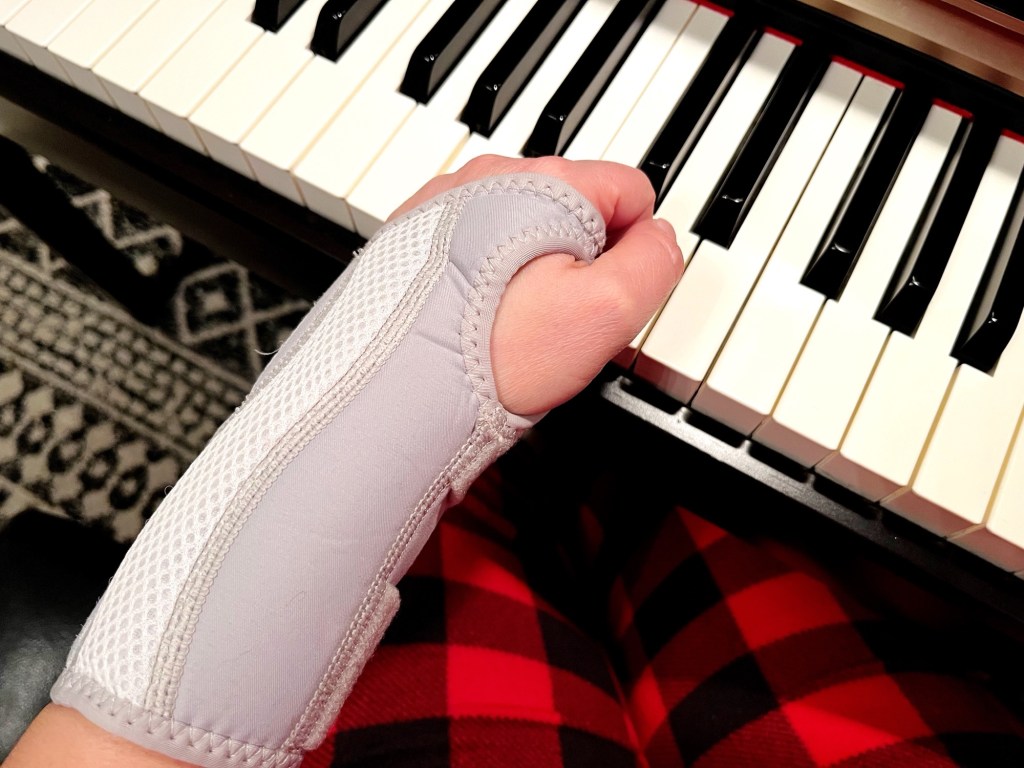
But pain is a sign that something is wrong and needs to be addressed. If left unchecked, a student could end up with: carpal tunnel syndrome, tendinitis, muscle strain, repetitive strain injury (RSI), neck and back pain, among others.
Another potential injury that can occur is when the fingernail gets caught between the keys of the piano. Because it happens so quickly, we usually do not realize that the nail is trapped until the finger tries to follow through with the motion it started. The trapped nail could end up breaking or pull at the at the hyponychium (the point where the nail meets the fingertip) and potentially causing a tear and bleeding. Although not as serious as other injuries, it is definitely annoying and can be quite painful in the moment.
How Long should Fingernails Be?
I have lived by the advice of one of my favorite piano teachers growing up: if the nail is peeking over the fingertip, it is time to cut it.
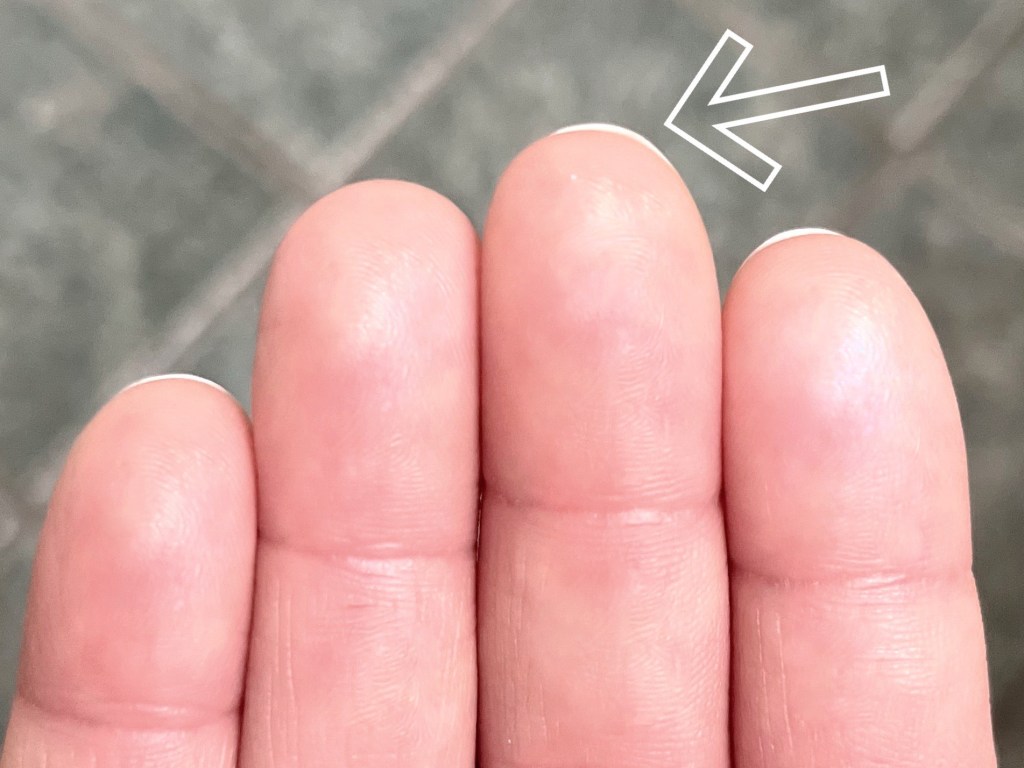
A student can also pay attention to their playing and ask themselves if anything feels off or if they are hearing a clicking sound.
What if a Student wants to Keep their Long Nails?
Like most things in life, choices are compromises. We gain one thing but also have to come to terms with the reality that we may be giving up other things.
The reality here is that choosing longer fingernails will limit what a student will be able to play.
The vast majority of piano students will be hobby pianists. Very few will make music their profession and even fewer will have concert careers.
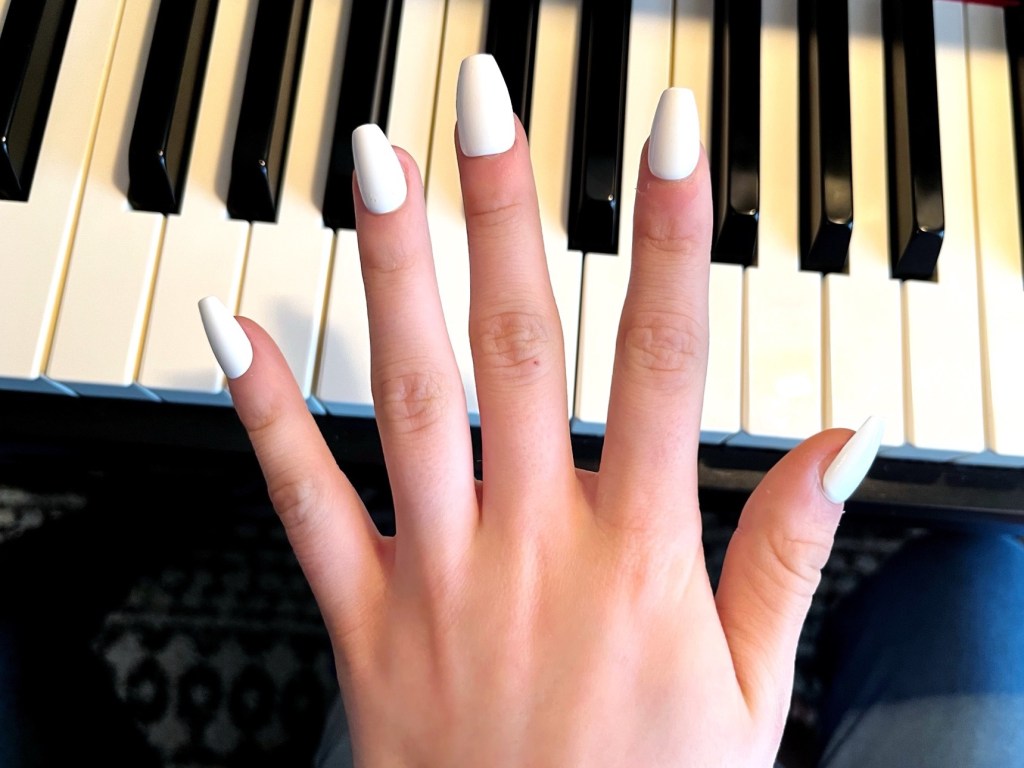
My advice is for teachers, students, and parents to talk about long fingernails and their drawbacks.
I always reiterate my thoughts on fingernails around recital time. I want my students to be able to perform with confidence and having long nails will affect their playing.
Ultimately, though, it is their choice. My job as a piano teacher is to educate. My hope is that, by providing them with all the information, they will be able to make a decision they are comfortable and happy with.
And this can take many forms… some students have chosen to get a manicure after a recital as a reward, others opted for shorter manicures (but still a bit long for my personal liking for the piano), while others go short, not wanting to tempt the fates at the recital.
For serious students, this tends to be a one-and-done conversation. They are committed to the piano and learning to play well is the priority.
For all the others, it will most likely come down to personal preferences and sometimes special events (like dance competitions, weddings, or graduations). And at the end of the day, everyone is entitled to their choices in life and we must respect that. And that respect should be extended both ways as a teacher may choose not to teach students with long nails.
As mentioned previously, for more information on proper piano technique and body mechanics, check out these books:
- What Every Pianist Needs to Know about the Body by Thomas Carson Mark, Roberta Gary, and Thom Miles
- The Complete Pianist – From Healthy Technique to Natural Artistry by Penelope Ruskell

- Top Practice Tools Every Piano Student should Have: Curiosity
Curiosity is the catalyst that gets students to start learning the piano in the first place and can be exactly what’s needed to keep them going for the long haul. Why is it so important and how do we keep it going? What if I don’t play an instrument, but want to encourage my child in their practicing? Check out all the answers plus download a free printable for parents! - Positive Notes: Recital Encouragement
Spread some positivity and encouragement to your students this recital season with these adorable Positive Notes! They will help remind them of how hard they work and how much you believe in them. - Slurs & Ladders: The Recital Prep Game
If there is one game my students beg to play year after year (and sometimes when we don’t even have a recital anytime soon!) is this recital prep game. It’s a great de-stressor and it shows students how prepared they are to perform while also injecting some fun and joy back into those recital pieces that may be sounding a little tired.

Let’s stay in touch, join the list!
As a “toucan” of our appreciation download a free set of note flashcards (link in our Welcome email)!
We are a participant in the Amazon Services LLC Associates Program, an affiliate advertising program designed to provide a means for sites to earn advertising fees by advertising and linking to Amazon.com. As an Amazon Associate we earn from qualifying purchases.

 Toucan Piano
Published by